Zhangjiajie Travel Guide - Avatar Mountains and Glass Bridges (3 Days)
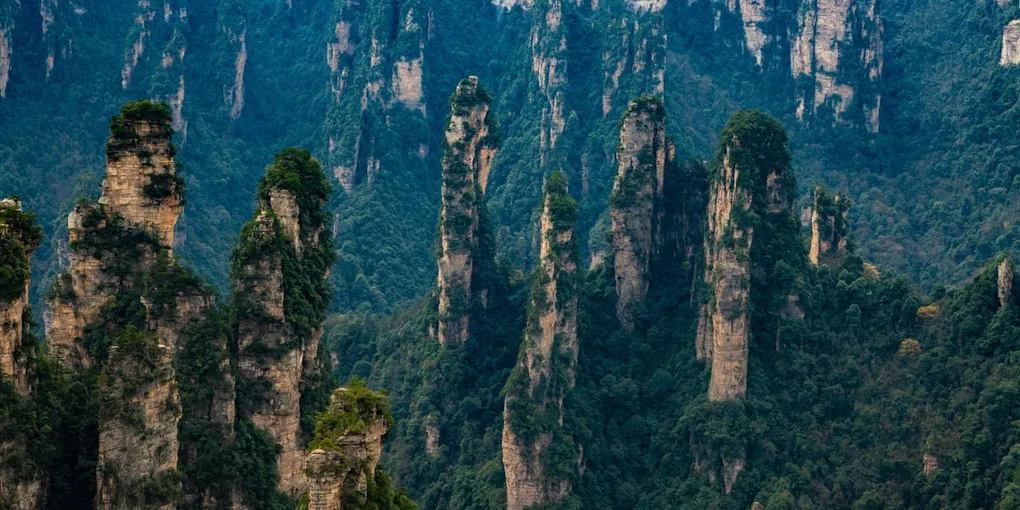
Thousands of quartzite sandstone pillars rise vertically from subtropical forest at Zhangjiajie, some over 1,000 meters (3,280 feet) into the clouds. They are striking enough that James Cameron modeled the floating Hallelujah Mountains in “Avatar” on them. Zhangjiajie also holds the world’s longest glass bridge, the world’s highest outdoor elevator, and a 99-turn mountain road.
A 3-day plan covers the highlights below, with the transport and ticket details foreign visitors need most.
How we verified this: SinoWander reads Chinese-language sources that English guides cannot, including official scenic-area notices, Trip.com (Ctrip), Xiaohongshu, and Dianping. We cross-check them before writing. We have not personally visited every location. Each guide is date-stamped when last verified: 2026-08-06. See our methodology.
When to Visit
April through June brings spring wildflowers and comfortable hiking temperatures. September through November offers the clearest skies and the best photographic conditions — misty mornings with sunlight breaking through create the ethereal “floating mountain” effect that made this place famous. Avoid the summer peak (July — August) when domestic tour groups flood the park, and the winter months when ice can close elevated walkways.
Budget: Plan for at least 2,000-3,500 yuan ($295-516) per person for 3 days, excluding flights to Zhangjiajie.
3-Day Itinerary
Day 1: Tianmen Mountain — Glass Walkway and Heaven’s Gate
| Time | Activity | Duration |
|---|---|---|
| Morning | Tianmen Mountain cable car (world’s longest) | 30-minute ride |
| Mid-Morning | West Line: Guigu Cliff Walkway + Glass Walkway | 2-3 hours |
| Midday | Tianmen Mountain Temple | 30 minutes |
| Afternoon | 7-level mountain escalator + Tianmen Cave | 1-2 hours |
| Late Afternoon | Descend via quick cable car or winding road | 1 hour |
Tianmen Mountain dominates the Zhangjiajie city skyline. You reach the summit on the world’s longest passenger cableway — 7,455 meters (4.6 miles), rising from the city center over 30 minutes.
At the top, the Glass Walkway clings to a cliff face at 1,430 meters (4,692 feet) elevation. The 160-meter (525-foot) transparent path hangs over a sheer drop, with nothing between you and the valley below. The Guigu Cliff Walkway extends along the entire mountain rim, offering panoramic views of the karst peaks dissolving into clouds.
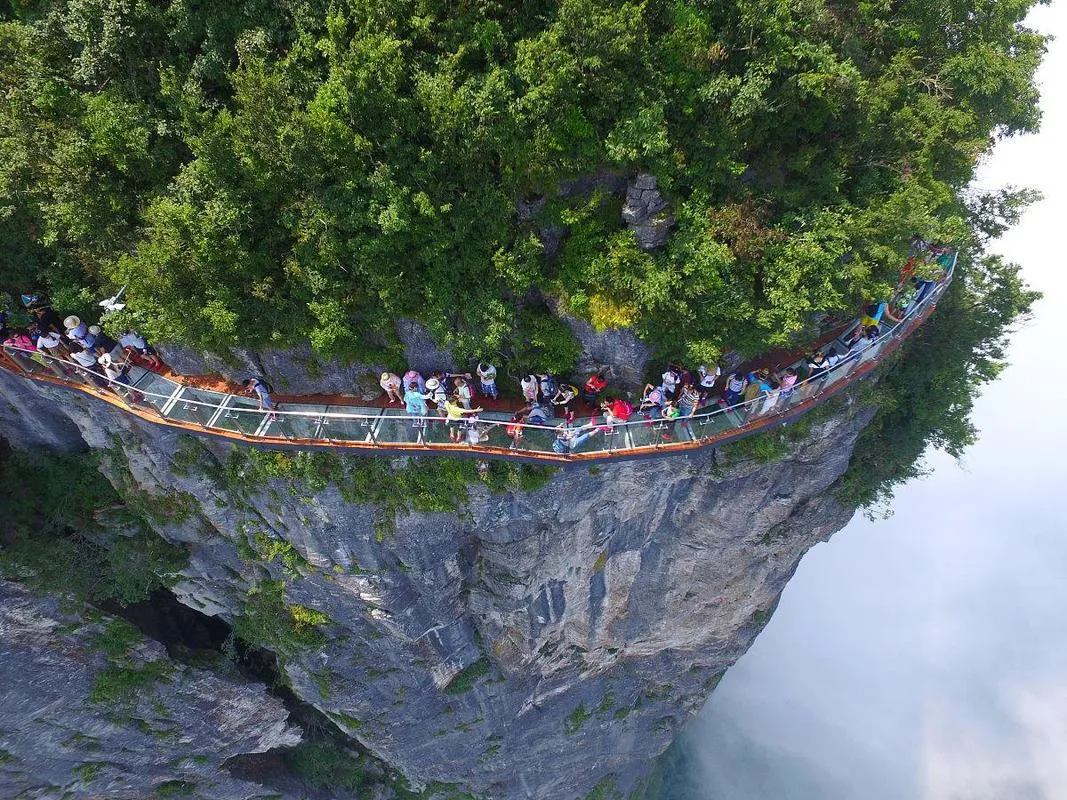 The Glass Walkway at 1,430 m: a transparent ledge on a sheer cliff.
The Tianmen Cave (Heaven’s Gate) is the world’s highest natural mountain hole — 131.5 meters (431 feet) tall and 57 meters (187 feet) wide, carved by erosion over millions of years. You reach it via the world’s longest outdoor escalator, which bores through the mountain in seven stages. Below the cave, the 99-Bend Mountain Road (10.77 km / 6.7 miles with exactly 99 hairpin turns) is an engineering spectacle visible from the cable car.
Tickets: A-line full ticket (includes round-trip cable car, eco-bus, escalators, and insurance): 288 yuan (~$43). Discounts for seniors over 60 (152 yuan) and over 65 (116 yuan).
Important construction notice (2026): The Tianmen Mountain Cableway has been undergoing a major upgrade since November 2025, with the upper section (mid-station to summit) suspended. The East Line Glass Walkway is also temporarily closed for maintenance from May 12, 2026. Check the official Tianmen Mountain channels for the latest route arrangements before your visit.
Day 2: Zhangjiajie National Forest Park — Avatar Mountains
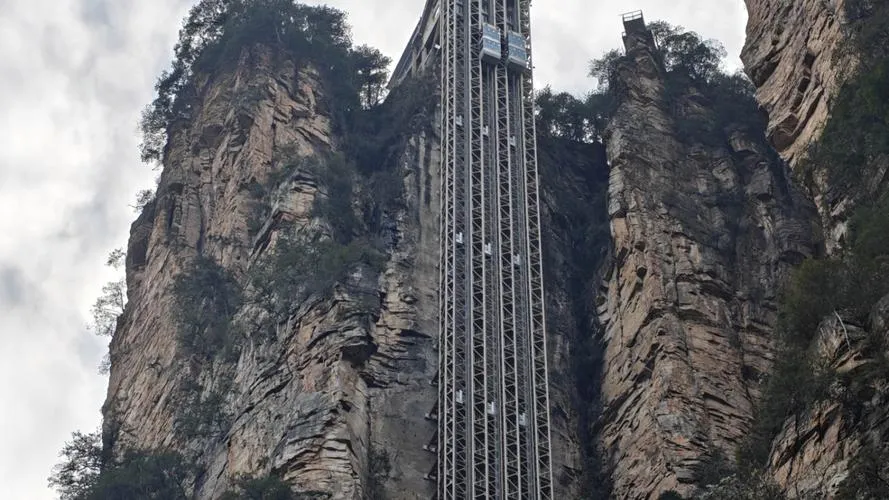 The Bailong Elevator against the pillar forest: 326 meters of glass-sided lift.
The Zhangjiajie National Forest Park is the reason most travelers come: a UNESCO Global Geopark spanning 4,810 hectares (11,894 acres) of towering sandstone pillars, deep ravines, and subtropical forest.
Recommended Route A (Classic Highlights):
Wulingyuan Gate -> Eco-bus -> Bailong Elevator (world's highest outdoor elevator)
-> Yuanjiajie (Avatar area) -> Mihuntai viewpoint -> Qiankun Zhu (Avatar pillar)
-> Tianxia Diyi Qiao (First Bridge Under Heaven) -> Eco-bus -> Tianzi Mountain
-> Helong Park -> Yubi Feng (Imperial Brush Peaks) -> Tianzi Mountain cableway down
-> Shili Huatang (Ten-Mile Gallery) mini-train -> Exit
Key sights:
| Sight | Description | Time |
|---|---|---|
| Bailong Elevator | 326-meter (1,070-foot) glass elevator bolted to a cliff face; 66 seconds from valley to summit | 1-minute ride + queue |
| Yuanjiajie (Avatar area) | The core zone where Avatar’s Hallelujah Mountains were conceived | 2-3 hours |
| Mihuntai (Soul-Enchanting Terrace) | The best panoramic viewpoint in the entire park; 360-degree views of the pillar forest | 30 minutes |
| Qiankun Zhu (Avatar Pillar) | The specific 1,074-meter (3,524-foot) pillar that inspired Avatar’s floating mountains; officially renamed “Hallelujah Mountain” in 2010 | 20-30 minutes |
| Tianxia Diyi Qiao | A natural stone bridge spanning 50 meters (164 feet) at a height of 300 meters (984 feet) | 20 minutes |
| Tianzi Mountain | ”An enlarged bonsai, a shrunken fairyland” — sea of clouds and peaks | 1-2 hours |
| Ten-Mile Gallery | A tram ride through a valley of fantastically shaped peaks | 1-1.5 hours |
| Golden Whip Stream | A 7.5-km (4.7-mile) creekside trail through lush forest; you may encounter macaques | 2-3 hours |
Tickets:
- National Forest Park entry (valid for 4 days):
165 yuan ($24) - Bailong Elevator (one-way):
65 yuan ($10) - Three Cableways + One Elevator combo (4 rides):
218 yuan ($32) - 4-day entry + Tianzi Cableway + Bailong Elevator package:
298 yuan ($44)
Local Tip: The Avatar pillar (Qiankun Zhu) is most magical on misty mornings after rain, when clouds swirl around its base, making it appear to float. The Mihuntai viewpoint is the single best location for a panoramic photograph.
Day 3: Glass Bridge and/or Huanglong Cave
| Time | Activity | Duration |
|---|---|---|
| Morning | Zhangjiajie Grand Canyon Glass Bridge | 3-4 hours (B-line) |
| Afternoon | Huanglong Cave (optional) | 2 hours |
The Zhangjiajie Grand Canyon Glass Bridge is the world’s longest (430 meters / 1,411 feet) and highest (~300 meters / 984 feet above the canyon floor) glass-bottomed bridge. Walking across it, you look straight down at the canyon below your feet. For adrenaline seekers, it also features the world’s highest bungee jump (260 meters / 853 feet).
Recommended route (B-line): Visitor Center -> Grand Canyon Theater -> Glass Bridge -> Yixiantian (Thread of Sky) -> Rainbow Plaza -> Momo Cave -> Shenquan Lake (boat ride) -> Exit
Tickets:
- B-line (Grand Canyon + Glass Bridge): 178-256 yuan (~$26-38)
- C-line (Glass Bridge only): 125-135 yuan (~$18-20)
- A-line (Grand Canyon only, discount): 50 yuan (~$7)
Opening hours: Summer/autumn (March 15 — October 31): 7:00 AM — 5:00 PM; Winter/spring (November 1 — March 14): 9:30 AM — 3:00 PM.
Huanglong Cave (alternative or addition): One of China’s largest karst caves, featuring an underground river, waterfalls, and massive stalactite formations. The cave maintains a constant 16 degrees C (61 degrees F), a relief during summer heat. Tickets: 100 yuan ($15). Allow 2 hours.
Where to Eat
Zhangjiajie’s cuisine belongs to the Tujia ethnic minority tradition, hearty and spicy with an emphasis on smoked meats and mountain ingredients.
Must-Try Dishes
| Dish | Description |
|---|---|
| Tujia Sanxia Guo (Three-in-One Pot) | The signature dish of Zhangjiajie: a communal pot of pork head meat, tripe, and intestines in a spicy broth. It is rustic, hearty food. |
| Shi Guo Yu (Stone Pot Fish) | Fresh fish slow-cooked in a heated stone pot |
| Tujia Kou Rou (Tujia Braised Pork) | Rich, saucy braised pork belly with preserved vegetables |
| Suan Zuo Yu (Fermented Fish) | A Tujia hospitality dish; sour and spicy |
| Da Gu Pi (Drum Skin) | Chewy Tujia snack with a spicy kick |
Street food: Try caomao mian (straw hat noodles) at “Uncle Bo’s” stall, Cili rice noodles, tang you baba (sweet fried rice cakes), and zhu naoke liang mian (pig-head cold noodles, a local favorite).
Recommended restaurants:
- Hu Shifu Sanxia Guo — the most authentic three-in-one pot (downtown)
- Yinxiang Ni Yan (Xibu Street, Wulingyuan) — Zhangjiajie’s landmark restaurant
- Jinshi Liu Longzi Noodle Shop — specialty rice noodles, rated 5.0
Food zones: Xibu Street in Wulingyuan has the densest concentration of restaurants; Nanzheng Street in downtown Zhangjiajie is the local hub.
Where to Stay
Critical advice: Do not stay in one location for the entire trip. The scenic areas are far apart.
Recommended strategy:
- Day 1 night: Stay in Zhangjiajie city center (close to Tianmen Mountain cable car station)
- Day 2 night: Stay in Wulingyuan (near the National Forest Park entrance — saves 40 minutes of driving each way)
- Day 3: Depart from Wulingyuan
| Area | Budget | Mid-Range | Luxury |
|---|---|---|---|
| Wulingyuan | 150-300 yuan ($22-44) | 400-800 yuan ($59-118) | 800-1,500+ yuan ($118-221) |
| City center | 150-300 yuan ($22-44) | 300-600 yuan ($44-89) | 600-1,000 yuan ($89-148) |
Wulingyuan hotels: Pullman Zhangjiajie, Crowne Plaza Zhangjiajie Wulingyuan, Hilton Garden Inn Wulingyuan boutique guesthouses: Qingyin,pushe, Zishan Manju, Yuxi City center: Sunshine Hotel, West Hotel, Manju Inn (near Zhangjiajie West Station)
Getting There and Around
How to Reach Zhangjiajie
By high-speed train (recommended):
- From Changsha South/Changsha Station to Zhangjiajie West Station
- 1 hour 45 minutes to 2.5 hours
- ~170-190 yuan ($25-28) for second class
- 50+ daily departures
By plane: Zhangjiajie Hehua International Airport (DYG) has direct flights from Beijing, Shanghai, Guangzhou, and Shenzhen. Airport to city center: 30-40 minutes by taxi or bus.
By long-distance bus: Changsha to Zhangjiajie takes 4-5.5 hours (~100-140 yuan / $15-21). Budget option only.
Local Transportation
| From Zhangjiajie West Station to: | Distance | Time | Mode |
|---|---|---|---|
| City center (Tianmen Mountain) | ~6 miles (10 km) | ~20 min | Taxi / bus |
| Wulingyuan (National Forest Park) | ~22 miles (35 km) | 40-50 min | Shuttle bus / taxi (~60-100 yuan / $9-15) |
| Grand Canyon (Glass Bridge) | ~31 miles (50 km) | ~1 hour | Shuttle bus / taxi |
Inside the National Forest Park: Free eco-buses run between all major scenic areas, trailheads, and exits. The Bailong Elevator and cableways are the vertical transit within the park.
Practical Information
Important Notes for Foreign Visitors
- Carry your passport at all times. Scenic areas use real-name facial recognition entry. Foreign visitors must present passports at ticket checkpoints.
- Passport holders do not receive discounts on cable cars and elevators (Bailong, Tianzi, etc.) — full-price tickets only.
- International booking platforms: Klook, GetYourGuide, and Trip.com sell Zhangjiajie tickets and guided tours in English.
- Payment: Alipay and WeChat Pay linked to international cards work at most venues. Carry some cash as backup.
What to Pack
| Item | Reason |
|---|---|
| Hiking shoes with grip | Thousands of stone steps; surfaces are slippery when wet |
| Rain jacket / umbrella | Mountain weather changes rapidly |
| Sun protection | High-altitude UV is intense |
| Light jacket | Mountain summits are cold even in summer |
| Power bank | Long days of photography drain batteries |
| Cash | Small bills for snacks and minor purchases |
Safety
- No high heels on the glass walkway or glass bridge — they can damage the glass panels
- Check the glass bridge status before visiting; it may close temporarily for weather or maintenance
- Do not feed or provoke the macaques on the Golden Whip Stream trail
- Stone steps become extremely slippery in rain — proceed with caution
Local Tip: Book a 2-3 day guided tour through GetYourGuide or Klook if you are unsure about navigating the park independently. The park’s size makes routing hard to plan from abroad, and a good guide saves you hours of figuring out buses, queues, and timing. All-inclusive 2-day tours with English-speaking guides are available for about $120-180 per person.
Avoid: Never accept rides from unlicensed drivers outside the train station or scenic areas — they often divert tourists to commission-based jade shops or “ethnic minority performances” that are thinly disguised sales events. Use only official taxis, Didi, or shuttle buses. Similarly, refuse any “free” services offered by people in ethnic costumes near scenic spots — there is always a hidden charge, especially for photographs.
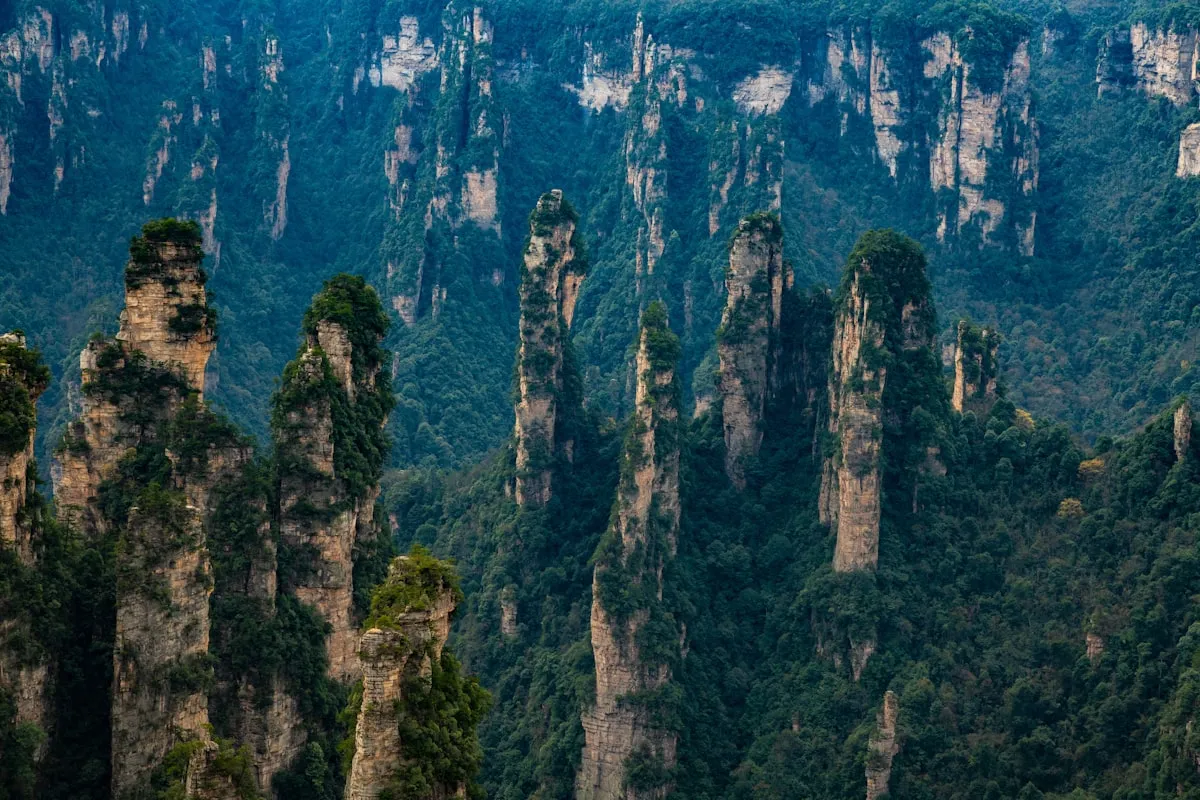 The Avatar-inspired pillar (Qiankun Zhu) at Zhangjiajie, with clouds swirling around its base at dawn.
Sources & Verification
This guide was last verified on 2026-08-06. Key Chinese-language sources:
- Tianmen Mountain official channels (天门山官方公告): construction and closure notices for the cableway upgrade and Glass Walkway maintenance, ticket pricing, and route arrangements.
- Zhangjiajie National Forest Park official ticketing (武陵源景区官方售票): entry pricing, 4-day validity, eco-bus routes, and Bailong Elevator and cableway fares.
- Trip.com (携程, trip.com): English-language ticket and guided-tour availability for foreign visitors, and package options.
- Xiaohongshu and Dianping (小红书 and 点评): recent traveler reports on queues, weather closures, and local restaurant recommendations.
Because the body of this guide focuses on ticket prices, construction notices, and official designations rather than named individual reports, we have relied on the standard authoritative sources for this scenic destination.
See our full verification methodology.
Related Articles
- Guilin and Yangshuo Travel Guide (2026) — The other iconic karst landscape in China
- 2 Weeks in China Itinerary — Zhangjiajie as an optional detour
- China Backpacking Budget Guide — Budget tips for Zhangjiajie