Lijiang Old Town Guide (2026) - Three Ancient Towns + Jade Dragon Snow Mountain
Lijiang Old Town Guide (2026) - Three Ancient Towns + Jade Dragon Snow Mountain
Lijiang sits on a 2,416-meter plateau in southwest China’s Yunnan province, where three old Naxi towns spread beneath a 5,590-meter snow peak. It is one of the country’s most photographed corners, and since 2024, travelers from 57 countries can fly straight in without a visa.
What most English guides call “Lijiang Old Town” is really three separate towns bundled into one UNESCO World Heritage Site: Dayan (the big, busy one you have seen in photos), Shuhe (quieter, tea-horse-road trading post), and Baisha (the oldest, where the Naxi rulers began). You can walk between them in a day or two, but each has a different rhythm. Two or three days here is the sweet spot.
How we verified this: SinoWander reads Chinese-language sources that English guides cannot, including official scenic-area WeChat booking notices, the National Immigration Administration, the Ministry of Culture and Tourism, and Ctrip. We cross-check them before writing. We have not personally visited every location. Each guide is date-stamped when last verified: 2026-08-06. See our methodology.
Visa-free entry: you can fly straight to Lijiang
This is the detail most overseas guides get wrong. Lijiang San’yi Airport (LJG) is itself a 240-hour transit visa-free port, along with Kunming Changshui (KMG). Citizens of 57 countries with a passport valid at least three months and an onward ticket to a third country can enter without a visa, stay up to 240 hours (10 days), and travel across nine Yunnan prefectures including Lijiang, Kunming, and Yuxi.
That means you can land directly in Lijiang, skip the Kunming connection, and be inside the old town within an hour. Full country list and rules are in our 240-hour visa-free transit guide.
Cultural context
Lijiang was founded at the end of the Song dynasty, around the 13th century, and is built on Naxi culture. The Naxi practice Dongba, a religion whose script is one of the few living pictographic writing systems in the world. Their protective deity is called Sanduo, and traditional music known as Naxi ancient music blends Tang, Song, and Yuan court melodies that have vanished elsewhere.
The architecture is the giveaway that you are in Naxi country. Courtyard houses follow the “three buildings and one screen wall” layout, with a third building added for larger homes. Streets are paved with red breccia cobblestones, and the old town has no city walls; legend says the Mu rulers refused to build them because the character for “Mu” (木) inside a wall forms the character for “trap” (困). Dayan alone has 354 small bridges over its water channels, which is why locals call it the “Venice of the East.”
The three towns at a glance
| Town | What it is | Entry | Time |
|---|---|---|---|
| Dayan | The main old town: Sifang Square, Mu Manor, Wangu Pavilion, Black Dragon Pool. Most commercialized. | Maintenance fee 50 yuan, but rarely checked for independent visitors strolling Dayan; checked at Black Dragon Pool | 1-2 days |
| Shuhe | Tea-horse-road trading town, 4A scenic area, far quieter than Dayan | Free for independent visitors; reserve on the “Shuhe Ancient Town” WeChat account | Half a day |
| Baisha | The original Naxi capital, where the Mu clan started. Baisha Murals. | Town is free; murals about 30 yuan | Half a day |
Day 1: Dayan Old Town
Start at Sifang Square, the cobblestone heart of the old town, and work outward. Mu Manor is the rebuilt seat of the Mu hereditary rulers, a 369-meter central axis of halls and courtyards that took its cues from Han, Bai, and Naxi building traditions. Tickets are 40 yuan and include a guided talk in Chinese; budget two hours and follow a guide to understand what you are looking at. From here, climb to Wangu Pavilion on Lion Hill for the postcard view of rooftops rolling toward Jade Dragon Snow Mountain (open 8:30-18:30).
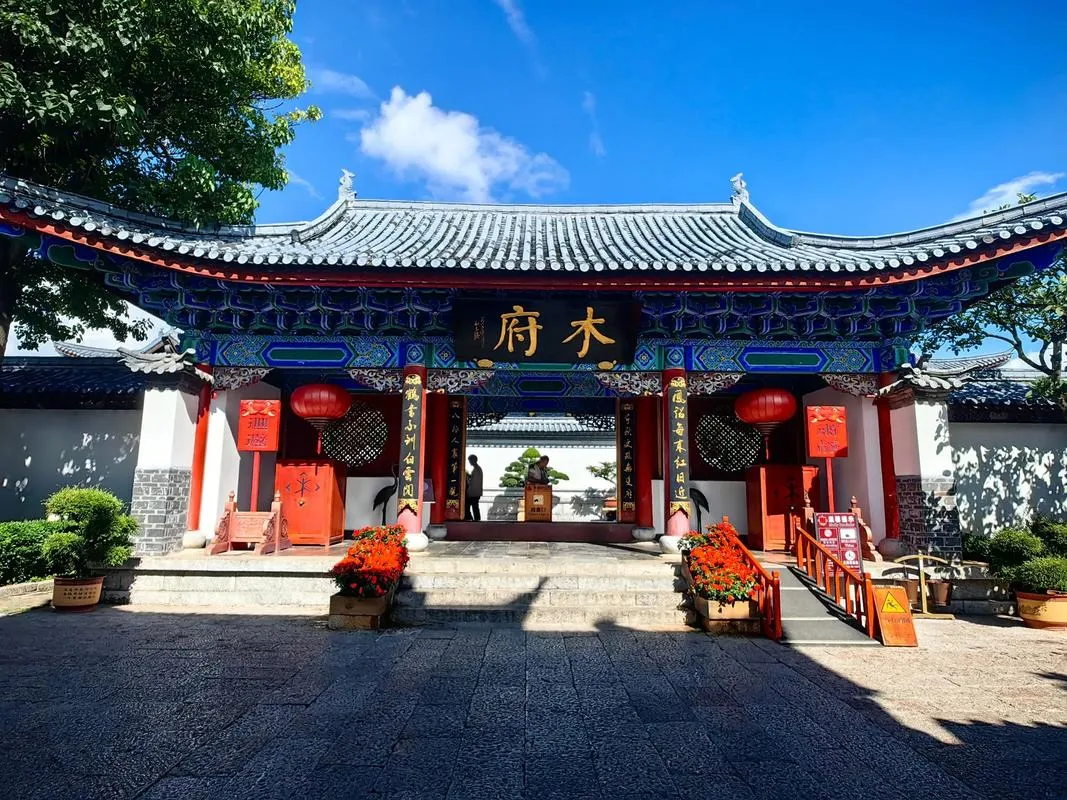 Mu Manor — the rebuilt seat of the Naxi hereditary rulers; the 40-yuan ticket includes a Chinese-language guided talk.
In the afternoon, walk up to Black Dragon Pool. This is where the classic reflection shot of the snow peak over the bridge is taken. The pool does check the 50-yuan maintenance fee, so keep your receipt if you already paid it at the old town gate.
In the evening, the choice is loud or quiet. Bar Street is exactly what it sounds like. For something calmer, eat along Wuyi or Qiyi Streets, where the restaurants are older and the crowds thinner.
Local Tip: The old town is at its best between 7 and 8 in the morning, when the lanes are empty, the light is soft, and the vendors are still setting up. Sleep in and you miss it.
Day 2: Jade Dragon Snow Mountain
This is the day most visitors remember. The mountain is a 5A scenic area whose main peak, Shanzidou, reaches 5,590 meters, with a snow line between 4,800 and 5,000 meters. It is the closest temperate marine glacier to the equator in the Eurasian continent, and the Naxi consider it the embodiment of their god Sanduo.
You are not climbing the peak. You are riding one of three cable cars, each reaching a different altitude:
- Glacier Park large cable car (4,506 m, walk up to 4,680 m): 140 yuan. This is the headline experience, and tickets sell out.
- Yak Meadow middle cable car (3,800 m): 65 yuan. The best angle on the thirteen peaks, and usually bookable same-day.
- Spruce Meadow small cable car (3,240 m): 60 yuan. Lowest altitude, forest and meadow, easiest on the lungs.
There is also a 100-yuan mountain entry fee that covers Blue Moon Valley and Ganhaizi, a mandatory 20-yuan shuttle, and the optional Zhang Yimou-directed “Impression Lijiang” open-air show (280 yuan standard, 346 VIP).
How to actually get a Glacier Park ticket. This is the part foreign guides usually skip. The only official channel is the WeChat mini-program called “Liji Lvyuo Jituan” (丽江旅游集团, Lijiang Tourism Group). There is no website, no app, and no authorized third-party reseller; anyone offering to book for you is a scalper. The system releases tickets seven days out, every evening at 8:00 PM Beijing time, and during summer they can be gone within ten minutes. Before you try, open the mini-program, add every traveler’s passport details, and complete the face check. If Glacier Park is sold out, switch to Yak Meadow (same day) or Spruce Meadow.
After the cable car, the shuttle drops you at Blue Moon Valley, a chain of turquoise lakes fed by snowmelt under the peaks. An electric cart costs 10 yuan per segment or 40 for the full route, but you can also walk.
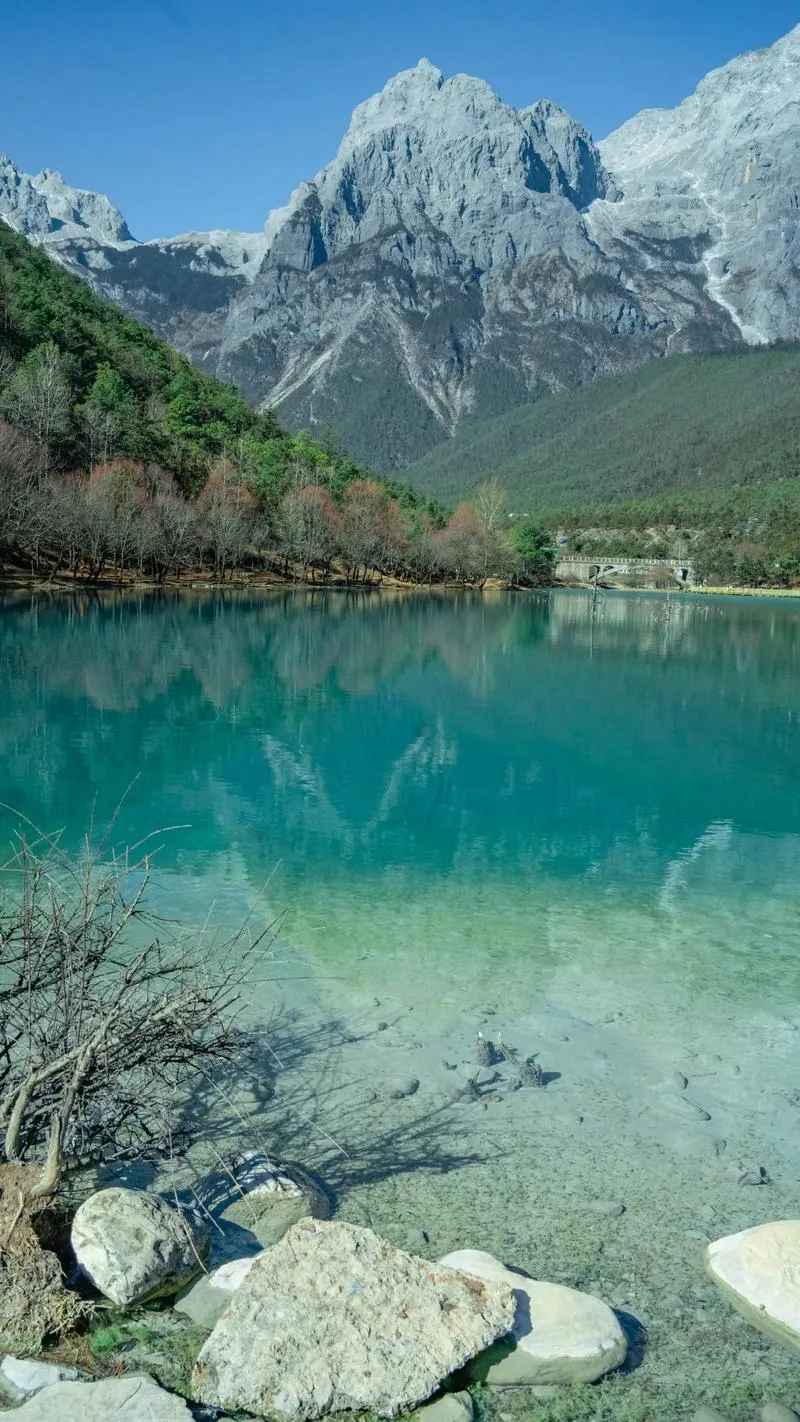 Blue Moon Valley — turquoise snowmelt lakes beneath Jade Dragon Snow Mountain, included in the 100-yuan mountain entry fee.
Local Tip: At 4,506 meters the air is thin. Walk slowly, do not run or jump for photos, and rent a small oxygen can at the mountain if you are unsure. Anyone with a history of severe altitude sickness or heart and lung conditions should pick Spruce Meadow instead.
Day 3 (optional): Shuhe and Baisha
If you have a third day, use it to escape the crowds.
Shuhe is a 20-minute taxi from Dayan and a relic of the tea-horse road, the trade route that carried Pu’er tea to Tibet. The lanes are quieter, the teahouses are real, and it is the place to sit with a cup for an afternoon. Independent visitors enter free with a WeChat reservation.
Baisha is the oldest of the three, the Naxi capital before the Mu clan moved to Dayan. Its treasure is the Baisha Murals: 55 surviving frescoes painted over 300 years from the early Ming dynasty, mixing Han, Tibetan, Naxi, and Bai techniques. They are ranked alongside the Mogao, Fahai, and Yongle grottoes as one of China’s four great mural traditions. Entry is about 30 yuan, the mural hall is open 9:00-17:30, and photography of the originals is forbidden. The town itself is free, a maze of low earth-walled houses and coppersmiths’ workshops. To get there, take bus 6 from the old town (3 yuan) or a taxi (about 30 yuan, 20 minutes). A new snow-mountain sightseeing train opened in 2025 and links Baisha to the scenic area (50 yuan single, 80 return).
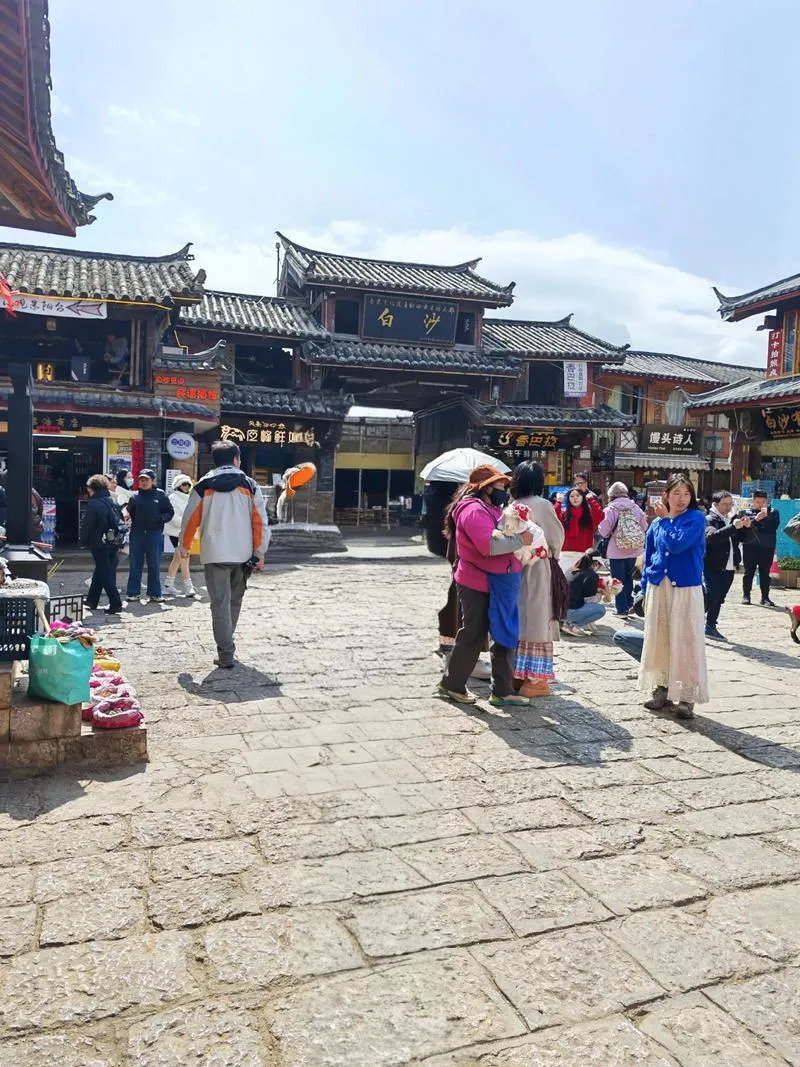 A lane in Baisha, the oldest of the three towns and the Naxi capital before the Mu clan moved to Dayan.
Getting there
By air: Lijiang San’yi Airport (LJG) is a 240-hour visa-free port (see above). The airport bus to the old town’s south gate takes about an hour and costs 20 yuan; a taxi is around 40 yuan.
By high-speed train: From Kunming, C-series intercity trains reach Lijiang in about 3 hours 29 minutes to 3 hours 58 minutes, second class 166-190 yuan. From Dali, the ride is about 1 hour 25 minutes. At Lijiang station, take bus 18 or 4 to the old town, or a taxi for 30-40 yuan.
Tickets and reservations (2026)
| Item | Price | How to book |
|---|---|---|
| Mountain entry fee | 100 yuan | Scan at the gate |
| Glacier Park cable car (4,506 m) | 140 yuan (120 in summer promo) | “Lijiang Tourism Group” mini-program, 8 PM, 7 days out |
| Yak Meadow cable car (3,800 m) | 65 yuan | Usually same-day |
| Spruce Meadow cable car (3,240 m) | 60 yuan (40 in summer promo) | Mini-program, 9 PM release |
| Impression Lijiang show | 280 / 346 VIP | Online |
| Blue Moon Valley cart | 10 per segment / 40 full | On site |
| Snow-mountain sightseeing train | 50 single / 80 return | Mini-program |
| Mu Manor | 40 yuan (guide included) | On site or online |
| Baisha Murals | about 30 yuan | On site |
| Old town maintenance fee | 50 yuan (valid 365 days) | “Lijiang Old Town” account; rarely checked in Dayan, checked at Black Dragon Pool |
A note on commercialization
In April 2026, China’s Ministry of Culture and Tourism publicly named Lijiang Old Town for management and service problems. If you have read older reviews complaining about over-commercialization, they are not wrong. Bar Street is loud, and the main lanes are lined with the same souvenirs you see in every tourist town in China.
None of that erases the place. The old town is still a genuine World Heritage Site with 800 years of layered history, and the version worth coming for is still findable: get up before the tour groups, take the side alleys off Wuyi Street, and spend a night in Shuhe or Baisha instead of Dayan. Pair this with our notes on tourist traps and the worst times to visit China, and you will do fine.
Budget (2-3 days, excluding long-haul flights)
- Lodging: 200-500 yuan per night for a guesthouse inside the old town
- Food: 100-200 yuan per day
- Snow mountain day (entry, large cable car, show, cart): about 500-650 yuan per person
- Rough total: about 1,500-2,500 yuan per person
Sources & Verification
This guide was last verified on 2026-08-06. Key Chinese-language sources:
- 丽江旅游集团 (Lijiang Tourism Group, WeChat mini-program): The only official booking channel for Jade Dragon Snow Mountain Glacier Park cable car tickets, with the seven-day-ahead release and 8 PM Beijing time drop described in the article. It has no website or app.
- 文化和旅游部 (Ministry of Culture and Tourism, mct.gov.cn): The April 2026 public notice that named Lijiang Old Town for management and service problems, referenced in the commercialization section.
- 国家移民管理局 (National Immigration Administration, nia.gov.cn): The 240-hour transit visa-free policy listing Lijiang San’yi Airport (LJG) as a port, covering 57 countries and nine Yunnan prefectures.
- UNESCO World Heritage Convention (whc.unesco.org): The World Heritage designation that frames Lijiang Old Town as the three bundled towns of Dayan, Shuhe, and Baisha.
See our full verification methodology.
Related Articles
- 240-Hour Visa-Free Transit in China — the full country list and rules that let you fly into Lijiang
- China Travel Scams and Tourist Traps — honest guide to what to skip
- Worst Time to Visit China 2026 — season-by-season, including Yunnan
- Chengdu Travel Guide — pandas and hot pot, the other western China favorite