Chongqing Travel Guide - China's 3D Cyberpunk Mountain City (2 Days)
Few Chinese cities look like Chongqing. Built on steep hills where the Yangtze and Jialing Rivers meet, this megacity of 32 million people stacks vertically: the 1st floor and the 22nd floor of the same building can both open onto different streets. A metro line passes straight through a residential tower on columns. A 1,000-year-old cliffside village sits lit up at the base of a modern skyscraper district. The hot pot is the city’s signature dish, simmered in chilies and numbing Sichuan peppercorn.
Visitors often say the city feels like a science-fiction film set. The Chinese nickname captures the same idea: “3D magic city,” because the terrain is so steep and stacked that two points a few meters apart on your map can sit twenty stories apart in real life.
Quick answer: Chongqing is China’s “3D magic city”: a megacity of 32 million built on steep hills where the 1st floor and 22nd floor of the same building open onto different streets. Spend 2 days: Day 1 covers the 3D city core (Hongya Cave, Kuixing Tower, Yangtze Cableway), Day 2 goes deeper into the mountain city. Eat hot pot (nine-grid, red chili oil). Avoid summer (35°C+ “Four Furnaces”). See our hot pot guide and Yangtze cruise guide.
How we verified this: SinoWander reads Chinese-language sources that English guides cannot, including Ctrip, official scenic-area notices, and Dianping. We cross-check them before writing. We have not personally visited every location. Each guide is date-stamped when last verified: 2026-08-06. See our methodology.
When to Visit
Spring (March — May) and autumn (September — November) are the best seasons, with mild temperatures and clearer skies. Summers (June — August) are among the hottest in China, with temperatures regularly exceeding 35 degrees C (95 degrees F) and oppressive humidity that earns Chongqing its place among China’s “Four Furnaces.” Winters are gray and foggy but mild.
Local Tip: Chongqing’s nickname is the “Fog City.” If you visit in winter, embrace the mist, which softens the skyscrapers and bridges, especially at night.
2-Day Itinerary
Day 1: The 3D City Core
| Time | Activity | Duration |
|---|---|---|
| Morning | Jiefangbei (Liberation Monument) and Bayi Food Street | 2 hours |
| Midday | Lunch: Chongqing xiaomian (spicy noodles) | 1 hour |
| Afternoon | Shibati (Eighteen Stairs) traditional area | 1-2 hours |
| Late Afternoon | Kuixing Tower (1st floor = 22nd floor experience) | 30 minutes |
| Late Afternoon | Yangtze River Cableway | 1-2 hours |
| Evening | Hongya Cave (illuminated cliffside village) | 2-3 hours |
Start at Jiefangbei (Liberation Monument, free), the towering monument at the center of Chongqing’s commercial district and the symbolic heart of the city. The surrounding pedestrian zone is a shopping hub, but your real destination is the adjacent Bayi Haochi Jie (Bayi Good Food Street), where you will find Chongqing’s iconic xiaomian (spicy noodles, about 10-15 yuan / $1.50-2), suanlafen (hot and sour sweet potato noodles), and shancheng xiaotangyuan (mountain city sweet dumplings).
Shibati (Eighteen Stairs, free) is a newly renovated traditional neighborhood cascading down the hillside, preserving the stone stairways and old Chongqing architectural character that once defined the city. It offers excellent views back up toward the modern skyline.
Kuixing Tower (free) is the quintessential Chongqing 3D experience. You enter what appears to be the ground floor of a building, walk to the edge, and discover you are on the 22nd floor, with a road and plaza far below. Your GPS will be thoroughly confused.
The Yangtze River Cableway (one-way 30 yuan / ~$4.50; round-trip 50 yuan / ~$7.40) is a vintage cable car that has been carrying commuters across the Yangtze since 1987. The ride takes about 4 minutes and offers wide views across both riverbanks. Book in advance via Trip.com or GetYourGuide to skip the (very long) holiday queue. Chongqing is also the boarding point for the famous Yangtze River cruise through the Three Gorges: a 4–5 day journey downstream to Yichang that many travelers tack onto a Chongqing visit.
Local Tip: The IC card discount time slots (Monday-Friday, 7:30-9:00 AM and 5:00-7:00 PM) cost only 1.8 yuan (~$0.27). If you have a local transit card or can find a friendly local to swipe you through, this is a massive bargain.
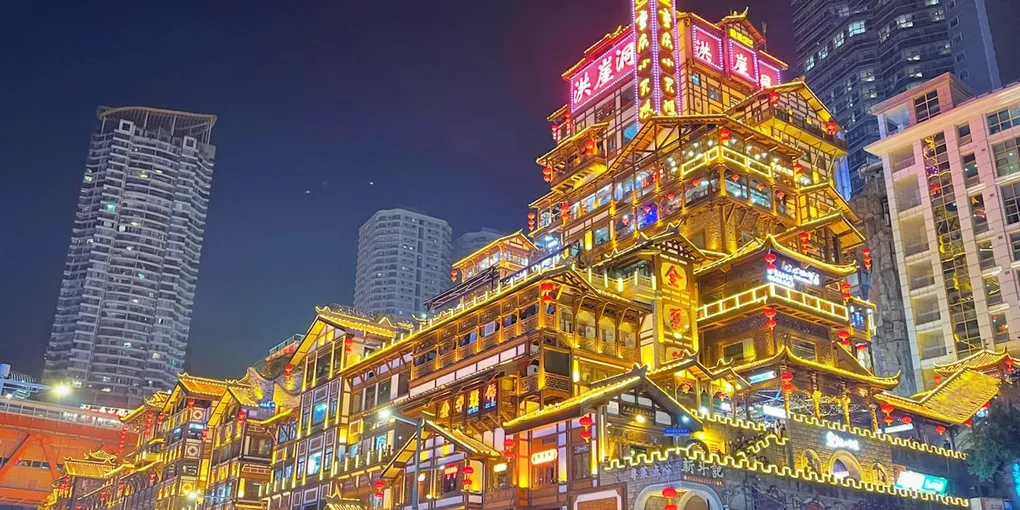
Hongya Cave (Hongya Dong, free) is the climax of Day 1. This 11-story wooden stilt-house complex (diaojiaolou) clings to a cliff above the Jialing River, housing restaurants, shops, and a hot pot restaurant on the 7th floor. The buildings are illuminated from dusk (roughly 18:30-19:30 depending on season) to 23:00, creating a scene that looks like the spirit-world bathhouse from Hayao Miyazaki’s “Spirited Away.”
Best viewing spots:
- Qiansimen Bridge (free): walk onto the bridge for a panoramic view across the water
- The road directly opposite Hongya Cave on the far bank
- The Grand Theatre area on the south bank (Metro Line 6, Grand Theatre station)
Local Tip: Arrive at Hongya Cave by 18:00 to claim a good viewing spot before the lights come on (around 18:30 in winter / 19:30 in summer). The area becomes extremely crowded within an hour of the switch-on, especially on weekends and holidays.
Day 2: Mountain City Deep Dive
| Time | Activity | Duration |
|---|---|---|
| Morning | Ciqikou Ancient Town | 2-3 hours |
| Midday | Lunch at Ciqikou (Chen Mahua, maoxuewang) | 1 hour |
| Afternoon | Liziba Station (train-through-building photo spot) | 30 minutes |
| Late Afternoon | Mountain City Step Trail (Shancheng BuDao) | 1-2 hours |
| Evening | Hot pot dinner | 2-3 hours |
Ciqikou Ancient Town (free) is a 1,000-year-old market town preserved within the modern city. Its narrow flagstone streets wind between tea houses, craft shops, and food stalls. The two things to buy here are Chen Mahua (fried dough twists, crispy and sweet, sold in dozens of flavors) and maoxuewang (a fiery stew of duck blood, tripe, and tofu in chili oil, and one of Chongqing’s signature “jianghu” dishes).
Liziba Station (free) is where Metro Line 2 passes directly through a residential building on columns, with apartments on either side of the tracks. It has become one of China’s most viral internet phenomena. To photograph it: take Metro Line 2 to Liziba station, exit the station, and walk to the viewing platform on the street below, where you can look up and watch trains glide through the building.
Local Tip: Stand at the street-level viewing area and look up. When a train approaches, it appears to dive into the building like a scene from a sci-fi film. Trains run every 3-5 minutes, so you will not wait long.
The Mountain City Step Trail (Shancheng BuDao, free) is a restored series of old stone stairways that wind up and down the steep hillside, passing through residential neighborhoods, small temples, and viewpoints. It is the best way to experience the “ladder culture” (tikan wenhua) that defines old Chongqing life. Wear good shoes and bring water.
End your day with a proper Chongqing hot pot, the spiciest in all of China and fiercer than its Chengdu cousin, with a numbing, tongue-tingling ma la (numbing-spicy) intensity that will make your eyes water and your forehead sweat. This is a point of civic pride.
Recommended hot pot restaurants:
| Restaurant | Style | Price per Person | Notes |
|---|---|---|---|
| Yuwei Xiaoyu (Pipashan location) | Featured on “A Bite of China”; classic beef tallow base | 80-120 yuan ($12-18) | The quintessential Chongqing hot pot experience |
| Pipayuan Hot Pot | Set on a mountainside with panoramic city views; thousands of lanterns | 90-150 yuan ($13-22) | A dinner here feels like a festival |
| Yefu Hot Pot | Small, neighborhood-style; bold ma-la flavor | 60-90 yuan ($9-13) | Purist’s choice |
| Silai Hot Pot (Guanyinqiao) | Community-style in a residential building | 60-80 yuan ($9-12) | Fresh beef tendon specialty |
| Gan Jiumei Hot Pot | 35 years of hand-crafted spice blend | 70-100 yuan ($10-15) | Old master at work |
| Dongting Xian Hot Pot | Cave hot pot, served inside a natural cavern | 80-120 yuan ($12-18) | Tripadvisor 4.4 rating; unique setting |
Hot pot pricing guide: Community neighborhood restaurants run 60-80 yuan ($9-12) per person; well-known brand restaurants 80-120 yuan ($12-18); scenic mountain-top restaurants like Pipayuan 90-150 yuan ($13-22).
Must-try street foods:
| Food | Where | Description |
|---|---|---|
| Chongqing xiaomian | Bayi Food Street, Huashi Wanza Mian | Spicy, numbing noodle soup (Chongqing’s daily breakfast) |
| Suanlafen | Bayi Food Street | Hot-and-sour sweet potato noodles |
| Chen Mahua | Ciqikou (original shop) | Sweet fried dough twists; the most popular souvenir |
| Maoxuewang | Ciqikou | Fiery blood-curd-and-tripe stew |
| Wu Chaoshou | Near Jiefangbei | Chongqing-style wontons in spicy broth |
Where to Stay
Best location: The area around Xiaoshizi Metro Station (Lines 1 and 6 intersect here) or Jiaochangkou Station (Lines 1 and 2). Both are within a 10-minute walk of Jiefangbei, Hongya Cave, and the cliffside viewpoints.
🏨 Book your hotel: Search Chongqing hotels on Trip.com (passport-friendly, foreign-card payment, river-view options).
| Budget | Price (per night) | Recommendations |
|---|---|---|
| Budget | 100-300 yuan ($15-44) | Cloud Heights River View Hotel (near Xiaoshizi, walking distance to Hongya Cave); local guesthouses in high-rise apartments with stunning views |
| Mid-range | 300-600 yuan ($44-89) | Enji M Hotel (opened 2025, rated 5.0); Shanqiu Hotel (Jiefangbei area); Feifanchengpin Hotel |
| Luxury | 600+ yuan ($89+) | Hampton by Hilton Jiefangbei Hongya Cave (river views, free breakfast); UrCove by Hyatt (smart rooms); high-floor panoramic hotels in Nan’an district (floors 38-55, floor-to-ceiling windows overlooking the river) |
Local Tip: Prioritize a high-floor room with a river view. Waking up to the sight of Hongya Cave glowing across the water at dawn is an experience worth paying extra for. Book 1-2 months ahead for holidays and summer weekends.
Getting Around
From the Airport
Chongqing Jiangbei International Airport (CKG): Metro Line 3 reaches the city center in 45-60 minutes (transfer to Line 2 for Jiefangbei). The last metro leaves around 22:30. Airport buses depart from Terminal 2. A taxi takes 40-60 minutes.
City Transit
Chongqing’s metro and light rail system spans 558 km (347 miles) with an average daily ridership of 3.65 million. Fares: 2-9 yuan ($0.30-1.30). Operating hours: approximately 6:30 AM to 11:00 PM.
Key metro lines for tourists:
| Line | Key Stops |
|---|---|
| Line 1 | Ciqikou, Jiaochangkou (Shibati/Jiefangbei), Xiaoshizi (Hongya Cave) |
| Line 2 | Liziba (train-through-building), Linjiangmen (Jiefangbei) |
| Line 3 | Jiangbei Airport |
| Line 6 | Grand Theatre (Hongya Cave viewpoint from south bank) |
Important note on navigation: Chongqing’s mountainous terrain makes GPS notoriously unreliable. Your map may show a destination 100 meters away that requires a 10-minute descent down 200 stairs. Ask locals for directions frequently. They are accustomed to the confusion.
Practical Information
Ticket Summary
| Attraction | Price | Reservation |
|---|---|---|
| Hongya Cave | Free | None |
| Jiefangbei | Free | None |
| Yangtze River Cableway | 30 yuan one-way / 50 yuan round-trip | Reserve online during holidays |
| Ciqikou | Free | None |
| Liziba Station | Free | None |
| Shibati | Free | None |
| Nanshan One Tree Viewpoint | ~30 yuan ($4.50) | None |
Budget Estimate (2 days, excluding flights)
| Category | Budget | Mid-Range | Comfortable |
|---|---|---|---|
| Accommodation (1 night) | 100-300 yuan ($15-44) | 300-600 yuan ($44-89) | 600+ yuan ($89+) |
| Food | 150-300 yuan ($22-44) | 300-500 yuan ($44-74) | 500+ yuan ($74+) |
| Tickets/activities | 50-100 yuan ($7-15) | 100-200 yuan ($15-30) | 200+ yuan ($30+) |
| Transport | 30-60 yuan ($4-9) | 60-120 yuan ($9-18) | 120+ yuan ($18+) |
| Total | ~330-760 yuan ($49-112) | ~760-1,420 yuan ($112-210) | ~1,420+ yuan ($210+) |
Chongqing is notably cheaper than Shanghai and somewhat more affordable than Chengdu, making it the best value among China’s three western mega-cities.
Local Tip: Chongqing’s hot pot is significantly spicier than Chengdu’s. Even if you consider yourself a spice veteran, start with the “wei la” (mild) setting and work your way up. The numbing Sichuan peppercorn (hua jiao) adds a tingling sensation that Western palates often find surprising. It is not a heat you can train for; the peppercorn works on different nerves than chili does.
Avoid: Do not attempt to navigate Chongqing on foot using only your phone’s GPS. The vertical terrain means you may be standing directly above or below your destination with no obvious way to bridge the gap. When in doubt, ask a local. Chongqing residents are friendly, and most are happy to point you toward the nearest stairs, elevator, or funicular that connects the layers of the city.
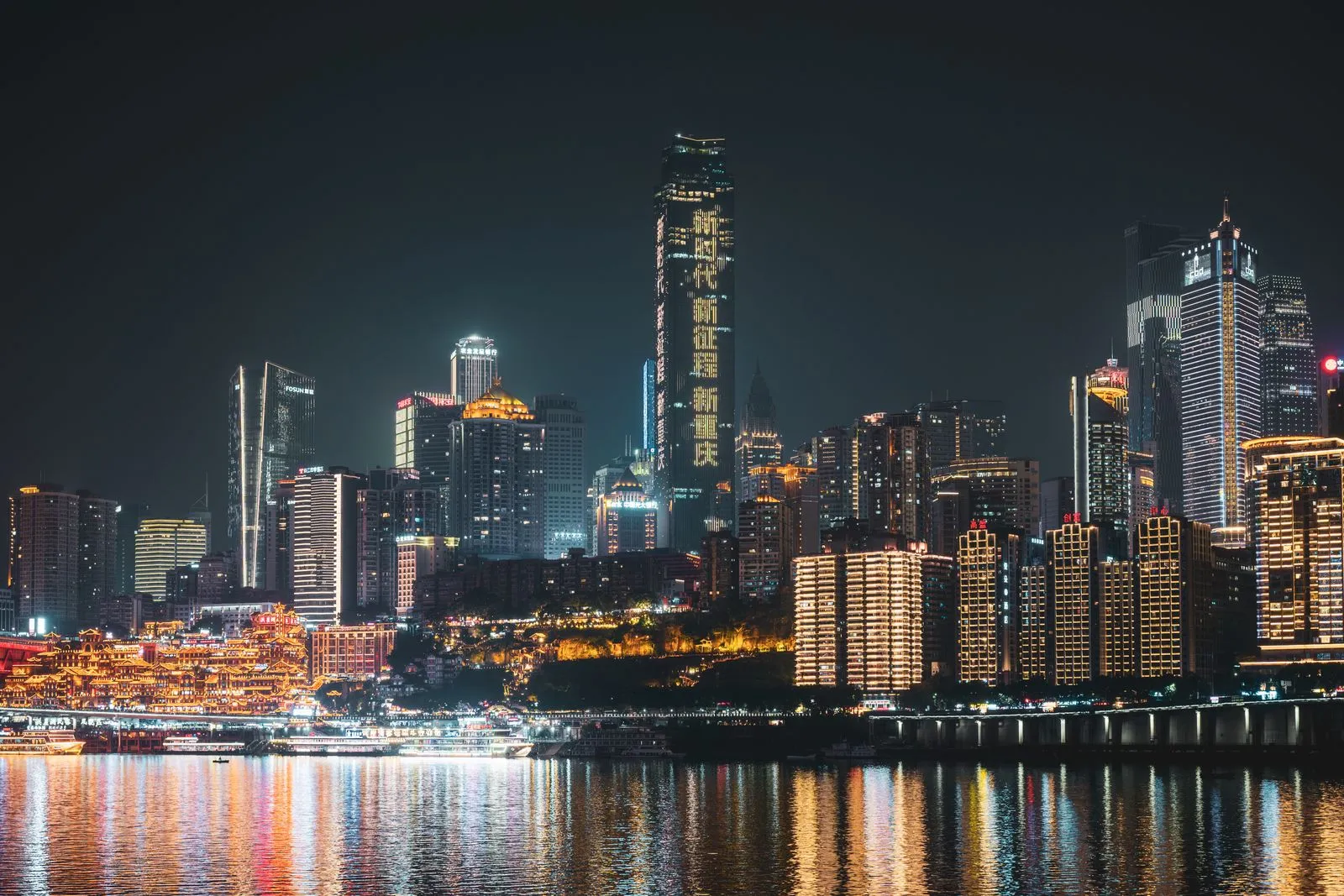 Chongqing’s skyline reflected in the Yangtze River at night.
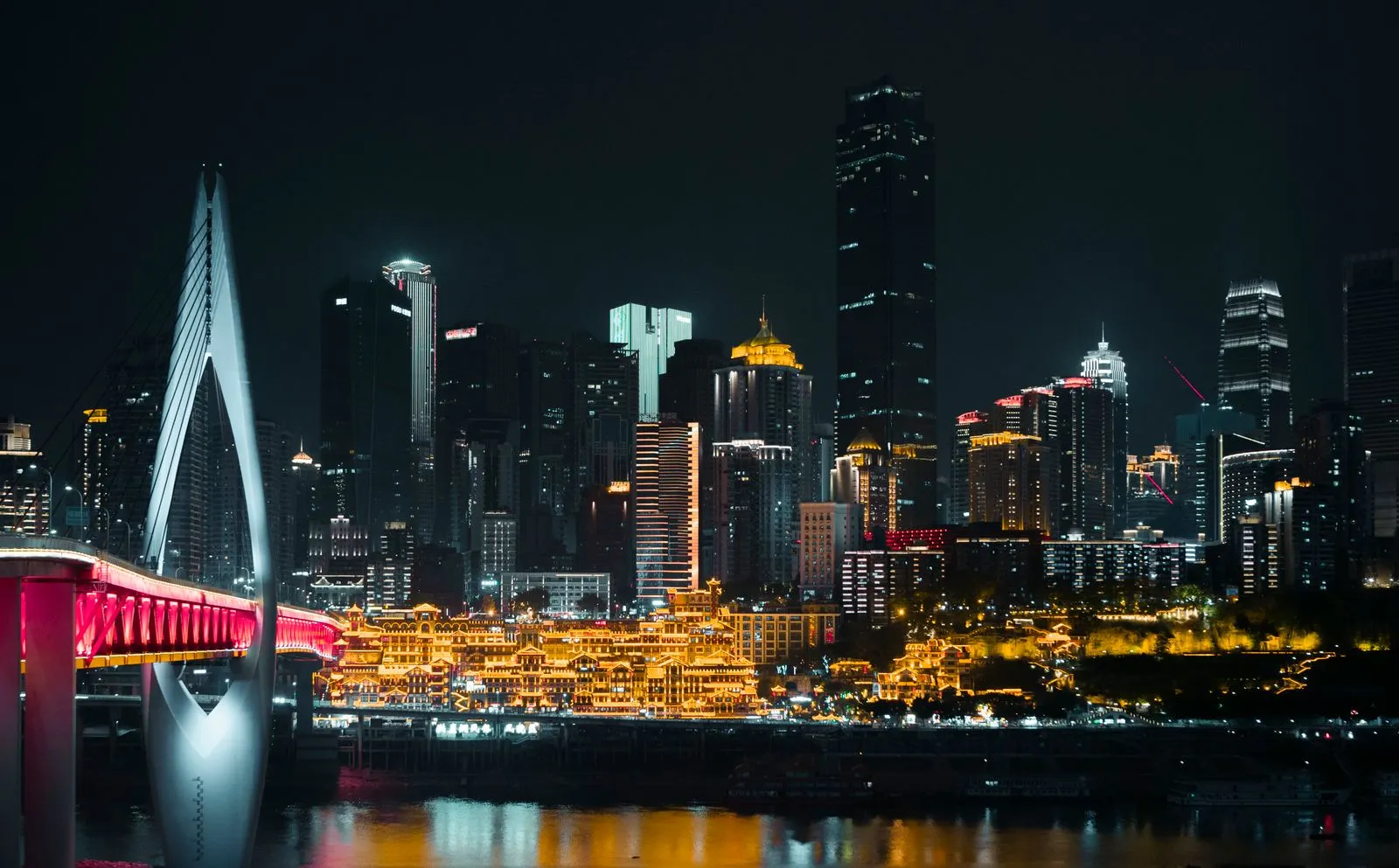 Neon lights over a Chongqing street. The city’s nightlife runs late.
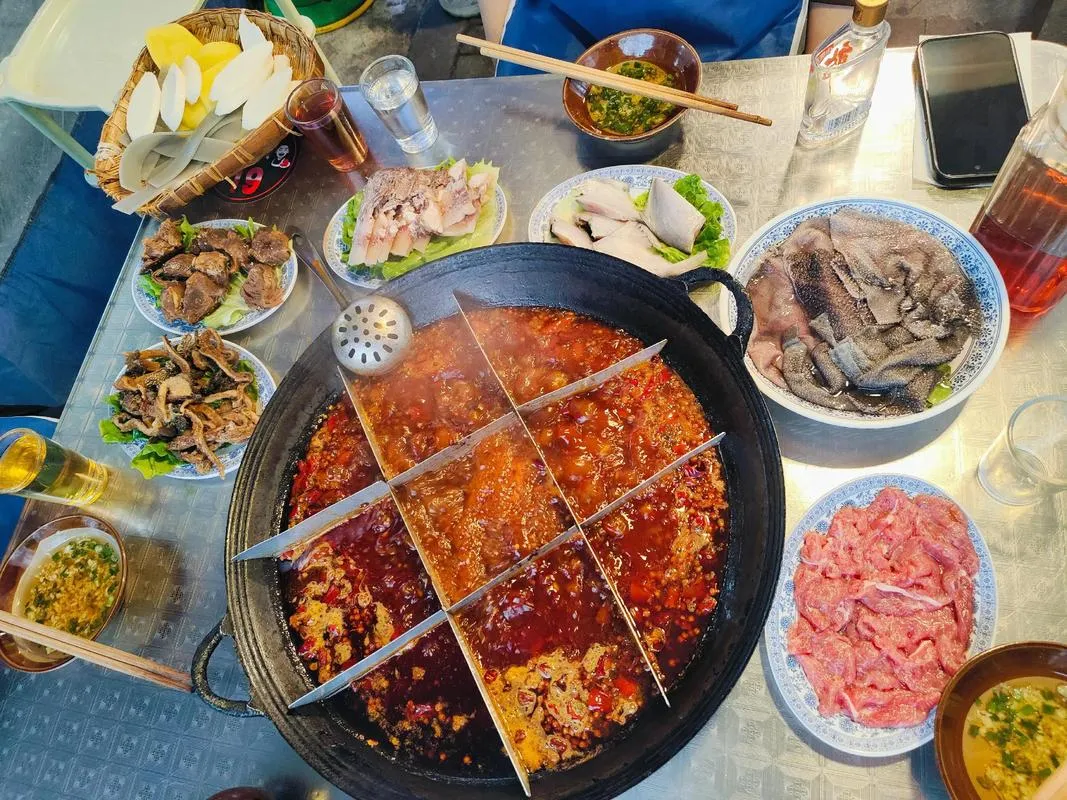 A nine-grid hot pot (九宫格) bubbling with red chili oil. Chongqing’s signature dish.
Sources & Verification
This guide was last verified on 2026-08-06. Key Chinese-language sources:
- Trip.com / Ctrip (携程, trip.com): The international booking brand of Ctrip, referenced for reserving the Yangtze River Cableway (to skip holiday queues) and Chongqing hotels with passport-friendly, foreign-card payment.
- “A Bite of China” (舌尖上的中国): Chinese food documentary cited in this guide as the show that featured Yuwei Xiaoyu hot pot at the Pipashan location.
- Official scenic-area notices (景点官方公告): Standard source for this topic, providing Hongya Cave lighting hours (dusk to 23:00, roughly 18:30-19:30 depending on season), free-entry policies at Ciqikou and Shibati, and Yangtze Cableway pricing.
- Dianping (大众点评, dianping.com): Standard source for hot pot restaurant pricing and the per-person budget ranges (60 to 150 yuan) used in this guide.
See our full verification methodology.
Related Articles
- Yangtze River Cruise Guide (2026): the Three Gorges cruise departs from Chongqing
- Chengdu Travel Guide (2026): 1 hour from Chongqing by high-speed train
- Chinese Food Guide for Foreigners: Chongqing hot pot and street food explained
- China Backpacking Budget Guide: Chongqing is one of China’s cheapest major cities