How to Use China's Subway & Bus — Complete Foreigner's Guide (2026)
China’s urban subway systems are among the largest, newest, and cleanest in the world — led by Beijing, Shanghai, Guangzhou, and Shenzhen, with more track and ridership than almost anywhere else. For a short-term visitor, the subway is almost always faster than a taxi (traffic in big Chinese cities is brutal), cheaper (a few yuan to cross the whole city), and more reliable than any other form of city transport.
But the first time you face an all-Chinese subway station, it’s normal to feel lost: How do I buy a ticket? What’s that round plastic coin? What if I don’t have Alipay or WeChat? Does Apple Pay work? This guide answers all of it.
Local Tip: The good news for 2024–2026 is that China has dramatically upgraded transit payments for international visitors — Alipay’s transit QR code now accepts foreign passports, and UnionPay international cards can tap directly through gates. Most English travel guides haven’t caught up to these changes yet.
Why you should take the subway in China
- No traffic: Beijing and Shanghai rush-hour gridlock can be soul-crushing. The subway has its own right-of-way the whole way.
- Cheap: Distance-based fares, usually ¥2–4 to start; crossing a whole city rarely costs more than ¥10.
- Fast & extensive: First-tier city networks (Beijing and Shanghai each have around 20 lines) reach virtually every major sight, shopping district, and transit hub.
- Modern & clean: Most lines were built in the last 10–15 years — new trains, clean platforms, air-conditioning, and platform screen doors (safe).
- Well-connected: Airports and high-speed rail stations almost always have a subway stop.
The one downside: rush hour is extremely crowded (see the tips section).
Before you enter: security check & finding the entrance
Finding the entrance: Look for green/blue “地铁” or Metro/Subway signs, often with an “M” logo. Entrances usually show a line map and operating hours.
Security check (mandatory at every station):
- All bags go through an X-ray machine; you walk through a scanner
- Liquids: staff may ask you to take a sip or put the bottle in a tester
- Banned: knives (including large scissors), excessive lighters, flammables, oversized aerosols, alcohol
- Luggage: fine — there’s a wide lane for big bags
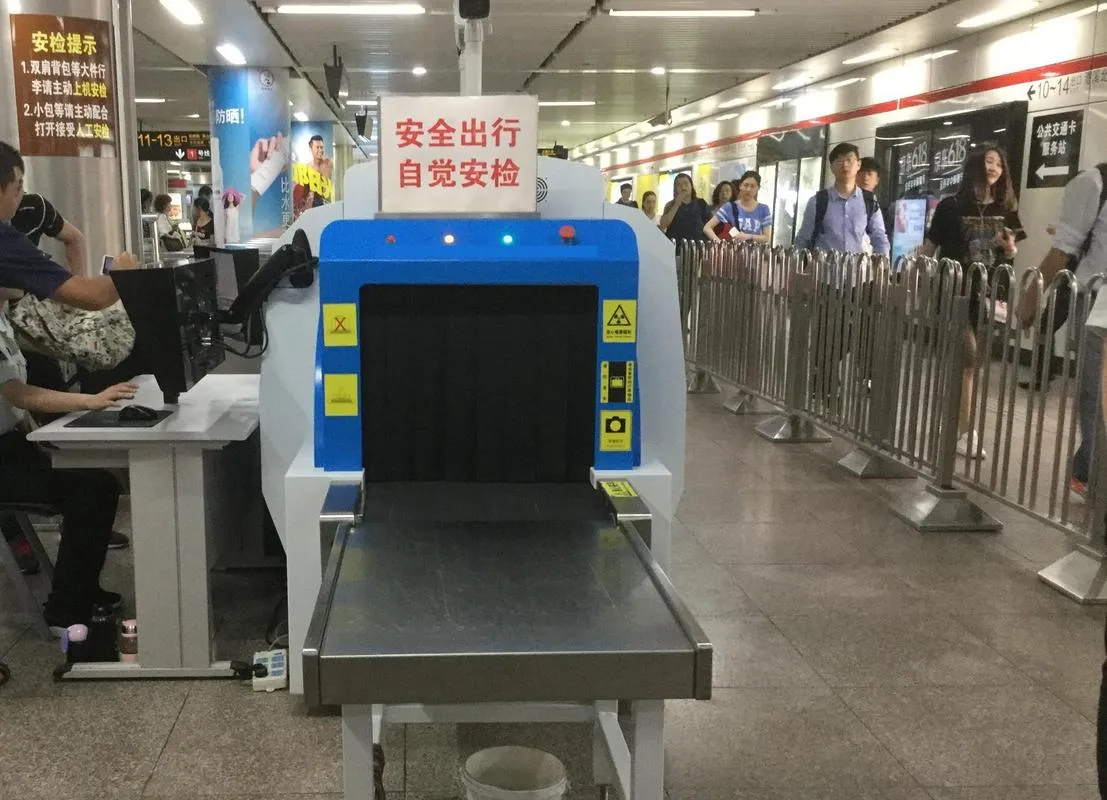 All bags go through an X-ray scanner at every station entrance.
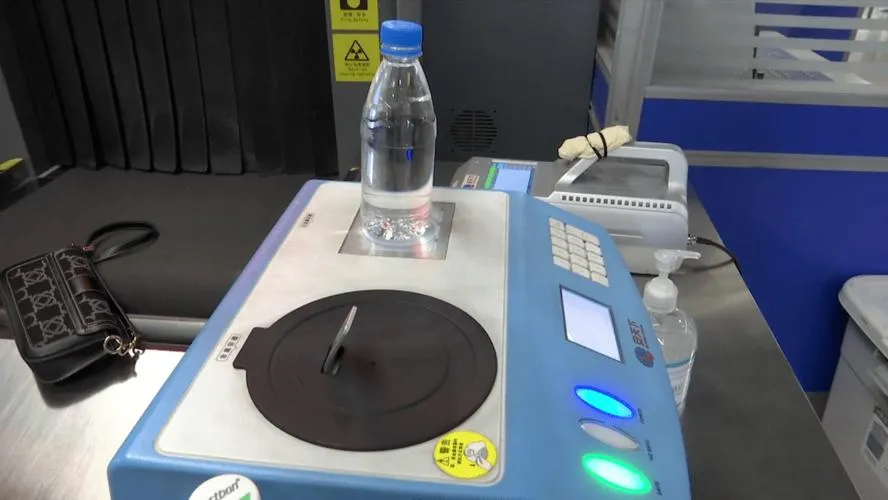 Staff may scan drinks with a liquid detector — a standard step at Chinese subway security.
Local Tip: Security staff rarely speak English, but the process is obvious — put your bag on the belt and follow the gestures.
The 4 ways to pay & enter (the core of this guide)
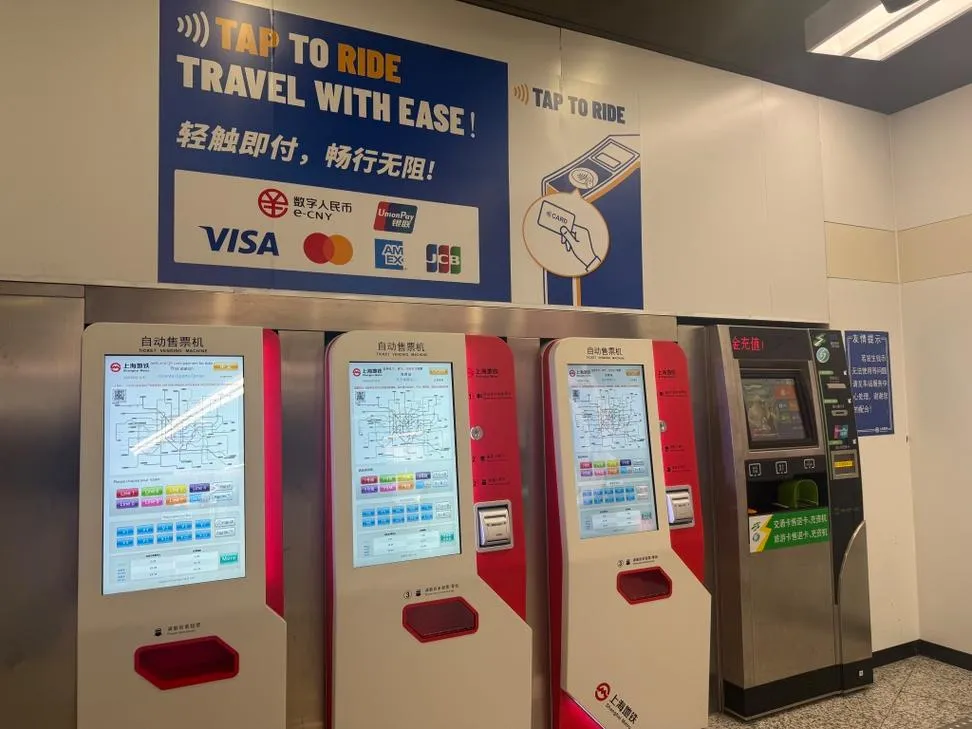 A ticket vending machine — tap “English”, pick your station, and pay with cash or QR.
Way 1: Ticket vending machine (⭐ most reliable for first-timers)
If you don’t have a Chinese phone number or Alipay, this is your most reliable option.
- Touchscreen machines at every station entrance, switchable to English (look for the “English” button in the corner)
- Steps: pick destination → number of tickets → machine shows fare → pay
- Payment: cash (coins + small notes, bring change); newer machines also accept QR
- What comes out: most cities dispense a round plastic token (single-journey ticket), some a paper QR ticket
- How to use the token: tap it on the gate reader to enter → drop it into the gate’s slot when you exit (tokens aren’t kept; they’re returned on exit)
Way 2: Scan a QR code to enter (⭐ foreigners can use this too since 2024!)
This is how locals mostly ride, and now foreigners can too:
- Alipay: open the “Transport / 乘车码” transit code in Alipay. Since May 2024, Alipay accepts foreign phone numbers (9 digits) and covers Beijing, Shanghai, Guangzhou, Shenzhen, Hangzhou, Nanjing, Chengdu, Suzhou, Kunming, Wuhan, Qingdao and other key inbound-tourism cities, with “ride now, pay later”. (See /blog/01-how-to-set-up-alipay-in-china — foreigners can verify Alipay with a passport.)
- WeChat: the “乘车码” mini-program also works
- How: generate a QR → scan at the entry gate → scan again at exit → fare is deducted by distance
- Some cities (e.g. Guangzhou) now let passport / HK-Macau / Taiwan-ID holders activate the transit code directly
City apps are foreigner-friendly too: Shanghai’s Metro Metropolis (Metro大都会) app accepts passport / HK-Macau / Taiwan-ID registration, then you bind a foreign card (Visa, Mastercard, etc. via Alipay/WeChat/UnionPay) and scan to ride, pay later.
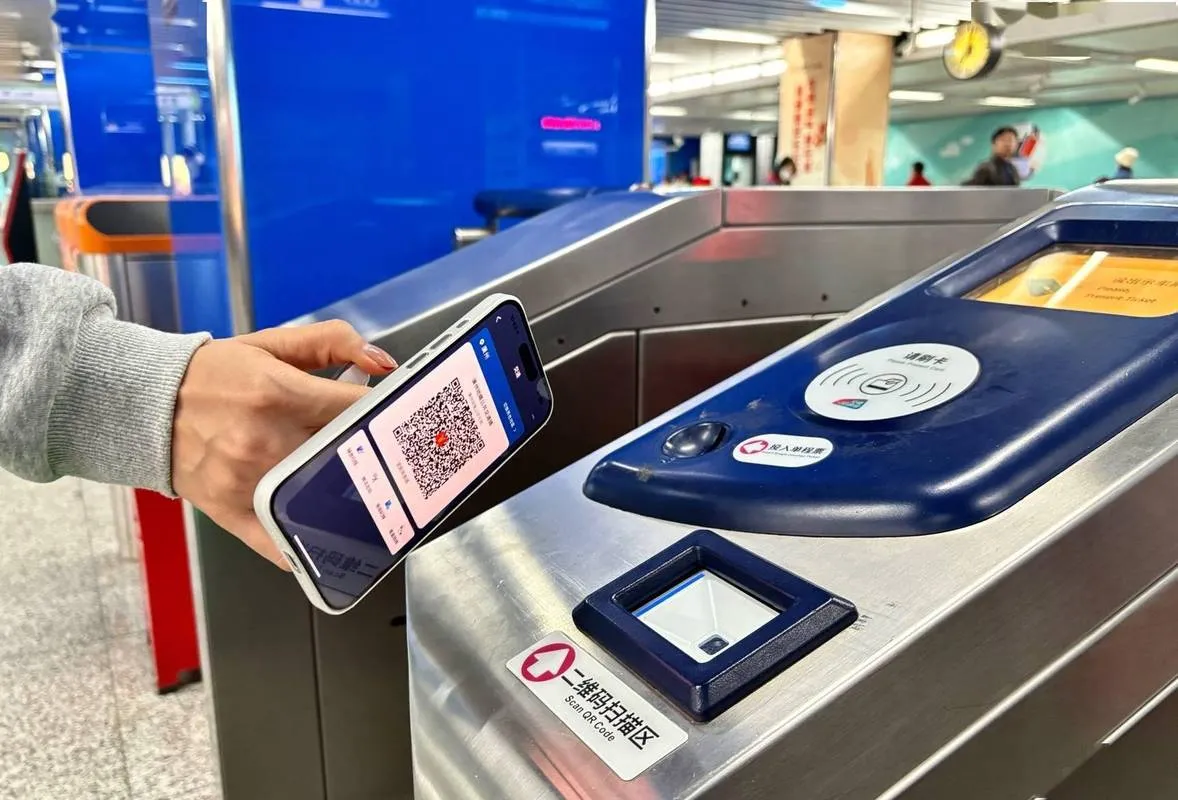 Scan the transit QR code at the entry gate — then scan again on the way out.
This is the biggest convenience upgrade of the past two years — foreigners used to be stuck with ticket machines; now passport verification + a foreign phone number is enough to scan.
Way 3: Transit card (best for multiple trips / longer stays)
- Each city has its own card: Beijing “Yikatong” (一卡通), Shanghai “Transport Card,” Guangzhou “Yangchengtong”
- Bring your passport to a station service counter to buy one (foreigners can get them); deposit + top-up; also sold at convenience stores
- Tap to enter, tap to exit — saves buying a ticket every time
- Refundable on departure (rules vary by city; usually a small fee)
- “Transport Union” (交通联合) cards: cards with this logo work across hundreds of Chinese cities — ideal for multi-city travel
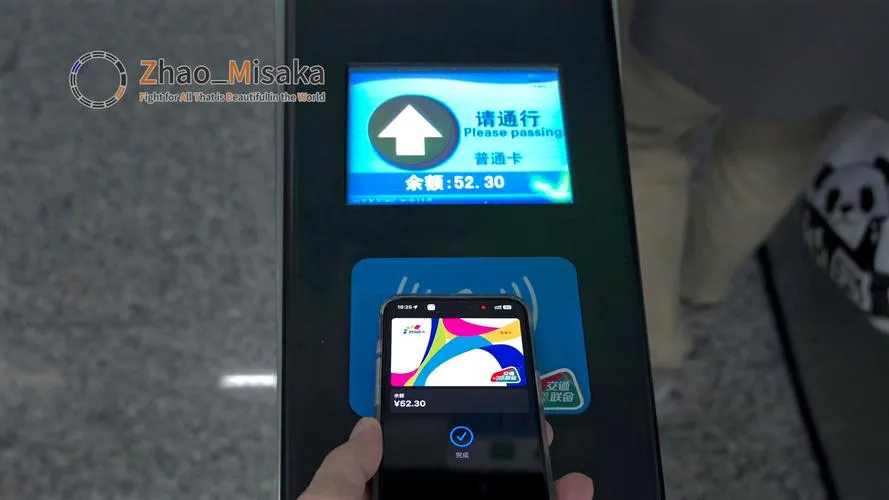 Tap a phone or UnionPay card at the gate — standalone foreign Visa/Master cards won’t work here.
Way 4: Bank cards / Apple Pay / phone tap (great for foreigners, 2024–2025 upgrades)
China’s transit payment used to be UnionPay-only, but 2024–2025 opened it up. Three paths:
Path A — UnionPay international / co-branded card, tap to enter (2025, easiest) From June 28, 2025, UnionPay’s “Jinxiu Action 2025” expanded flash-pay gate entry to the entire Shanghai metro network, covering 46 cities including Beijing, Shanghai, Guangzhou, Shenzhen. Holders of UnionPay international IC cards or UnionPay-Visa co-branded chip cards can tap straight through the gates.
Path B — Apple Pay express transit card (needs a Chinese UnionPay card to top up) Per Apple’s official guide, you add a Chinese transit card (e.g. Beijing Yikatong, Shanghai Transport Card) to Wallet on your iPhone or Apple Watch, set it as the express transit card, and tap the gate — no Face ID or unlock needed. But topping up requires a Chinese UnionPay debit/credit card, so the hurdle for foreigners is first obtaining a Chinese UnionPay card.
Path C — Foreign Visa/Master etc.: gates won’t read them, but POS machines will Apple Pay tied to a standalone foreign Visa/Master/Amex/JCB can’t tap the gates directly. But cities like Shanghai have POS machines at every station service center where you can swipe Visa, Mastercard, Discover, Amex, Diners Club, and JCB to buy single-journey / 1-day / 3-day tickets (handled by staff).
Bottom line: UnionPay/co-branded card → Path A tap; have a Chinese UnionPay card → Path B Apple Pay; only a foreign Visa/Master → Path C buy at POS, or go back to Way 2 and bind the foreign card in the Metro Metropolis app. These 2024–2025 upgrades are the core of this guide’s value — most English travel guides haven’t covered them yet.
Major-city subway cheat sheet
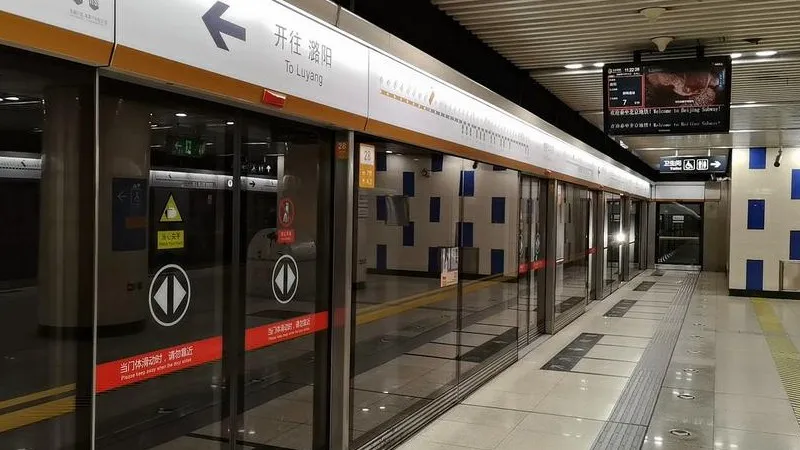
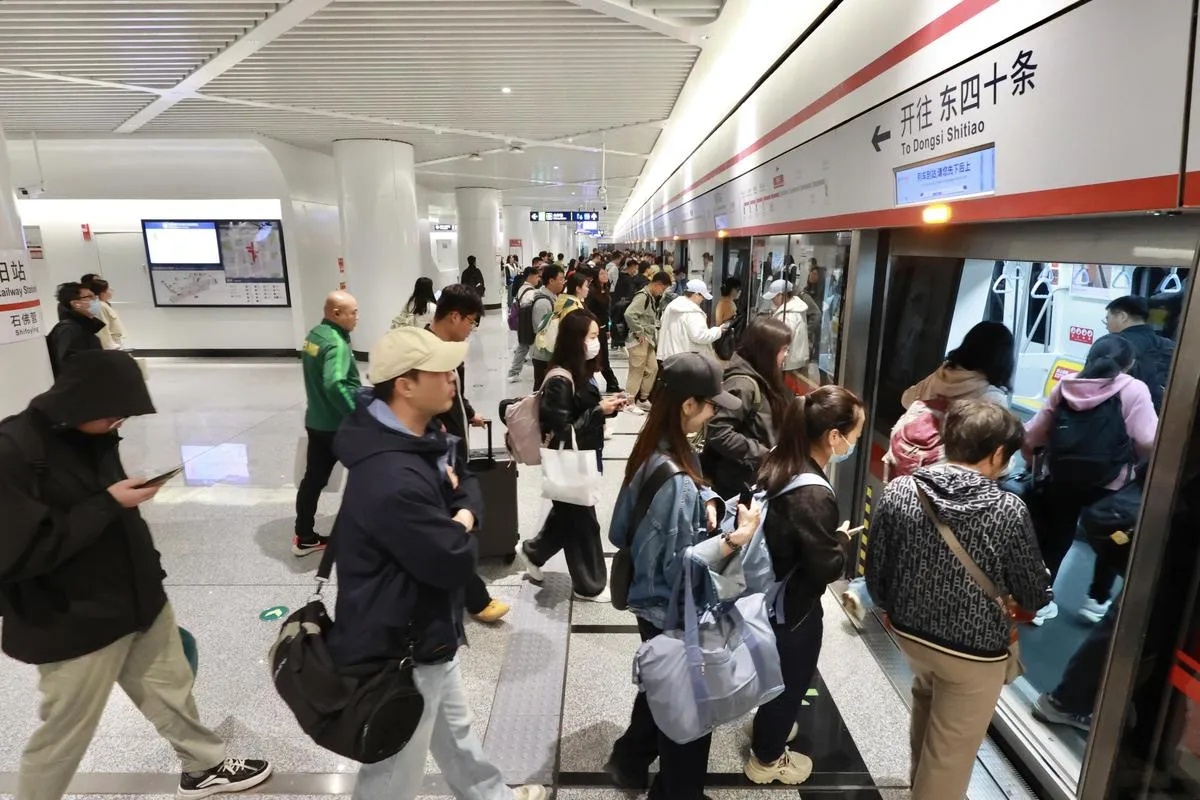 A busy subway platform — modern, clean, well-signed, and very crowded at rush hour.
| City | Official App | Starting fare (approx.) | Notes |
|---|---|---|---|
| Beijing | Beijing Subway (“Yitongxing” is the bus/Yikatong system, also works) | ~¥3 | Capital, densest network; reaches Forbidden City & Great Wall |
| Shanghai | Metro Metropolis (Metro大都会) | ~¥3 | One of the biggest; maglev to Pudong airport; UnionPay foreign cards tap-to-ride since 2025 |
| Guangzhou | Guangzhou Metro | ~¥2 | Greater Bay Area core; passport holders can activate transit code |
| Shenzhen | Shenzhen Metro | ~¥2 | Connects to Hong Kong crossings |
| Chengdu | Chengdu Metro | ~¥2 | Panda Base / Taikoo Li |
| Xi’an | Xi’an Metro | ~¥2 | Terracotta Warriors need a transfer |
| Hangzhou | Hangzhou Metro | ~¥2 | West Lake / Alibaba |
Note on fares & apps: Fares are distance-based, starting ¥2–4; line counts grow yearly — check each city’s official site for exact numbers. App names are stable. Other cities: Tianjin = Tianjin Metro, Wuhan = Wuhan Metro, Nanjing = Yu Ning Tong, Chongqing = Yu Chang Xing, Suzhou = Su e Xing.
Special tips for foreign visitors (the information gap)
- No Chinese phone number? → Use the ticket machine with cash (safest), or bring your passport to a counter for a transit card. (For a Chinese SIM/eSIM, see /blog/05-china-sim-card-vs-esim.)
- Can I register metro apps / activate the transit code with a passport? → Most city apps let you select “passport” as ID; Alipay/WeChat transit codes are open to foreigners (see Way 2); Guangzhou and others let passports activate gate codes directly.
- Does Apple Pay / my foreign card work? → See Way 4: UnionPay international/co-branded cards work (2025 new policy); standalone foreign Visa/Master don’t tap gates but work at POS.
- Easiest combo → Set up Alipay (passport-verified) for the transit code + keep some cash for the ticket machine — belt and suspenders.
- English signage/announcements → First-tier cities (Beijing/Shanghai/Guangzhou/Shenzhen) generally have bilingual station names + English announcements; lower-tier cities have weaker English coverage.
- Transfers → Follow the “换乘 / Transfer” signs inside the station; most same-station transfers don’t require exiting.
A complete ride, step by step
- Enter → security (bags on belt)
- Get a ticket: machine + cash for a token / scan QR / tap card / tap bank card
- Enter the gate: tap token / scan QR / tap card / tap card
- Find your platform direction (mind the train’s terminus — each line runs two ways, don’t board the wrong direction)
- Wait: let passengers off first, queue
- Board
- Transfer: follow Transfer signs
- Exit: drop token / scan QR / tap card / tap card at the gate
- Pick the right exit (A/B/C…) — check the neighborhood map for the nearest one
Practical tips
- Avoid rush hour: weekdays 7:30–9:00 and 17:30–19:00 are packed; shift your timing if you can
- Check the direction: each line has two termini — confirm the train’s direction before boarding
- Women-first cars: some cities (e.g. Shenzhen) designate women-priority cars at peak times
- No eating in cars: most cities ban eating/drinking (including water) in the cars; you may be stopped
- Queue & yield: let passengers off first, line up, offer seats to the elderly
- Watch the exit number: big stations have many exits (A1/A2/B…) — look up the nearest exit to your destination in advance to save lots of walking
- Luggage: wide gates fit large bags; high-speed-rail and airport stations are luggage-friendly
- Operating hours: most cities ~5:30–23:00, varies — after the last train, take DiDi (see /blog/06-how-to-use-didi-in-china)
- Toilets: usually on the platform level (look for signs)
A quick note on buses (harder for foreigners)
Compared to the subway, China’s buses are tougher for visitors: complex routes, little English announcement, unclear stops. If you must:
- Use a map app: Amap (高德) / Baidu Maps show live bus info and transfers (see /blog/04-what-apps-to-download-before-going-to-china)
- Payment: tap a transit card, or scan (Alipay/WeChat transit code, some accept UnionPay); older buses may take cash
- When to use buses: places the subway doesn’t reach, short hops, or when you want to see the street
- Long-distance / intercity: take high-speed rail (see /blog/02-how-to-buy-china-train-tickets), not buses
Visitor priority for city transport: subway > taxi (DiDi, see #06) > bus. Buses are a supplement.
Apps to download (internal links)
- Amap (高德) / Baidu Maps: subway routes, transfers, live info, exit numbers
- Each city’s official metro app: live lines, first/last trains (names in the table above)
- Alipay / WeChat: transit code (see /blog/01-how-to-set-up-alipay-in-china, WeChat Pay)
- MetroMan (地铁通): subway maps and transfer planning for 50+ Chinese cities
- DiDi: taxis after the subway closes (see #06)
The takeaway
China’s subway is the best option for getting around as a visitor: cheap, fast, clean, and safe. Master four things: ① No Chinese phone number? Buy a token with cash at the machine. ② Got Alipay (passport-verifiable)? Scan the transit code — foreigners can since 2024. ③ Have a UnionPay/co-branded card? Tap through gates in Shanghai and 45 other cities since 2025. ④ Don’t expect a standalone foreign Visa/Master Apple Pay to work at gates. Nail these four and you can navigate the underground of any big Chinese city with ease.