China Travel Scams & Tourist Traps — The Foreigner's Honest Guide (2026)
Let’s calibrate the tone before anything else: China is one of the safest countries in the world for travelers. Violent crime is rare, streets are well-lit and busy late into the night, and attacks on tourists are uncommon. What this guide covers is almost entirely a different thing — consumer traps that cost you money, not danger that costs your safety. The worst realistic outcome is that you overpay by a few hundred to a few thousand yuan, not that you get hurt.
The reason a guide like this exists at all is an information gap: these traps are things Chinese locals learn to spot from childhood, but visitors hit them because of the language barrier, cultural unfamiliarity, and the very real warmth of “friendly strangers.” This guide takes the anti-scam knowledge that’s common sense on the Chinese internet (Zhihu, Xiaohongshu, state-media exposés) and lays it out for foreign visitors. We report it honestly — neither exaggerating nor pretending it doesn’t exist.
And one piece of good news up front: the government has been cracking down hard on the worst of these for years (more on that in a moment), so the most blatant scams are far less common than they were a decade ago.
New here? For the broader safety picture (health, documents, the law), see our China Travel Safety Tips. This article focuses specifically on money-losing tourist traps.
Why foreigners get targeted
- The “friendly stranger” approach. The signature move is an overly warm stranger who approaches you — offering to practice English, chat about culture, or show you around for free. Chinese locals default to wariness toward street approaches; Western visitors often read the same behavior as friendliness.
- Language barrier. You can’t read the menu, the price list, or the meter — so you depend on whatever number the other person quotes.
- Politeness. Once you’ve been walked into a shop and the tea is poured, it feels rude not to pay.
- Unfamiliar payment apps. The amount is entered by someone else, and you scan without checking.
- “Official” disguises. Fake price lists, fake staff IDs, even buses painted to mimic real transit lines.
Rule of thumb. A stranger on the street who approaches you and speaks good English is usually just being friendly — don’t be paranoid. The one thing to watch is where they’re leading you: the moment they start steering you toward a tea house, art gallery, jade shop, KTV, or bar, it’s almost certainly a setup aimed at your wallet. Enjoy the chat, but don’t follow them inside.
The good news: a sustained government crackdown (2024–2026)
Before the specific scams, understand the backdrop: these traps are being policed aggressively, and they’re declining overall. It’s not “no one cares” — it’s “regulated tightly, and getting tighter.”
Three ministries, one national campaign. The Ministry of Culture and Tourism, the Ministry of Public Security, and the State Administration for Market Regulation work together on what they call full-chain governance — before, during, and after the trip. In April 2026 the culture ministry held a dedicated press conference to report progress on forced-shopping enforcement (CCTV, 2026-04-28).
The scale is real and measurable:
- 2024 market-order campaign: authorities inspected 133,000+ tourism businesses and handled 2,660 cases (ministry briefing, Dec 2024).
- Four target groups: travel agencies, tourism shops, tour guides, and online travel platforms — focusing on false advertising, “shopping-subsidized tours,” illegal subcontracting, and unlicensed operation.
- Public “typical case” naming and shaming (Dec 2024, Sept 2025 batch three, etc.): violators are named publicly to deter others.
- The “rating revocation” mechanism bites: enforcement results are tied directly to scenic-area quality ratings — “revoke the rating when warranted.” The three fake Terracotta Army sites near Xi’an, delisted in 2017, were an early example of exactly this.
- Named-and-shamed problem areas: Zhangjiajie, Lijiang Old Town, Guilin’s Li River, Shaolin Temple, Huangguoshu Falls, and overpriced scenic-area shuttle buses at several 5A sites have all been singled out for rectification.
Complaint channels are being upgraded too:
- A revised Tourism Complaint Handling Measures took effect March 15, 2026, sharply cutting processing times.
- A new model group-tour contract rolled out nationwide from March 31, 2026, tightening rules on shopping stops and paid add-on activities.
The takeaway for visitors: the “open rules” are steadily winning over the “hidden rules.” You might still run into an opportunistic trap (which is why the rest of this guide is worth reading), but heavy-handed forced shopping is now the exception, not the norm — and if something goes wrong, the complaint channels genuinely work.
Street approaches (most common, classic Beijing)
The tea-house scam (the “tea-shill”)
- How it works: Around Tiananmen Square, Wangfujing, the Forbidden City, and Nanluoguxiang, one to three well-dressed “women” or “students” with decent English approach you and chat about your country, culture, world affairs — seeming sincere and cultured. Once you’re comfortable, they invite you to “experience traditional tea ceremony” or “see a nearby hutong.” At the tea house, a “tea master” brews several rounds for you to taste, then encourages you to “pick a few teas to take home.” The bill runs to hundreds or thousands of yuan (tens to a few hundred US dollars, and in aggressive cases more). To seem natural, your “friend” even chips in part of the cost.
- Still active (verified 2025–2026): a March 2025 legal-rights guide still lists the “Nanluoguxiang overpriced tea” scam as a current Beijing scenario, and a “trade-show leftover tea” variant appeared in late 2025. The playbook is old, but there’s always a fresh wave of new visitors — so knowing it still matters.
- Variant: the opener may be “I want to practice my English” or “I’m an English major.”
- How to avoid: a street stranger inviting you to drink tea or watch a tea ceremony = walk away. To genuinely experience tea culture, go to a chain tea shop (Wuyutai, Zhang Yiyuan) or a proper teahouse with clearly marked prices.
 A proper teahouse — the genuine tea culture a street “tea ceremony” invite is imitating. The scam version ends in an astronomical bill.
The “art student” scam
- How it works: Near historic sites, metro exits, and busy corners, presentable “art students” invite you to a “free student exhibition.” They actually take you to a partner crafts/calligraphy shop and sell cheap work at several times the market price. The same items cost a fraction at Panjiayuan or Liulichang markets.
- How to avoid: any “free exhibition / student work” street pitch = a scam.
KTV / bar inflated bills (entertainment trap)
- How it works: A “new friend” or street tout takes you to a KTV or bar. After a few songs and beers, a woman orders brandy and a cart of “snacks and drinks” — none of it priced — and the final bill is astronomical. The essence is a bill trap (making you pay for consumption you never priced).
- How to avoid: don’t go to KTVs or bars recommended by strangers; go to legitimate chains with people you know, and check the drinks menu prices before ordering.
- Note: this type has become rarer in recent years thanks to enforcement and real-name rules. If a dispute does happen, pay the reasonable portion, ask for a receipt, keep your evidence, and file a 12315 complaint if needed — no need to panic.
Transport
Unlicensed taxis (airport / station touts)
- How it works: On arrival, someone approaches: “Taxi? Going?” These are unlicensed cars that charge far above the real fare, sometimes hiking the price mid-trip.
- How to avoid:
- Use the official airport taxi queue (signposted, staffed). Ignore drivers who approach you directly.
- Look for a legitimate license plate: in Beijing these start with 京B (Shanghai 沪B, etc. — the commercial-operating plate); uniform paint, roof light, and a meter.
- Insist on the meter, and ask for a printed receipt at the end (it shows distance, fare, and the company phone; unlicensed cars give a handwritten slip or nothing).
- Beijing airport to downtown by legitimate taxi (verified 2025 rates): Capital Airport ≈ ¥90–150 (depending on origin — East 3rd Ring ~¥90–110 + ¥10 toll, toward Beijing West Station ~¥120–150); Daxing Airport ≈ ¥140–200, and trips from the city to Daxing have a metered-price cap (central districts max ¥160, within South 3rd/4th Ring max ¥140, toll included) — a mechanism designed precisely to prevent astronomical fares. The return trip from the airport meters normally.
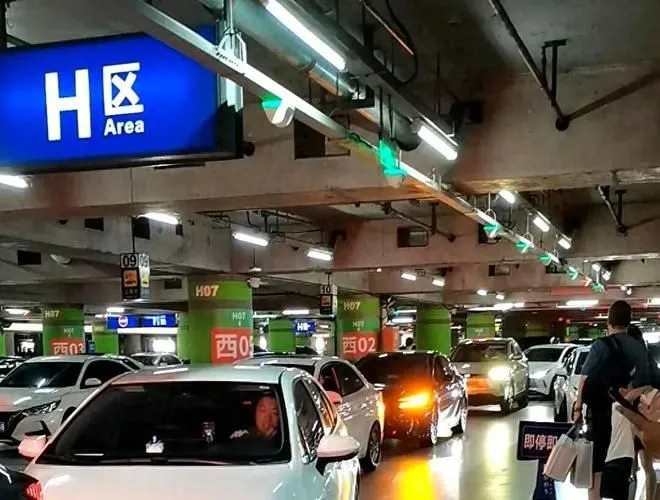 Use the signposted official taxi queue — and ignore drivers who walk up to you inside the terminal offering a ride.
Rickshaw / pedicab overcharging
- How it works: Near Beijing’s Forbidden City north gate, the Shichahai hutongs, and other hotspots, “pedicab hutong tours.” You agree on ¥40, and at the destination it becomes ¥400 — the driver plays dumb and produces a fake “official comprehensive price list” claiming ¥400 is the rate, exploiting your rush or politeness.
- How to avoid: Before getting in, agree the total price in writing (type it on your phone, screenshot, show the driver) or record video. Refuse “we’ll figure it out later” or “whatever.” Prefer licensed sightseeing pedicabs (company markings, can issue a receipt).
Legitimate taxi taking the long way
- How it works: Even a metered, licensed taxi, noticing you’re a visitor, takes a deliberately long route to run up the fare.
- How to avoid: Open a map app (Amap/百度 Maps) on your phone and let the driver see you tracking the route; check the receipt’s distance afterward.
Tours & sights
The cheap Great Wall day-tour shopping trap + fake Badaling
- How it works: “Low-price Great Wall day tours” (a few dozen yuan, including car, ticket, lunch) advertised on the street or slipped under hotel doors. Once on the bus: mid-trip price hikes, a detour to a fake “Badaling” (a minor section like Shuiguan before the real Badaling, or a privately built wall), and most of the day spent in jade / silk / herbal-medicine shops where the guide earns commissions.
- How to avoid: For the Wall, use official transport only — to Badaling take the suburban railway S2 line or bus 877; to Mutianyu take an official direct bus (e.g. Mubus). Buy tickets only through official Chinese channels. Any street/flyer cheap tour = a trap.
 The real Badaling — what a legit trip gets you. Cheap street tours instead bus you to a minor or fake section plus hours in shopping stops.
The fake Terracotta Army (Xi’an — well documented)
The real Terracotta Army is in Lintong, far from downtown Xi’an. This distance is what the scam exploits.
- How it works: Unlicensed drivers, “guide” touts, or a fake “Tour 5 (游5)” bus take you to one of three counterfeit sites: the World’s Eight Wonders Simulation Hall, the Qin Mausoleum Underground Palace Exhibition Hall, or the Hongmen Banquet Museum — filled with crudely made “double-eyelid, red-lipped” fake warrior models, charging admission as if they were the real museum.
- Current status (verified stable): Xi’an delisted all three in 2017 (revoking their 3A rating); after a 2018 cleanup they reopened with a required “man-made attraction” sign at the entrance. But the three venues still exist as attractions, and tout talk still steers unsuspecting visitors there (confirmed across multiple 2022 sources). The real site is the Emperor Qinshihuang’s Mausoleum Site Museum (official site bmy.com.cn, operating normally in 2026).
- How to avoid: The real Terracotta Army = Emperor Qinshihuang’s Mausoleum Site Museum. From Xi’an station take the real Tour 5 (Bus 5) — green livery, a conductor on board, “state-operated” markings — to the terminus; or an official direct bus. Look for the museum’s main entrance. If you’re being taken to an “Underground Palace” or “Eight Wonders Hall,” it’s fake.
- Want the full real-site rundown? See our Terracotta Warriors Guide.
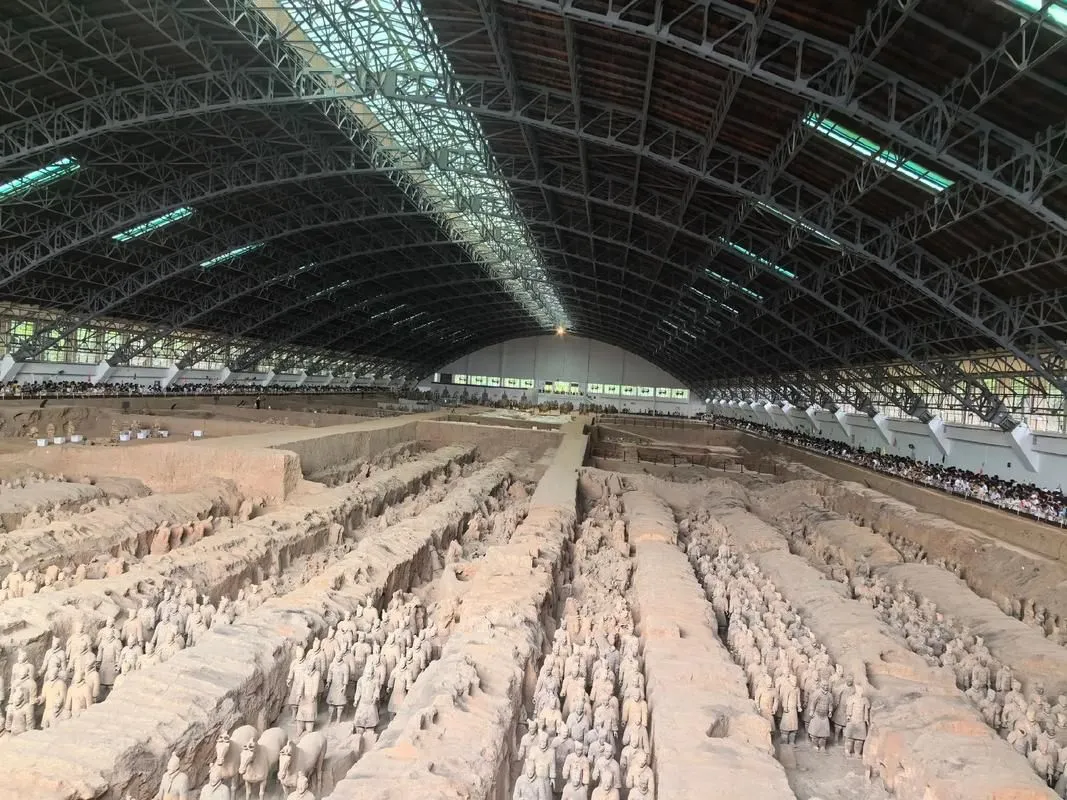 The genuine Terracotta Army at Emperor Qinshihuang’s Mausoleum Site Museum (bmy.com.cn). If a driver or “guide” steers you to an “Underground Palace” or “Eight Wonders Hall,” it’s a counterfeit.
Fake tickets / scalpers
- How it works: Outside popular sights — the Forbidden City, Terracotta Army, National Museum — scalpers sell “skip-the-line tickets” that are fake or overpriced resales; or you’re scammed buying through an unofficial mini-program or website.
- How to avoid: For every major sight, use the official reservation channel — the Forbidden City’s official account/site, the Terracotta Army’s official site, the National Museum’s official account. Book 5–7 days ahead. Don’t buy from door scalpers.
Shopping
Jade / jewelry / tea — the “my friend owns a shop” commission scam
- How it works: Your chatty “friend” (often continuing from the tea or art-student setup) says their family/relative/friend owns a jade, jewelry, or tea shop, and takes you for “insider prices.” The shop marks cheap jade or tea at thousands, your “friend” helps “negotiate” it down to one or two thousand — still a huge margin, with a fat kickback to the guide/tout.
- How to avoid: A stranger taking you to any “friend/family” shop = a scam. For jade and jewelry, go to large legitimate malls (with appraisal certificates and return policies); for tea, go to chain brand shops.
Antique-market fakes
- How it works: At Panjiayuan, Liulichang, and similar antique markets, “heirloom” or “excavated” pieces are all modern reproductions, with elaborate invented backstories.
- How to avoid: Buy them as souvenirs and haggle at craft prices (tens to a few hundred yuan) for fun — never as a real-antique investment.
By-weight / market-price traps (seafood, herbal medicine)
- How it works: Seafood stalls and some restaurants price by “market rate” or by weight (per jin / 500g, or per 50g). You point at a fish and say “this one”; the owner cooks it without quoting a total, and the bill is calculated at “wild leopard coral grouper ¥980/jin” into an astronomical figure. Traditional medicines work the same way (田七, dendrobium ground into powder on the spot, then you’re forced to buy).
- How to avoid: For seafood or market-price dishes, ask first: “How much per jin? How much does this one weigh? What’s the total?” — have the server write down the confirmed total before you nod. At any medicine stall with a “once ground/sliced, no returns” rule, just leave.
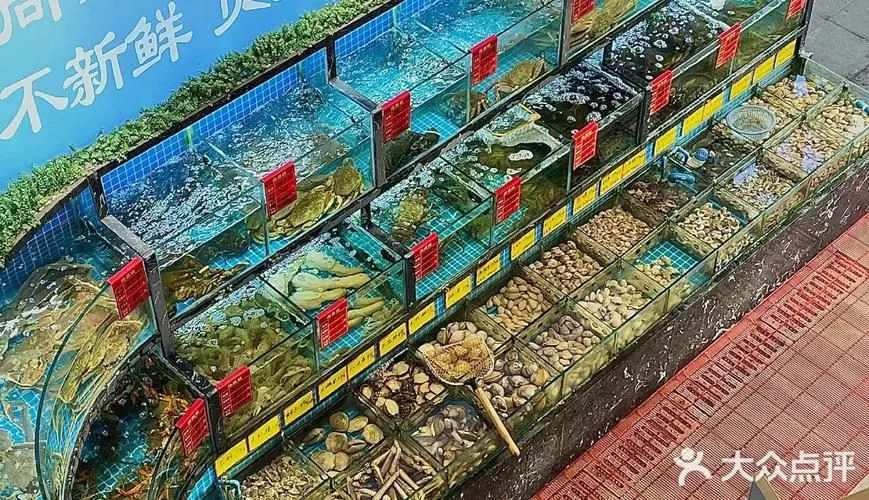 The classic setup: pick live seafood from the tank, they weigh it, then cook it. Always confirm the per-jin price and total before it heads to the kitchen.
Food & drink
Dual-language menu markup / substitution
- How it works: A few tourist-area or station restaurants charge different prices on the Chinese vs. English menu (the English one higher), or serve a short portion / swap a cheaper substitute for a roast duck or signature dish.
- How to avoid: Check the Chinese menu prices (use a translation app’s camera); pick highly-rated, well-reviewed spots on Dianping (大众点评); for roast duck and signature dishes, go to established names (Quanjude, Bianyifang, Da Dong — all clearly priced).
Change-making tricks
- How it works: When making change, deliberately dropping a coin, quietly swapping out a large bill, or repeatedly claiming “no change” to shortchange you. Night taxis sometimes try this with the interior light off.
- How to avoid: Mobile payment (Alipay/WeChat Pay) sidesteps most change issues; with cash, count it face-to-face, slowly and clearly.
Payment (especially for foreigners)
QR overcharging / double charges
- How it works: At market stalls and roaming vendors in tourist areas, the amount is set high before you scan, or “let me enter the amount for you” slips in an extra zero; sometimes the stall’s QR code itself has been swapped for the scammer’s.
- How to avoid:
- Check the amount and the payee name yourself before entering your PIN / confirming.
- Keep the payment receipt (screenshot) after paying — there’s a record to chase.
- Use Alipay/WeChat Pay (linked to your foreign card) so you can dispute; use less cash (no record).
Fake monks / “blessings”
- How it works: Near sights, people in monastic robes hand you a “talisman/gold card,” force a red string onto your wrist, or offer a “free blessing,” then demand a “donation” of hundreds or thousands.
- How to avoid: Don’t engage, don’t accept, don’t stop — shake your head and walk on. Real temples don’t pressure donations.
Other common ones
Street begging (much of it “professional”)
- Street beggars in big cities like Beijing — in underpasses and around sights — are a “professional begging” trade to a significant degree: per the Baidu Baike entry on “professional beggars,” tactics include faking illness, renting disabled children, and posing as students, with some operating in organized groups and earning more than ordinary jobs. (Note: the “85%” figure floating around some travel sites has no authoritative source, so we don’t repeat it.)
- How to avoid: Don’t give money. To genuinely help, donate to a legitimate relief agency (local civil-affairs救助 stations).
ATMs / credit cards (universal common sense, not China-specific)
- This is the same advice as in Paris, New York, or Bangkok: use ATMs inside bank branches, convenience stores, or malls; avoid isolated, sketchy machines; turn on card transaction alerts.
- In China, mobile payment (Alipay/WeChat Pay linked to a foreign card) is actually safer — there’s a transaction record and you can dispute, with less hassle than cash or cards.
Accommodation / day-tour touts
- “Cheap rooms” or “charter day-tours” pitched at stations and sight gates are often tied to unlicensed cars, shady lodgings, and shopping shops.
- How to avoid: Book hotels/guesthouses through legitimate platforms (Booking, Agoda, Trip.com); use official transport.
Eight golden rules
- Enjoy the warmth, but watch the direction. A street approach from an English-speaking stranger is usually genuine friendliness — Chinese people are genuinely hospitable. The single red line: are they quickly steering you toward a tea house, gallery, jade shop, KTV, or bar? If yes, it’s almost certainly a setup; if it’s just a chat or directions, accept it graciously.
- Agree prices up front, and keep evidence (phone screenshot / typed confirmation / video) — for pedicabs, taxis, and market-price dishes.
- Buy sight tickets only through official channels (official account / website / official ticket window). No scalpers, no “agents” at the gate.
- Use official transport to major sights (the real Tour 5 / official direct bus / suburban rail). Don’t book street- or flyer-advertised cheap tours.
- At restaurants, for market-price or seafood, ask first — “How much per jin? How much does this one weigh? What’s the total?” — and get it in writing before ordering.
- Enter the payment amount yourself and confirm before paying. Keep the payment screenshot. Be wary of “let me enter it for you.”
- In taxis, look for legitimate markings (local commercial plate like 京B + meter + printed receipt + navigation on).
- Learn to say no. Smile, say “No thanks, I don’t need it,” repeat three times, and walk away — don’t let politeness cost you. That’s exactly what Chinese locals do with scammers.
What to do if you get scammed
| Channel | Number / route | Use it for |
|---|---|---|
| Tourism complaint | 12345 government service hotline (24h; merged the former 12301 national tourism line at end-2021) | Rogue guides, fake sights, cheap-tour traps, scenic-area disputes — the most-used |
| Online complaint | National Culture & Tourism Market Complaint System jbts.mct.gov.cn | File tourism/culture-market complaints online, fully tracked |
| Consumer complaint | 12315 | Food/shopping price fraud, counterfeit goods, forced purchases |
| Foreigner / exit-entry | 12367 (24h) | Foreigner entry/visa questions; can also help direct you |
| Police | 110 | Safety-related emergencies (rarely needed — as noted, China is safe) |
Note: the 12301 tourism hotline was discontinued at end-2021 and folded into 12345 (confirmed by the culture ministry and a 2025-06 State Council General Office document). Just call 12345.
- If scammed via payment: dispute/complain that specific transaction in your Alipay/WeChat Pay record — the platform can intervene (works with a linked foreign card too). This is the most practical route to recover money.
- Keep evidence: receipts, payment screenshots, photos of the shop/plate, chat logs.
- Mindset: the overwhelming majority of cases are “I overpaid.” File a complaint, keep your evidence, and don’t panic. Only in the rare case of an actual safety threat do you need 110 plus your embassy.
Fact-checked 2026-06-23 against multiple Chinese-language sources, including the Ministry of Culture and Tourism’s 2026-04-28 joint press conference with the Ministry of Public Security and State Administration for Market Regulation (via CCTV), the ministry’s Dec-2024 enforcement briefing (133,000+ inspections, 2,660 cases), verified Beijing taxi pricing rules, and the official Qinshihuang Mausoleum Site Museum (bmy.com.cn). The scam playbooks are stable common knowledge; all variable figures (prices, hotline status, current activity) were verified before publishing.