Mid-Autumn Festival 2026: A Foreigner's Guide to China's Moon Festival (Sep 25–27)
The Mid-Autumn Festival (中秋节) is China’s harvest moon holiday, the night families gather, share mooncakes, and watch the year’s brightest full moon. In 2026 it falls on September 25 (Friday), and it stands apart from the National Day week that follows on October 1. The holiday runs three days, September 25 to 27, on its own.
That separation matters. Mid-Autumn is a reunion holiday, not a travel holiday. In 2024, the last standalone Mid-Autumn, domestic trips averaged about 35.7 million a day, roughly one-third of the daily volume during National Day. For a foreign visitor that means thinner crowds at the famous sites, normal hotel rates, and a rare window to see a Chinese festival built around family, food, and the moon rather than parades or peak-season tourism.
Quick answer: Mid-Autumn 2026 runs September 25 (Fri) – September 27 (Sun), three days, separate from National Day. It is a family reunion holiday, not a big-travel week; daily trips run about one-third of National Day’s. Eat mooncakes (look for the GB/T 19855 standard), try fresh Yangcheng Lake hairy crab (the season opens the same week), and watch the moon from a classic spot like West Lake. The 240-hour visa-free transit covers 57 countries for the full three days. Stack three days of leave (Sep 28–30) and you bridge straight into National Day for a 13-day trip. See our 240-hour transit guide and National Day 2026 guide.
How we verified this: SinoWander reads Chinese-language sources that English guides cannot, including the official State Council holiday notice, the GB/T 19855 national mooncake standard, Yangcheng Lake crab industry data, and National Immigration Administration visa policy. We cross-check them before writing. We have not personally visited every location. Each guide is date-stamped when last verified: 2026-08-06. See our methodology.
The 2026 Dates (and Why They’re Unusual)
China’s State Council sets the calendar a year ahead. For 2026 the official notice (国办发明电〔2025〕7号) places Mid-Autumn on September 25 (Friday) through September 27 (Sunday), three days with no makeup workday.
The 2026 gap is the unusual part. In 2025, Mid-Autumn landed inside the National Day week and the two merged into a single eight-day holiday. In 2026 they split: Mid-Autumn ends on Sunday September 27, then three ordinary workdays (September 28–30) sit before National Day begins on Thursday October 1.
That gap is an opportunity. Take September 28, 29, and 30 as paid leave and you string together a continuous 13-day window from September 25 to October 7, at the cost of working one Sunday (September 20). You get a standalone Mid-Autumn, the bridge days, and the full National Day week in one trip. Few foreign visitors think to plan this far ahead, which is exactly why it works.
What Mid-Autumn Actually Is
The festival lands on the 15th day of the eighth lunar month, the night of the brightest full moon of the lunar autumn. Its roots run back over three thousand years, to imperial moon-worship rites in the Zhou dynasty. The version families celebrate today took shape in the Tang and Song dynasties, when moon-gazing, poetry, and round pastries became the core rituals.
The legend everyone knows is Chang’e (嫦娥), the moon goddess. In the most common telling she drank an elixir of immortality, floated to the moon, and lives there still with a jade rabbit as her only companion. Families eat round food on this night, mooncakes chief among them, because the roundness stands for completeness and reunion. The Song-dynasty poet Su Shi (苏轼) is often quoted on the link between “small cakes that taste like the moon” and gathering under it.
Mooncakes: The National Standard and the Five Schools
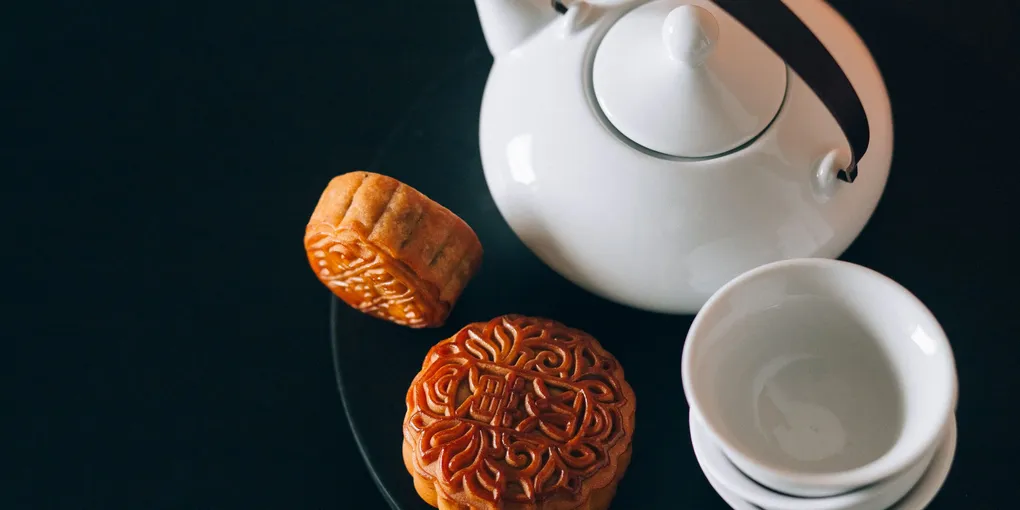
A mooncake is a small, dense pastry with a filling inside a thin crust, pressed in a mold that stamps a pattern on top. They are round (for family reunion) or rectangular, given as gifts, shared in wedges, and eaten with tea.
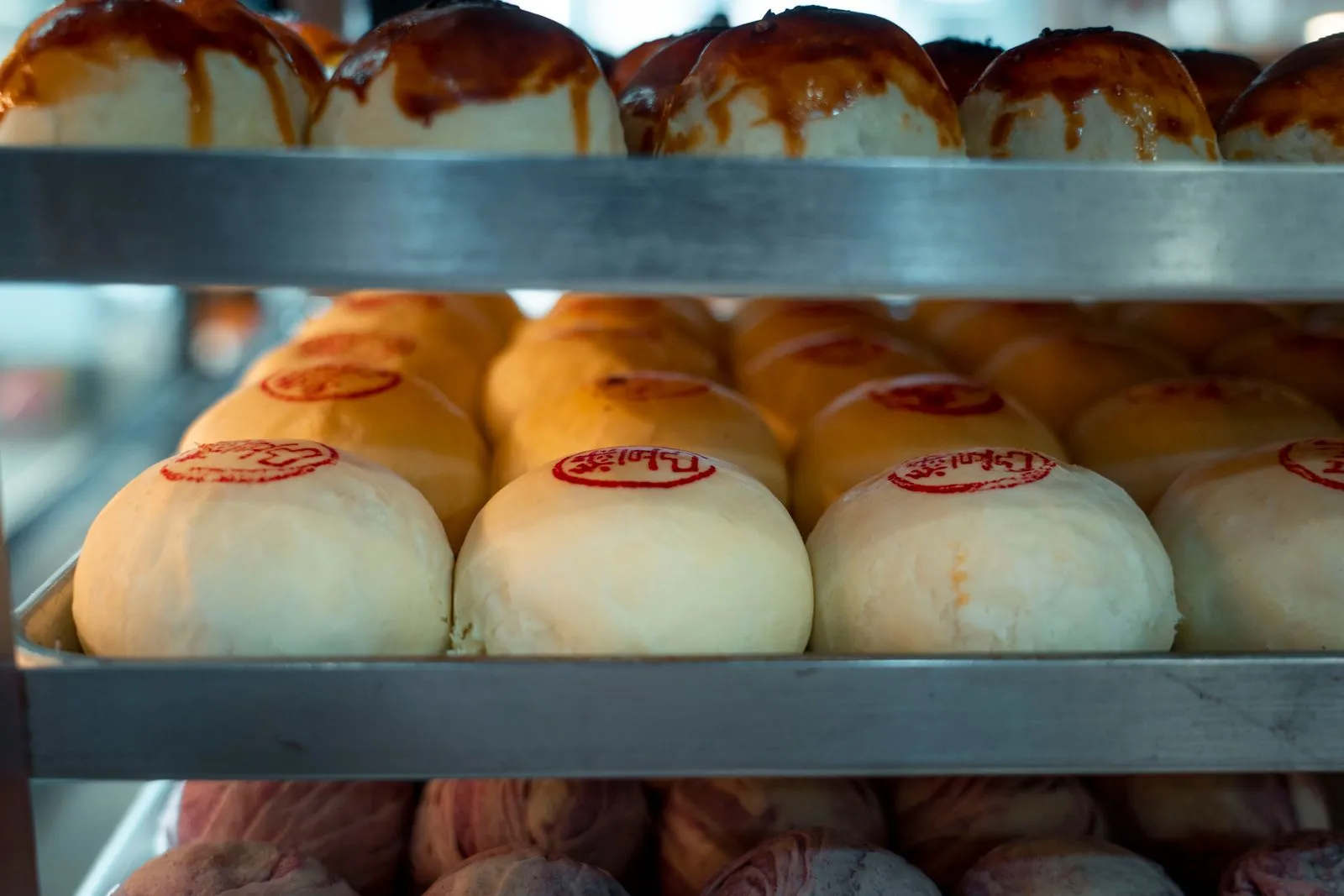 A traditional stamped mooncake, fresh off the bakery rack.
If you want to tell a good one from a bad one, look for the GB/T 19855 mark. That is China’s national mooncake standard, revised in 2023 and in force since April 2024. It sets rules for ingredients, fillings, and labeling, and it is the cleanest shorthand for “this is a real mooncake, not a cheap gift-box filler.” Planning to carry mooncakes home? Several countries restrict egg-yolk and meat fillings at customs; our customs declaration guide covers what you can bring back.
There are five main regional schools, each with a distinct style:
| School | Origin | Character |
|---|---|---|
| Cantonese (广式) | Guangdong | The most common worldwide; thin crust, rich lotus-seed paste, salted egg yolk |
| Suzhou (苏式) | Jiangsu | Flaky, lamination-style crust; savory pork or sweet date fillings |
| Beijing (京式) | Beijing | Less sweet; “self-rising” crust, sesame, walnut, red bean |
| Yunnan (滇式) | Yunnan | Ham-filled (云腿), a savory-sweet specialty |
| Chaozhou (潮式) | Guangdong Chaozhou | Crisp lard crust, often mung bean or black sesame |
The “five kernel” (五仁, wǔrén) mooncake is the most divisive variety in China. Internet memes have spent a decade calling it inedible. It is a dense mix of five nuts and candied fruit with a devoted traditional following, and it is not for everyone. Try one if you find it; do not believe the meme before you do.
The Food Beyond Mooncakes: Crab, Osmanthus, and Regional Feasts
Mooncakes are the symbol, but the Mid-Autumn table carries a great deal more. This is where a food-focused traveler wins.
Hairy crab (大闸蟹) is the season’s prize.
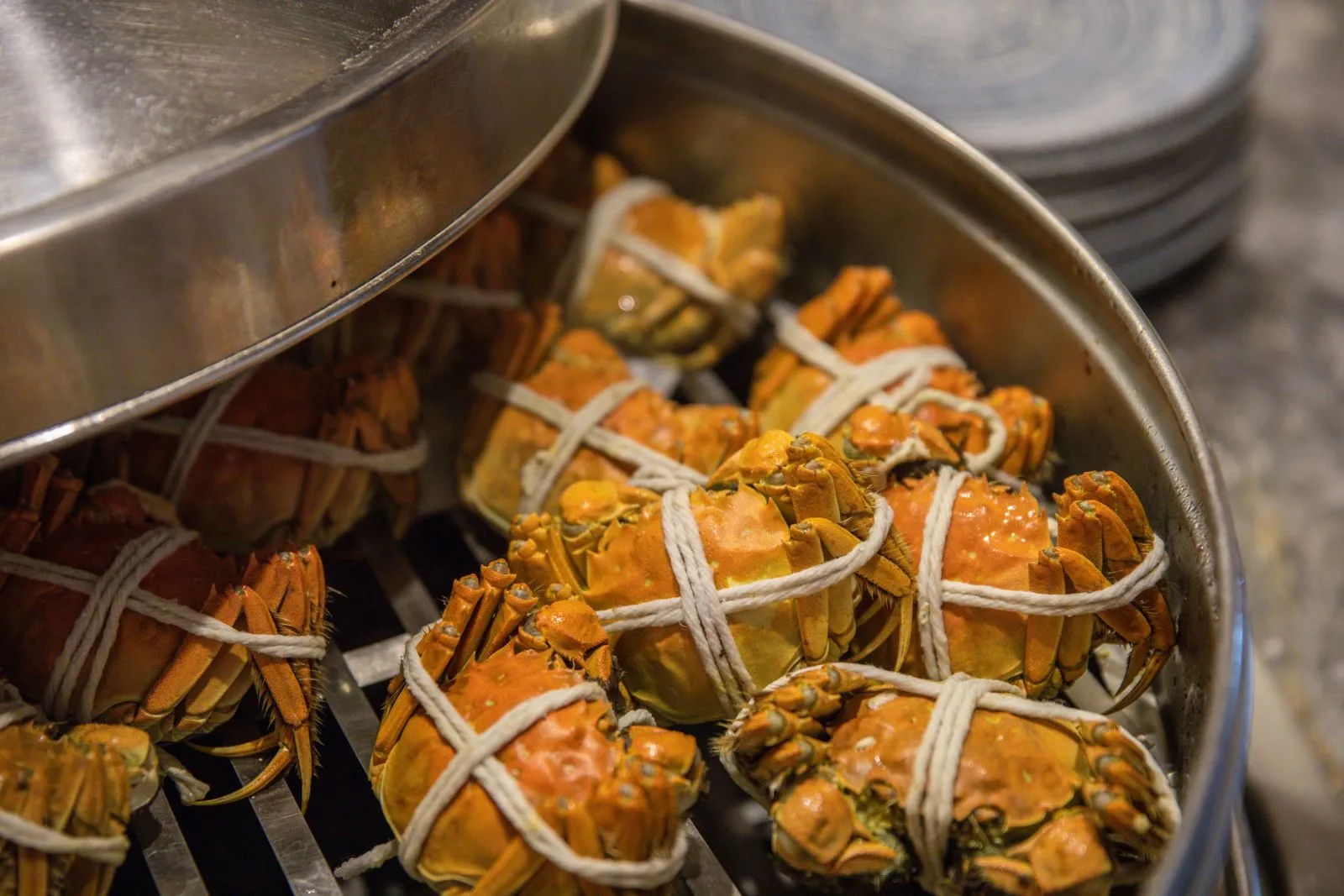 Steamed freshwater crabs, served the way Mid-Autumn tables do. Check the ring tag for a genuine Yangcheng Lake crab.
These freshwater crabs from Yangcheng Lake and nearby waters mature in early autumn, and the opening of the Yangcheng Lake season falls in the last week of September, the same window as the 2026 Mid-Autumn. The picking rule the locals use is “nine-female, ten-male” (九雌十雄): in the ninth lunar month (around late September into October) the female crabs are full of golden roe, and after that the males are full of creamy milt. So a Mid-Autumn visit lands you right in the female-crab sweet spot.
Real Yangcheng Lake crab is scarce. Official 2025 production was about 10,350 tons, and roughly 85 percent of that is pond-farmed under the Yangcheng brand rather than net-caught in the lake itself. Counterfeits are everywhere. The “bathing crab” (洗澡蟹) trick takes cheaper crabs from other lakes, soaks them briefly in Yangcheng water (or, worse, washes them with chemicals) to fake the clean blue-shell look, and sells them at the premium price. The most reliable check is the anti-counterfeit ring tag on each genuine crab’s leg, with a one-time scan code. When in doubt, buy from Taihu or Guchenghu lakes instead. They taste close to the same and cost a fraction of the price.
Osmanthus arrives at the same time. The sweet osmanthus trees (桂花) bloom in September and October, and their scent hangs over southern Chinese cities through Mid-Autumn. Cooks fold the flowers into osmanthus wine (桂花酒, a mild yellow liquor of 15 to 20 percent), osmanthus cake (桂花糕), and osmanthus-syrup taro (桂花糖芋苗). The moon and the osmanthus are paired in Chinese poetry so often that the two are hard to separate at this time of year.
A few more seasonal items round out the table. Pomelo (柚子) is eaten for its roundness and for the pun, “youzi” sounding like “to bless the children.” Pomegranate seeds stand for fertility. River snails (田螺) are a traditional Mid-Autumn dish, said to be at their best and good for the eyes. In the Minnan region of southern Fujian, the festival is unthinkable without Bobing (博饼), a dice game played for mooncakes and gifts that is listed as a national intangible cultural heritage; it is one of the few Mid-Autumn traditions a visitor can take part in.
Where to Watch the Moon
Classic Chinese moon-viewing spots pair water with an open horizon.
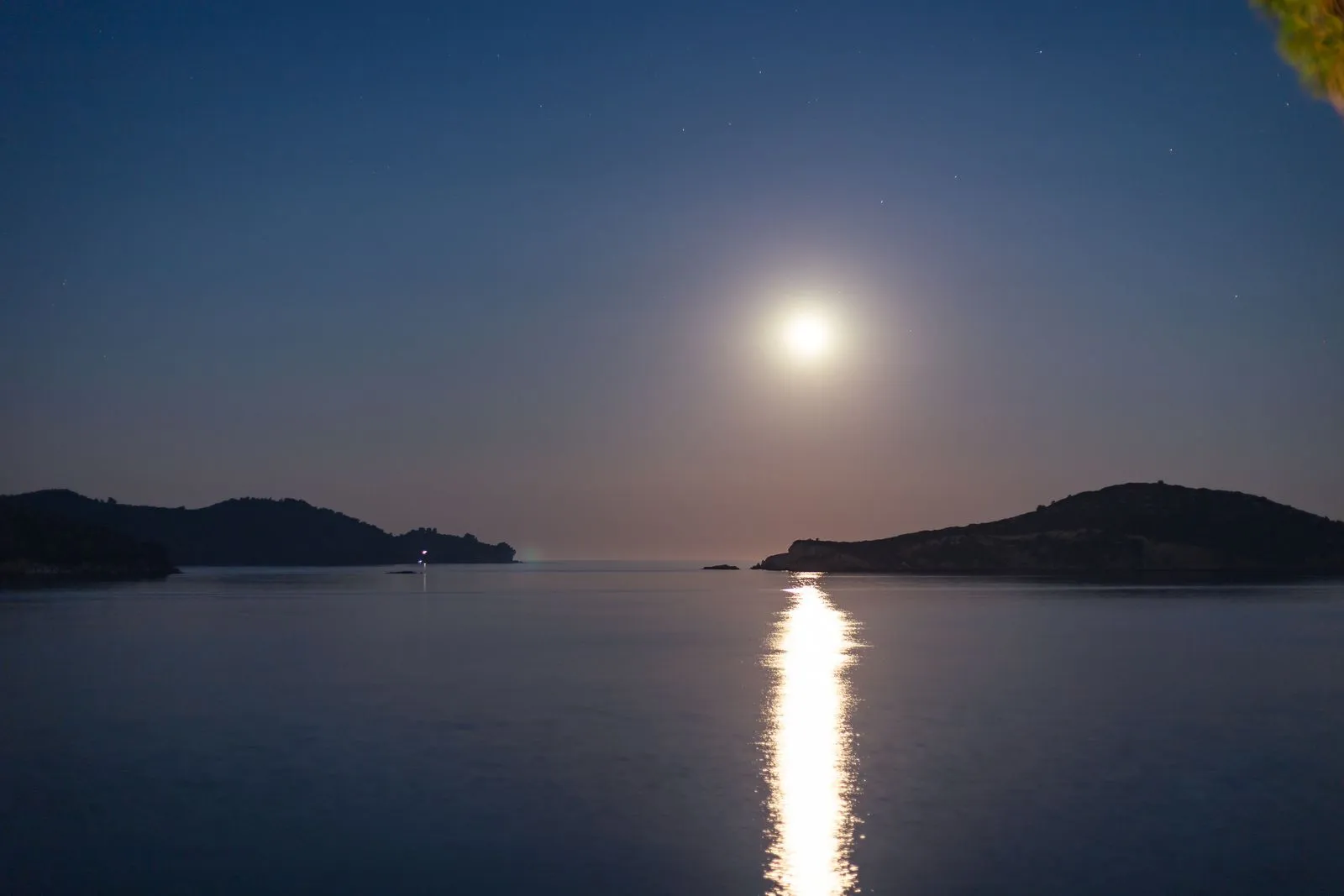 A full moon on still water, the classic Mid-Autumn view.
Four stand out, all reachable under the 240-hour transit policy:
- West Lake, Hangzhou: “Calm Lake Autumn Moon” (平湖秋月) and “Three Pools Mirroring the Moon” (三潭印月) are two of the lake’s ten named scenes. The West Lake is a UNESCO site, and its causeways, pavilions, and lotus ponds were built around the kind of moonlit night poets wrote about. The lake is a short bullet-train hop from Shanghai.
- Marco Polo Bridge, Beijing: “Moon at the Marco Polo Bridge at Dawn” (卢沟晓月) is one of the eight classic scenes of old Beijing. It is in the city’s southwest, reachable by metro and a short walk, and away from the National Day crowds at Tiananmen.
- Erhai Lake, Dali: In Yunnan, “Erhai Moon” is one of the “wind, flower, snow, moon” four scenes of the Dali region. The high-altitude lake reflects the moon against the Cangshan range.
- Emei Mountain, Sichuan: “Autumn Moon at Emei” is another classic pairing; the mountain’s temples host moon-viewing through the autumn fog.
For most foreign visitors, Hangzhou’s West Lake is the easiest combination of strong scenery, good transport, and English-friendly infrastructure.
240-Hour Visa-Free Transit
The 240-hour transit policy covers 57 countries entering from any of 65 designated ports across 24 provinces, for a stay of up to ten days. The full list of countries and ports is in our 240-hour transit guide and the 2026 visa-free countries list.
For a standalone Mid-Autumn visit, ten days comfortably covers the three-day holiday plus a few days on either side. For the 13-day stack, the 240-hour window is too short on its own (it runs ten days from the day after entry), but the 30-day unilateral visa-free entry for qualifying countries, or a regular L tourist visa, covers the full bridge.
Mid-Autumn vs National Day vs Spring Festival
Foreign visitors often lump the three together as “Chinese holidays.” They differ in ways that change a trip:
| Mid-Autumn | National Day | Spring Festival | |
|---|---|---|---|
| Length 2026 | 3 days (Sep 25–27) | 7 days (Oct 1–7) | 7 days (Feb–Mar) |
| Character | Family reunion, food | Travel, parades, peak crowds | Family reunion, closures |
| Daily trips | ~35.7 million | ~111 million | ~85 million |
| Weather | Early autumn, mild | Early autumn, mild | Winter, cold |
| Shops open? | Yes | Yes | Many small shops close |
Mid-Autumn is the quietest of the three, the most food-focused, and the only one where you can taste the season (crab, osmanthus, pomelo) rather than fight a crowd for it. Spring Festival and National Day are bigger, busier, and more famous, but for a foreign traveler who can take three days, Mid-Autumn is the gentlest entry into how Chinese families celebrate. For the other two, see our Spring Festival 2027 guide and National Day 2026 guide.
The Verdict
If you want to see a Chinese festival the way Chinese families live it, come for Mid-Autumn. The 2026 dates fall alone, before the National Day crush; the crowds are a third of what they will be a week later; and the food is at its seasonal peak. Eat a GB/T 19855 mooncake, try a fresh hairy crab (and check the ring tag), find a moon-viewing spot, and if you can take three days of leave, turn it into a thirteen-day China trip. Mid-Autumn is the festival most foreign visitors skip, and one of the easiest to enjoy once you arrive.
Sources & Verification
This guide was last verified on 2026-08-06. Key Chinese-language sources:
- State Council holiday notice (国务院办公厅, gov.cn): Sets the official 2026 Mid-Autumn dates of September 25 to 27 via notice 国办发明电〔2025〕7号, the source for the dates section.
- GB/T 19855 (national mooncake standard): The 2023-revised national standard for mooncake ingredients, fillings, and labeling, the quality mark referenced in the Mooncakes section.
- Yangcheng Lake crab industry (阳澄湖大闸蟹) official data: The 2025 production figure of roughly 10,350 tons and the anti-counterfeit ring-tag system described in the crab section.
- National Immigration Administration (国家移民管理局) visa policy: The 240-hour transit rules covering 57 countries and 65 ports across 24 provinces, referenced in the visa section.
See our full verification methodology.
Related Articles
- National Day Golden Week 2026: The holiday that follows a week later
- 240-Hour Visa-Free Transit China: Full rules and country list
- China Visa-Free Countries 2026: Who can enter without a visa
- Chinese New Year 2027 China Guide: The reunion holiday in winter
- How Foreigners Book Hotels in China: Booking for the festival dates
- China High-Speed Rail Guide: Reaching Hangzhou or Beijing for the moon