National Day Golden Week 2026: A Foreigner's Guide to Visiting China (Oct 1–7)
Every October 1, China marks its National Day, and the seven-day holiday that follows becomes the largest annual movement of people on the planet. In 2025, the Ministry of Culture and Tourism recorded 888 million domestic trips in eight days. Trains sell out, Forbidden City tickets vanish in minutes, and half the English travel advice on the internet boils down to four words: avoid Golden Week.
That advice is half right. The crowds are real. But for a foreign visitor with the right dates, the right visa setup, and a few counter-programming tactics, early October is also the best weather window of the year, the moment when 240-hour visa-free transit covers the entire holiday, and your only real chance to watch the flag-raising on Tiananmen Square. Read on for the dates, the real crowd picture, and how to time a visit around the bottlenecks.
Quick answer: National Day 2026 runs October 1 (Thu) to October 7 (Wed), with Mid-Autumn a separate holiday September 25–27. The 240-hour visa-free transit covers 55 countries and spans the full week. Prices rise only modestly (airfare about +10.8%, not double). Foreigners can attend the Tiananmen flag-raising with a passport and a reservation. Come for peak atmosphere and autumn color; stay away only if you cannot tolerate crowds. See our 240-hour transit guide and the 2026 visa-free countries list.
The 2026 Holiday Dates (and a Quirk)
China’s State Council sets the holiday calendar about a year in advance. For 2026 the official notice lays out:
| Holiday | Dates | Days | Makeup workdays |
|---|---|---|---|
| Mid-Autumn Festival | Sep 25 (Fri) – Sep 27 (Sun) | 3 | None |
| National Day | Oct 1 (Thu) – Oct 7 (Wed) | 7 | Sep 20 (Sun), Oct 10 (Sat) |
The quirk that matters for 2026: the two holidays fall separately. In 2025, Mid-Autumn landed inside the National Day week, producing a single eight-day super-holiday, which is why the 888-million-trip figure covers eight days rather than seven. In 2026 they sit six days apart, with Sep 28–30 as ordinary workdays in between.
That gap is an opportunity. Take three days of paid leave on Sep 28, 29, and 30, and you string together a continuous 13-day window from Sep 25 to Oct 7, at the cost of working one Sunday (Sep 20). The State Council itself nudges employers and individuals to form longer holidays through paid-leave arrangements. For a foreign visitor already flying long-haul, those three bridge days buy you both Mid-Autumn and National Day without changing your flight.
The two makeup workdays (Sep 20 and Oct 10) are normal working Saturdays and Sundays in China, so banks, offices, and some attractions run on a weekday schedule.
How Big Is Golden Week, Really?
The headline number everyone quotes is enormous. It helps to know what it measures.
In 2025, the Ministry of Culture and Tourism counted 888 million domestic trips over the eight-day combined holiday, up 123 million from the seven-day 2024 holiday, with total spending of 809 billion yuan (about $114 billion). Reuters, CNBC, Caixin, and Xinhua all reported the same figures.
A second number floats around online: 2.43 billion “person-trips.” This is a different measure. It counts every cross-region movement, including daily commuting and business travel, not tourism alone. English guides mistake one for the other and describe Golden Week as “2.4 billion tourists,” which overstates the tourist count by nearly three times.
There is a catch the headlines skip. Both Caixin and CNBC noted that while trip volume and total spending rose, spending per trip fell. Domestic travel is booming, but travelers are spending more carefully. For a foreign visitor this mostly means fuller trains and attractions, not higher prices.
The Crowds: Truth vs. Myth
The crowd concern is legitimate, but more managed than the internet suggests.
At the top attractions, expect peak density. The Forbidden City, the Great Wall (especially Badaling), West Lake in Hangzhou, the Bund in Shanghai, and the Terracotta Army in Xi’an all run at or near their daily visitor caps during the first three days of the holiday. Each operates a mandatory reservation system with a hard daily ceiling. The Forbidden City releases tickets seven days ahead at 8:00 pm Beijing time through its English booking portal (bookingticket.dpm.org.cn); the Terracotta Army takes reservations through bmy.com.cn. Same-day walk-up entry is near impossible at these sites in early October.
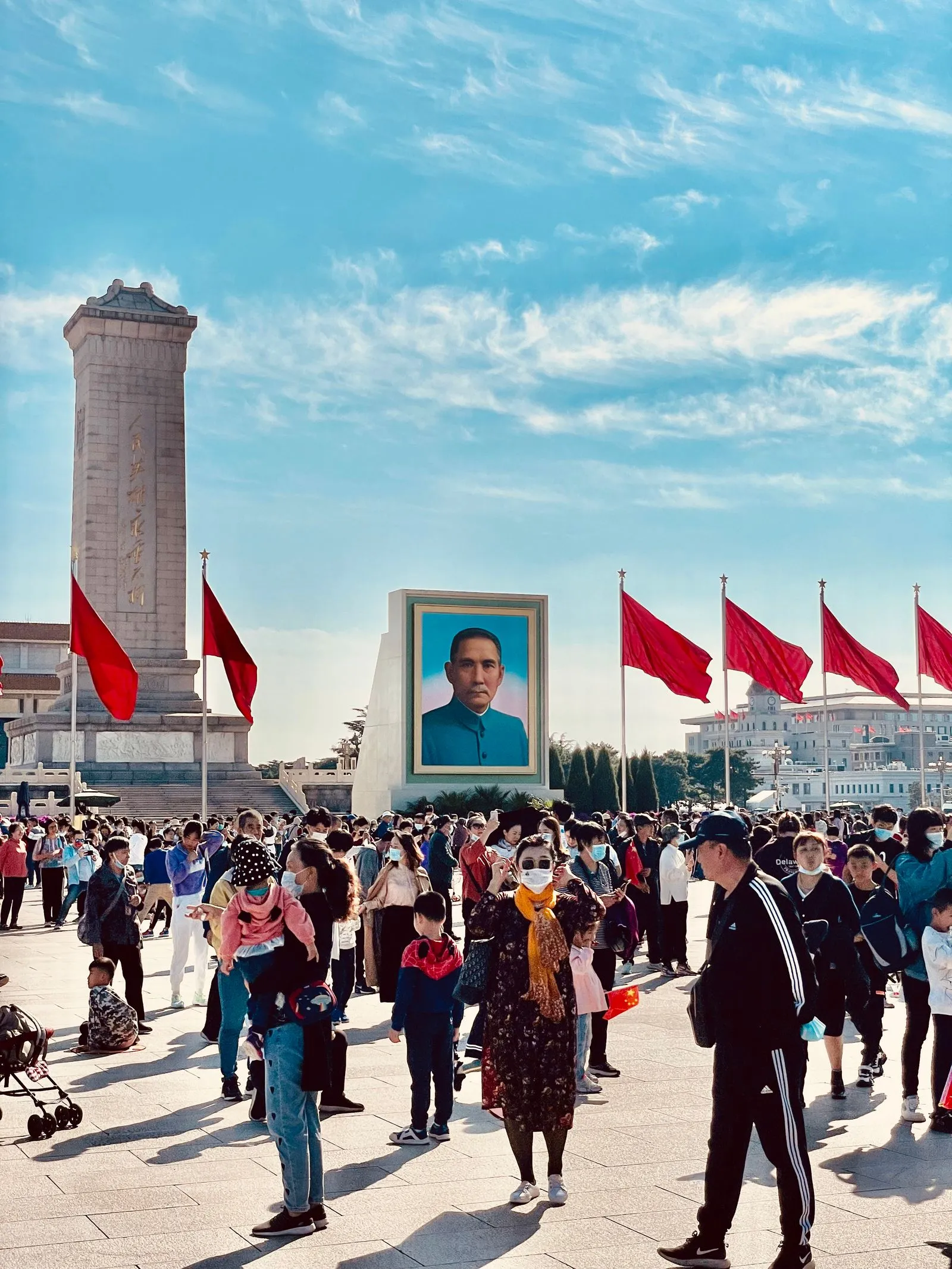 A flagship Beijing sight on a National Day morning. Dense, but bounded by daily reservation caps.
Two points temper the “packed to the point of immobility” myth. First, the reservation caps bound the worst-case crowding. You will be in a dense crowd, but not a dangerous one. Second, the crush is uneven across the week and the country. The first three days (Oct 1–3) carry the heaviest load at flagship sites; the back half thins out as travelers head home. Outside the top-20 names, much of China is busy, not gridlocked.
If your heart is set on the Forbidden City or Badaling, book the moment reservations open and prefer Oct 4–7 over Oct 1–3. Flexible on dates? The next section explains how to sidestep the crowds almost entirely.
240-Hour Visa-Free Transit Covers the Whole Week
For 55 countries, China’s 240-hour visa-free transit policy lines up neatly with National Day. That ten-day window, effective since December 2024, lets eligible travelers enter China without a visa from any of 65 designated ports across 24 provinces, provided they are transiting to a third country.
The eligible list covers 40 European countries, 6 in the Americas (including the US and Canada), 2 in Oceania (Australia and New Zealand), and 7 in Asia (including Japan, South Korea, and Singapore). Indonesia joined on June 12, 2025, and five Guangdong ports joined on November 5, 2025, bringing the totals to the current 55 countries and 65 ports. Many older English guides still list “54 countries / 60 ports” and are out of date.
For National Day, the timing works cleanly. A traveler entering on September 28 can stay through October 7, covering the entire holiday. The 240 hours count from 0:00 on the day after entry, not from the moment your passport is stamped. So an October 1 arrival gives you through October 11, and the arrival day itself is bonus time.
Two provinces have sub-limits. In Shanxi you can transit through Taiyuan and Datong only, and in Jiangxi through Nanchang and Jingdezhen only. The other 22 provinces allow travel across the whole province, which is what makes the reverse-tourism options below reachable.
Full rules, the country list, and the port list sit in our dedicated 240-hour transit guide and the 2026 visa-free countries list.
The Price Truth: Not 2–3×
The most repeated Golden Week warning in English forums is that hotels and flights double or triple. The 2025 data says otherwise.
Meituan reported average domestic airfare of 613 yuan, up 10.8% year-on-year. Ctrip’s average hotel rate over the peak moved little, up about 1.8%. High-end hotel revenue per available room in tier-one cities rose 10–20%. These are real increases, but nothing like “double or triple.”
The largest spikes cluster in specific places: the Greater Bay Area and eastern Guangdong (Macau, Shantou, Chaozhou, where some rates hit 5×), Sanya on Hainan, and the luxury tier in Hangzhou around West Lake. Tier-one business cities (Beijing, Shanghai, Chengdu) saw modest moves.
The surge was in booking volume, not in price. Order counts rose over 120%, and charter-car demand rose 115%. The real problem for travelers is availability: everything sells out. Prices only rise modestly. Book early, and you pay roughly what you would in any busy season.
For booking specifics, see our guide to booking hotels as a foreigner.
How to Avoid the Crowds: Reverse Tourism
If the flagship sites sound unappealing at peak, two tactics open up much quieter alternatives.
The first is timing. Booking data from travel platforms shows a predictable pattern. The first wave of travelers departs Sep 28–Oct 1, the second wave Oct 3–5. The thin window is October 2–3, when the first wave has reached its destinations and the second has yet to leave. Trains, domestic flights, and top attractions are less crowded on those two days.
The second is destination. A growing “reverse tourism” trend sends younger Chinese travelers away from the famous names toward small cities marketed for being uncrowded. An English-language feature from The World of Chinese in October 2025 highlighted five offbeat National Day escapes: Huludao in Liaoning, Wuhai in Inner Mongolia, Xuchang in Henan, Fuzhou in Jiangxi, and Dongfang on Hainan.
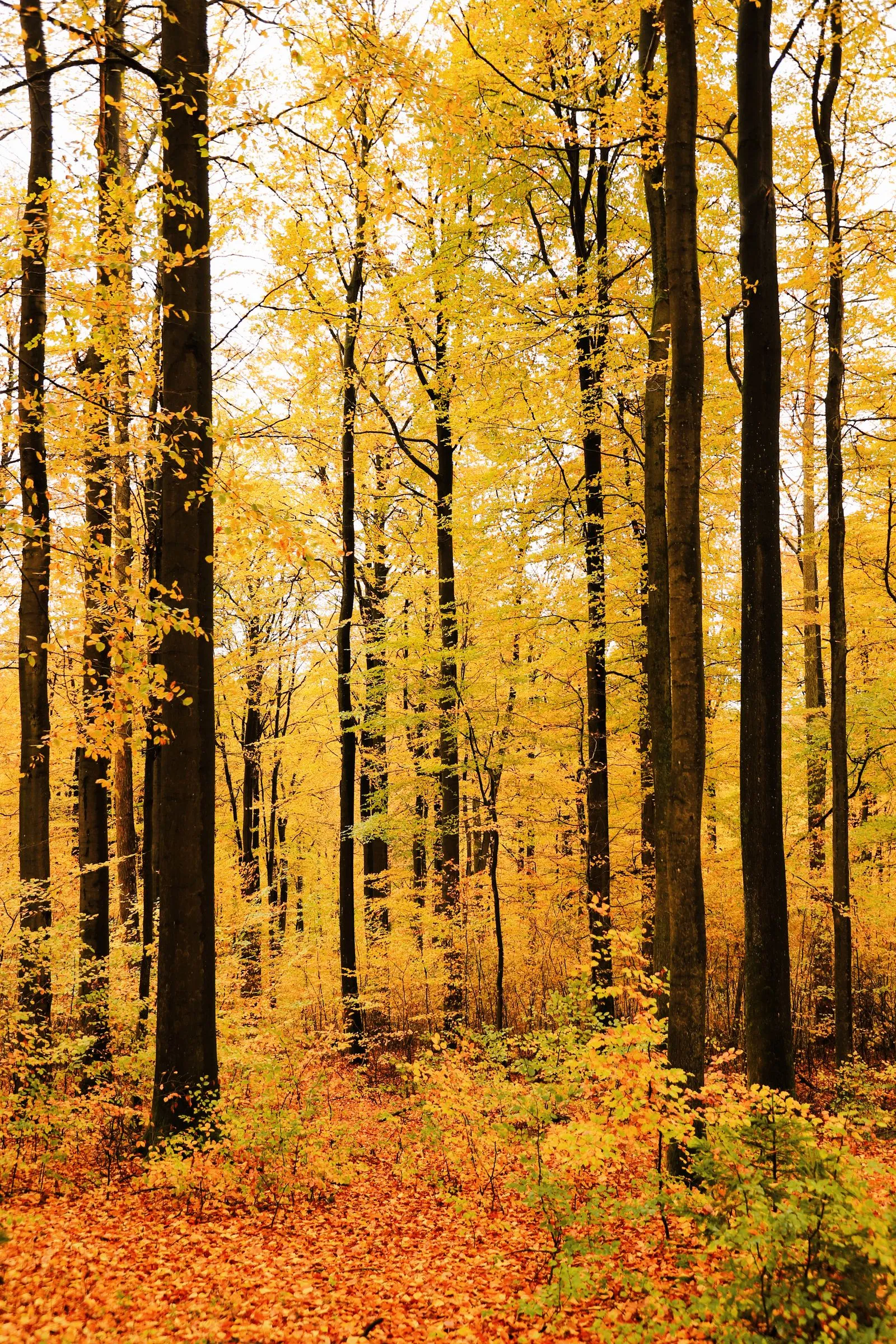 Autumn color in China’s northeast forests, peaking in early October. Go north instead of to the famous names and you share it with few people.
Two natural picks for autumn scenery, both reachable under 240-hour transit. Yichun in Heilongjiang offers forest and “five-color mountain” fall foliage; fly into Harbin and connect. Weiyuan in Sichuan holds the largest dome-geology region in China, about two hours from Chengdu. Both sit well off the foreign-tourist map and have thin English infrastructure, so they suit travelers who do not mind handling logistics themselves.
National Day vs. Spring Festival
Foreign visitors often assume Spring Festival is the bigger, more important holiday, so National Day must be the lighter alternative. The numbers say otherwise: National Day produced 888 million domestic trips in 2025 against about 596 million over Spring Festival.
For a visitor, National Day has three structural advantages. The weather in October is the best of the year across most of China, mild and dry, versus winter cold in January and February. Shops, restaurants, and attractions stay open, because Golden Week is when merchants make money, while many small businesses close for the first days of Spring Festival. And National Day is when you can see the flag-raising and the square decorations in Beijing.
For how Spring Festival compares in detail, see our Chinese New Year 2027 guide.
Can Foreigners See the Flag-Raising?
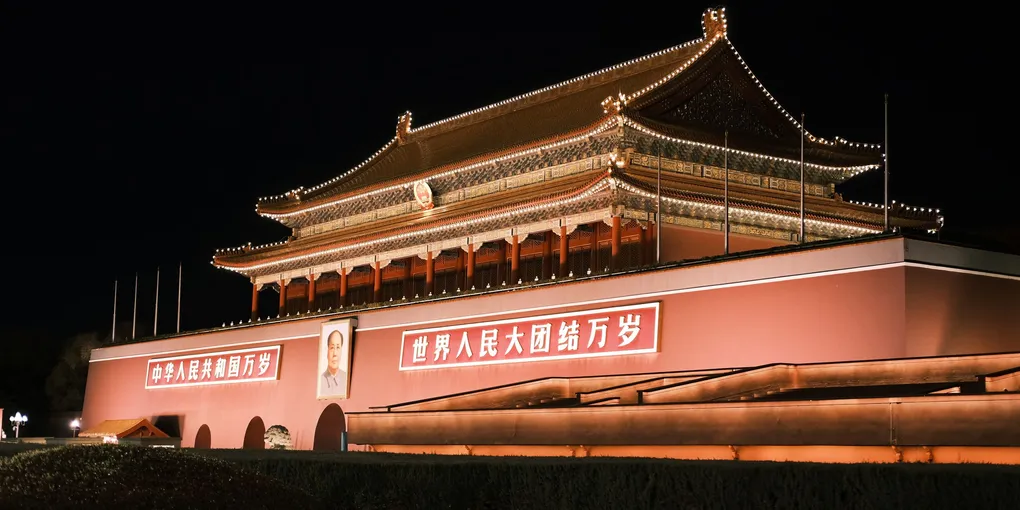
The National Day flag-raising on Tiananmen Square is one of the few Beijing experiences that only happens meaningfully on October 1, and foreigners can attend.
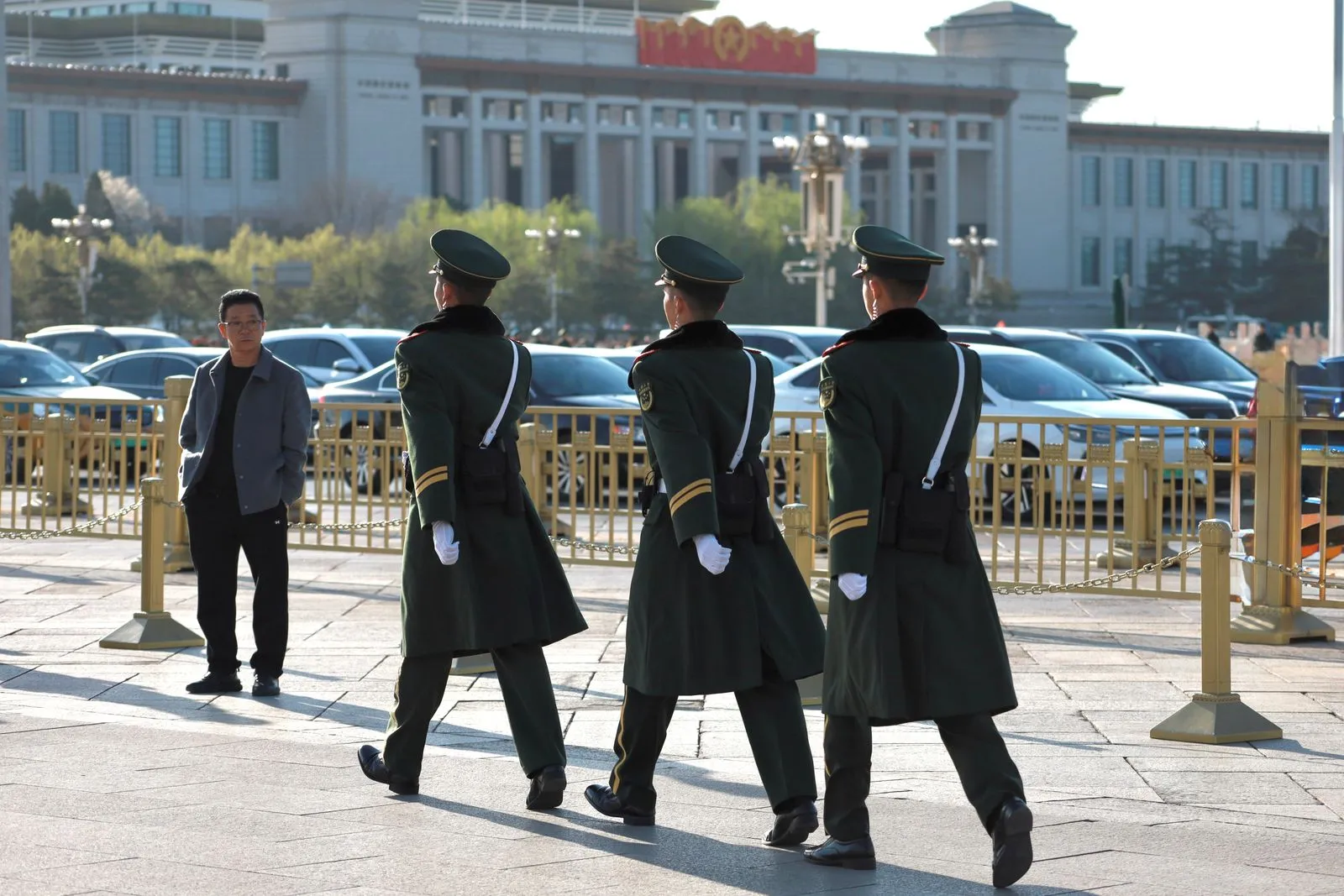 Uniformed guards outside a Beijing state building. The ritual draws about 120,000 people to the square each October 1.
On October 1, 2025, about 120,000 people gathered for the ceremony. Among them was an Australian visitor, Shane, whom Xinhua’s account describes as having dropped by the square and been drawn in by the ritual. He is quoted admiring how people wait through the night for a flag-raising. His presence corrects the forum claim that the square is closed to foreigners on National Day. The access mechanism is straightforward: reserve a time slot one to nine days ahead through the Tiananmen Square Visit Reservation platform, bring your passport, and clear the standard security check.
The ceremony follows sunrise, which on October 1 in Beijing falls around 6:10–6:25 am. The surrounding streets (Chang’an Avenue, Qianmen) see traffic controls the night of September 30 through the morning of October 1, and the Tiananmen East, Tiananmen West, and Qianmen metro stations may skip stops during the ceremony window. Take the first train and leave extra time.
China holds National Day military parades on major anniversaries, the tenth-year cycle (50th, 60th, 70th). The 2026 anniversary is the 77th, so no parade is expected. The next National Day parade would fall in 2029, the 80th. The 2015 and 2025 parades fell on September 3, the WWII victory anniversary, not October 1.
The Verdict
Should you visit China during National Day Golden Week? If dense queues ruin a trip for you, aim for late October or April instead. If you can plan ahead and tolerate a busy day or two at the headline sights, early October offers the best weather of the year, a 240-hour visa-free window that covers the whole holiday, manageable price increases, and the chance to see a National Day that most foreign travelers skip. Plan around the Oct 2–3 lull, book the moment reservations open, and the week becomes one of the most rewarding times to be in China.
Related Articles
- Worst Time to Visit China 2026 — Where Golden Week fits in the year
- Chinese New Year 2027 China Guide — The other big holiday, compared
- 240-Hour Visa-Free Transit China — Full rules and country list
- China Visa-Free Countries 2026 — Who can enter without a visa
- How Foreigners Book Hotels in China — Booking during peak demand
- China High-Speed Rail Guide — Trains sell out; here is how to handle it