
China Visa-Free Entry in 2026: All 3 Pathways Explained (50+ Countries)
China now lets citizens of more than 50 countries walk in without a visa, and the rules change often enough that most English guides online are already out of date. As of July 2026 there are three separate visa-free pathways, each with its own country list, stay limit, and fine print. Pick the wrong one and you can still be denied boarding. This guide breaks down all three, current through the latest official announcements from the National Immigration Administration and the Ministry of Foreign Affairs.
The scale is real: in the first half of 2026, 17.8 million foreigners entered China visa-free, according to the National Immigration Administration’s July 2026 briefing. That is 77.7% of all inbound foreigners, and 30.6% more than the same period a year earlier.
If you only remember one thing: check whether your nationality qualifies before you book your flight, and re-check on cs.mfa.gov.cn within a week of travel, because China keeps adding countries and adjusting end dates.
The Three Visa-Free Pathways at a Glance
| Pathway | Countries | Max Stay | Need onward ticket? | Where you can go |
|---|---|---|---|---|
| 1. Unilateral visa-free | 50 | 30 days | No | Anywhere in China |
| 2. Mutual visa-free | ~25 (ordinary passport) | 30 days (most) | No | Anywhere in China |
| 3. 240-hour transit | 55 | 10 days (240 hrs) | Yes, to a third country | Limited to a stay zone (province group) |
Most travelers will use Pathway 1 or 2. Pathway 3 is for layovers. We go through each below.
Pathway 1: Unilateral Visa-Free Entry (50 Countries, 30 Days)
This is China’s flagship program. China unilaterally grants citizens of 50 countries visa-free entry — meaning your country does not need to reciprocate. You show up with a passport, get stamped, and can stay up to 30 days. No onward ticket required. No application. No fee.
The list below is official, sourced from the National Immigration Administration (updated February 17, 2026) and confirmed by the Ministry of Foreign Affairs.
Europe (35 countries): France, Germany, Italy, the Netherlands, Spain, Switzerland, Ireland, Hungary, Austria, Belgium, Luxembourg, Poland, Slovenia, Portugal, Greece, Cyprus, Slovakia, Norway, Finland, Denmark, Iceland, Andorra, Monaco, Liechtenstein, Bulgaria, Romania, Croatia, Montenegro, North Macedonia, Malta, Estonia, Latvia, Russia, Sweden, the United Kingdom.
Asia (7 countries): Brunei, South Korea, Japan, Saudi Arabia, Oman, Kuwait, Bahrain.
Americas (6 countries): Brazil, Argentina, Chile, Peru, Uruguay, Canada.
Oceania (2 countries): Australia, New Zealand.
Conditions
- Hold a valid ordinary passport (diplomatic and official passports have different rules)
- Passport validity of at least 6 months
- Permitted purposes: business, tourism, visiting family or friends, cultural exchange, transit
- Not permitted: employment, study, journalism — these still require a proper visa
- Each stay up to 30 days (counted from the day after entry)
- Can be used repeatedly; no published cap on cumulative days per year
How long does the policy last?
This is the part most guides get wrong, because the end dates differ by country and have been extended several times:
- Brunei: no expiry date set
- Russia: in effect through September 14, 2026 (recently adjusted — verify before travel)
- The other 48 countries: in effect through December 31, 2026
China has extended these deadlines repeatedly since the program began in late 2023, so the December 2026 date is very likely to roll forward into 2027. But until it officially does, treat the printed date as real.
 Visa-free entry has fueled a boom in foreign tourism — visitors from the 50 eligible countries now explore cities like Shanghai on a whim.
Pathway 2: Mutual Visa-Free Agreements
These are bilateral treaties — China and the other country agreed to let each other’s citizens in visa-free. For ordinary passport holders (the type tourists carry), the most useful mutual agreements cover:
- United Arab Emirates (since 2018)
- Thailand (since 2024, 30 days)
- Serbia, Bosnia and Herzegovina (30 days)
- Belarus (since 2018, 30 days)
- Ecuador, Georgia, Qatar, Maldives, Mauritius, Seychelles, Barbados, Bahamas, Grenada, Fiji, Tonga, Samoa, Vanuatu, Suriname, San Marino, Antigua and Barbuda (since 2024)
- Azerbaijan (ordinary passport, since July 2025)
The full table runs much longer because most mutual agreements only cover diplomatic and official passports, not the ordinary passports tourists hold. The countries listed above are the ones whose agreements include ordinary passports. The Ministry of Foreign Affairs publishes the complete mutual visa-free table, updated through May 29, 2026.
If your country is on this list, mutual visa-free works the same way as unilateral: show up, get stamped, stay up to 30 days, no onward ticket.
Pathway 3: 240-Hour Transit Visa-Free (55 Countries, 10 Days)
If your nationality is not covered by Pathway 1 or 2, you may still qualify for the 240-hour transit exemption. This covers 55 countries (including the United States) and lets you enter for up to 10 days — but with two big catches:
- You must hold a confirmed onward ticket to a third country (not back to where you came from)
- You must stay within a defined transit zone (a group of provinces), not roam all of China
For the full country list, eligible entry ports, stay zones, and sample 10-day itineraries, see our complete 240-hour transit guide.
 Shanghai Pudong International Airport — one of the 65 ports where 240-hour transit entry is processed.
Which Pathway Applies to You?
A quick decision guide:
- Your country is on the 50-country unilateral list → Use Pathway 1. 30 days, anywhere in China, no onward ticket. Simplest option.
- Your country has a mutual treaty with China (UAE, Thailand, Serbia, etc.) → Use Pathway 2. Same terms as Pathway 1.
- Your country is on neither list but is one of the 55 transit countries (e.g., United States) → Use Pathway 3 (240-hour transit), but you need an onward ticket to a third country and must stay in the zone.
- Your country is on none of the three lists → You need a regular visa. See our China entry requirements guide for visa types and the application process.
Common Questions (From the Ministry of Foreign Affairs)
Can minors use visa-free entry? Yes. Minors follow the same rules as adults — ordinary passport, eligible nationality, same purposes.
Can I use visa-free entry for a sports competition, conference, or summer camp? Yes, if the stay is under 30 days and you hold an ordinary passport. These activities count as “exchange” or “business.”
Can tour groups use visa-free entry? Yes. Eligible travelers can enter visa-free whether they are in a tour group or traveling independently.
Does the 30-day limit mean 30 days per year or per visit? Per visit. Each entry grants up to 30 days. There is no published annual cap, though border officers can question frequent back-to-back entries.
Will the airline let me board without a visa? Usually yes for Pathway 1 and 2, but some airline staff are not up to date. Carry a printed copy of the official policy page or your embassy’s notice. For Pathway 3, airlines always check your onward ticket at check-in.
What to Do Before You Fly
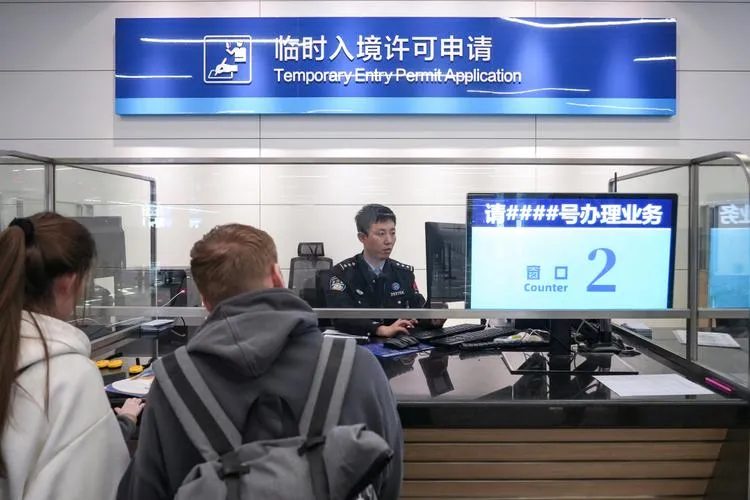 A border inspection counter — visa-free travelers still present passport and arrival card here, but no visa sticker is needed.
- Confirm your eligibility at cs.mfa.gov.cn or your nearest Chinese embassy within a week of travel
- Check passport validity — at least 6 months remaining
- Complete the online arrival card via the 12367 app or s.nia.gov.cn before departure (available since November 2025)
- Print your hotel booking and return flight as backup, in case airline staff or border officers ask
- Install Alipay and a VPN before landing — see our entry requirements guide for the full pre-departure checklist
The Bottom Line
China’s visa-free opening is real and generous in 2026. If you hold an ordinary passport from any of the 50 unilateral countries — or a mutual-treaty country like the UAE or Thailand — you can visit for up to 30 days with nothing more than your passport and an online arrival card. The only travelers who need to plan carefully are those on the 240-hour transit pathway (onward ticket required) and those whose nationality is on none of the three lists (regular visa required).
The policy dates shift. The December 31, 2026 deadline for most countries will almost certainly be extended again, but until it is, treat it as the real date and re-check before you book.
Related Articles
- 240-Hour Visa-Free Transit Guide (2026) — The full transit exemption: 55 countries, ports, and stay zones
- China Entry Requirements (2026) — For travelers who need a visa: types, customs, and the arrival process
- How Foreigners Book Hotels in China (2026) — Booking a hotel that accepts foreign guests