Harbin Ice and Snow World 2026-27: Tickets, the 240-Hour Visa Truth, and a -30°C Survival Guide
Harbin Ice and Snow World is the easy part of the trip to understand: a 1.2-million-square-meter park built every winter from Songhua River ice, with slides, towers and full-scale buildings that glow from within. The parts that decide whether your trip works are harder. The ticket price includes the famous rides, but only through a same-day reservation system most guides never explain. The 240-hour visa-free entry that English forums keep recommending for “northeast China” stops at Harbin’s city limits, and the park’s most recent season ended eleven days earlier than every guide promised, when a record-warm February melted the sculptures. This guide covers all of it, based on the 27th edition (2025-26) as the baseline and the 28th edition’s confirmed status as of August 2026.
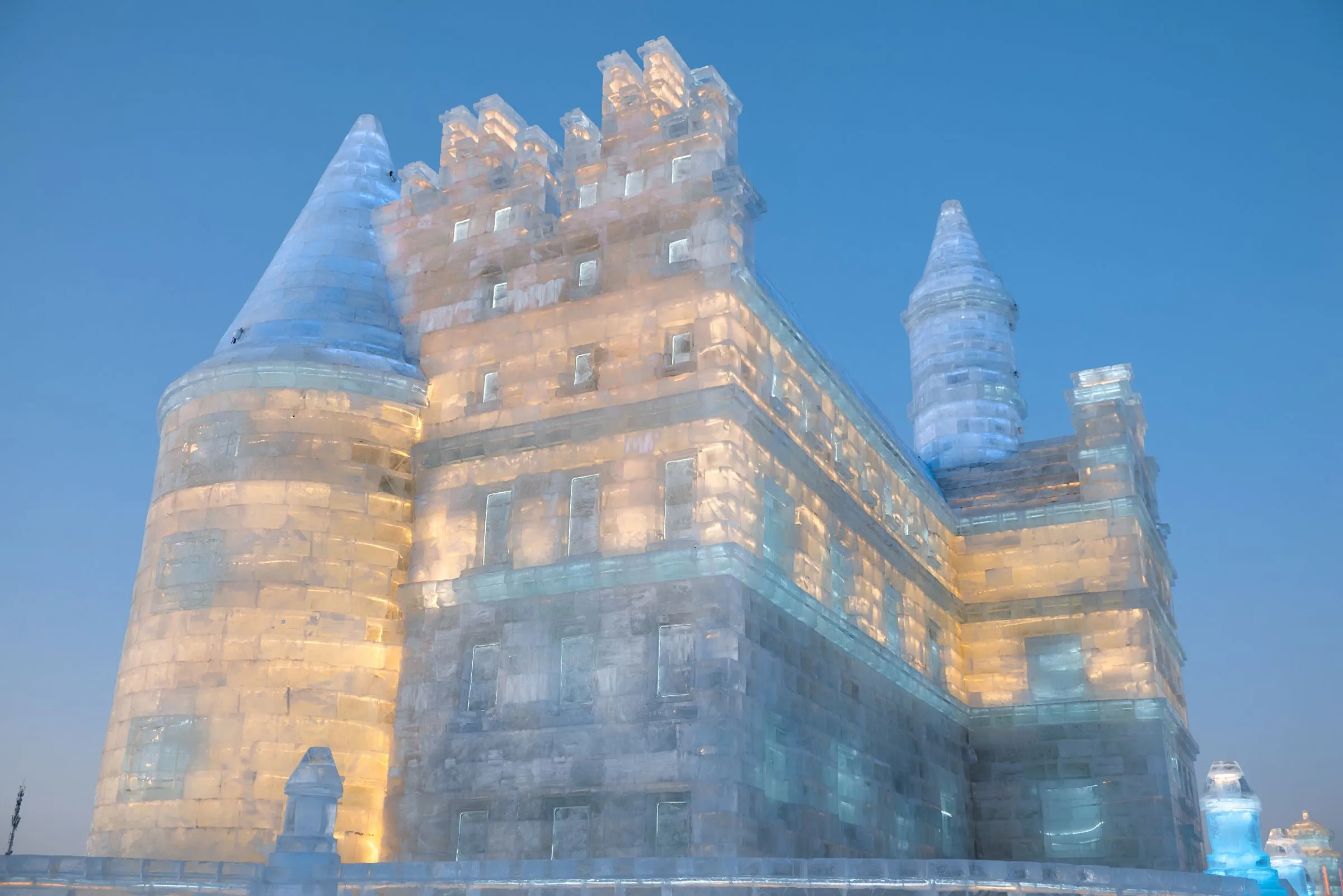 The 27th edition at night: full-scale buildings carved from Songhua River ice, lit from within.
Quick answer: The 28th edition (2026-27 winter) is confirmed in the making but not yet announced: ice harvesting for it began on January 15, 2026, and the date-theme-price trio historically drops between late November and late December, days to weeks before a mid-December opening (recent editions all opened December 17-21). Baseline prices from the last three editions: ¥328 adult / ¥240 concession, with the headline rides included via free same-day reservation. Visa reality check: the 240-hour transit waiver at Harbin airport covers Harbin city only; Yabuli is inside the zone, but China Snow Town and Mohe are not, so use the 30-day visa-free entry (50 countries) for the full northeast loop. Book flights and hotels by mid-November: New Year fares from Guangzhou rose 56% last season. See our Harbin city guide and visa-free country list.
How we verified this: SinoWander reads the original Chinese documents that English guides cannot: the park operator’s official announcements (including the February 2026 closure notices, quoted verbatim), the Heilongjiang provincial government’s published stay-zone interpretation of the transit visa, the culture-and-tourism department’s foreign-ticketing guide, and Harbin Metro’s holiday schedules. Claims were cross-checked against foreign travelers’ 2025-26 season reports. Each guide is date-stamped when last verified: 2026-08-26. See our methodology.
Three Festivals, One City: Get the Names Right First
English usage mashes three different things into “Harbin Ice Festival”, and the confusion costs real itinerary mistakes.
- Harbin Ice and Snow World (哈尔滨冰雪大世界) is the park: the ice-built theme site in Songbei district, first built in 1999, rebuilt every winter. The 2025-26 winter was its 27th edition; the coming winter is the 28th. This is what you buy a ¥328 ticket for.
- The China Harbin International Ice and Snow Festival is the citywide festival, founded in 1985 as China’s first international ice-and-snow festival. Its 42nd edition opened on January 5, 2026, with the opening ceremony held inside the park. It has no closing ceremony; city events simply run into late February.
- The Ice Lantern Art Fair at Zhaolin Park is the oldest layer, the birthplace of the whole festival, where the traditional ice-lantern craft is displayed in the old town.
For planning: the park is the destination, the festival is the atmosphere, the lantern fair is a free-evening bonus in central Harbin. Our city guide covers how they fit together.
 Ice harvesting on the Songhua: blocks cut at 60 cm thickness in January, stored through three seasons for the December build.
The 28th Edition: What Is Actually Known (August 2026)
Pre-season guides tend to invent certainty. Here is the full inventory of what is official right now, and nothing more:
- Ice harvesting for the 28th edition began January 15, 2026, while the 27th was still running. Workers cut Songhua River ice at over 60 cm thickness, to a standard block size above 1.6 by 0.8 by 0.5 meters, and store it through spring, summer and autumn under layered insulation for the December build.
- No date, theme, or price has been announced. The recent pattern: the last three editions announced the trio between late November and late December, days to weeks before opening. The one October announcement (26th edition’s theme, in October 2024) was an Asian Winter Games tie-in, not a rule. Expect the 28th’s details on that same late-November-to-late-December rhythm, with opening in the December 17-21 window that every recent edition has used.
- Why the 28th is already worth planning: Chinese New Year 2027 falls on February 6, eleven days earlier than 2026’s festival. The single-day crowds (the 27th set its all-time record of 120,000 visitors on February 19, 2026, the third day of the holiday) will land in the 7th or 8th week of the season. Translation: the late-December and early-January window is calmer than the calendar suggests, and the very tail of the season has fully matured lighting with thinned crowds, balanced against the closure risk below. Our Chinese New Year 2027 guide covers the holiday mechanics.
This guide updates when the 28th edition’s details drop; nothing below invents them.
Tickets: What ¥328 Buys, and How the Reservation System Works
The last three editions have held prices perfectly stable: ¥328 standard, ¥240 concession, with a ¥298 opening-week special in the most recent season. Concession rules favor readers under 25: the ¥240 tier covers full-time students up to age 24 (Chinese ID plus student card at entry; passport holders can buy the tier, but whether a foreign student card passes on-site inspection is not officially specified, so treat it as uncertain). One honest boundary for older readers: the 65-plus free-admission category is built on the Chinese national ID system, with a mandatory 18-digit ID field in the booking form; a foreign passport has no documented route to that free ticket, so budget ¥328 and call the park line (400-639-1999) to check.
The headline rides are included, through a reservation system you activate after entering. This is the part English guides most often get wrong (some claim the rides cost extra; they do not):
- Enter the park first; ticket verification is what unlocks reservation rights. There is no pre-opening reservation race.
- Scan the on-site code or open the park’s official WeChat account, then verify with the ID number tied to your ticket. The system accepts the passport number you booked with, confirmed in the official step-by-step and by foreign visitors’ 2025-26 walkthroughs.
- Pick rides and time slots: the Super Ice Slide, the Snowflake Ferris Wheel and the car ballet show are the capacity-limited three. Each reservation covers up to 3 people at once.
- Show the QR code in your slot.
Practical translation: the first twenty minutes inside the gate decide your evening. Reserve immediately, then start walking. A ¥800 “express” pass exists that simply skips the reservation step.
Booking as a foreigner follows the channels the Heilongjiang culture authority published in December 2024 (26th edition): passport works on the park’s official WeChat account and on major Chinese platforms; from overseas, Ctrip’s international Trip app sold direct; at the gate, the self-service machines take foreign cards without needing yuan cash. The 27th edition’s opening-day coverage confirmed passport booking and overseas payment support continued. Trip.com carried the park through the 27th season at roughly $37-39; its listing sits dormant between seasons, so treat third-party availability as a per-season check. For the payment setup itself, see our Alipay guide.
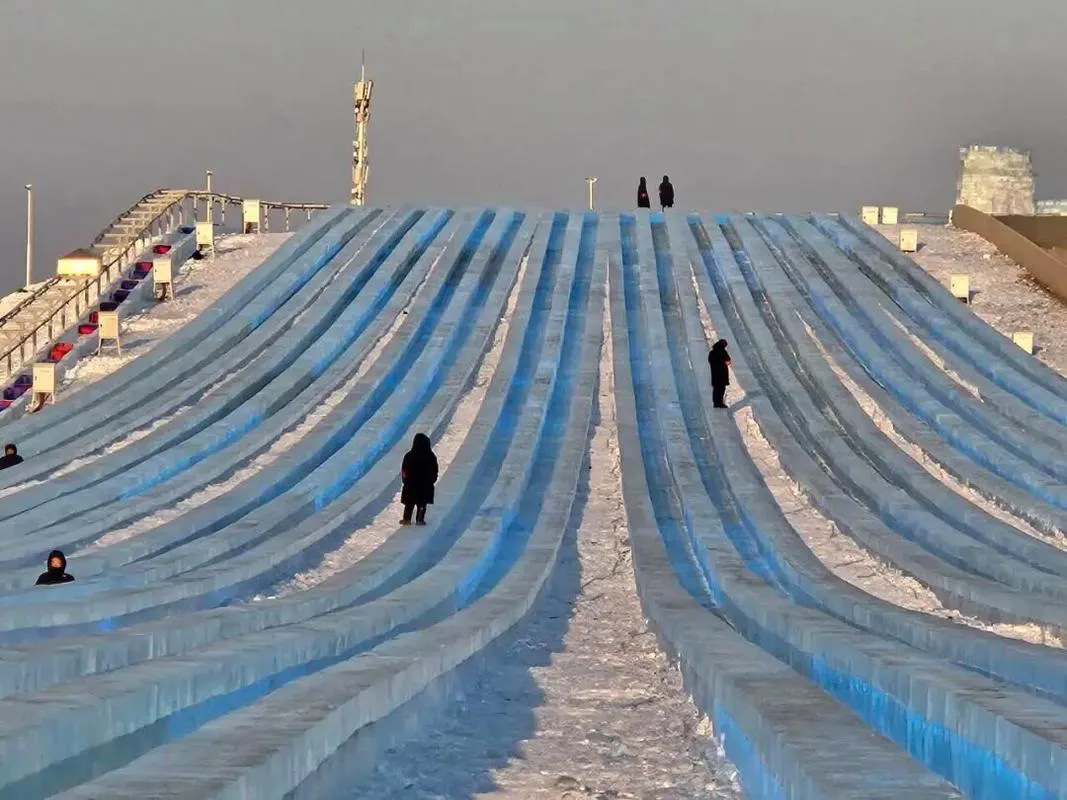 The Super Ice Slide’s 24 lanes: included in the ticket, but reservation slots fill fast.
The Visa Truth: 240 Hours Stops at the City Line
This is where the popular advice collapses, and it deserves precision because the official sources say the opposite of what AI summaries claim.
Harbin Taiping Airport (HRB) is a 240-hour transit port for 57 countries. But the transit policy’s stay zone in Heilongjiang is Harbin city only. The provincial government’s own implementation notice states it flatly: eligible transit passengers may stay “in the area of Harbin City” in Heilongjiang. Heilongjiang is in fact the most restricted of the 24 provinces in the scheme, a single-city zone (compare Liaoning, which allows its whole province, or Sichuan’s 11-city list; our Jiuzhaigou guide documents the Sichuan version of the same trap).
What that means on a map:
| Destination | 240-hour transit from HRB |
|---|---|
| Harbin city, the park, Central Street, Zhaolin Park | Allowed |
| Yabuli ski resort (administered by Harbin’s Shangzhi) | Allowed, technically as part of Harbin |
| China Snow Town (Hailin, Mudanjiang) | Not allowed |
| Mohe / the Arctic Village (Daxing’anling) | Not allowed |
| Cross-province hop to Beijing, Shanghai, Liaoning etc. | Allowed within those provinces’ zones |
Search snippets claiming Heilongjiang was expanded province-wide misread the very government page that says otherwise. If Snow Town or Mohe are on your list, the right instrument is the 30-day unilateral visa-free entry (50 countries, no onward-ticket requirement) or a tourist visa, entering at any international port. The two visa products look similar in forum posts and behave completely differently here; our 240-hour transit guide separates them in full.
What February 2026 Proved About the Weather Risk
Every English guide publishes a closing date. The 27th edition made that fiction obvious, and the sequence is worth quoting because it will rhyme with future warm winters.
On February 19, 2026, the park set its all-time single-day record: 120,000 visitors. The next day it was closed. The operator’s announcements tell the story: February 19 flagged above-freezing temperatures and shut the park for February 20-21, proposing to reopen February 22 at reduced prices (¥228/¥168, a plan that never took effect for a single day); on the evening of February 21 it declared the season over, citing ice landscape deterioration from record heat. The final tally: 65 days, 3.06 million visitors, and refunds for unused tickets. Holders of February 20-28 tickets were offered free entry to the next edition, with one catch for foreign readers: the offer’s wording requires the Chinese national ID, with no stated passport equivalent.
Three practical defenses. Book through refundable channels (the official platforms refunded automatically). Treat any itinerary item after mid-February as provisional. And know the indoor fallbacks: the park’s indoor Dream Ice Museum reopened the day after the closure, and the city’s ice-shows continued as scheduled.
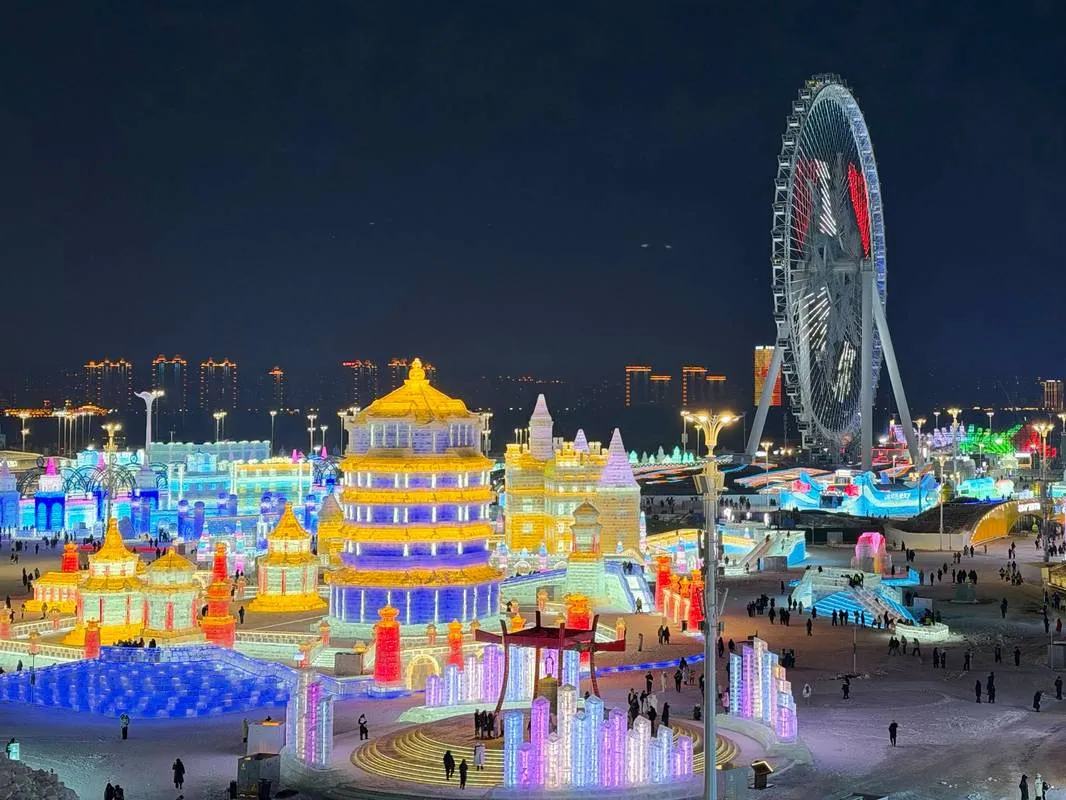 Light through the ice: the blue-hour window around 16:00-17:00 is the photographers’ hour.
Surviving -30°C: The Layering Math
The park sits open to the Songhua wind, roughly 10 degrees colder than the forecast feels. The advice below is the Chinese internet’s hard-won consensus, plus the park’s own countermeasures.
Body: the onion rule, but weighted for the indoor-outdoor swing (heated halls hold around 20°C). Base layer, fleece, a real down jacket rated for the cold, insulated boots with actual grip (ice underfoot is the park’s default surface), and a balaclava or scarf for the wind. Hands: thin touchscreen liners under waterproof mittens, so phone use does not mean bare skin. Eyes: sunglasses matter more than visitors expect; snow blindness has a 6-8 hour lag and ruins the following day. Skin: metal freezes to damp skin at these temperatures; the metal railings are not for bare hands. Phone: cold saps batteries into fake-death; keep the phone in an inner pocket with a heat pad, carry a power bank, and know that the park hands out free mobile power banks at stations across the site. When the cold wins, the park’s 5,000-square-meter heated hall (and the 300-meter wind-shielded queue corridor at the ice slide) are the recovery points.
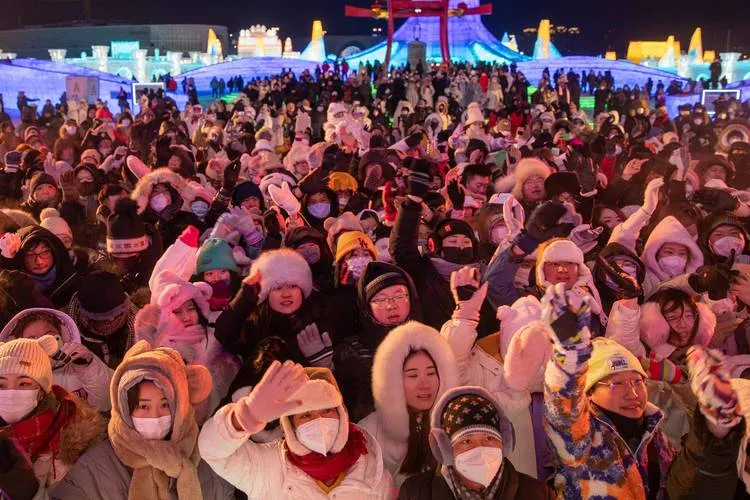 -30°C is a clothing problem with a known solution; the park hands out free power banks for the other casualty, your phone.
Timing, Light and the Last Train
The 27th edition ran 10:00 to 22:00 daily (last entry 21:45). One widely copied schedule claiming an 11:00 opening traces to a 2015-16 ticketing page that search-engine summaries keep mis-attributing to the current park; ignore it. The official recommendation to arrive by 14:00 is about light, not gates: it buys you the daytime view of the carving craft, the blue-hour window (about 16:00-17:00, when the sky is not yet black and the lit ice glows from within, the single best photography hour), and the full night reveal after the main tower’s 17:30 light show.
Two transit numbers matter. The park’s own site lists a “21:30 last metro” with a “for reference” disclaimer; the actual metro schedule runs to 22:30 normally, which comfortably covers a 22:00 park close. And in high season Harbin Metro extends: on New Year’s Eve 2025 the Line 2 trains ran until 1:30 the next morning (to 2:00 near the park if crowds demanded), with holiday extensions to 23:00-23:30 through the season. Check the metro’s official WeChat account during your dates rather than trusting either static number.
Getting There, and the Booking Calendar
From the airport: Harbin Taiping is 39 km and about 50 minutes from the park; the airport bus Line 4 runs the route, and a taxi is realistically ¥100-plus. By metro: Line 2 stops at Ice and Snow World station directly, with connections from Harbin Railway Station and Central Street without a transfer. By train, Harbin is the high-speed hub of the northeast; our China rail guide covers passport booking.
The price calendar is the quiet budget-maker. Last season, Guangzhou-Harbin flights averaged ¥787 in November and ¥1,230 around New Year (up 56%), with Harbin homestay bookings running 80% hotter through the season. The exploitable windows: mid-November bookings for everything, and the opening week itself (mid-December), when the park is fully built but the holiday crowds have not arrived. Where to sleep is covered in our hotel booking guide; the short version is to stay on Line 2 between Central Street and the park and skip the cross-river commute at -25°C. For how the ice season fits the year as a whole, see the winter section of our best-time guide.
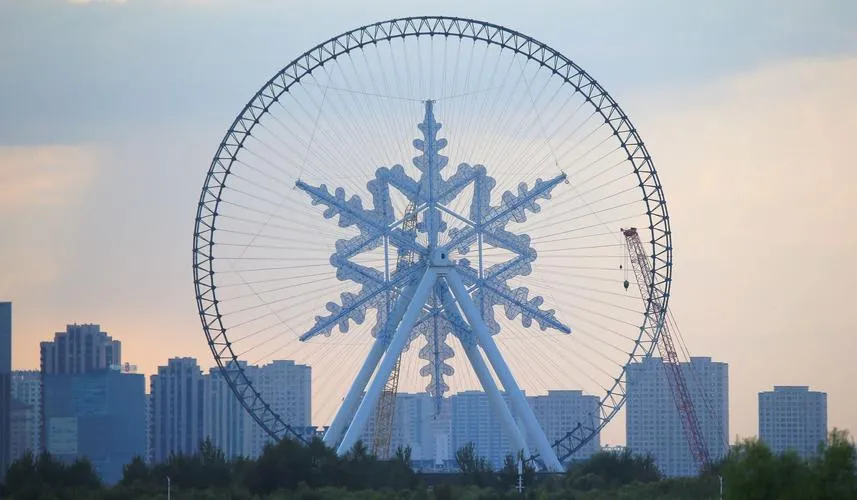 The Snowflake Ferris Wheel against the winter skyline.
Quick Reference (27th-Edition Baseline, 28th Pending)
| What | Detail |
|---|---|
| Ticket | ¥328 adult / ¥240 concession (three editions stable); opening-week ¥298 |
| Rides | Included; free same-day reservation after entry, passport number works, 3 slots per booking |
| Hours | 10:00-22:00 (27th edition); arrive by 14:00 for daylight plus night |
| 28th edition | Ice harvesting began Jan 2026; announcement expected late Nov to late Dec; opening Dec 17-21 window |
| Visa | 240h covers Harbin city + Yabuli only; Snow Town/Mohe need the 30-day visa-free entry |
| Weather risk | 27th closed 11 days early (warm February); protect post-mid-February plans |
| Metro | Line 2 direct; normal last train 22:30; holiday extensions to 23:00+ |
| Airport | HRB, 39 km / 50 min; bus Line 4 or ¥100+ taxi |
| Foreign booking | WeChat official account / Trip app from overseas / gate machines take foreign cards (26th-edition official channels) |
| Emergency warmth | Free power banks, 5,000 m² heated hall, wind-shielded slide queue |
Go in the opening fortnight or right after New Year, book everything refundable, treat the visa zone as a map not a slogan, and the world’s largest ice park is exactly as unreal as the photos promise.
Sources & Verification
This guide was last verified on 2026-08-26. Key Chinese-language sources:
- Heilongjiang Provincial Government (黑龙江省人民政府): the provincial implementation notice stating that 240-hour transit passengers may stay “in the area of Harbin City” only, the single-city zone that rules out China Snow Town and Mohe.
- National Immigration Administration (国家移民管理局): the December 17, 2024 announcement listing Harbin Taiping airport among the transit ports, with the scheme now covering 57 countries.
- Heilongjiang Culture and Tourism Department (黑龙江省文化和旅游厅): the foreign-ticketing guide published December 2024 (passport booking on the park’s official WeChat account, the Trip app from overseas, and gate machines that take foreign cards), the 28th-edition ice harvest that began January 15, 2026, and the 27th edition’s closing statistics.
- Harbin Ice and Snow World operator announcements (哈尔滨冰雪大世界官方公告): the ¥328 / ¥240 / ¥298 price structure held across three editions, the free same-day ride reservation system that accepts the passport number, and the February 2026 closure sequence: the 120,000-visitor record on February 19, the warm-weather shutdown, and the season ended February 21 after 65 days and 3.06 million visitors.
- Baidu Baike (百度百科): the edition-by-edition timeline since 1999, checked against our own date arithmetic, and the three-concept distinction between the park, the citywide festival founded in 1985, and the Zhaolin Park ice lantern fair.
- Xinhua News Agency and People’s Daily Online (新华网/人民网): the 27th-edition opening coverage and the January 2026 ice-harvest reports.
- CCTV News Network and Securities Times (央广网/证券时报): the Tongcheng winter-travel report figures: Guangzhou-Harbin fares averaging ¥787 in November and ¥1,230 at New Year (up 56%), with homestay bookings running 80% hotter through the season.