Xi'an Muslim Quarter Food Guide: What & Where to Eat (2026)
Xi’an Muslim Quarter Food Guide: What & Where to Eat (2026)
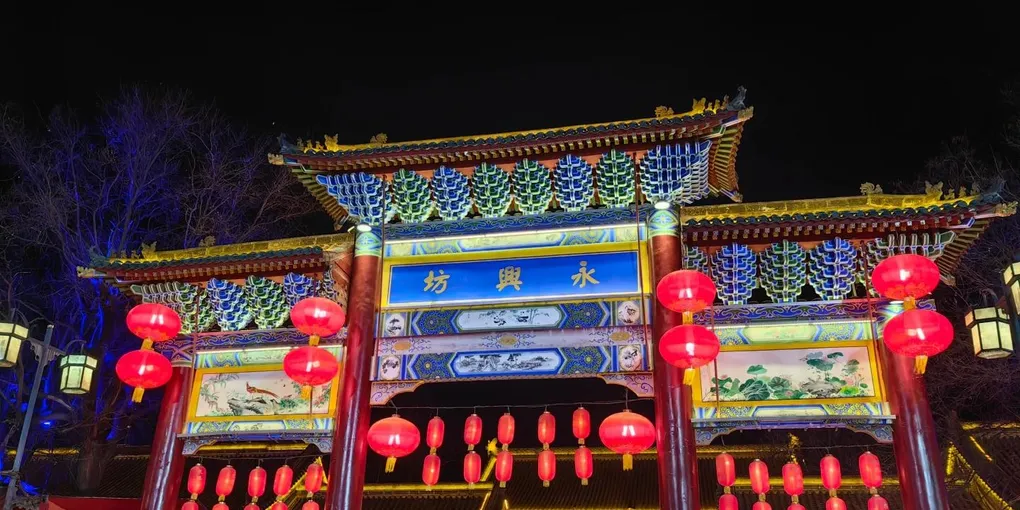
The “Muslim Quarter” most tourists see is one crowded street; Beiyuanmen, lined with red-willow skewers and squid stalls, priced for tour groups. The real Xi’an food quarter is six streets, and locals eat two streets over on Sajinqiao (洒金桥) and Dapiyuan (大皮院), where the same bowl of mutton paomo costs half. A common line on Chinese travel forums in 2025-2026: tourists spend around ¥80 on Beiyuanmen and leave unsatisfied, while locals eat themselves full on Sajinqiao for around ¥40. This guide is built around that gap; what to eat, which street to eat it on, and the verified 2026 prices.
How we verified this: SinoWander reads Chinese-language sources that English guides cannot, including Dianping, Baidu Baike, Xi’an Bendibao, and Xiaohongshu. We cross-check them before writing. We have not personally visited every location. Each guide is date-stamped when last verified: 2026-08-06. See our methodology.
The quarter is six streets, not one
The Muslim Quarter (Huimin Jie / 回民街, also called Fangshang or Huifang) is a Hui Muslim neighborhood of roughly 60,000 people in Xi’an’s Lianhu district, made up of six streets:
| Street | What it is |
|---|---|
| Beiyuanmen | The tourist main street (the one with the archway). Crowded, pricey, tour groups. |
| Sajinqiao | Where locals actually eat. Highest food density, cheaper, the in-the-know pick. |
| Dapiyuan | Another local-eats street; home to several old-name shops. |
| Beiguangji Jie | Connects into Sajinqiao; old shops like Lao Bai Jia and Dongnanya Zenggao. |
| Xiyang Shi | Transition street; Liu Jixiao’s cured beef and others. |
| Huajue Lane | Cultural strip, home to the Great Mosque. |
How to use it: the Bell Tower metro stop drops you five minutes from the Beiyuanmen archway. Walk through Beiyuanmen once for the atmosphere and the lights, then turn into Dapiyuan or Sajinqiao to actually eat. Sajinqiao has been heavily promoted on Xiaohongshu, Douyin, and Zhihu since 2024 as the “local authentic” pick, so it now draws in-the-know travelers alongside locals; but it is still cheaper and more authentic than Beiyuanmen, and tour groups do not go there.
What to eat (2026 verified prices, RMB)
Mutton / beef paomo (泡馍): the dish with the biggest price spread
Paomo (pita bread torn into bits and soaked in rich mutton or beef broth) is Xi’an’s signature dish, and where you eat it changes the price dramatically:
- Local alley shops (Sajinqiao / Beiguangji Jie): ¥18–28 a bowl
- Old-name shops (Tongshengxiang, Lao Mi Jia): ¥38–45
- Beiyuanmen tourist shops: ¥28–42 “regular,” ¥38–50 “premium”; the worst traps charge ¥68
Order it the local way: tear the flatbread into small pieces yourself (smaller = more flavor), do not ask the kitchen to machine-cut it. Pickled garlic and chili paste come on the side.
Other must-eats
| Dish | Price | Notes |
|---|---|---|
| Jia San soup dumplings (贾三灌汤包) | ¥25 / basket of 10 | Qinchuan beef filling, beef-marrow broth. One of “Xi’an’s three specialties.” |
| Zenggao (甑糕) | ¥5–15 | Sticky rice, jujube, bean paste steamed in an iron vessel. Dongnanya Zenggao (no “Wang” in the name) is the name shop; go before noon, it sells out. |
| Sesame niangpi (麻酱酿皮) | ¥8–10 | Cold skin noodles in heavy sesame paste. Sheng Zhiwang (note: Wang with the “gazing” 望 character) on Dapiyuan. |
| Shuipen mutton (水盆羊肉) | ¥28–35 | Clear mutton soup with flatbread. Lao Bai Jia (Beiguangji Jie 76, a century-old shop) is the canonical one. |
| Xiao surou (小酥肉) | ~¥30 / portion | Crispy spiced beef (halal; beef, not pork). Ding Jia, at the Sajinqiao entrance. |
| Cured-beef roujiamo (腊牛肉夹馍) | ¥15–20 each | Slow-cured beef in a flatbread. Liu Jixiao on Xiyang Shi is the famous one to buy cured beef by weight (~¥80 / 500 g vacuum-packed). |
The roujiamo question: beef or pork?
This trips up foreign visitors. The Chinese burger roujiamo (肉夹馍) comes in two separate dishes:
- In the Muslim Quarter: la niurou; cured beef, halal. This is what every shop here sells.
- Outside the quarter (Han areas): la zhi rou; pork belly, braised in a spiced broth. Brands like Fan Ji and Yuan Ji; featured on A Bite of China in 2012. Not sold in the Muslim Quarter.
So the meat in your Muslim-Quarter burger is cured beef, not the pork version you may have read about. They are two different dishes from two different communities.
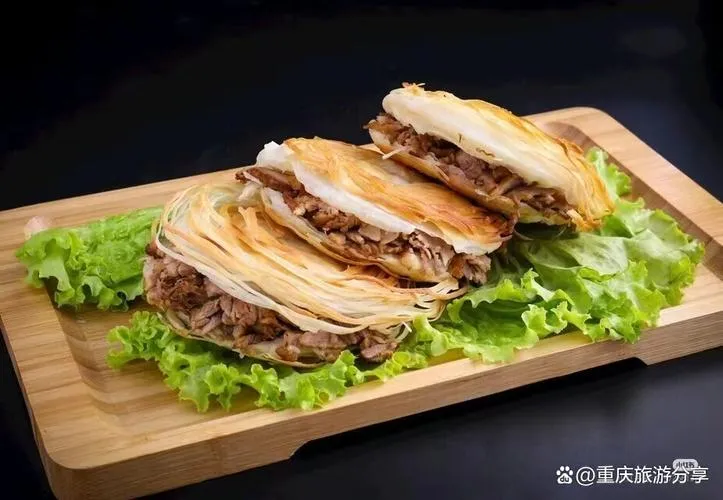 The Muslim-Quarter roujiamo is filled with cured beef (halal) — a different dish from the pork version sold in Han areas of Xi’an.
Old-name shops (verified 2026)
| Shop | Signature | Founded | Note |
|---|---|---|---|
| Lao Sun Jia (老孙家) | Mutton paomo, cured beef | 1898 | National-level intangible heritage (2021). Flagship is on Dong Da Jie (outside the quarter); there is a Beiyuanmen branch at no. 157. |
| Tongshengxiang (同盛祥) | Beef/mutton paomo | 1920 | First national-level paomo heritage site in the northwest (2008). Flagship near the Bell Tower (just south of the quarter). |
| Jia San (贾三) | Soup dumplings | 1987 | National-level heritage (2021). Not a century old, despite the reputation. |
| Dongnanya Zenggao (东南亚甑糕) | Zenggao | 1920s–30s | Registered trademark 1990s; Beiguangji Jie 129 / Majia Shizijiao. |
| Sheng Zhiwang (盛志望) | Sesame niangpi | — | On Dapiyuan. |
| Ding Jia (定家) | Xiao surou | — | Sajinqiao entrance; open in 2026. |
| Lao Bai Jia (老白家) | Shuipen mutton | ~century | Beiguangji Jie 76. |
One framing point: Lao Sun Jia and Tongshengxiang are Xi’an-wide paomo institutions whose flagships sit outside the quarter’s alleys, with branches inside. Treat them as “Xi’an old names with a Muslim-Quarter presence,” not as alleys-originals.
What to skip (verified; not local traditions)
- Red-willow skewers (红柳枝烤肉): a Xinjiang specialty (southern Xinjiang: Qiemo, Hotan, Kashgar), listed as Xinjiang intangible heritage in 2018; not a Xi’an or Hui tradition. The Beiyuanmen versions are a trap: ordinary sticks dyed red, sometimes duck passed off as lamb. They run ¥10–15 a stick; if a vendor charges more, walk away. Locals who want skewers go to Hasan Kaorou or Wenwen Kaorou.
- Giant fried squid (轰炸大鱿鱼): originated in Taiwan night markets around 2013 (Shilin), then spread across the mainland. A recent Taiwan-origin item, not a Xi’an or Hui dish. Same generic night-market food you find anywhere in China.
The Great Mosque of Xi’an (Huajue Lane)
Halfway along Huajue Lane sits something that surprises most foreign visitors: the Great Mosque (化觉巷清真大寺), and it looks nothing like a mosque you might picture. There are no onion domes. It is a Chinese palace-style complex; flying eaves, dougong brackets, courtyards laid out east-to-west so the prayer hall faces Mecca, with Islamic details and Koranic calligraphy fused into Chinese architectural form. A five-courtyard layout, roughly 12,000 sq m. For anyone interested in how Islam and Chinese architecture merged, this is the building.
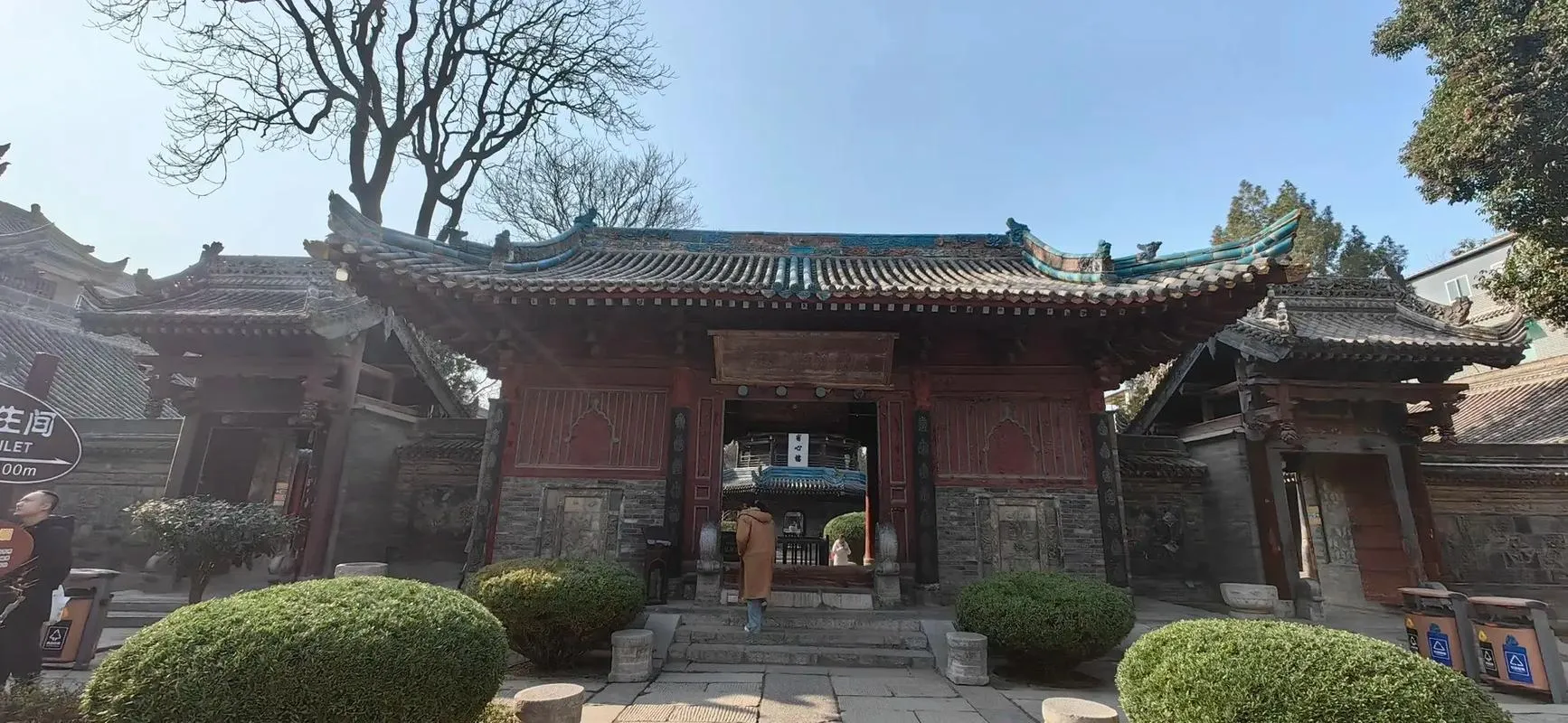 The Great Mosque’s Chinese palace-style architecture — flying eaves and dougong brackets, with no onion dome in sight.
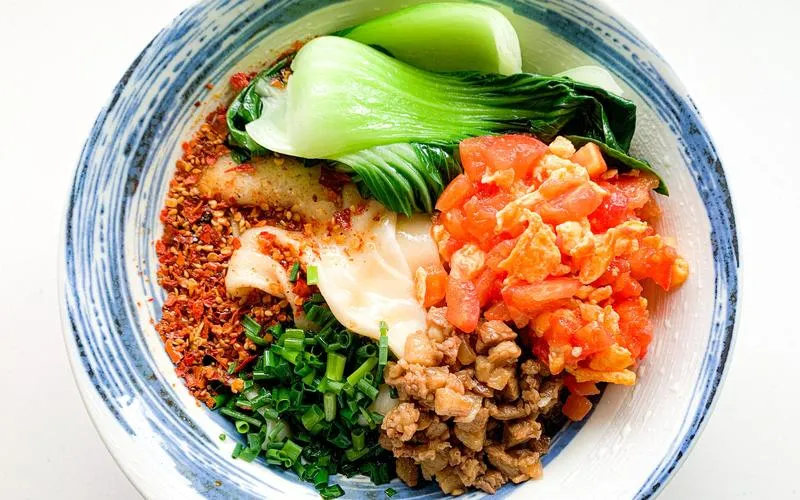 Biangbiang mian: the wide belt noodles in chili oil, a Muslim Quarter staple.
- Tickets: ¥25 peak (Mar–Nov), ¥15 off-peak (Dec–Feb), ¥15 student. Muslims enter free.
- Hours: about 8:00–19:00 (sometimes to 20:00 in summer), last entry 19:00. Closes on major Islamic holidays; confirm before going.
- Non-Muslims welcome (buy a ticket). Address: 30 Huajue Lane.
A note on the history
The neighborhood’s roots trace back to the Tang-dynasty Fanfang; the foreign-merchant quarter in the northwest corner of Chang’an, on the same ground as today’s Muslim Quarter. But the Hui Muslim community itself took shape later, in the Northern–Southern Song period (around the 12th century), growing through the Yuan and commercializing through the Ming and Qing. The mosque’s famous 742 CE (Tang) founding stele is considered a Ming-era forgery by scholars (including Japanese historian Kuwabara Jitsuzo and Chinese historians Chen Yuan and Bai Shouyi); the reliable record begins with a Ming imperial restoration in 1392 (Hongwu 25), and the buildings you see today are Ming and Qing. Use the Song-Yuan community and the Ming mosque date as the facts; treat the 742 Tang story as legend.
Practical tips for foreign visitors
- Getting there: Metro Line 2 to Bell Tower (钟楼), then a 5-minute walk north to the Beiyuanmen archway.
- Timing: evenings are most lively. For zenggao and old-name shops, go in the morning or early afternoon; things sell out.
- Payment: WeChat Pay and Alipay work everywhere (foreign-card setup in our WeChat Pay guide).
- Routing: pair it with the Bell Tower, Drum Tower, and City Wall; all within walking distance.
Sources & Verification
This guide was last verified on 2026-08-06. Key Chinese-language sources:
- Dianping (点评, dianping.com): dish prices for paomo, roujiamo, soup dumplings, and other Muslim-Quarter staples, cross-checked for the 2026 brackets.
- Baidu Baike (百度百科, baike.baidu.com): old-name shop founding dates and national-level intangible heritage status, including Lao Sun Jia, Tongshengxiang, and Jia San.
- Xi’an Bendibao (西安本地宝, xian.bendibao.com): Great Mosque ticket prices, opening hours, and the note that hours vary by source and should be confirmed before a dedicated visit.
- Xiaohongshu (小红书, xiaohongshu.com): the local-authentic reputation of Sajinqiao and Dapiyuan versus the Beiyuanmen tourist street, promoted heavily since 2024.
See our full verification methodology.
Related Articles
- Xi’an Travel Guide: the city, the Terracotta Army, how many days
- Chinese Food Guide for Foreigners: the national overview
- Iconic Chinese Dishes and Their Legends: the stories behind the food
- Beijing Travel Guide: for a north-China pair
Prices verified against Dianping, Baidu, and 2025–2026 Xi’an food guides (accessed July 2026). Old-name shop founding dates and heritage status per Baidu Baike. Great Mosque tickets and hours per Xi’an Bendibao and Guojixing (June 2026); hours vary slightly by source, confirm before a dedicated visit. Paomo prices span a wide range by shop tier; the figures above are the verified 2026 brackets.