China's Best Food Cities: A Culinary Tour
Ten cities, ten different ideas of what dinner should be. In Chengdu noodles arrive slicked with red oil and numbing pepper; in Suzhou the same bowl comes in a clear broth built around river shrimp. In Guangzhou dinner starts with soup. In Xi’an you tear your own bread into the bowl before the kitchen will touch it, and in Chongqing you do the same thing with a basket of tripe and a stopwatch.
This guide compares China’s ten best food cities, gives you each city’s signature dishes with pinyin so you can point at a menu, tells you which neighbourhood to walk to, puts an approximate price on a meal in each one, and — the part English guides get wrong — sorts out which of these cities really hold a UNESCO title.
Quick answer: China has seven UNESCO Cities of Gastronomy: Chengdu (2010), Shunde (2014), Macao (2017), Yangzhou (2019), Huaian (2021), Chaozhou (2023) and Quanzhou (2025). Of the ten cities here, only Chengdu is one. Chongqing is a UNESCO City of Design (2023); its food title, “China’s Hotpot Capital”, came from the China Cuisine Association in 2007. Changsha holds a UNESCO City of Media Arts title and a separate, non-UNESCO “International City of Gastronomy” title, both from 2017 — and Xi’an took the very same non-UNESCO title from the same body eight days later. Suzhou is still bidding. On cost: street snacks are cheap, neighbourhood restaurants budget-friendly, and the famous old names a splurge — still a fraction of what you would pay at home. Approximate figures per city are in each section below.
How we verified this: SinoWander reads the Chinese-language sources English guides cannot, here including the full Chinese list of UNESCO Creative Cities with admission years, the Quanzhou municipal government’s statement on China’s seven gastronomy cities, Macao’s Secretariat for Economy and Finance, the Chongqing Municipal People’s Congress on the hotpot regulation that took effect in 2026, the Shanghai municipal and Huangpu district governments on the relocation of the old snack brands, Beijing’s official tourism site on Niujie, provincial-government sources on Hunan’s flavour profile, and Chinese reference works on the Eight Great Cuisines, Shaanxi, Beijing, Shanghainese, Zhejiang, Jiangsu, Suzhou and Hunan cooking. Price figures come from the same class of sources — including the Beijing municipal tourism site and Shanghai municipal reporting on the relocated old-brand shops — and are rounded to readable ranges. Cross-checked before writing; we have not eaten at every restaurant named, and businesses open and close — check before you go. Last verified 2026-10-06. See our methodology.
The UNESCO Hook: Only One of These Ten Cities Is a City of Gastronomy
China has twenty cities in the UNESCO Creative Cities Network. Only seven are in the Gastronomy category; the other thirteen sit in design, crafts and folk art, media arts, literature, film and music. Mixing those two numbers up is where most English errors come from.
China’s seven UNESCO Cities of Gastronomy: Chengdu (2010), Shunde (2014), Macao (2017), Yangzhou (2019), Huaian (2021), Chaozhou (2023), Quanzhou (2025).
Now hold that list against our ten:
| City | UNESCO City of Gastronomy? | What it actually is in the network | Year |
|---|---|---|---|
| Chengdu | Yes | City of Gastronomy | 2010 |
| Chongqing | No | City of Design | 2023 |
| Guangzhou | No | Not in the network (Guangdong’s title belongs to Shunde) | — |
| Xi’an | No | Not in the network — but holds the same non-UNESCO food title as Changsha | 2017 |
| Beijing | No | City of Design | 2012 |
| Shanghai | No | City of Design | 2010 |
| Hangzhou | No | City of Crafts and Folk Art | 2012 |
| Suzhou | No — still bidding | City of Crafts and Folk Art | 2014 |
| Changsha | No — holds a non-UNESCO food title | City of Media Arts | 2017 |
| Nanjing | No | City of Literature | 2019 |
Three consequences worth internalising.
Chongqing is not a UNESCO City of Gastronomy. It is a City of Design, admitted in 2023. What it holds is “China’s Hotpot Capital”, conferred by the China Cuisine Association — handed over at the third China (Chongqing) Hotpot Food Culture Festival in March 2007 — plus hotpot’s election as first among the city’s Ten Cultural Symbols in 2016. The proof is in Chongqing’s own legislation: the hotpot-industry regulation that took effect in May 2026 sets a goal of creating a “World Hotpot Capital” by 2035. A city still working toward a title plainly does not hold it.
Changsha and Xi’an both hold a non-UNESCO food title. On 21 December 2017 the World Federation of Chinese Catering Industry named Changsha an “International City of Gastronomy” at a ceremony at Huogongdian. Eight days later, on 29 December, the same body gave Xi’an exactly the same title. Changsha’s UNESCO award that year was for Media Arts. Neither city is a UNESCO City of Gastronomy, and English guides continually merge an industry association’s honour with a UN programme.
Suzhou is applying, not holding. Its city government runs a food-culture plan that explicitly promotes the creation of a World City of Gastronomy. Bid submitted; title not awarded.
One more caution: in Chinese, 美食之都 (“food capital”) is loose usage that appears in book titles and marketing copy. None of that is the UNESCO network.
China’s Eight Great Cuisines, and Where They Actually Live
Four cuisines were recognised in the early Qing — Lu, Chuan, Yue and Su — with four more added late in the dynasty: Min, Zhe, Xiang and Hui. Our full explainer is in Chinese Food Guide for Foreigners; here we need only the flavour keywords and the city mapping, because the mapping is where English guides slip.
| Cuisine | Flavour keyword in Chinese sources | Cities here |
|---|---|---|
| Lu (Shandong) | salty-fresh; masterly soups; seafood | — |
| Chuan (Sichuan) | numbing-hot (málà) | Chengdu, Chongqing |
| Yue (Cantonese) | fresh and fragrant; clear, light, never greasy | Guangzhou |
| Su (Jiangsu) | light; stewing, braising, simmering; sweet in the south | Nanjing, Suzhou |
| Min (Fujian) | fragrant; red wine lees; sweet-sour | — |
| Zhe (Zhejiang) | light; crisp and tender; true to the ingredient | Hangzhou |
| Xiang (Hunan) | sour-hot (suānlà) | Changsha |
| Hui (Anhui) | fresh-hot; heavy oil and colour; braising, stewing, smoking | — |
And the city-by-city mapping, using the Chinese authoritative classification rather than the loose English one:
| City | Cuisine | Sub-branch |
|---|---|---|
| Chengdu | Sichuan (Chuan) | Upper River (Shanghebang): Chengdu official cooking plus Leshan; relatively mild, leaning on douban and sugar |
| Chongqing | Sichuan (Chuan) — not independent | Lower River (Xiahebang), also called Yu cuisine: “river-and-lake” home cooking, heavy on pickled chilli |
| Guangzhou | Cantonese (Yue) | Guangfu, i.e. Guangzhou cuisine — the narrow definition of Cantonese |
| Xi’an | Shaanxi (Qin) — not one of the Eight | Guanzhong, centred on Xi’an |
| Beijing | Beijing (Jing) — not one of the Eight | Court + official-household + halal + local snacks |
| Shanghai | Shanghainese (benbang) — outside the Eight | A post-1843 fusion of sixteen regional schools |
| Hangzhou | Zhejiang (Zhe) | Hangbang: “on the lake” (fish, shrimp, poultry) vs “in the city” (meats) |
| Nanjing | Jiangsu (Su) | Jinling — one of Su’s four branches, not Huaiyang |
| Suzhou | Jiangsu (Su) | Su-Xi / Subang — also not Huaiyang |
| Changsha | Hunan (Xiang) | Xiang River valley: Changsha, Hengyang, Xiangtan, with Changsha mainstream |
One more detail English guides flatten: Sichuan cuisine is normally described in three branches, not two — Upper River (Chengdu, Leshan), Lower River (Chongqing, Dazhou, Wanzhou) and the much less often mentioned Middle River (Xiaohebang), the salt-merchant cooking of Zigong. Chengdu and Chongqing in this guide are the first and third of those, and plenty of what visitors love in Chengdu is actually Middle River salt-merchant technique in disguise.
Ten Corrections: What English Guides Get Wrong
- “Chongqing is a UNESCO City of Gastronomy.” No — City of Design, 2023. Its food title is from the China Cuisine Association, 2007.
- “Changsha is a UNESCO City of Gastronomy.” No — City of Media Arts (UNESCO) plus a non-UNESCO “International City of Gastronomy” awarded by the World Federation of Chinese Catering Industry, both 2017. The same body gave Xi’an the same title eight days later — another reason industry honours and UNESCO networks are not the same thing.
- “Suzhou is a City of Gastronomy.” Not yet; it is bidding.
- “Sichuan food is just chilli.” Chinese sources credit Sichuan cuisine with two dozen-plus distinct flavour profiles — Sichuan’s own tourism authority lists 24, and other sources count thirty-odd — plus dozens of cooking methods and thousands of classic dishes. The Chengdu branch is described as relatively light, and its demonstration dish is 开水白菜 (kāishuǐ báicài): cabbage heart in a broth so clear it looks like plain water.
- “Hunan food is málà like Sichuan.” No. Hunan’s defining note is 酸辣 suānlà, sour-hot — Hunan’s own provincial government sets out the whole comparison in one line: Sichuan is numbing-hot (麻辣), Hunan is sour-hot (酸辣), Guizhou is fragrant-hot (香辣), Yunnan is fresh-hot (鲜辣), Shaanxi is salty-hot (咸辣). Hunan heat comes from chopped salted chillies and fermented black beans, sharpened with pickling and vinegar; Sichuan pairs heat with the numbing tingle of Sichuan pepper. The “fragrant-hot” label English guides love actually belongs to Guizhou.
- “Shaanxi and Beijing are among the Eight Great Cuisines.” Neither is, though Shaanxi cuisine is described as one of China’s oldest.
- “Nanjing and Suzhou are Huaiyang cuisine.” Jiangsu cuisine has four branches: Jinling, Huaiyang, Su-Xi and Xu-Hai. Nanjing is Jinling; Suzhou is Su-Xi. Huaiyang is a third branch, centred on Yangzhou and Huaian — both UNESCO gastronomy cities, neither in this list.
- “Chongqing’s Yu cuisine is an independent cuisine.” Chinese authorities classify it as the Lower River branch of Sichuan cuisine.
- “Xi’an is just the Muslim Quarter.” Shaanxi cuisine has a full structure — official-household, merchant, restaurant, home and halal strands — plus a roster of famous houses.
- “Hangzhou is a food desert.” A Chinese internet joke, and unfair: the Southern Song record Dreaming of Millet catalogues a vast Hangzhou repertoire, the city published technical standards for five classic dishes in 2024, and it still runs a mutton shaomai house trading since 1788 and a rice cake listed as provincial intangible heritage.
Chengdu — The Only UNESCO City of Gastronomy Here
Chengdu earned its title in 2010 on a cuisine far broader than its chilli-oil reputation. It cooks the Upper River branch of Sichuan cuisine: Chengdu official-household cooking blended with Leshan, milder and more approachable than Chongqing’s, leaning on douban and sugar as much as heat.
| Dish | Pinyin | What it is |
|---|---|---|
| 麻婆豆腐 | mápó dòufu | Silken tofu and minced meat carrying Sichuan pepper’s numbness and douban’s heat |
| 夫妻肺片 | fūqī fèipiàn | Beef offal slices dressed in red oil; numbing, hot, fragrant, texturally layered |
| 回锅肉 | huíguō ròu | Pork boiled then stir-fried with garlic shoots — the king of Sichuan home cooking |
| 开水白菜 | kāishuǐ báicài | Cabbage heart in a broth so clear it looks like water, built from long-simmered chicken; the quiet summit of Chengdu cooking |
| 担担面 | dàndàn miàn | Thin noodles with sesame paste, red oil and a meat topping — the definitive Chengdu street snack |
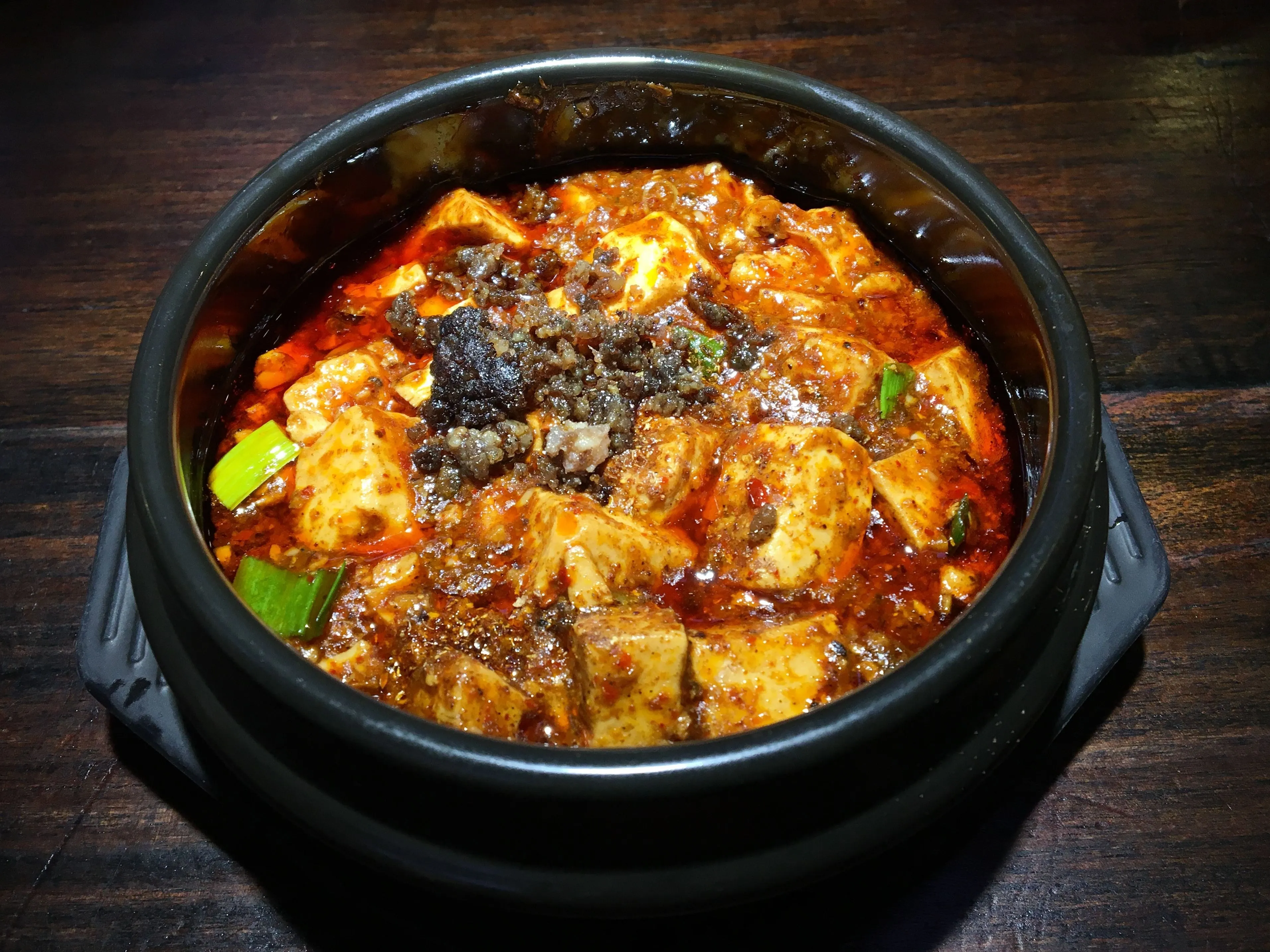 Mapo tofu in Chengdu — silken tofu cut into cubes that barely hold their shape, sitting in red oil with minced beef and fermented broad bean, served still bubbling in the black clay pot it was cooked in so the numbing pepper lands a second after the chilli. | ||
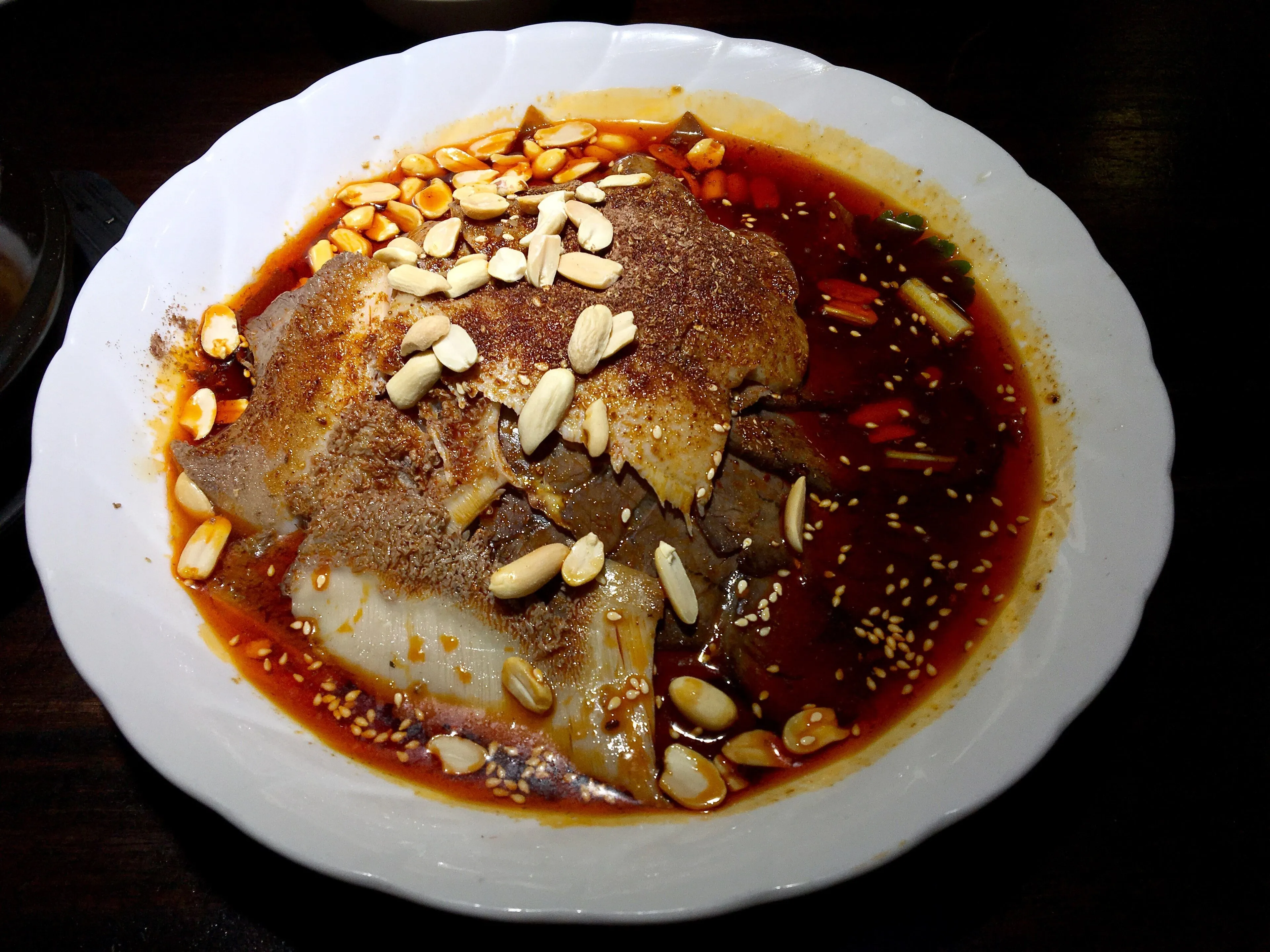 Fuqi feipian in Chengdu — beef shank and offal sliced thin, laid over a pool of chilli oil and buried under peanuts and sesame; it is served cold, which is why the meat stays firm and the oil reads as fragrance rather than heat. | ||
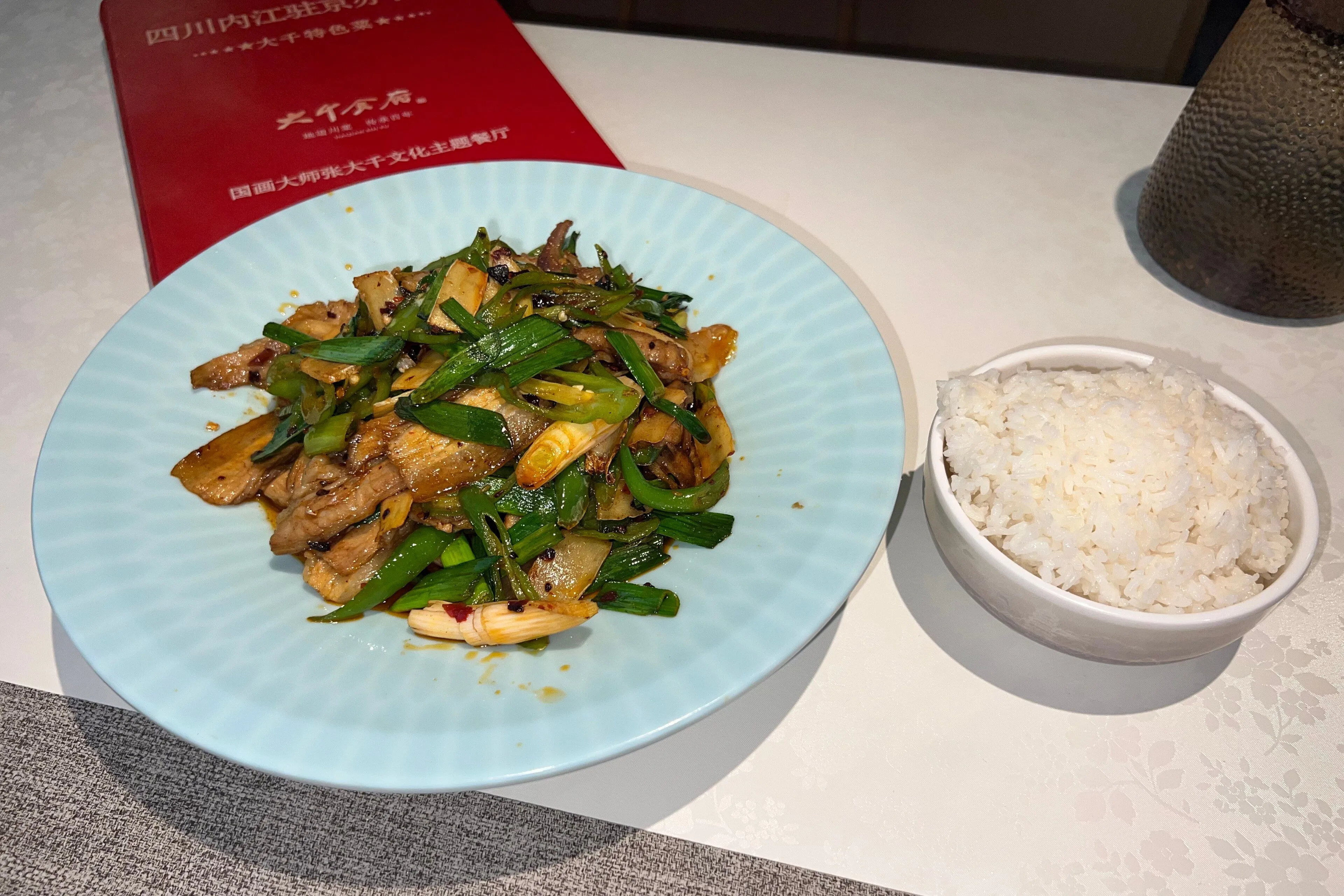 Twice-cooked pork in Chengdu — belly boiled first, then stir-fried until the edges curl and the fat turns translucent, here with garlic shoots and a bowl of plain rice; those curled edges are the sign the wok was hot enough. | ||
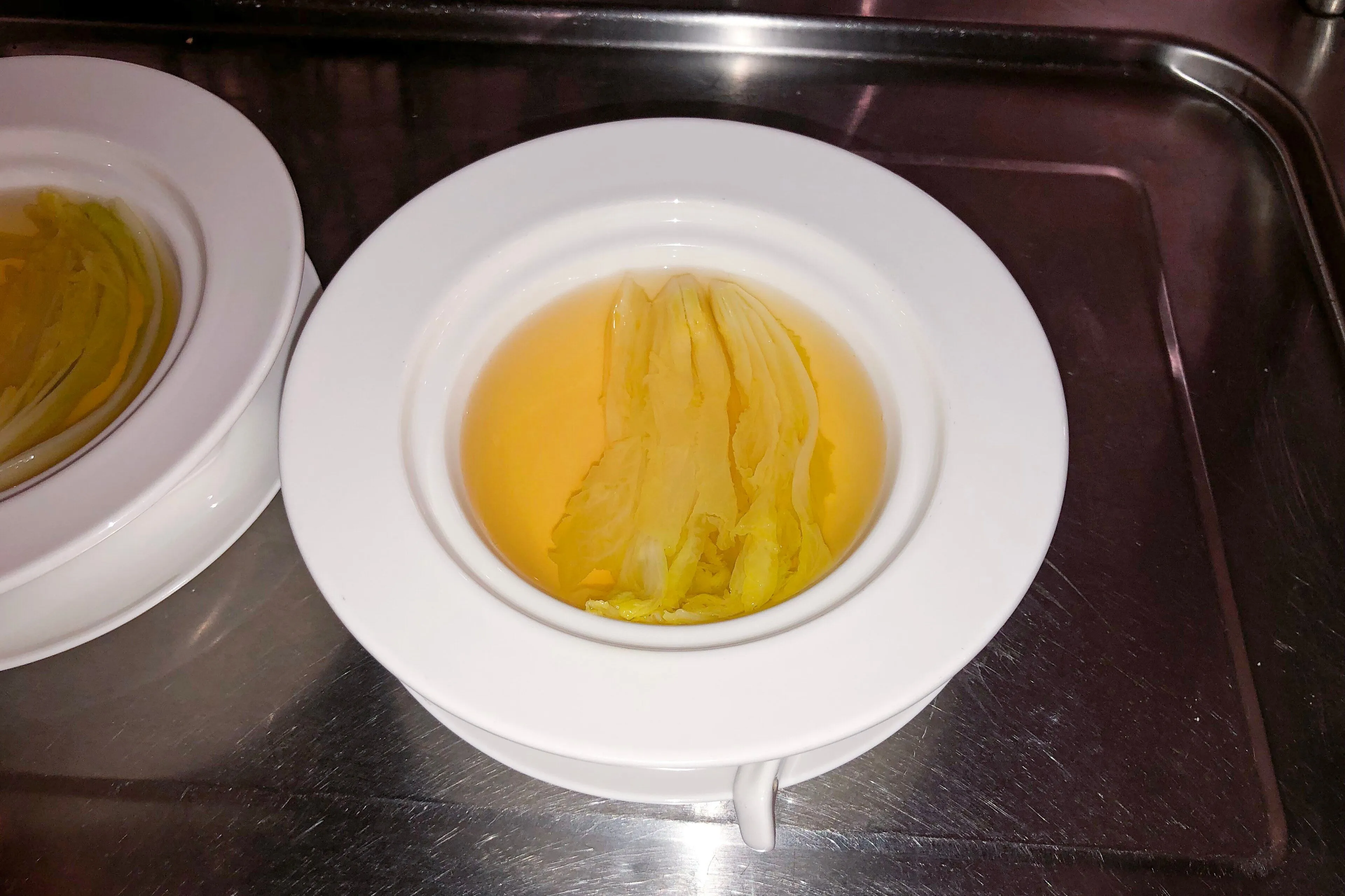 Kaishui baicai in Chengdu — one cabbage heart floating in a broth so pale you can see the ribs through it, though it tastes of long-simmered chicken; the dish exists to prove a kitchen’s stock, which is why it is ordered next to the chillies. | ||
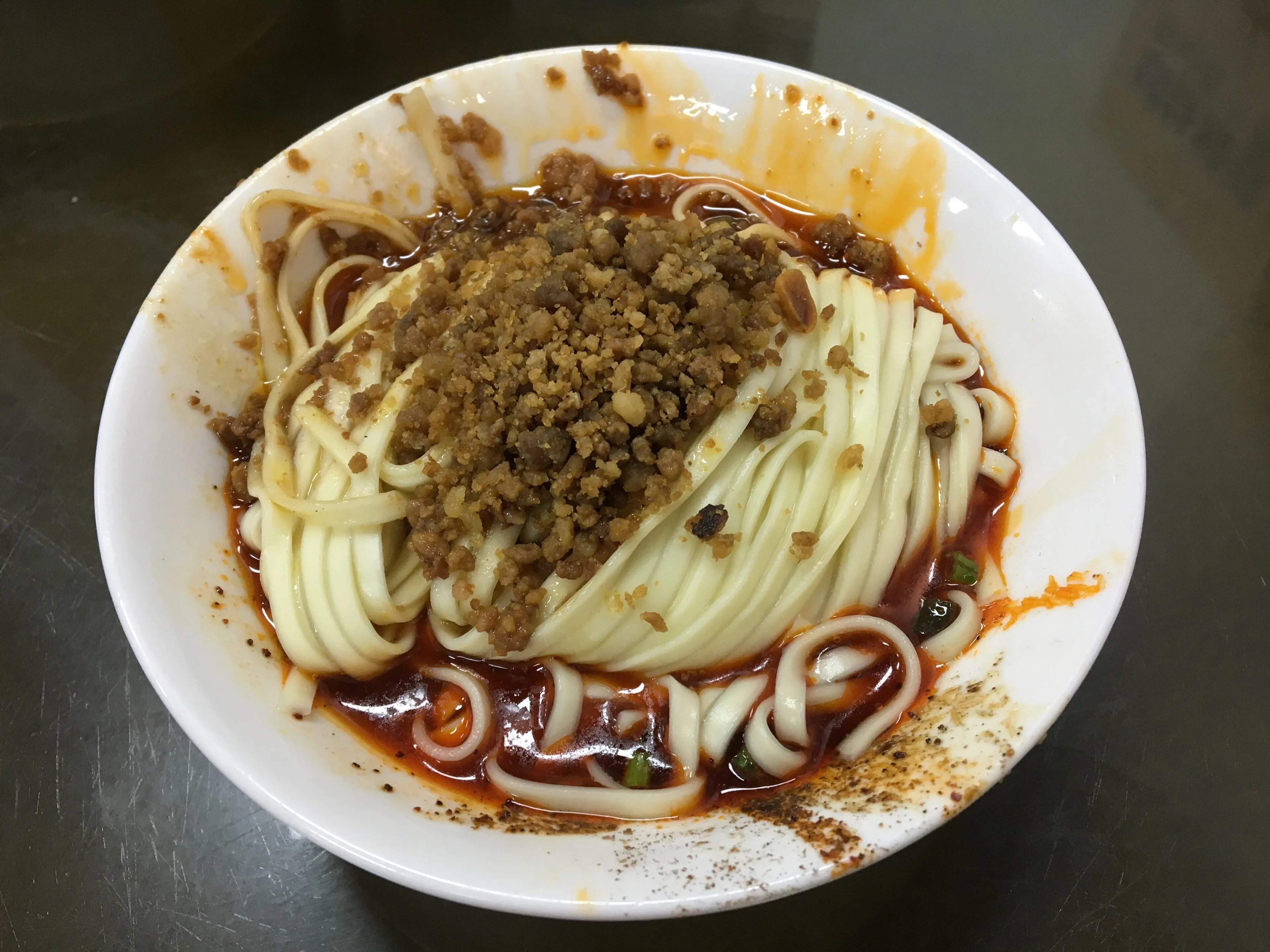 Dan dan noodles in Chengdu — a small bowl with no soup at all, the noodles tossed in sesame paste and red oil under a crumble of minced pork; mix hard before the first bite, and note the bowl is deliberately small so the sauce-to-noodle ratio stays high. |
Also look for 龙抄手 lóng chāoshǒu (wontons in clear broth) and 赖汤圆 lài tāngyuán (sweet glutinous dumplings), the paired old snack names, plus 蛋烘糕 dànhōng gāo, a small pancake cooked to order, sweet or savoury.
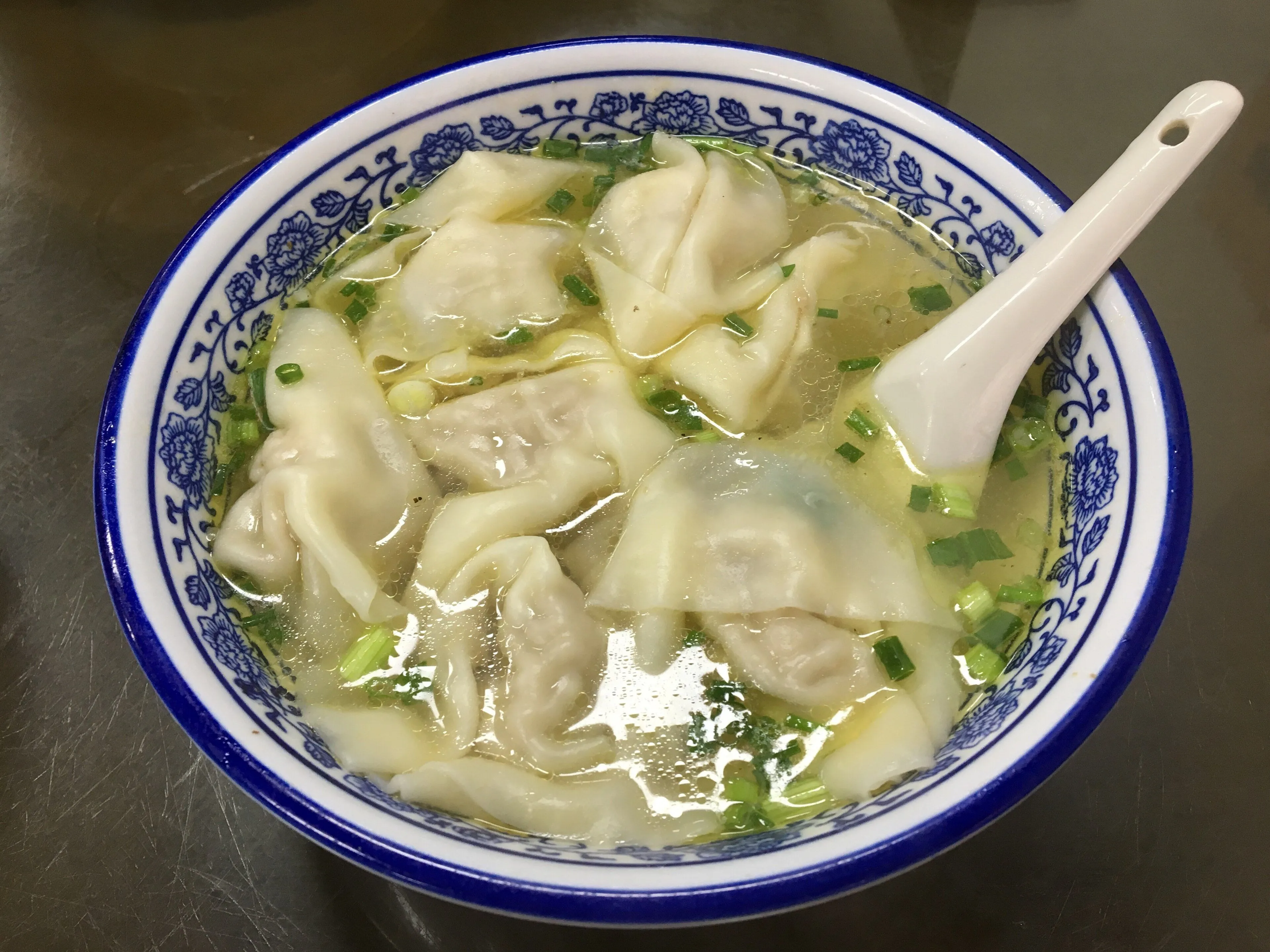 Long chaoshou in Chengdu — pork wontons with skins thin enough to show the filling, served in a clear broth with nothing but chopped scallion; the classic alternative is the same wontons dressed in red oil, and regulars order one of each.
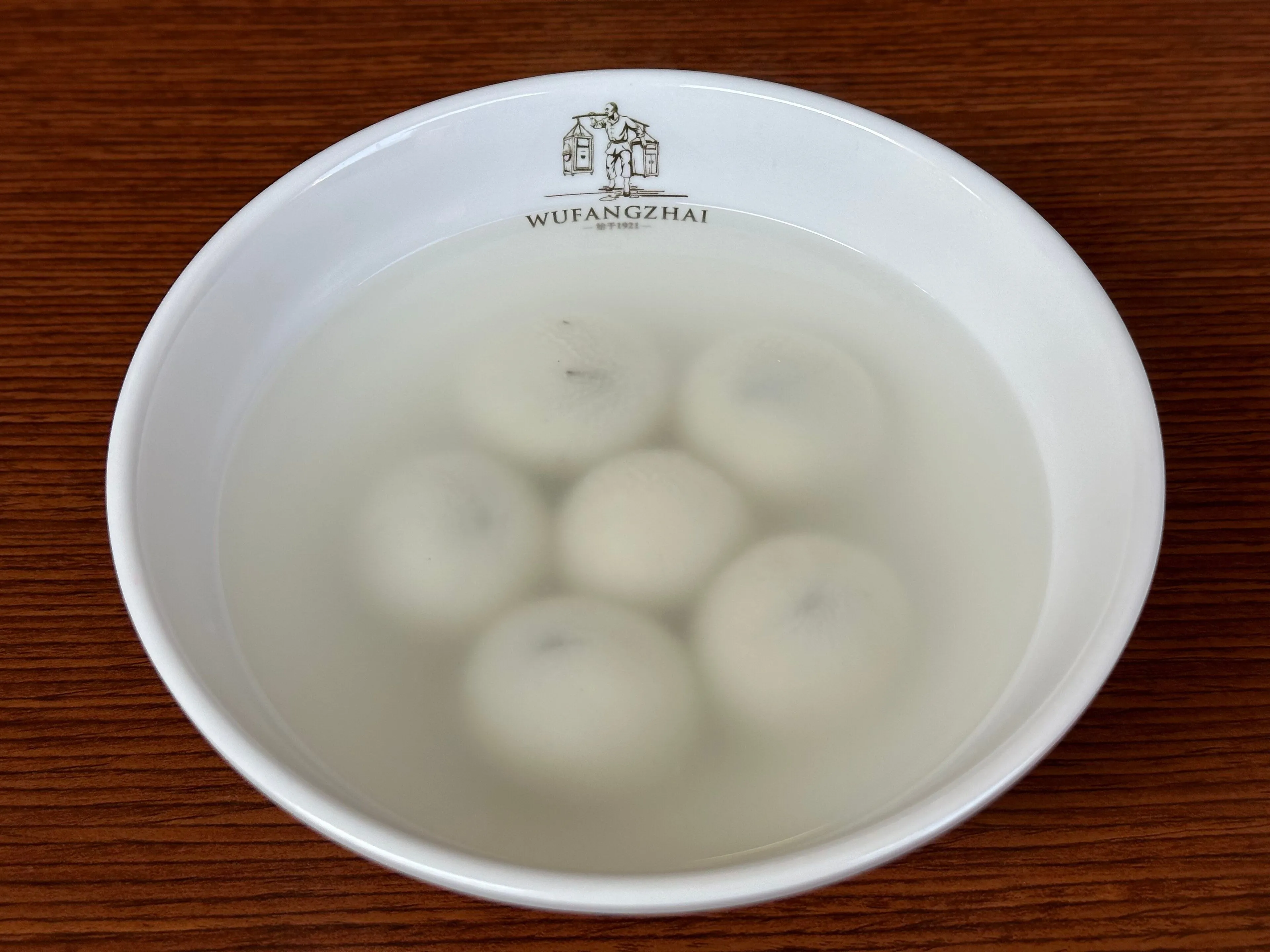 Tangyuan in Chengdu — glutinous rice balls with a sweet sesame centre, served warm in the cloudy water they were poached in rather than in a syrup; bite first and carefully, because the filling comes out molten.
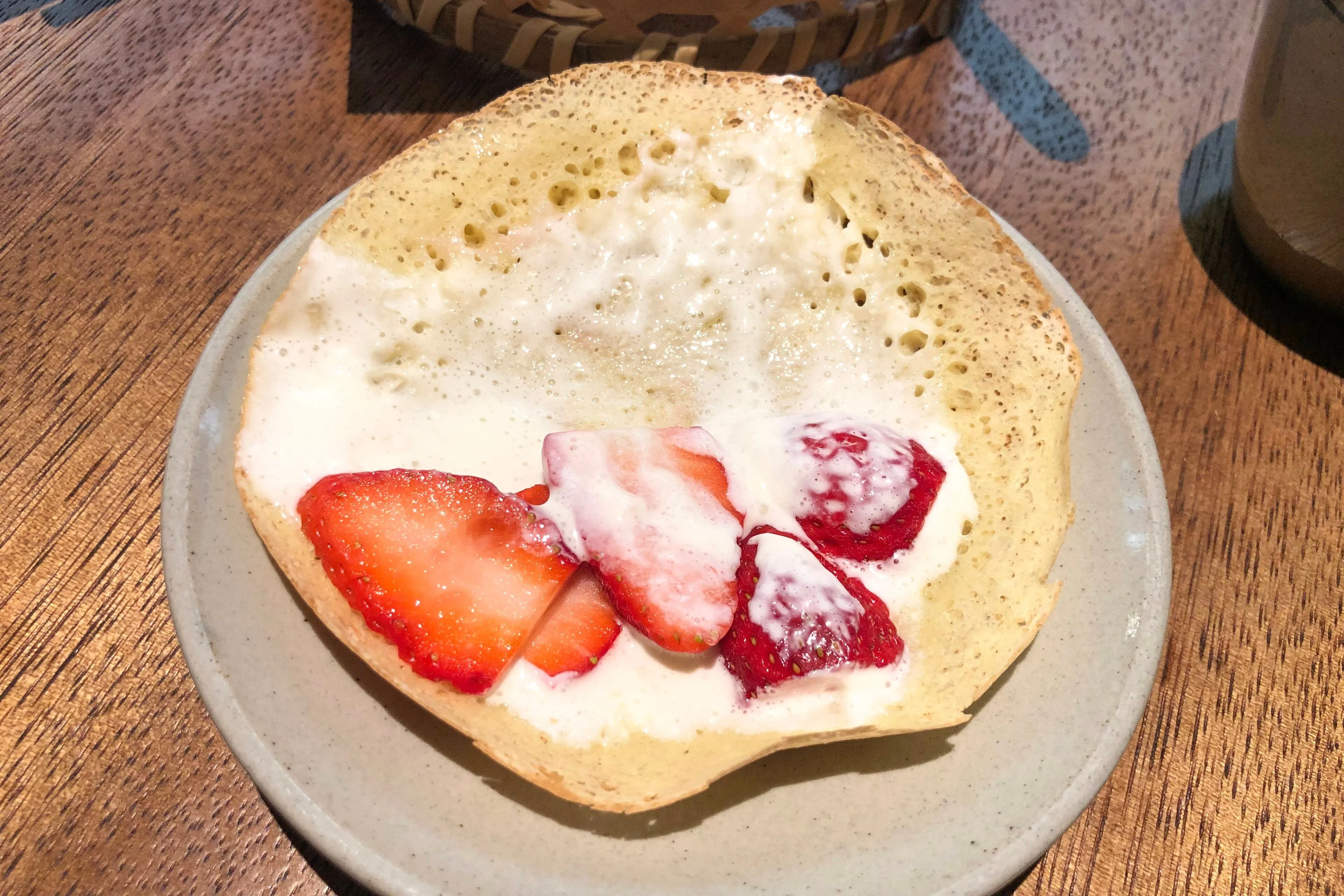 Danhonggao in Chengdu — a rice-flour and egg batter cooked to order in a small lidded pan, which is why the rim frills and the middle stays soft; this one is folded over whipped cream and sliced strawberry, the modern sweet reading of a snack that also comes savoury.
Where to eat. Jinli Ancient Street, beside the Wuhou Shrine, is free to enter and open around the clock, with its Nine-Rank Snack Street lining up the classics in one row. Kuanzhai Alley — Wide, Narrow and Well Alleys — is also free to enter and open all year. For a locals’ evening, the night-market strips of Jianshe Road and Kuixinglou Street and Yulin Road in the south are where small kitchens cluster; Wenhuafang concentrates the old snack names. Yipintianxia in Jinniu district is the purpose-built high-end dining strip.
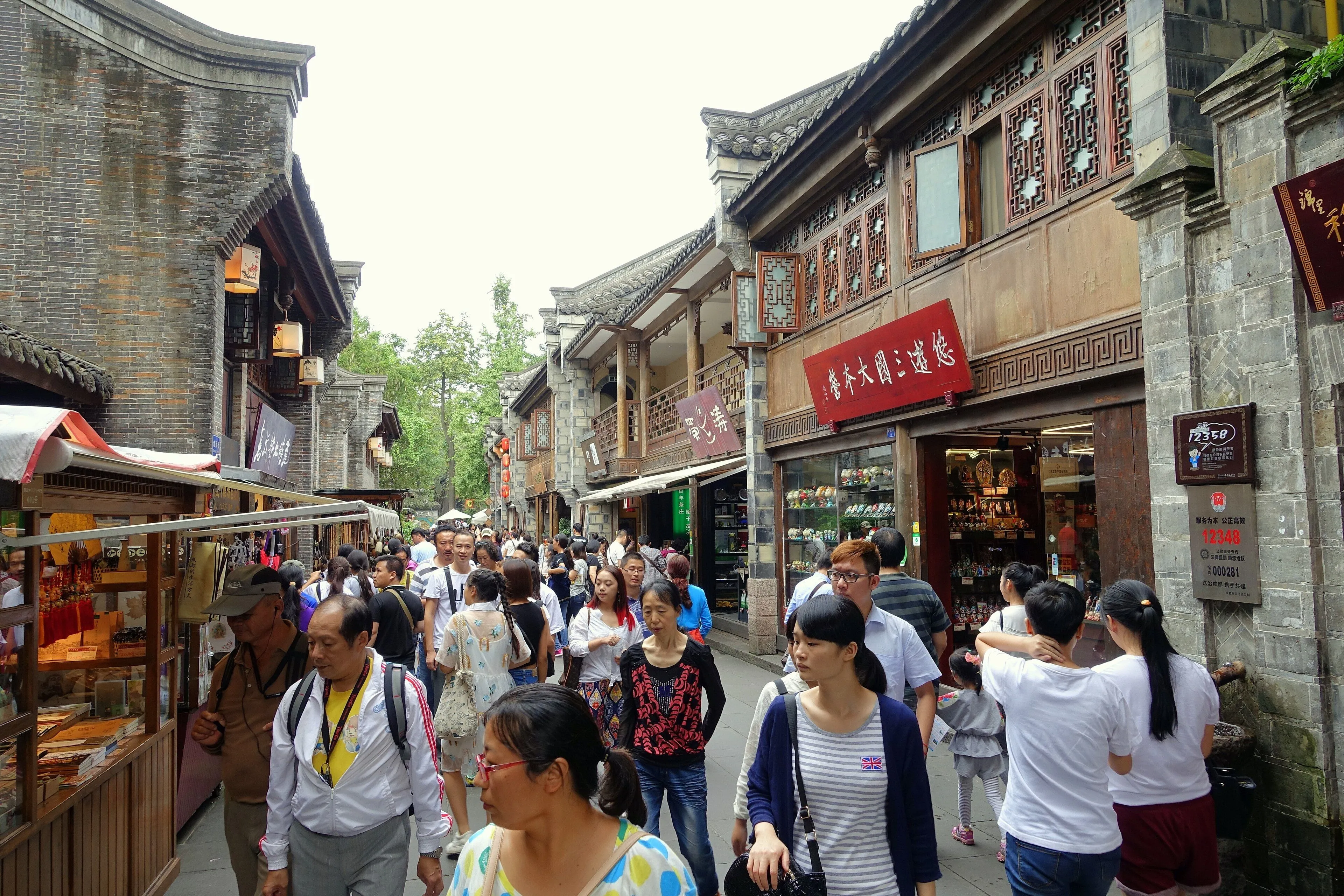 Jinli Ancient Street in Chengdu — rebuilt Qing-style shophouses on both sides of a single lane, souvenir counters at the front and snack stalls behind; come early, because by mid-morning the lane is packed shoulder to shoulder.
Hotpot note: Chengdu leans toward clear-oil broth and the local suobian fish hotpot, not Chongqing’s tallow-red style. Chengdu’s hotpot houses also multiplied only after the reform era; the trade places hotpot’s origin on the Chongqing docks.
What it costs. Hotpot is the headline act: expect to pay around ¥80–150 per person at a sit-down hotpot house. Chuanchuan (skewers) is the budget version at roughly ¥40–80. Street snacks like danhonggao cost just a couple of yuan each.
Spice: moderate and adjustable — the cuisine can be fierce, but this is the mild end of Sichuan, and a whole class of its finest dishes has no chilli. Vegetarian: good — dry-fried green beans, fish-fragrant aubergine, vegetable malatang, Jinli’s sweet snacks. Halal: we could not verify reliable listings; assume limited.
Build the rest of the trip from the Chengdu Travel Guide, adding Chengdu Giant Panda Base or Mount Emei and the Leshan Giant Buddha — Leshan being part of the same Upper River tradition.
Chongqing — Hotpot’s Birthplace, and a City of Design
The most muscular food city here and the most mislabelled: Chongqing is a City of Design. Its food credentials come from elsewhere entirely, and they are formidable.
The city’s 2026 hotpot-industry regulation — China’s first local law dedicated to a hotpot industry — defines Chongqing hotpot as a hotpot type originating in Chongqing, made with a base prepared by distinctive stir-frying, simmering and blending techniques, whose representative flavour is numbing-hot-fresh-fragrant, expressing the food culture of the Ba-Yu region. That is the definition to quote in English. The same law targets recognition as a World Hotpot Capital by 2035.
| Dish | Pinyin | What it is |
|---|---|---|
| 重庆火锅 | Chóngqìng huǒguō | Red broth of beef tallow, chilli and Sichuan pepper; dip tripe, throat, duck intestine and blood curd |
| 重庆小面 | Chóngqìng xiǎomiàn | A “small noodle” built on soy sauce, chilli oil, ground Sichuan pepper, lard and crushed peanuts — plain, or topped with zhajiang or braised beef |
| 歌乐山辣子鸡 | Gēlèshān làzǐjī | Crisp-tender chicken cubes you hunt for inside a plate of dried chillies |
| 万州烤鱼 | Wànzhōu kǎoyú | Charcoal-grilled fish finished in a tallow-and-chilli base with tofu and celery |
| 毛血旺 | máo xiěwàng | Duck blood curd with tripe, eel and luncheon meat; formalised in the Yu cuisine standards |
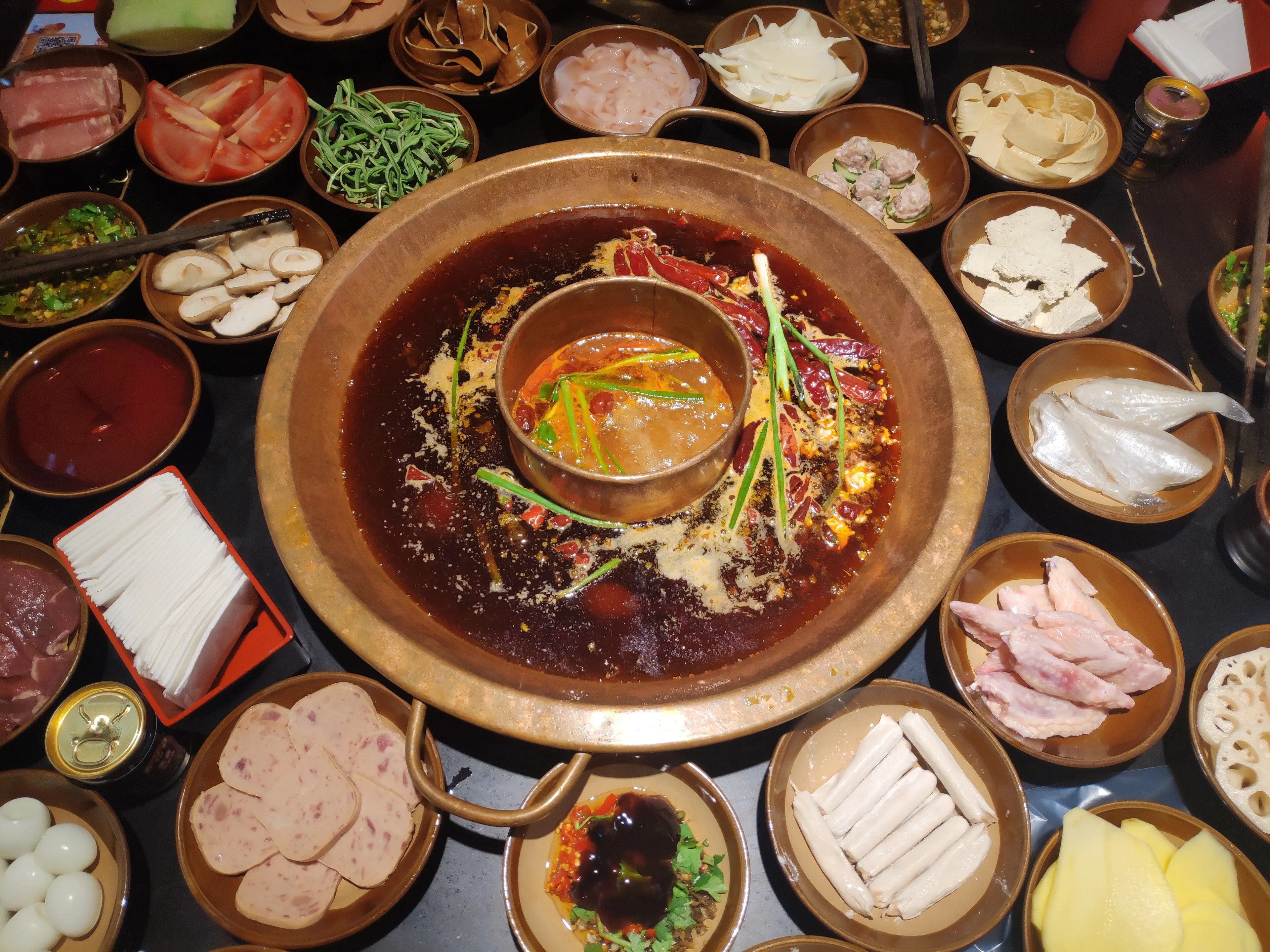 Chongqing hotpot — a brass pot of beef-tallow broth dark with chilli and Sichuan pepper, with a small clear-broth ring set into the middle for anyone at the table who needs a retreat; everything else arrives raw on small plates to be dropped in and fished out by the diner. | ||
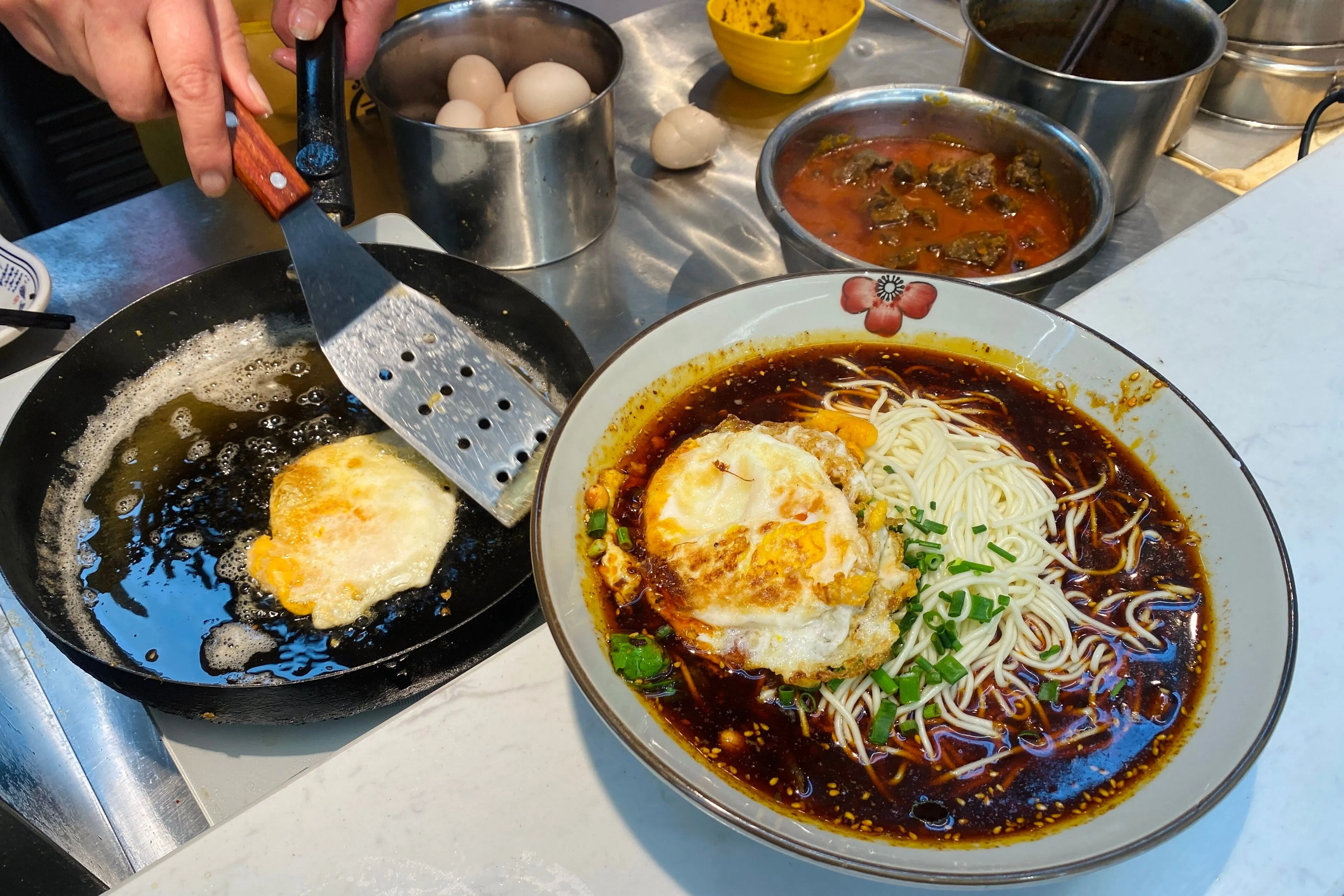 Chongqing xiaomian — thin wheat noodles in chilli oil, soy and ground pepper with almost no broth, a fried egg cooked to order on the griddle behind going on top; the egg is the usual addition, not a garnish. | ||
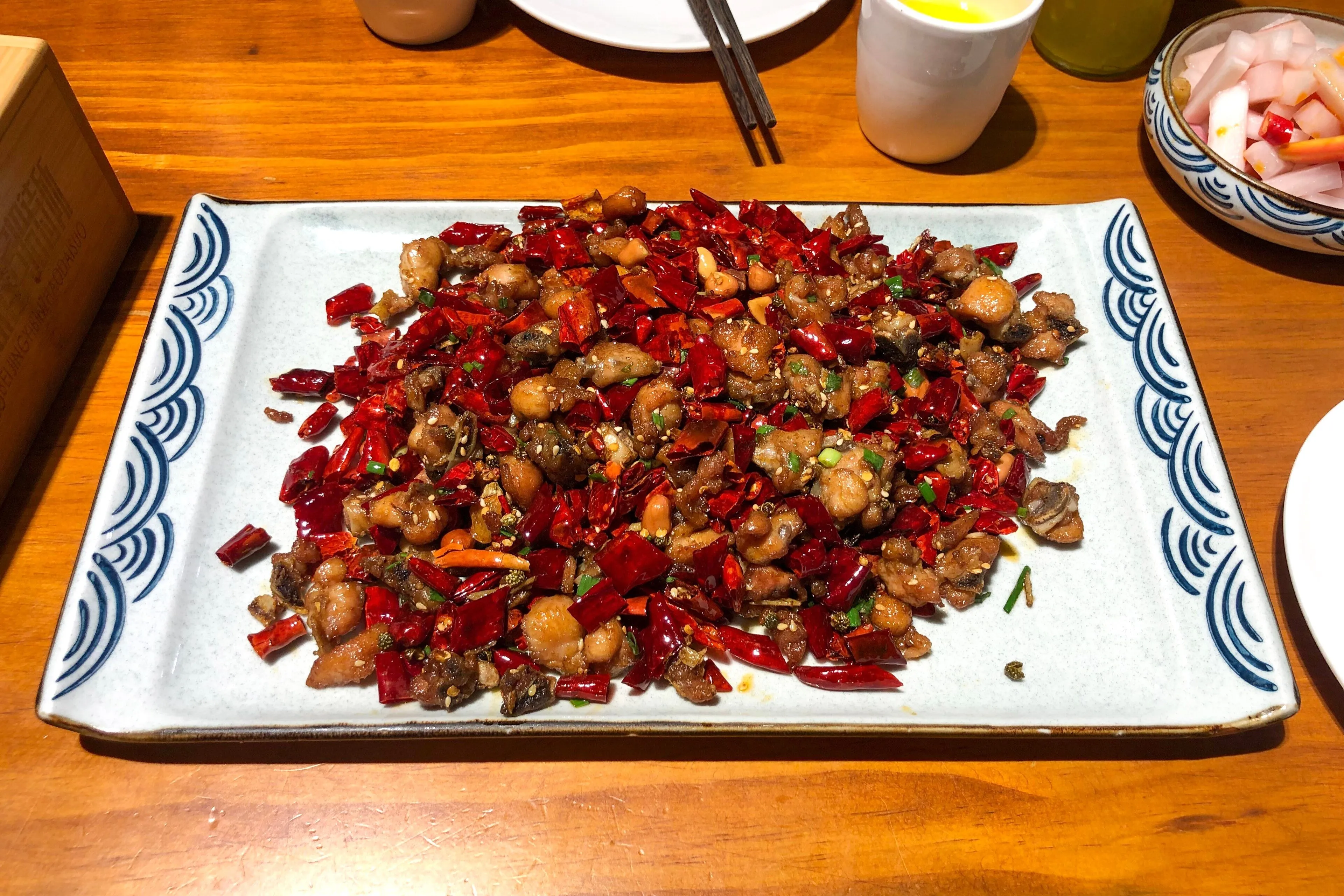 Geleshan laziji in Chongqing — chicken chopped into thumbnail cubes, fried twice for a dry crisp crust and buried in dried chillies at roughly one chilli to one piece of meat; the pleasure is the hunt, and the meat is far less fiery than the chilli count suggests. | ||
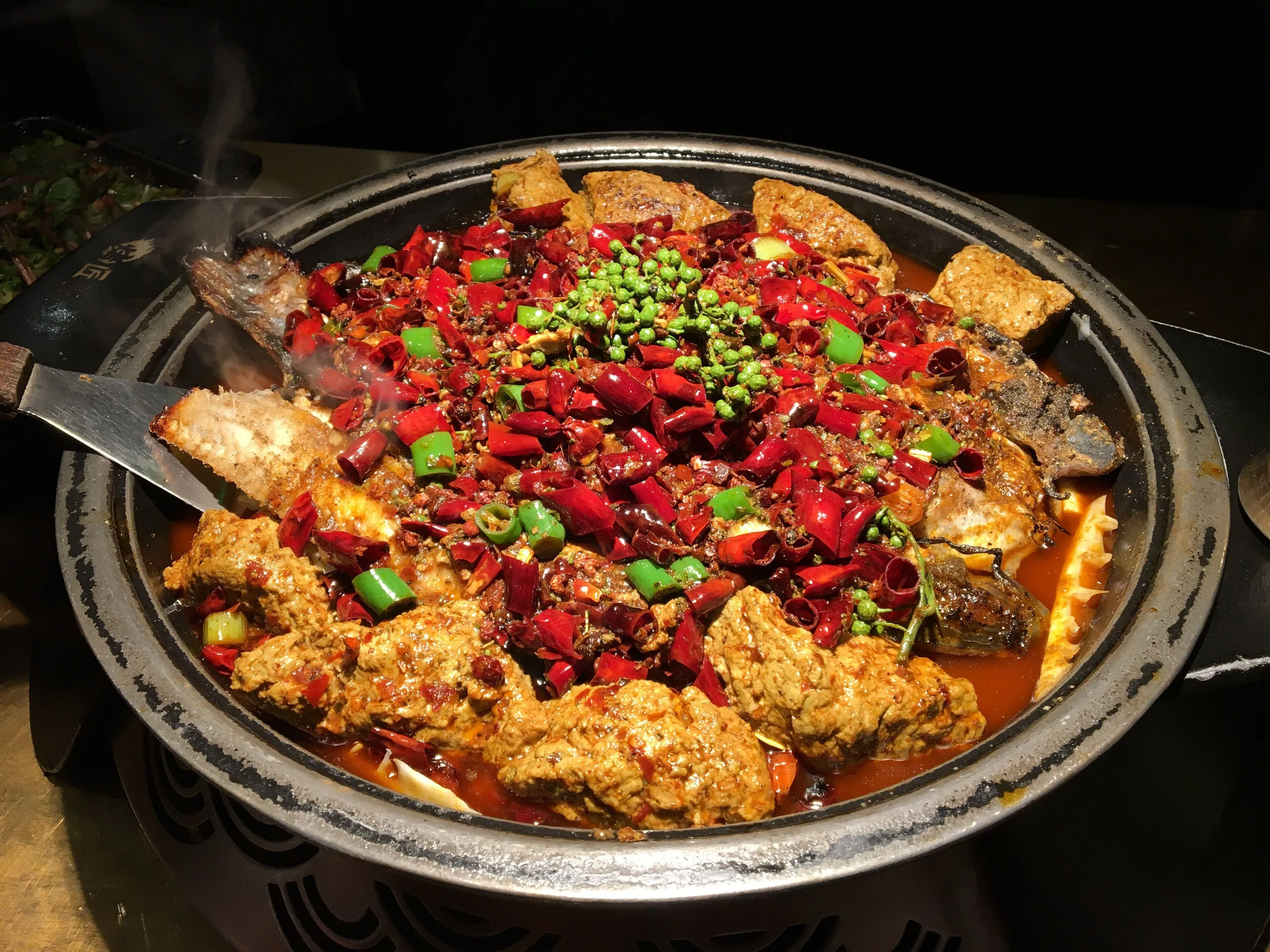 Wanzhou kaoyu in Chongqing — a whole fish grilled over charcoal, then finished in a shallow pan of tallow and chilli with fresh green Sichuan pepper, tofu and celery; it stays on the burner, so the sauce tightens as you eat. | ||
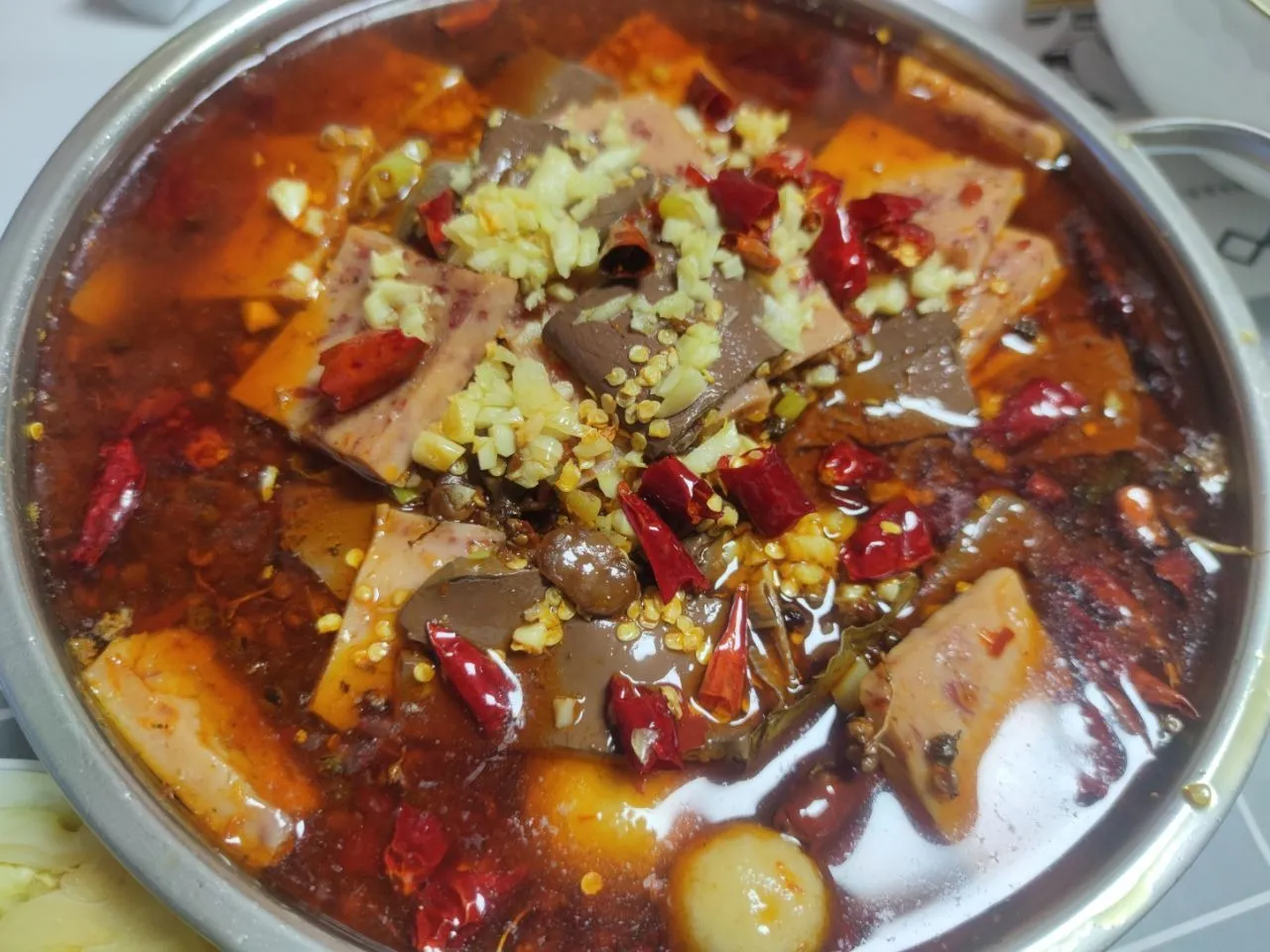 Maoxuewang in Chongqing — duck blood curd cut into slabs with luncheon meat and tripe in a dark chilli-oil broth, finished with a heap of raw minced garlic that half-cooks in the heat; good blood curd is set firm enough to hold on the chopsticks without breaking. |
Where to eat. Around Jiefangbei, Bayi Road is the densest snack street in the central district, and the lanes off Zou Rong Road and Minquan Road hold the old hotpot houses and noodle shops — local guidance is that the deeper the alley, the more authentic the kitchen. Jiaochangkou is known for late-night eating, including hotpot in converted air-raid tunnels. Hongyadong stacks Bayu food across its levels.
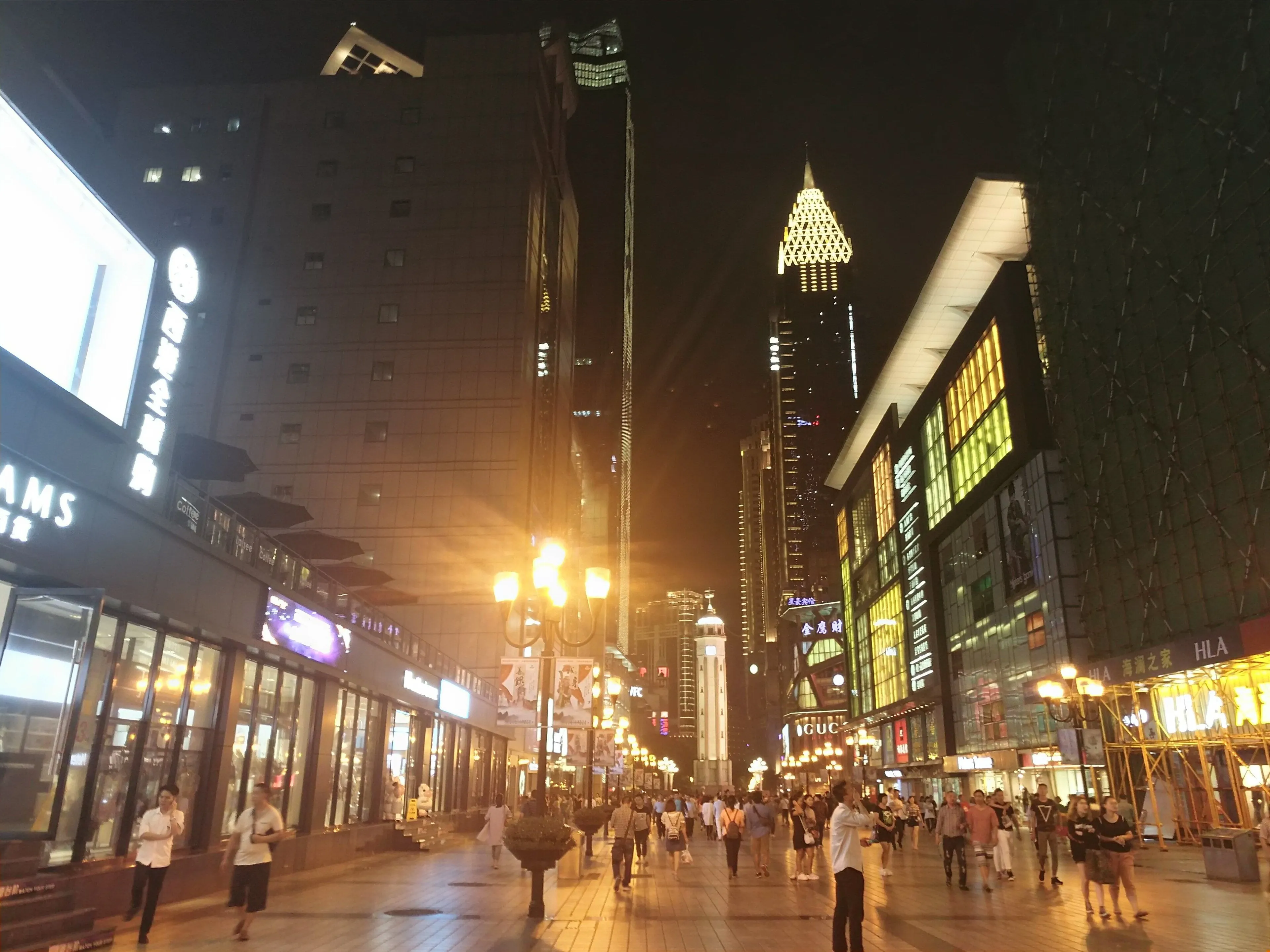 Jiefangbei after dark — the pedestrian mall itself is department stores and neon, and the eating is in the lanes behind it: Bayi Road for snacks, Zou Rong Road and Minquan Road for the older hotpot rooms.
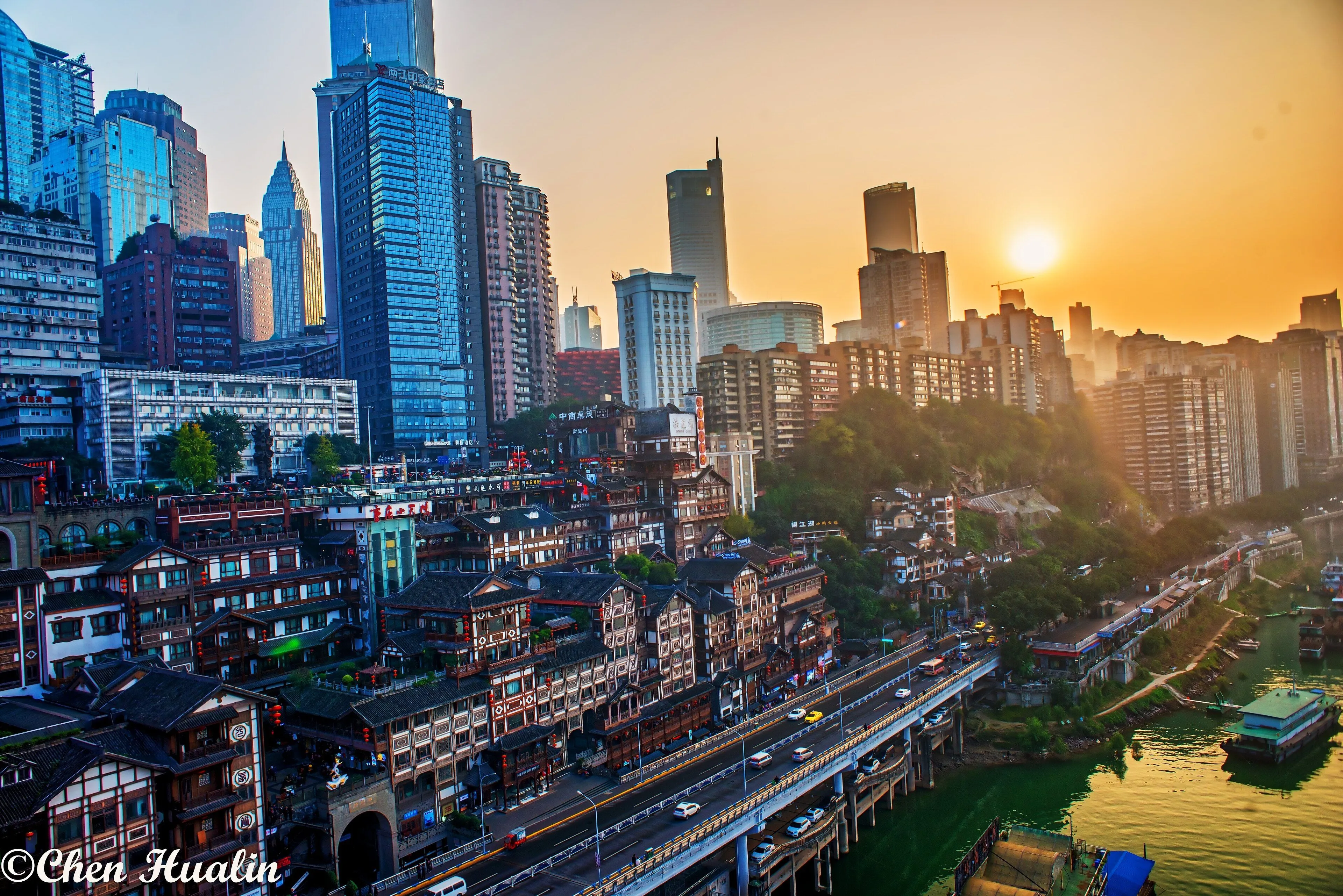 Hongyadong at dusk from the bridge — stilt-house tiers stacked up the cliff face, every level a restaurant or snack stall, photographed in the last light before the lanterns come on and the tour groups arrive.
What it costs. Neighbourhood hotpot is one of China’s best-value meals — roughly ¥50–85 a head at old community joints, while scenic-area and social-media-famous spots run ¥100–150. Budget under ¥100 and you’ll eat well; a bowl of xiaomian costs just a few yuan.
Spice: the highest here. This is the city that eats hotpot through the dog days of summer, outdoors, with iced beer. Vegetarian: limited but workable — douhua fan, cold noodles, cold jelly and steamed gege, though the broth is the problem. Halal: not verified; assume limited. For the city beyond the pot, see Chongqing Travel Guide.
Guangzhou — Where Cantonese Cooking Lives
Start with the proverb: “Eat in Guangzhou, the cooks come from Fengcheng” (食在广州,厨出凤城). Fengcheng is Shunde, today a district of Foshan — which is why Guangdong’s UNESCO gastronomy city is Shunde (2014) and not Guangzhou. Guangzhou is not in the network at all. That makes it the home base, not the lesser city.
What it cooks is Guangfu cuisine, also simply Guangzhou cuisine — the narrow definition of Cantonese. Its ideal is six words: clear, fresh, tender, smooth, crisp, fragrant. Soup is not optional: “better a meal without dishes than a meal without soup”, and on a banquet table soup arrives first. Order chicken and you are ordering into a serious tradition — 清平鸡 is called “Guangzhou’s number one chicken”, a white-cut bird poached in a plain master stock.
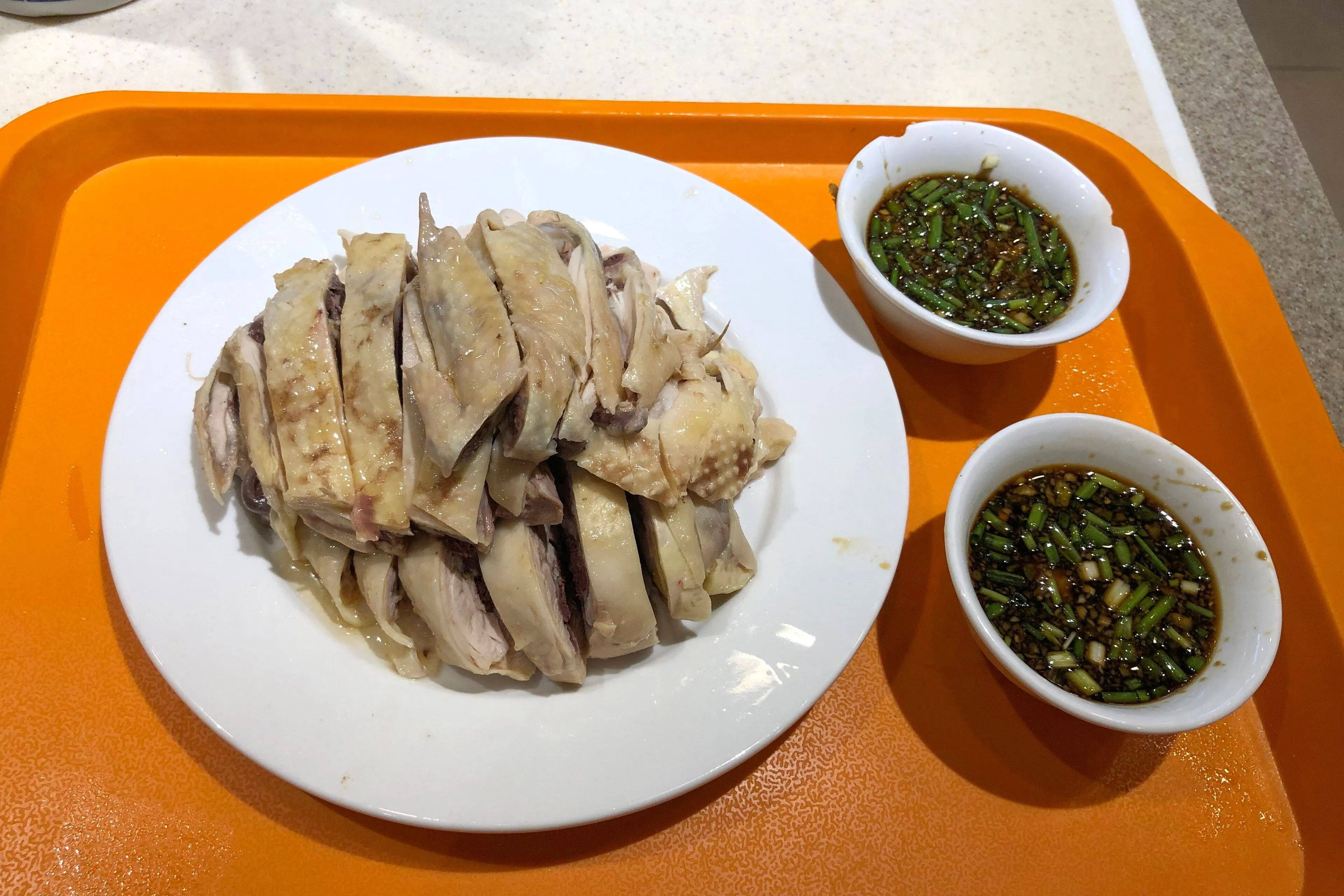 White-cut chicken in Guangzhou — a whole bird poached gently in a plain master stock and chopped straight through the bone, served at room temperature with two bowls of ginger-scallion oil; dip every piece, because the skin is the point and the ginger cuts its fat.
Because Guangzhou already has a dedicated guide here, we will not repeat its dish-by-dish work. For dim sum, the roast-meat counter, sweet-soup shops and restaurant names, read Guangzhou Food Guide; come back to this page for how Guangzhou compares with the other nine.
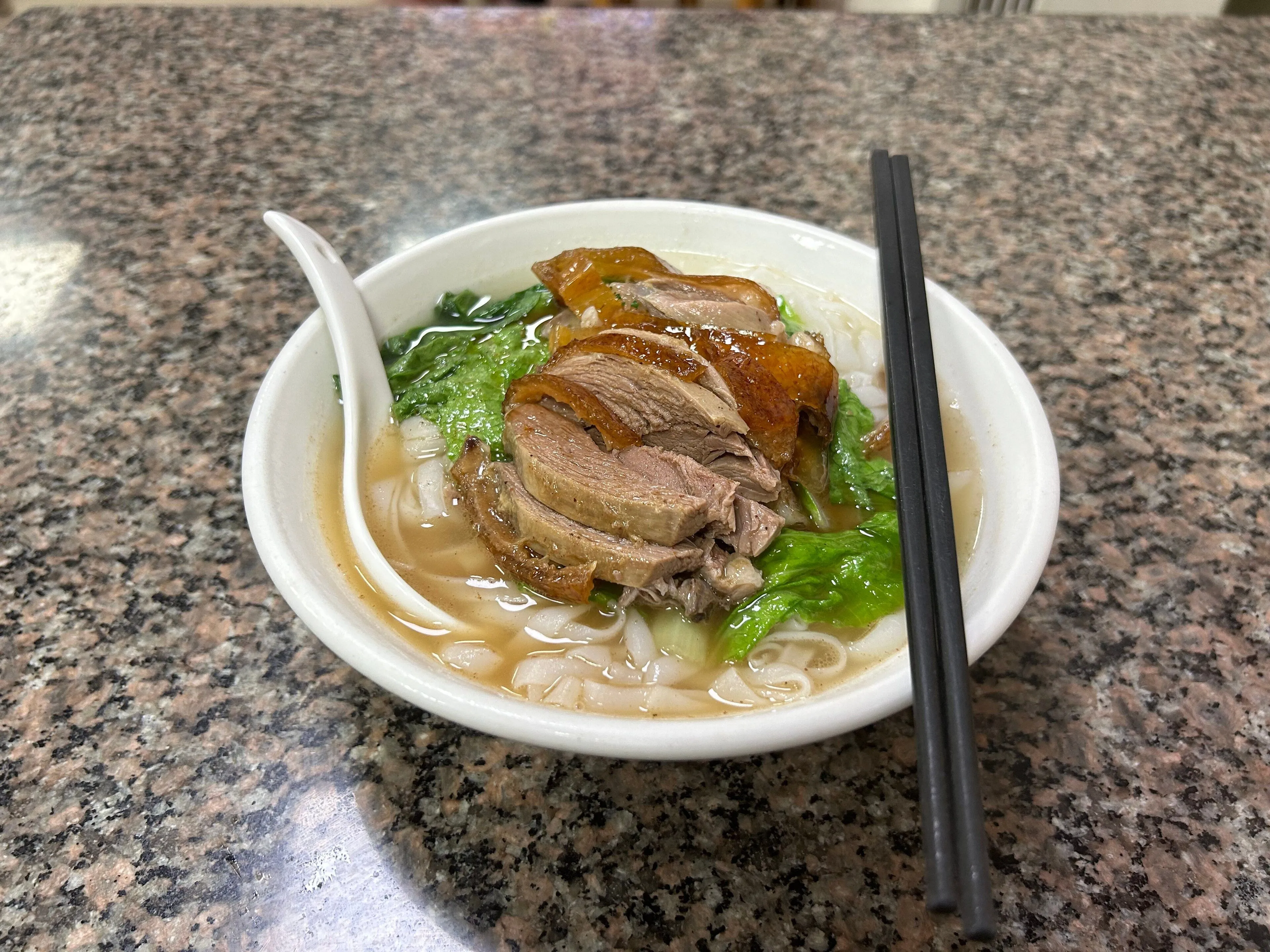 Roast duck noodles in Guangzhou — the bird carved off the bone and laid over rice noodles in a light broth with a few greens; the skin is crisp for the first few seconds and softens into the soup as you eat, which is how it is meant to go.
What Guangzhou alone adds: seasonality as a rule. The calendar is spoken in ingredients — bream in spring, carp in autumn, shad in summer, sea bass in deep winter; prawns fattest around Qingming; when the north wind rises, the flowering cabbage turns sweetest. If you want one sentence on why Cantonese cooking tastes as it does, that is it.
What it costs. Dim sum at a classic teahouse — Dian Dou De, Guangzhou Restaurant, Tao Tao Ju — typically runs ¥70–120 per person; neighbourhood teahouses can be as little as ¥30–55. Go before 11am, when many houses discount the early sitting.
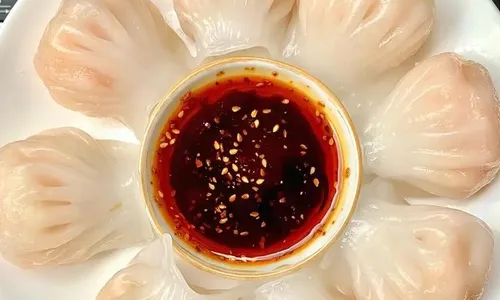
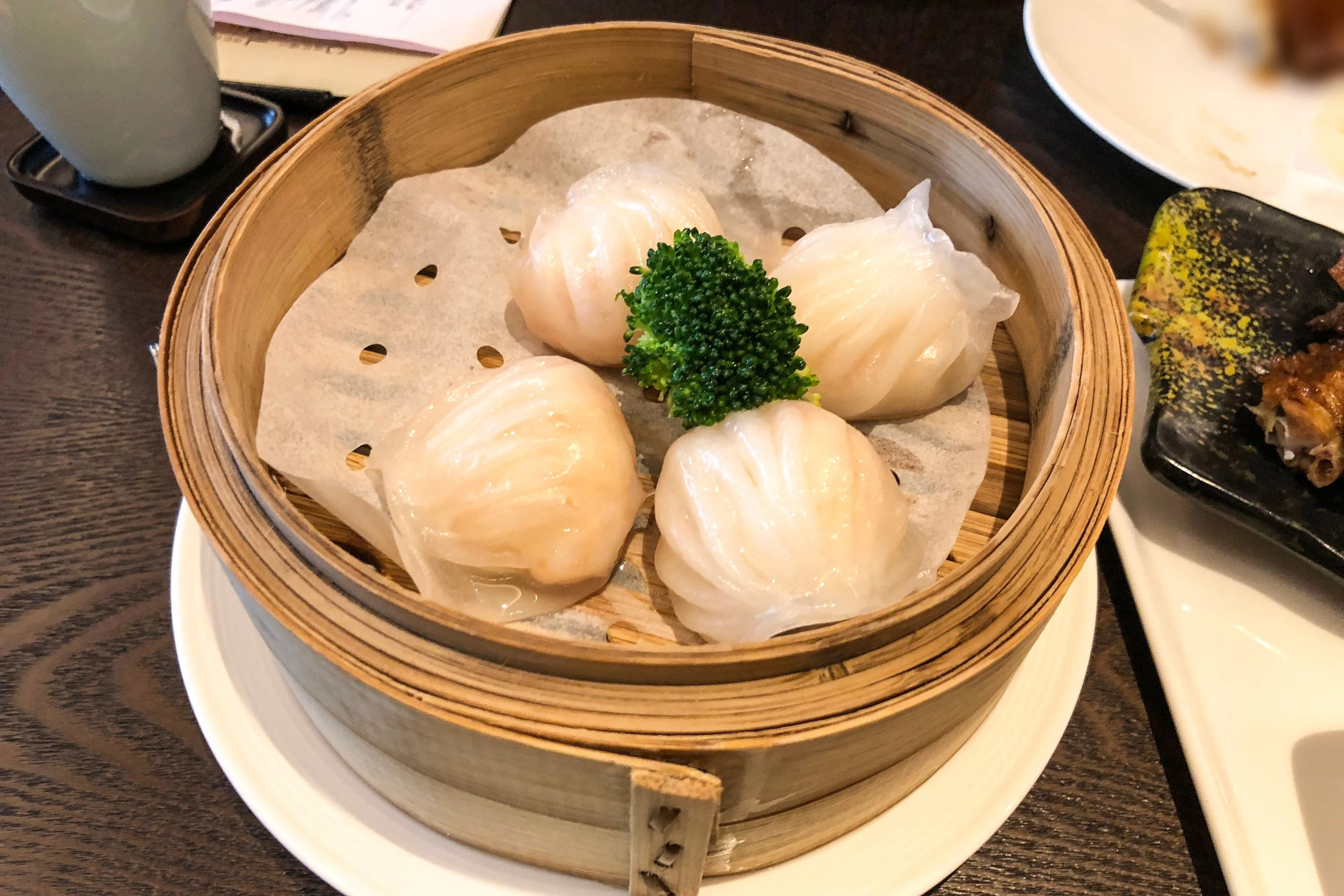 Har gow in a Guangzhou teahouse — prawn dumplings in a translucent wheat-starch skin, pleated by hand and steamed in a bamboo basket lined with paper; count the pleats, and eat them while the skin is still glossy and slightly tacky.
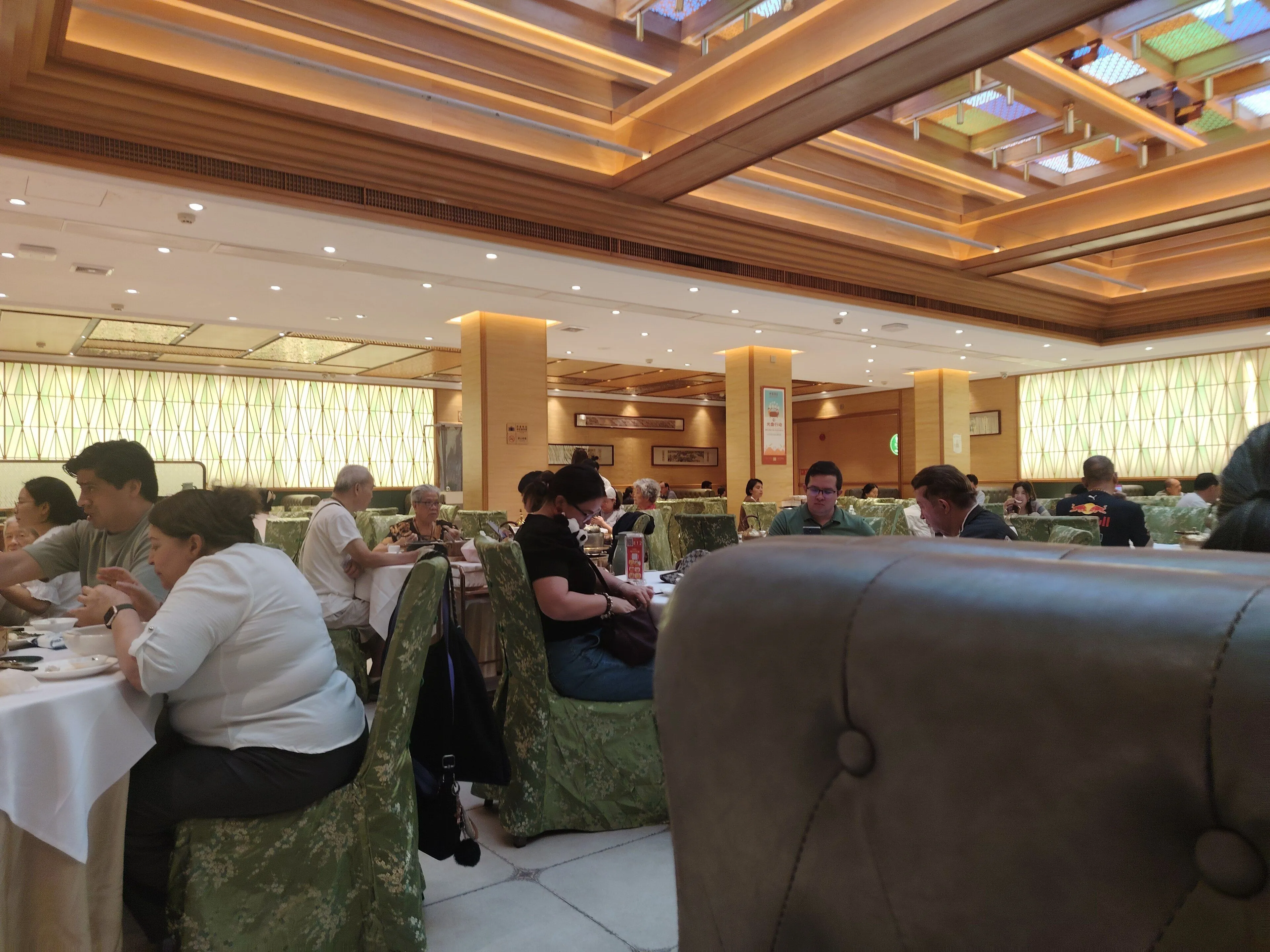 A Cantonese teahouse dining room in Guangzhou — round tables under a coffered ceiling, green upholstered chairs, pots of tea instead of a menu; the meal is a long morning of small plates and nobody hurries you out.
Spice: the mildest here. Vegetarian: strong — the vegetarian repertoire is complete and many dumplings are vegetable-filled. Halal: no reliable listings found; assume limited. Pair with the Guangzhou Travel Guide and Chinese Tea Culture and Night Markets.
Xi’an — China’s Oldest Cuisine, and Its Strongest Halal Scene
Xi’an cooks Shaanxi cuisine, also called Qin cuisine — not one of the Eight Great Cuisines, but described in Chinese sources as among the oldest in China. Its organising principle is the “three prominences”: the main ingredient is prominent (beef and mutton lead); the main flavour is prominent (one dish, one leading flavour); aroma is prominent — dried chillies, aged vinegar and Sichuan pepper fried in oil and often removed, giving fragrance without fierceness.
Qin cuisine is five strands: official-household, merchant, restaurant, home, and a minority-cuisine strand that is predominantly halal. That is why Xi’an is the strongest halal city here by a wide margin. (Its flavour keyword, in the provincial-government contrast quoted above, is salty-hot.)
| Dish | Pinyin | What it is |
|---|---|---|
| 羊肉泡馍 | yángròu pàomó | Mutton soup poured over bread you have torn into soybean-sized pieces; cooked to order, one ladle at a time |
| 腊汁肉夹馍 | làzhī ròu jiā mó | Pork simmered in a decades-old master stock, chopped into a flatbread described as “tiger-back, iron-ring, chrysanthemum-heart” |
| 葫芦鸡 | húlu jī | The representative Qin dish, hailed as “an ancient delicacy of Huaxia, the first flavour of Chang’an” |
| 水盆羊肉 | shuǐpén yángròu | Mutton in a wide bowl of broth with bread to soak as you go — the soupier ancestor of paomo |
| 岐山臊子面 | Qíshān sàozǐ miàn | Guanzhong’s noodle set, alongside buckwheat hele and cold-skin noodles |
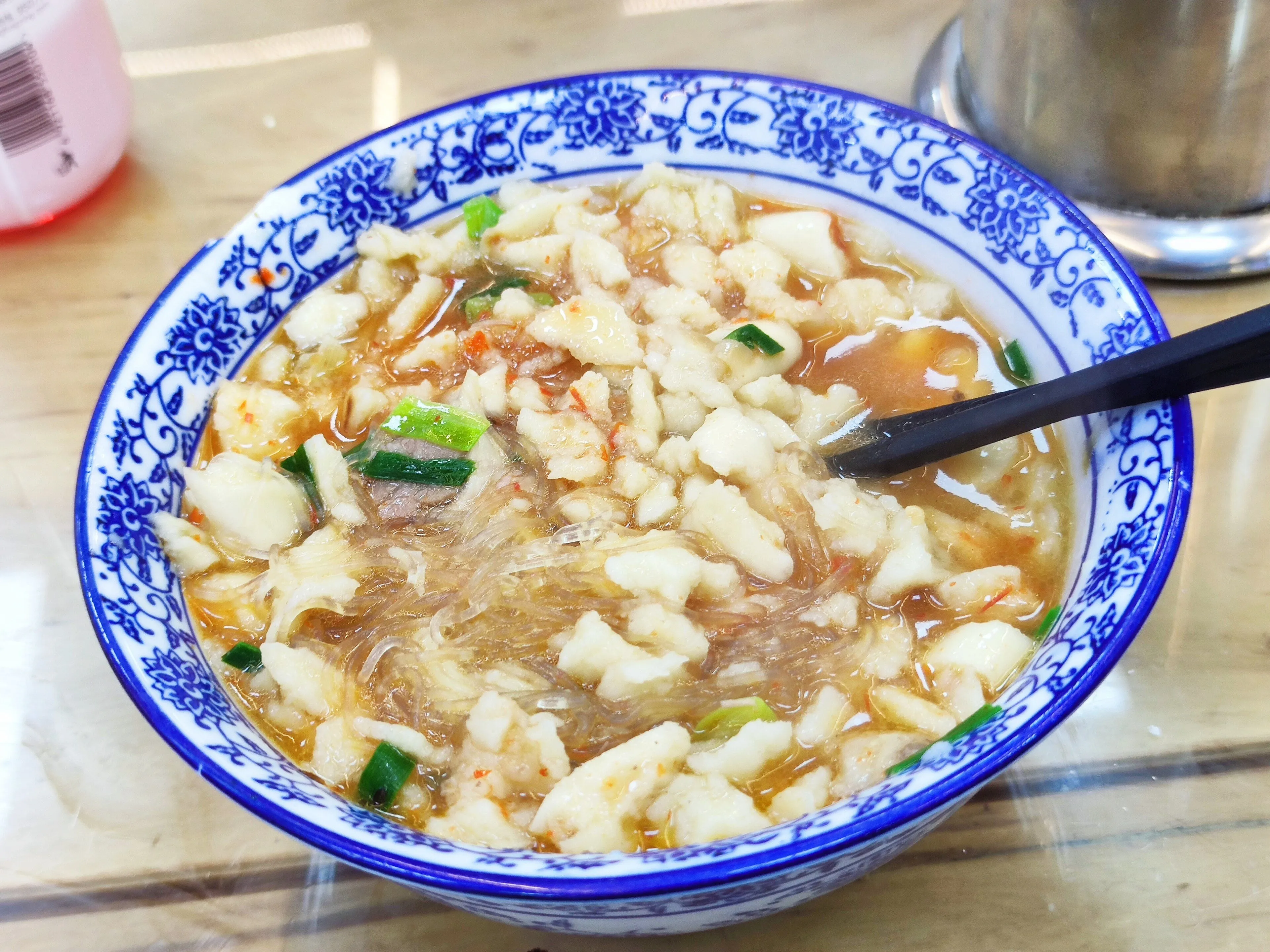 Yangrou paomo in Xi’an — bread you tore yourself, soaked in mutton broth with sliced mutton, glass noodles and coriander; the pieces should be soybean-sized, because the kitchen cooks them in the broth for as long as they take to soften. | ||
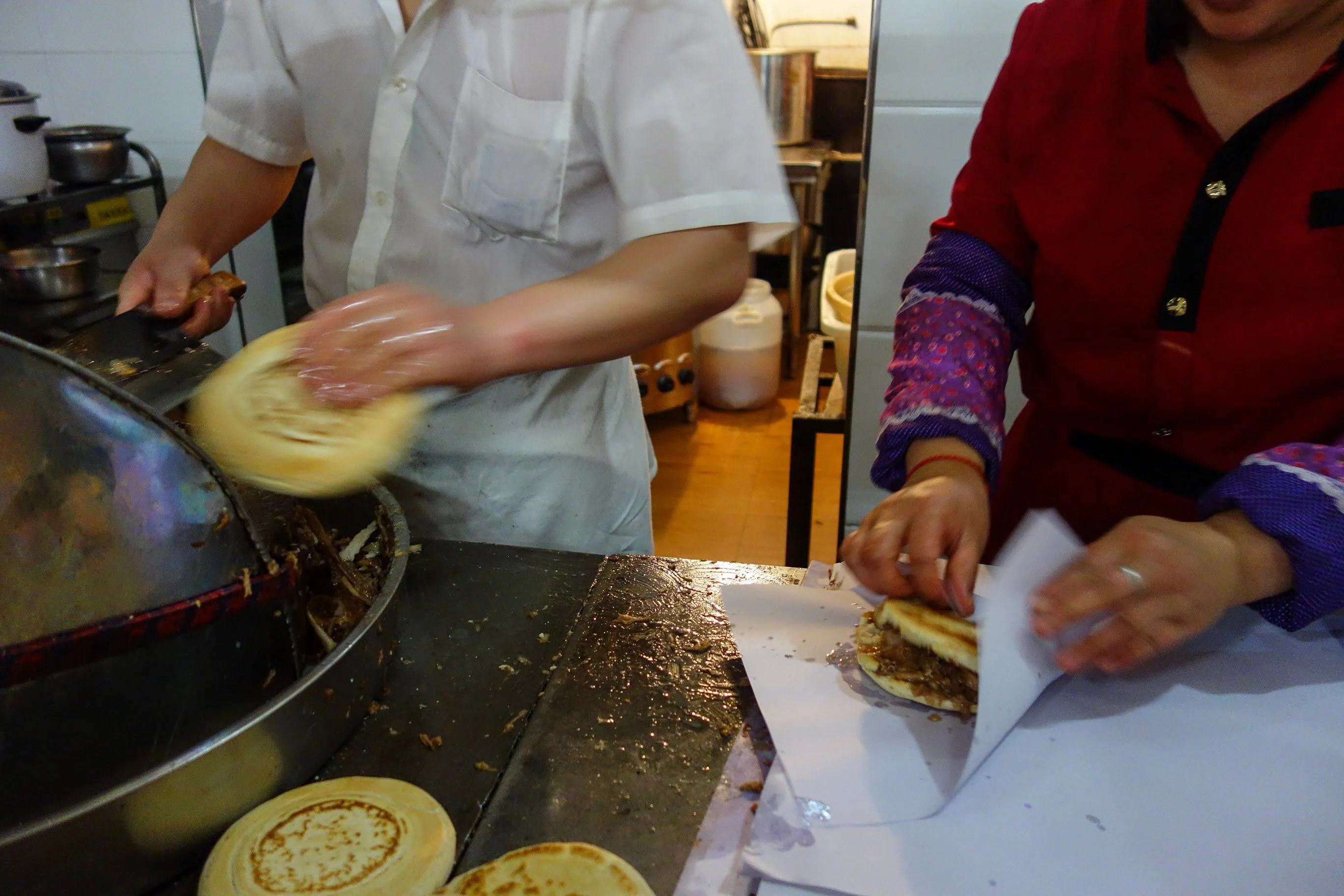 Roujiamo being made in Xi’an — the flatbread pressed against a hot griddle until it blisters, split open and packed with pork chopped out of a master stock, then wrapped in paper; eat it at once, while the bread still cracks. | ||
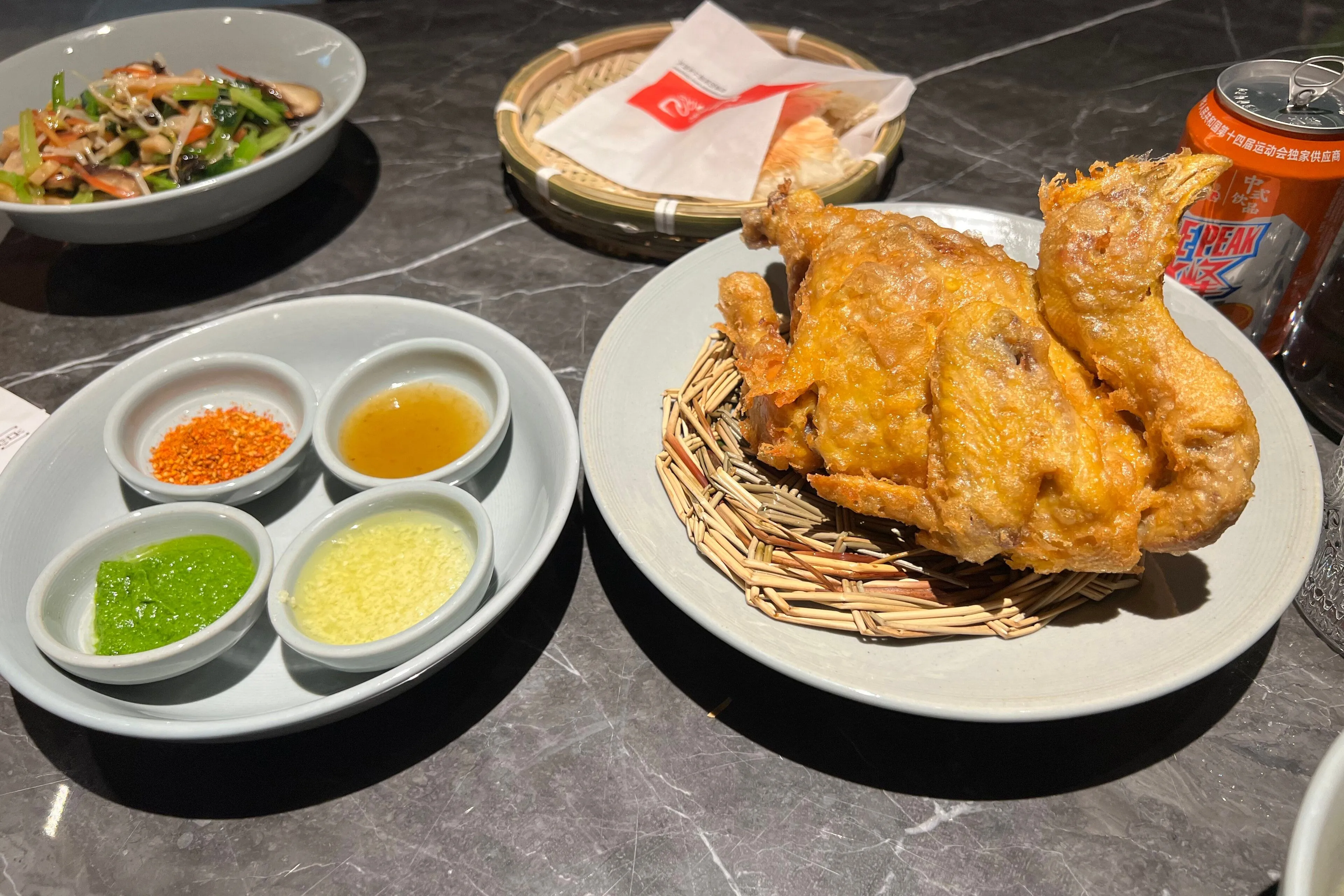 Hulu ji in Xi’an — a whole chicken trussed into a gourd shape, steamed then fried so the skin goes taut and amber, carved at the table and eaten with four saucers: chilli powder, vinegar, a green herb paste and minced garlic. | ||
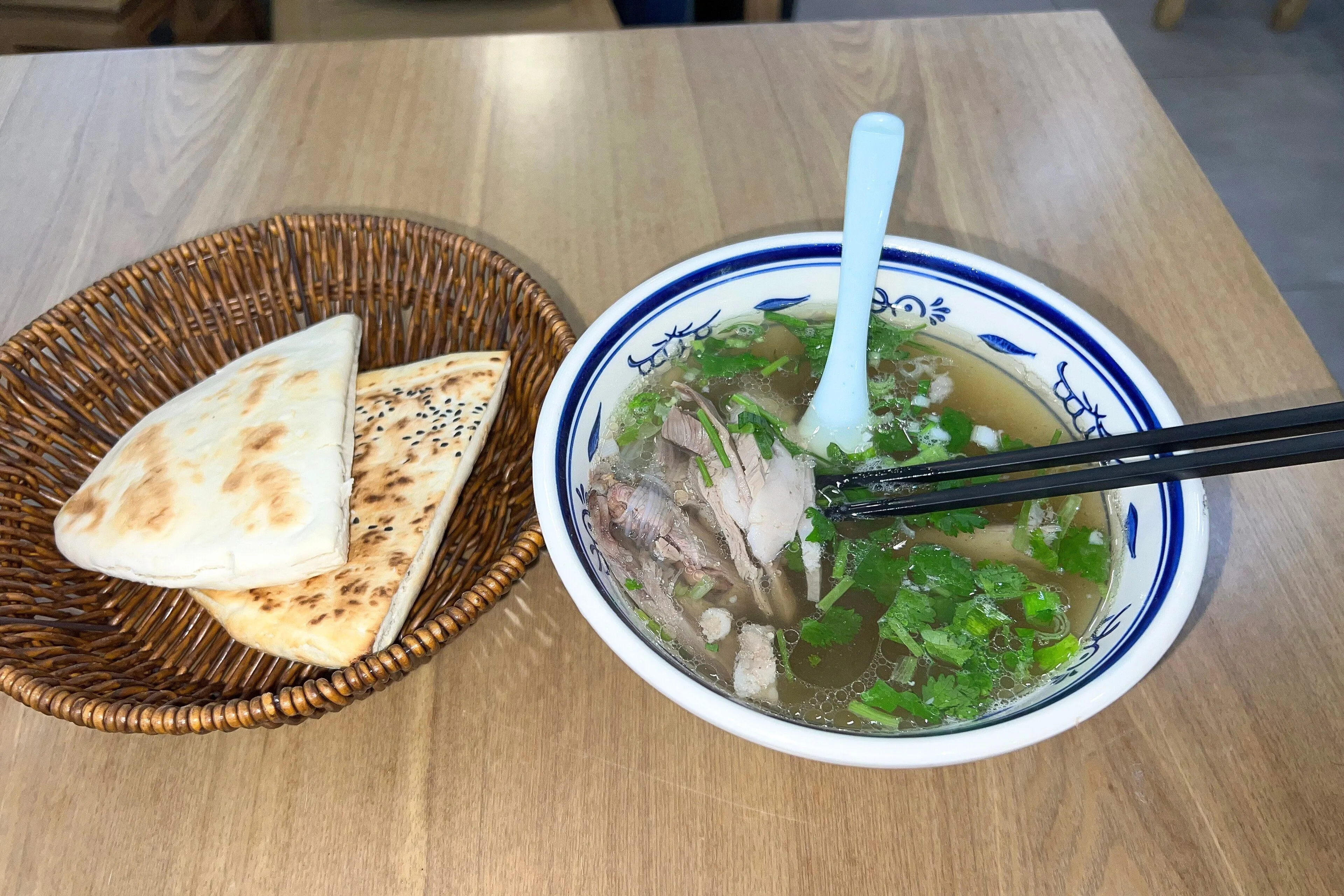 Shuipen yangrou in Xi’an — sliced mutton in a wide bowl of clear broth with coriander, sesame flatbread on the side to tear and drop in as you go; it is the soupier ancestor of paomo, and a cold-morning dish. | ||
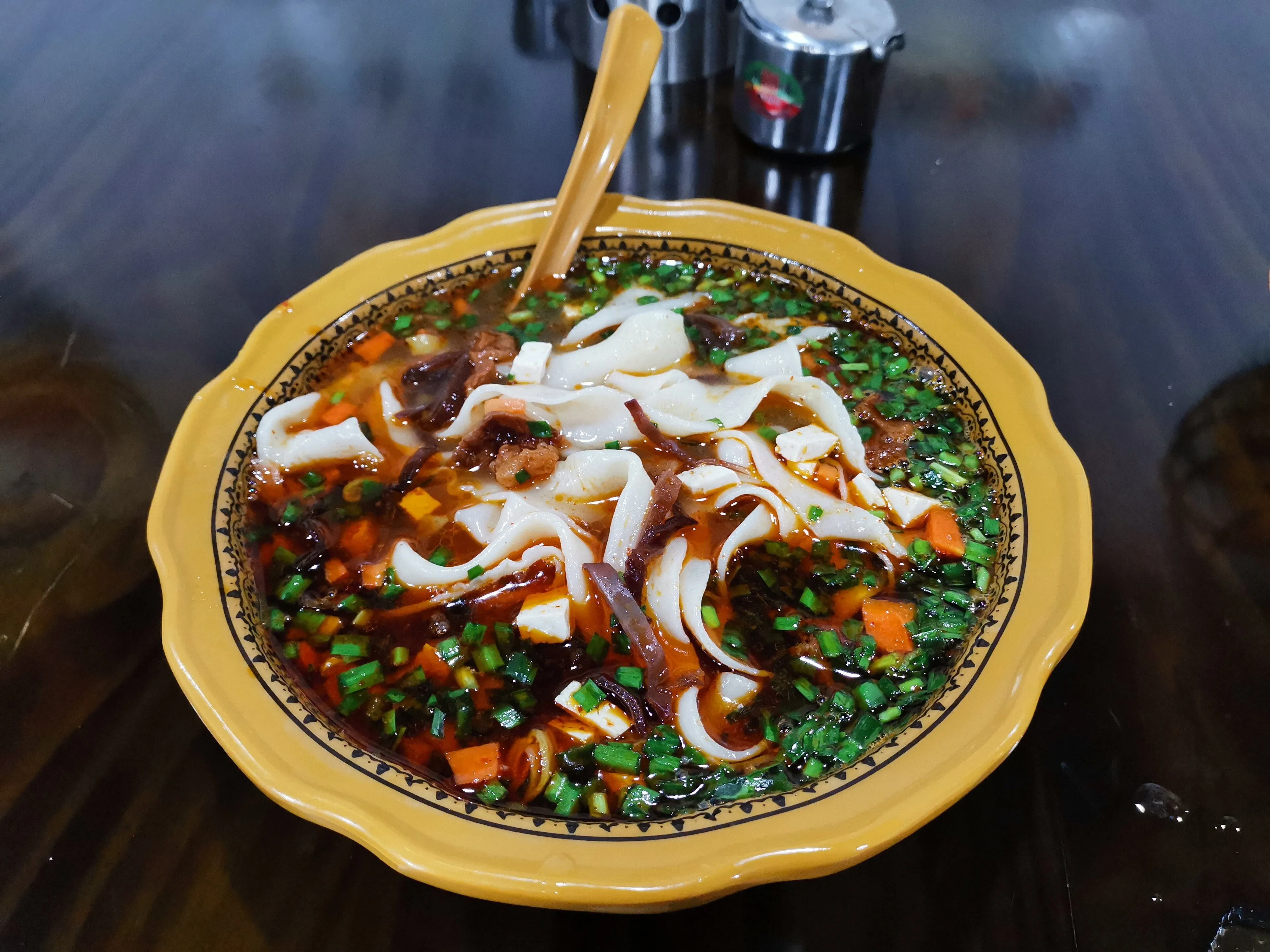 Qishan saozimian in Shaanxi — wide ribbon noodles in a thin orange-red soup soured with vinegar and coloured with chilli, topped with diced pork, carrot, wood ear and a heavy hand of scallion; the soup is drunk, not left. |
Where to eat. The famous houses — 西安饭庄, 同盛祥, 老孙家, 德发长, 春发生 among them — give the city a genuine formal restaurant culture, not only street food. For the Muslim Quarter, its six-street layout, the paomo houses and the mosque, see Xi’an Muslim Quarter Food rather than a summary here.
Beyond it: Yongxingfang, by the east gate of the city wall, is a Shaanxi intangible-heritage food court, free to enter and open all day, with stalls grouped by region so you can taste northern, southern and central Shaanxi in one walk. Datang Everbright City, running south from the Big Wild Goose Pagoda, is an open pedestrian street with no ticket whose life begins after dark — treat the food as a companion to an evening walk. Sajinqiao is the locals’ value strip, best early; Dongxin Street is the late-night quarter; Dapiyuan proves the local rule — stroll the main street, eat in the small lanes.
What it costs. Yongxingfang is free to enter and you’ll spend around ¥40–80 per person tasting your way through Shaanxi. The famous bowl-smashing rice wine is about ¥5 a bowl.
Spice: low to moderate, aromatic rather than aggressive. Vegetarian: moderate — cold-skin noodles, buckwheat noodles, flatbreads and persimmon cakes are largely plant-based, but the centre of gravity is meat. Halal: the best of the ten, structurally and on the street. Logistics: Xi’an Travel Guide.
Beijing — Court Cooking, Halal Cooking, and a Vast Snack Culture
Beijing cuisine is not one of the Eight. It is something more interesting: court cooking plus official-household cooking plus halal cooking plus local snacks, built on northern foundations, heavily influenced by Shandong, carrying Mongol and Manchu layers.
Two dishes carry the city. Peking duck comes in two schools: the open-fire “hung oven” (gualu) method represented by Quanjude (founded 1864), whose birds roast over fruitwood so the skin turns crisper and takes on a faint smoke, and the closed oven (menlu) method of Bianyifang (founded 1416), in which the duck never meets a naked flame and loses less moisture, so the meat stays more tender. Both techniques were inscribed on China’s national intangible cultural heritage list in 2008, in the same batch. The origin behind both is a migration story — the Ming capital at Nanjing developed the dish from Nanjing lake duck; the Yongle emperor brought Nanjing duck cooks north with him; by the Jiajing era duck had moved from palace to public, and the original Bianyifang opened near Caishikou selling what its signboard called “Jinling skin-sliced duck**. Instant-boiled mutton is the other pillar: a copper pot of clear broth, sesame-paste dip cut with fermented bean curd and chive flower; Donglaishun brought it into a shop setting in 1914.
| Dish | Pinyin | What it is |
|---|---|---|
| 北京烤鸭 | Běijīng kǎoyā | The city’s signature: crisp skin carved at the table with pancakes, scallion and sweet sauce |
| 涮羊肉 | shuàn yángròu | Mutton sliced thin and swished in a copper pot of clear broth |
| 炸酱面 | zhájiàng miàn | Noodles with fried bean sauce and separate vegetable toppings, mixed only once you agree |
| 卤煮火烧 | lǔzhǔ huǒshāo | The most confrontational local snack: stewed offal with a hard wheat cake |
| 豆汁 / 焦圈 | dòuzhī / jiāoquān | Fermented mung-bean drink with a fried ring — the breakfast that divides visitors |
| 门钉肉饼 | méndīng ròubǐng | A thin-skinned beef pie full of hot juice; Niujie’s is the benchmark |
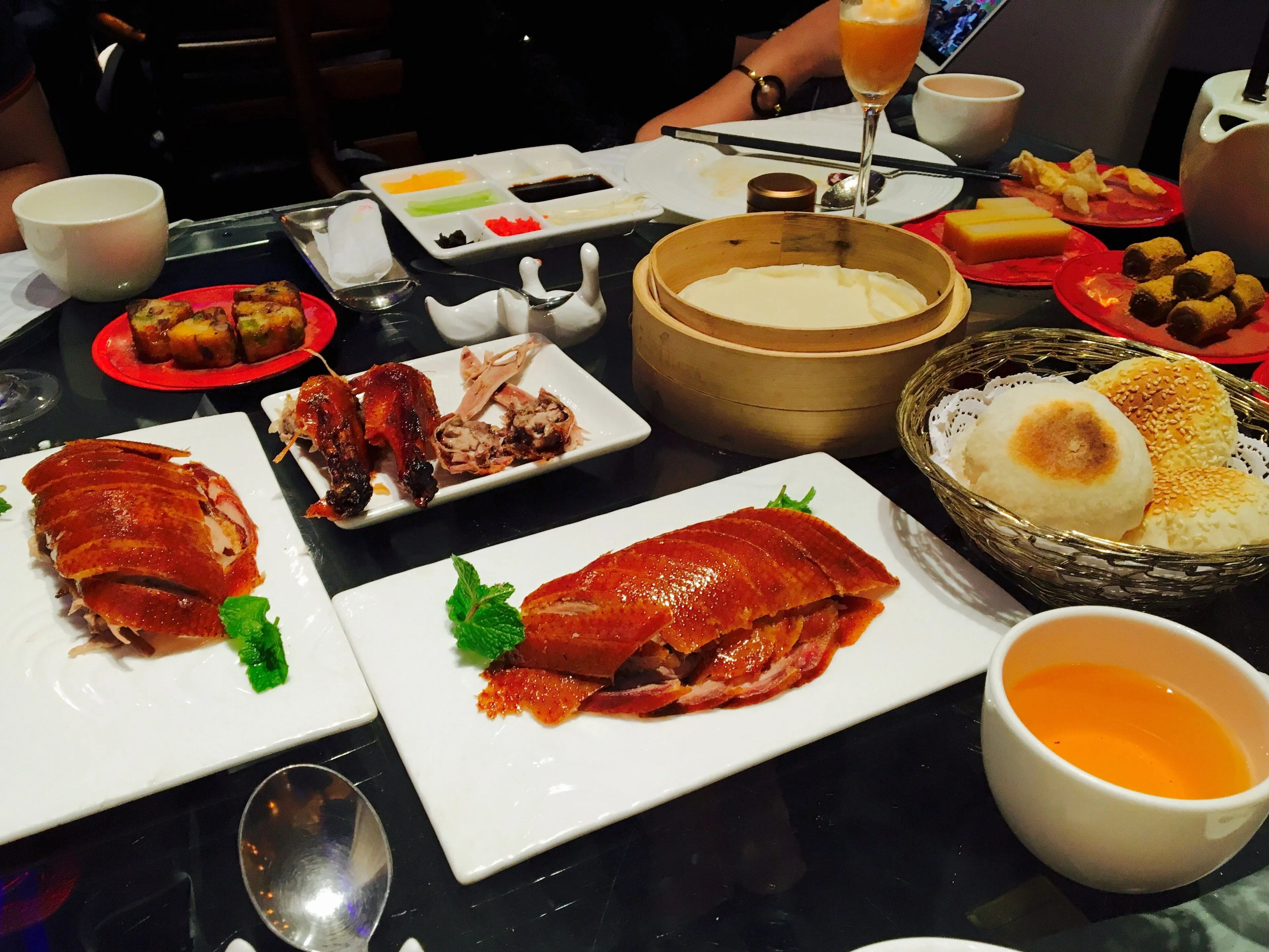 Peking duck in Beijing — the skin carved separately and laid in overlapping slices so it stays crisp, the meat plated behind it, pancakes in the steamer and sesame buns alongside; wrap one or two pieces at a time with scallion and sweet bean sauce. | ||
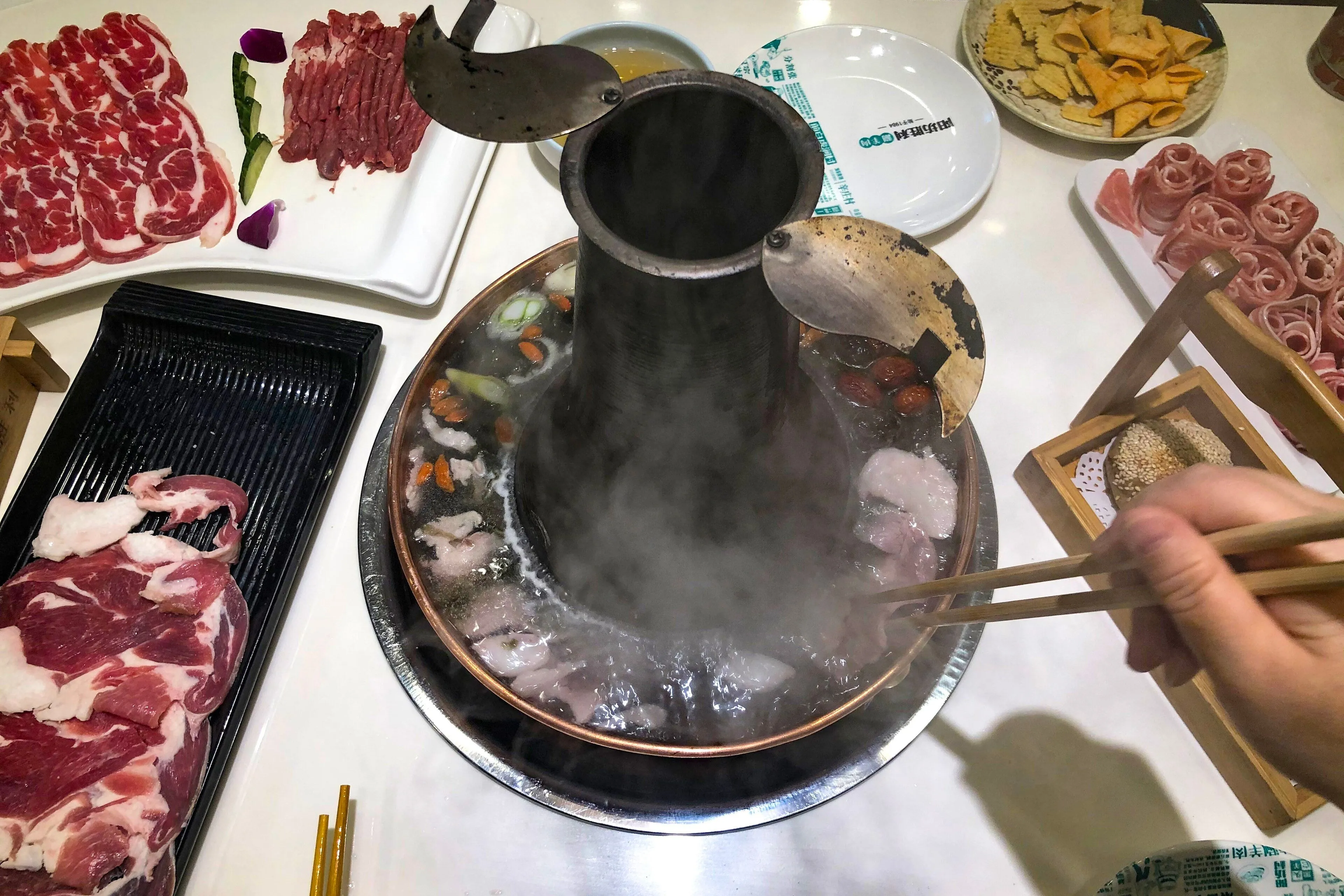 Instant-boiled mutton in Beijing — a copper pot with a charcoal chimney, clear broth with nothing in it but goji and scallion, and mutton sliced thin enough to cook in a few swishes; the dip is sesame paste, fermented bean curd and chive flower, mixed at the table. | ||
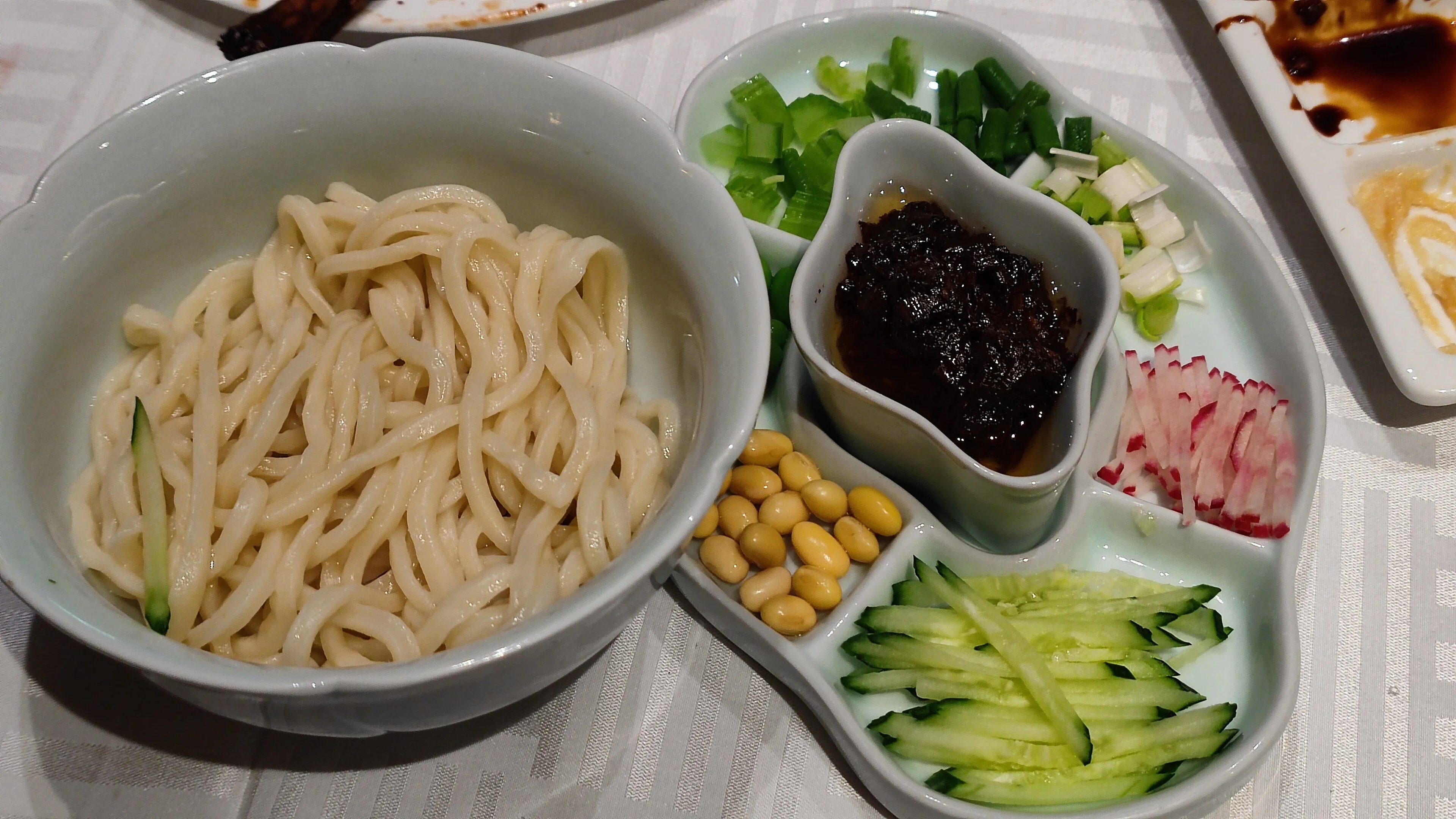 Zhajiangmian in Beijing — thick noodles with the fried bean sauce and the vegetable toppings kept apart on a partitioned tray: scallion, radish, cucumber, soybeans, peas; you add them yourself and mix once, which is why the sauce arrives dark and stiff. | ||
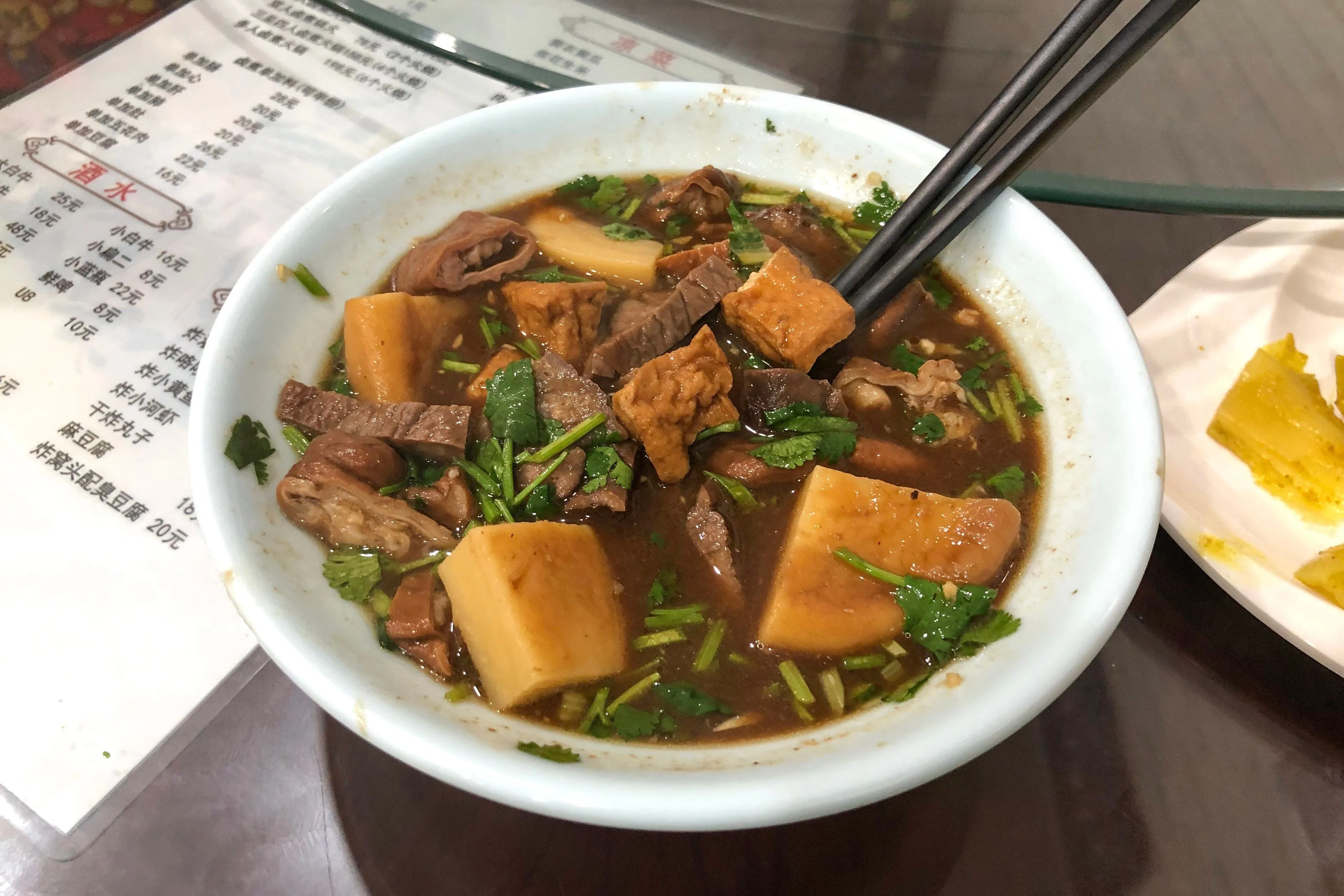 Luzhu huoshao in Beijing — pork offal stewed in a dark master broth with cubes of firm wheat cake that soak it up, finished with coriander; the smell is stronger than the taste, and the cake is there to turn a cheap bowl into a meal. | ||
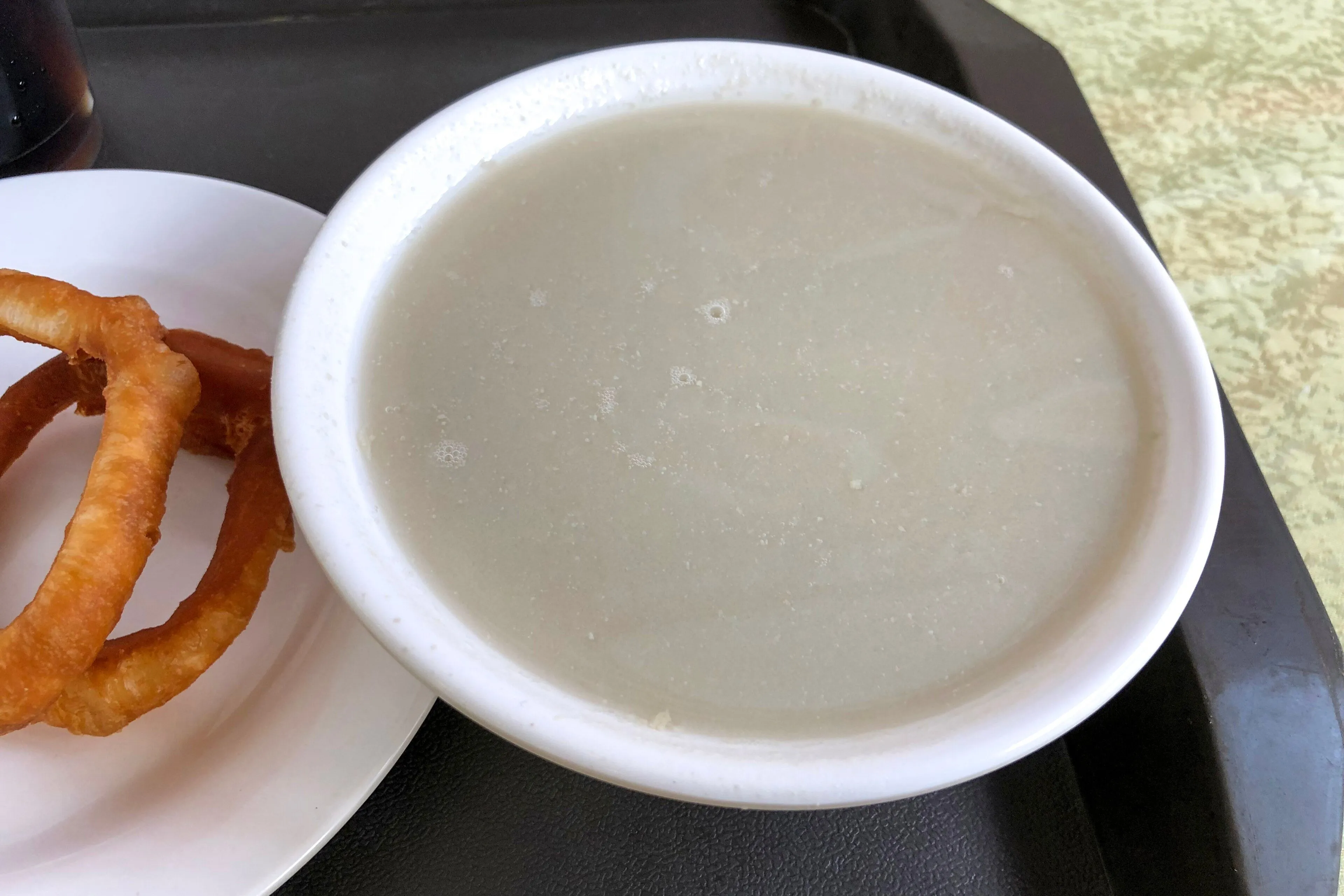 Douzhi and jiaoquan in Beijing — a bowl of fermented mung-bean liquid, thin and grey, drunk with a crisp fried ring for dipping; it is deliberately sour and faintly beany, and Beijingers either grew up on it or cannot finish a cup. | ||
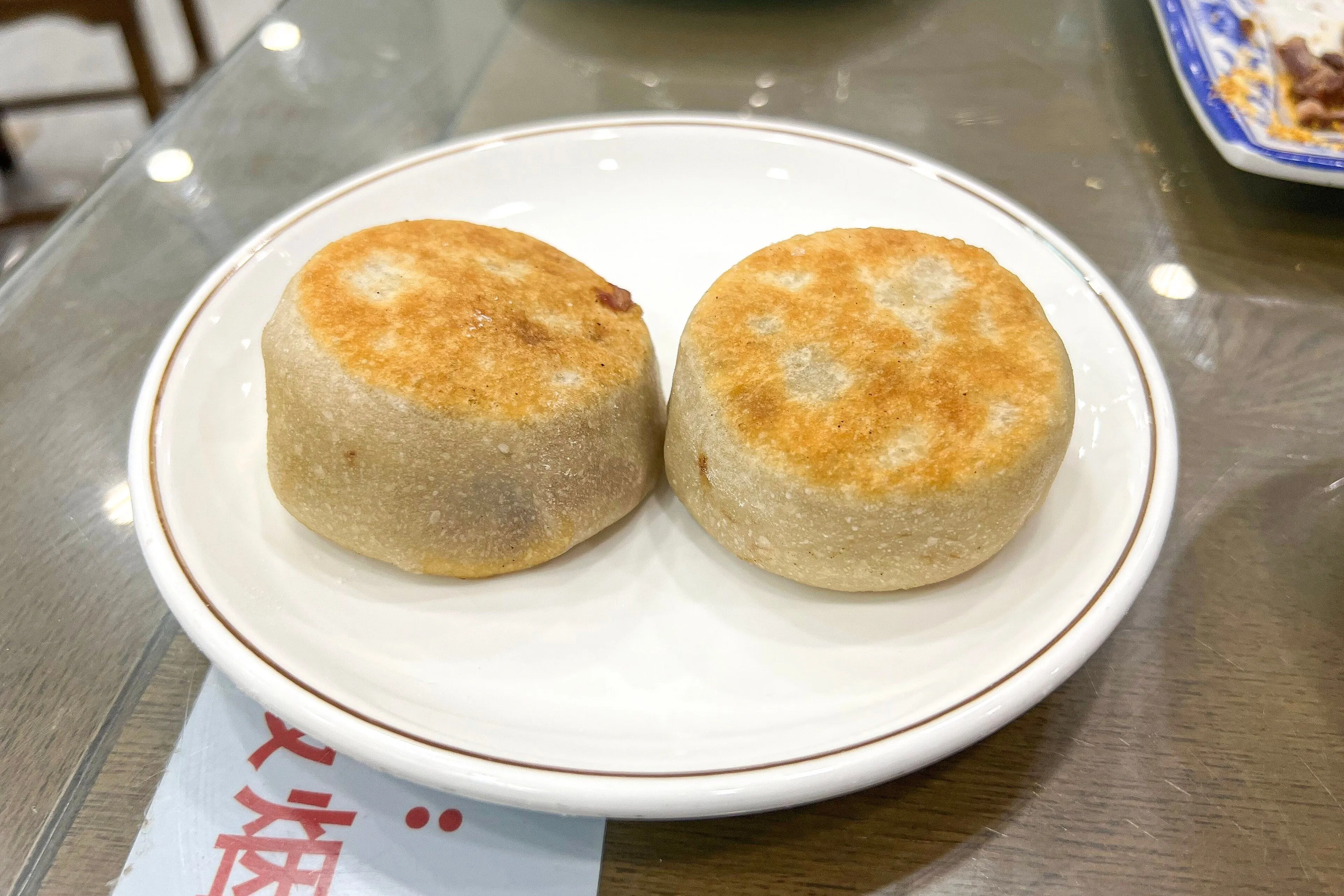 Mending roubing in Beijing — beef pies shaped like doornail heads, thin-crusted and cooked dry on a griddle so top and bottom brown while the sides stay pale; they are full of hot juice, so bite a hole first and let it out. |
Where to eat. Niujie is Beijing’s most important halal food street, with a mosque going back to the Liao dynasty and a cluster of mutton houses, snack shops, rice-cake makers and a 24-hour skewer grill. Guijie — the old “Ghost Street”, renamed in 2000 — is the densest restaurant street in the city, built around all-hours trading, with spicy crayfish and bullfrog as signatures. Qianmen Street is where the old names cluster. For duck, choose by school: Quanjude for the hung oven, Bianyifang for the closed oven. For grilled meat the local pairing is “Wan in the south, Ji in the north” — Kaorou Wan, founded in 1686 over pine and jujube wood, and Kaorou Ji, founded in 1848 near Shichahai; the technique entered China’s national intangible heritage list in 2008.
What it costs. A whole duck at Siji Minfu runs around ¥250 (expect ¥150–200 per person); the historic Quanjude is pricier at typically ¥260–330 for a bird, plus a reported 10% service charge. Zhajiangmian is ¥25–38. On Niujie, hotpot at Jubaoyuan is around ¥100 a head, while snacks cost just a few yuan.
Spice: low — Beijing cooking is salty-fresh and rich, not hot. Vegetarian: good, though 炒麻豆腐 is traditionally cooked in mutton fat — ask. Halal: strong, structurally part of the cuisine. Planning: Beijing Travel Guide.
Shanghai — Sixteen Schools, One Sweet-Savoury Accent
Shanghainese cooking, benbang or hu cuisine, sits outside the Eight — and that is its whole story. After the port opened in 1843 the city pulled in sixteen regional schools and fused them: Beijing, Cantonese, Jiangsu, Huaiyang, Wuxi, Ningbo, Hangzhou, Fujian, Sichuan, Anhui, Chaozhou and Hunan, plus local cooking, plus vegetarian, halal and Western kitchens. The result is summed up as 浓油赤酱 — heavy oil, red sauce: sweet-leaning, glossy, less salty than it looks.
| Dish | Pinyin | What it is |
|---|---|---|
| 红烧肉 | hóngshāo ròu | Red-braised pork belly, sweet and glossy — the clearest statement of the style |
| 油爆虾 | yóubào xiā | Flash-fried river prawns, red and shining, salt-sweet |
| 八宝鸭 | bābǎo yā | A whole boned duck stuffed, steamed and served in one piece |
| 腌笃鲜 | yān dǔ xiān | Salt pork, fresh pork and spring bamboo in a milky soup — Jiangnan in origin, Shanghainese by adoption |
| 水晶虾仁 | shuǐjīng xiārén | ”Crystal” shrimp, once called Shanghai’s number one dish |
| 四喜烤麸 | sìxǐ kǎofū | Braised wheat gluten, dark red and salty-sweet; its earliest form came from a vegetarian restaurant |
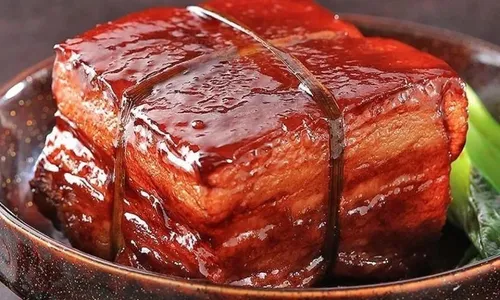
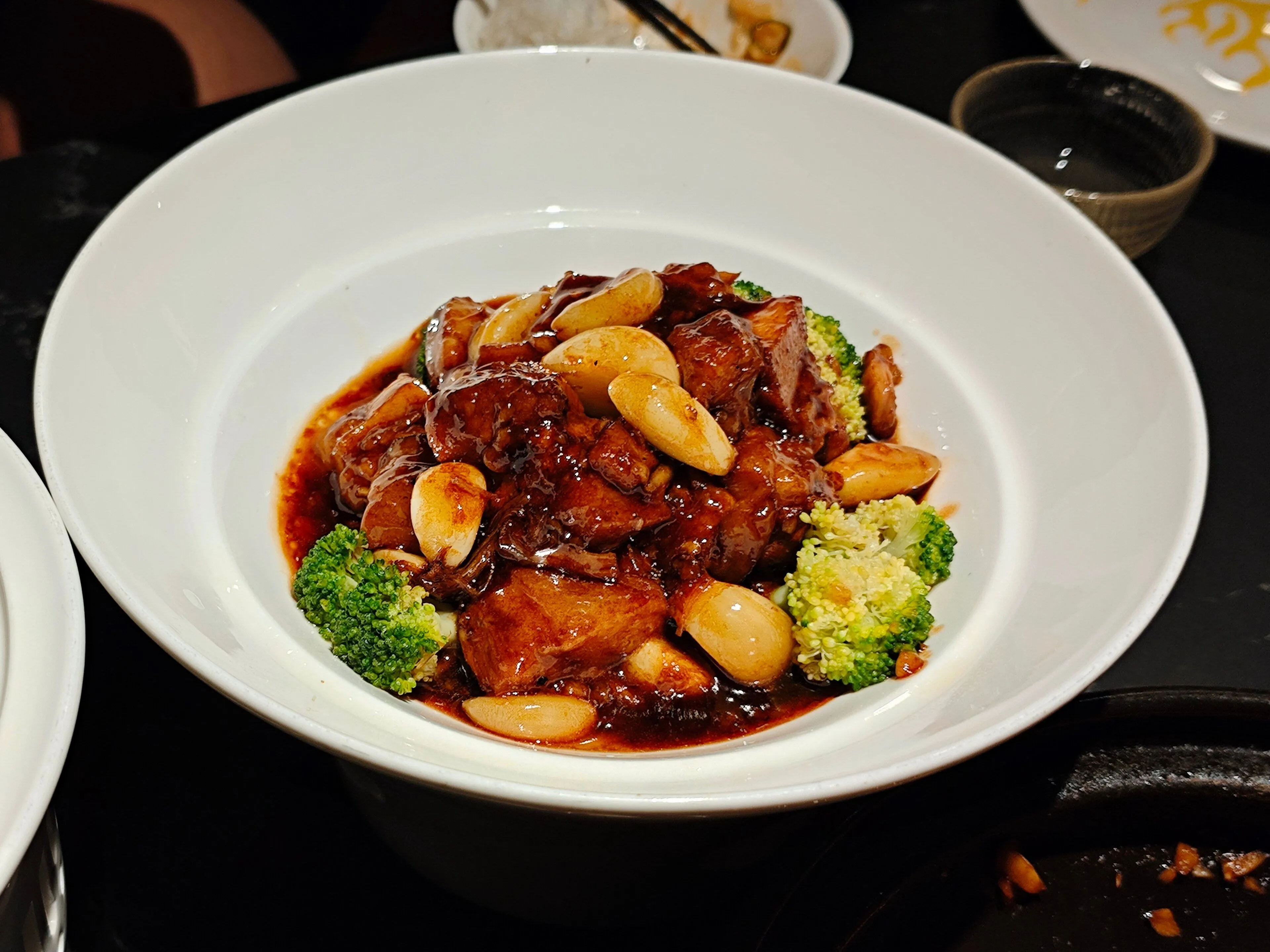 Hongshao rou in Shanghai — pork belly cut into thick squares and braised in soy and rock sugar until the sauce turns to dark lacquer, here with whole garlic cloves; the fat should cut with chopsticks while the skin still resists slightly. | ||
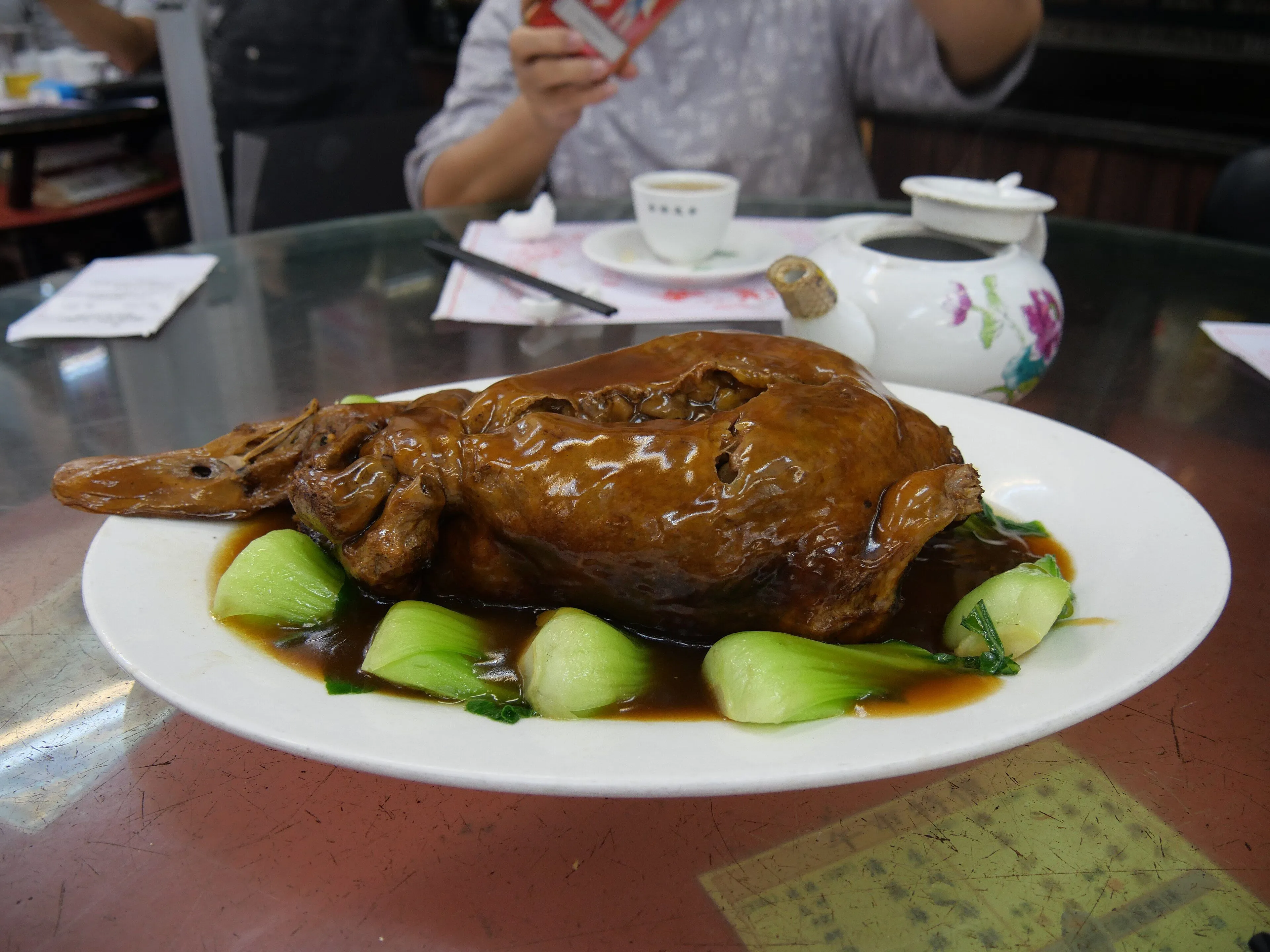 Babao ya in Shanghai — a whole duck boned from the inside, stuffed, steamed and served intact with its head on, in a pool of its own braising sauce and ringed with blanched greens; it is carved at the table, and the point is that nothing was cut before it arrived. | ||
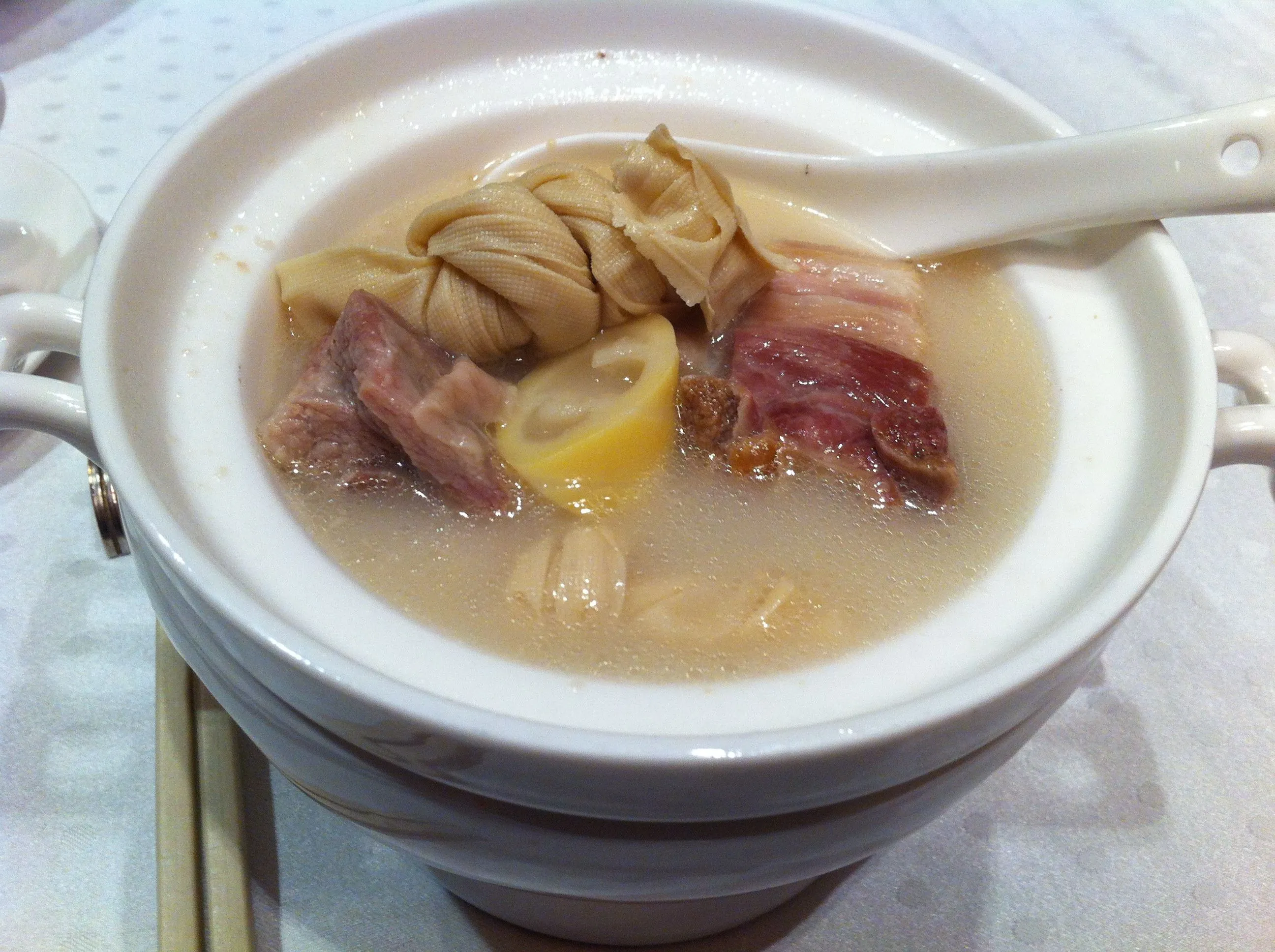 Yan du xian in Shanghai — salt pork, fresh pork and spring bamboo simmered to a milky white soup, with knotted tofu skin in the bowl to soak it up; the salt pork is what gives the broth its depth, with no stock cube or seasoning added. | ||
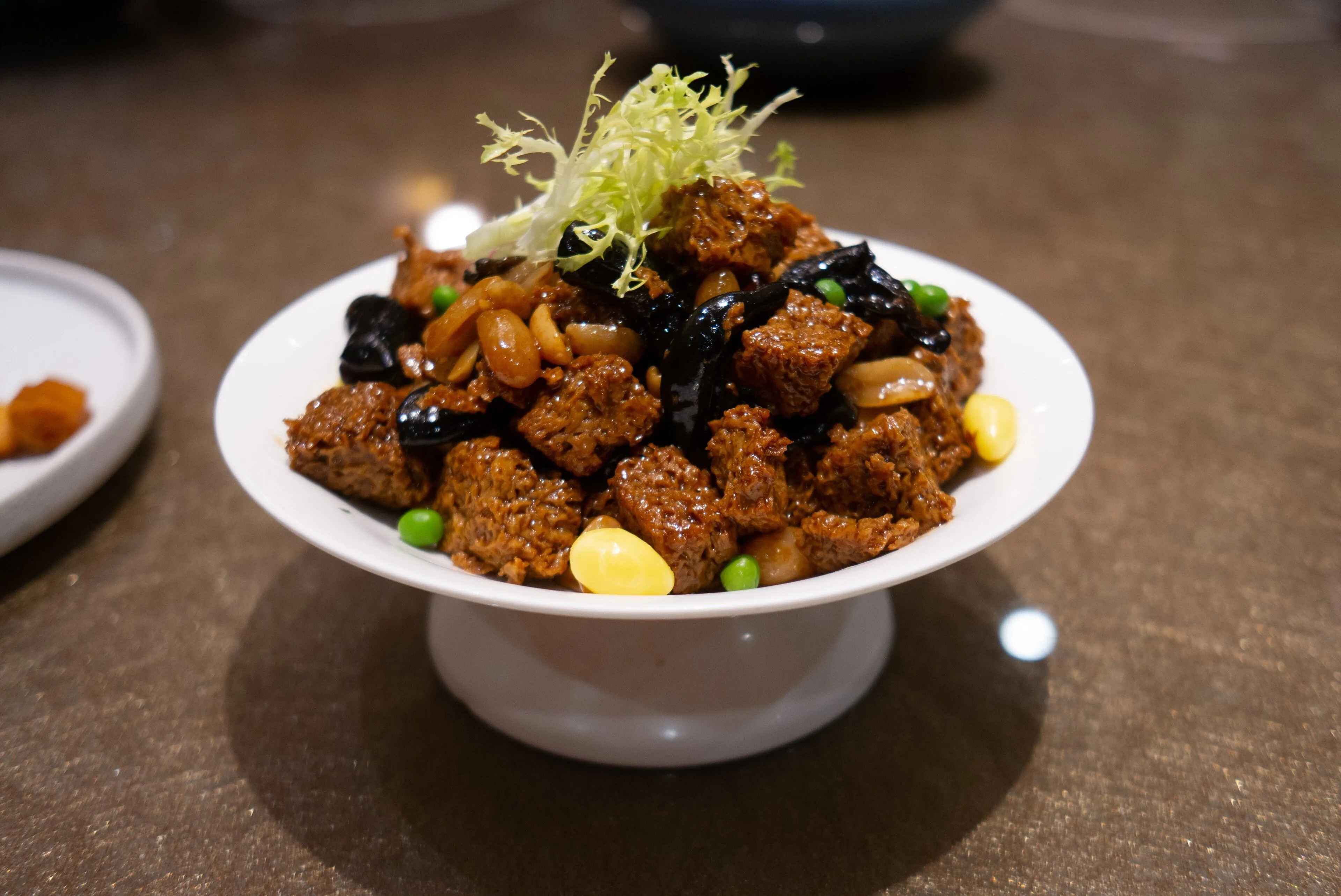 Sixi kaofu in Shanghai — wheat gluten cubes fried first so they puff into a honeycomb, then braised dark in soy and sugar with wood ear, peanuts and ginkgo; the spongy texture is the whole point, because it holds sauce that solid food cannot. |
Where to eat. The City God Temple area beside Yu Garden is the classic first stop: the Old City God Temple Snack Plaza cooks to order, and the street gathers the Nanxiang Steamed Bun House, opened here in 1900 — the bun itself was created in Nanxiang town in Jiading in the nineteenth century — the Songyuelou vegetarian buns, Lubolang dim sum, served since 1979 from a Ming-dynasty pavilion in the old west garden of Yu Garden, and Ningbo sweet dumplings. The temple itself requires a ticket. The important update: the famous snack brands that lined Yunnan Road did not disappear — they relocated. Since February 2026 eight heritage brands running nine outlets have been trading on three side streets off Nanjing Road: Shanxi South Road (signed as an old-brand food block), Fujian Middle Road and Jiangxi Middle Road, with a stated plan to return to an upgraded Yunnan Road once the old block’s redevelopment is finished. Da Hu Chun, Hongchangxing, Xiaoshaoxing, Deda, Xian De Lai, Yangzhou Restaurant and Wufangzhai trade there now; prices did not move with the move, most shops now carry bilingual Chinese–English menus, Xiaoshaoxing sends an English-speaking server to its flagship and serves until 22:00, and Xian De Lai runs to 01:00. Huanghe Road is the old Shanghai-style longtang food strip a recent television drama turned into a pilgrimage.
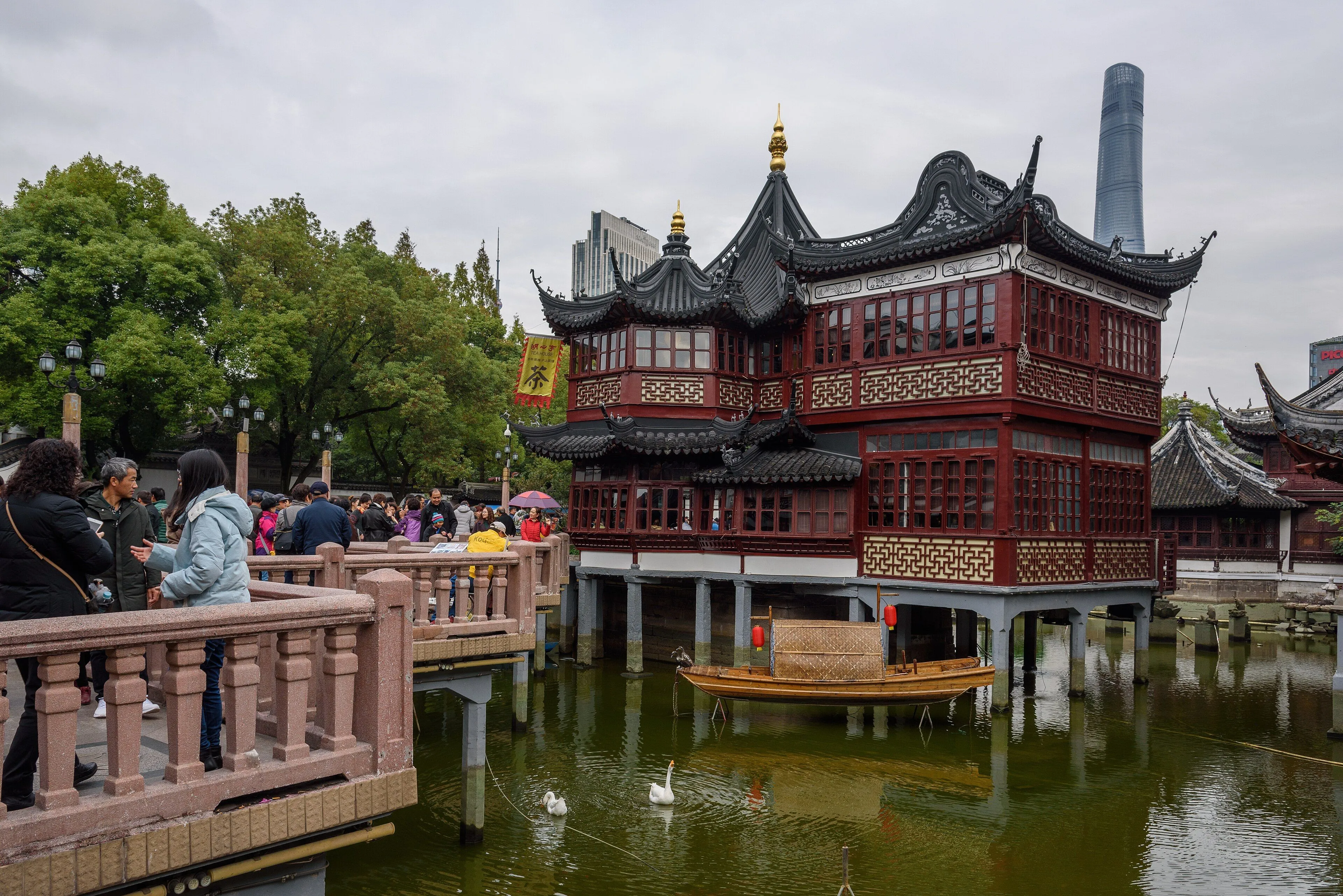 Huxinting Teahouse at Yu Garden in Shanghai — a Ming-style pavilion built out over the pond and reached by a zigzag bridge, with the towers of Lujiazui on the skyline behind; the bridge is free to walk, the tea room upstairs is not.
One warning, with a caveat: Xiao Nan Guo suspended operations across its Shanghai restaurants in February 2026 as part of a strategic restructuring — reported on the ground and confirmed in a stock-exchange filing, though the company’s own wording was “temporarily suspended” rather than closed for good. As of late 2026 nothing has reopened under the old name, so do not build a dinner around it. It is a fair caution about recommending famous names unchecked.
What it costs. Shanghainese food spans everything from ¥3 — a bowl of Xiaoshaoxing chicken congee still costs about ¥3, and the blood soup ¥8 — to mid-range Benbang restaurants at ¥80–150 per person. Pork chop with rice cakes at Xiandelai is roughly ¥15; xiaolongbao at Nanxiang Steamed Bun House is ¥30–48 a basket (¥60–100 per person). At the splurge end it runs well into the hundreds.
Spice: mildest here, alongside Guangzhou. Vegetarian: the best of the ten — vegetarian cooking is one of the sixteen constituent schools, and the top end of the vegetarian scene is world-class. Halal: present but thin; halal cooking is another of the sixteen schools and the century-old mutton hotpot house on the old-brand strip is the practical anchor, though sources do not label it explicitly. Logistics: Shanghai Travel Guide.
Hangzhou — Answering the “Food Desert” Joke
Hangzhou’s internet reputation as a 美食荒漠, a food desert, is a joke and a bad one. It cooks Hangbang cuisine within Zhejiang cuisine, split between the “on the lake” school — fish, shrimp and poultry, plainly stewed or quickly stir-fried — and the “in the city” school — meats, steamed, braised, red-cooked. Dreaming of Millet, the Southern Song record, catalogues a vast Hangzhou repertoire; in 2024 the city published technical standards for five classic dishes including West Lake Vinegar Fish.
| Dish | Pinyin | What it is |
|---|---|---|
| 西湖醋鱼 | Xīhú cùyú | Fish poached, then sauced with sugar and vinegar and no soy sauce and no oil — technique with nowhere to hide |
| 东坡肉 | Dōngpō ròu | The first calling card of Zhejiang cooking: a square of red-braised pork at exact tenderness |
| 龙井虾仁 | Lóngjǐng xiārén | River shrimp stir-fried with Longjing tea leaves — a post-republican addition |
| 宋嫂鱼羹 | Sòngsǎo yúgēng | Mandarin fish taken off the bone and returned to its own stock with soy, sugar and plenty of vinegar; traced back around eight centuries |
| 片儿川 | piànr chuān | The city’s noodle: pork-bone and hen broth with salted mustard greens, bamboo shoots and shredded pork — all three, no substitutes |
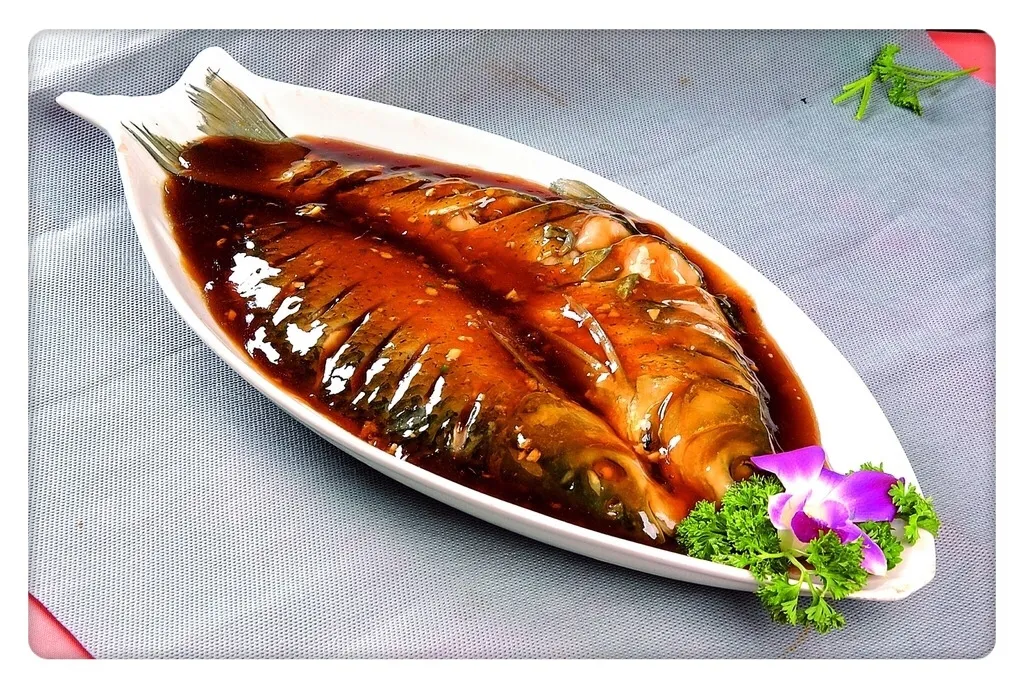 West Lake vinegar fish in Hangzhou — the fish poached whole and napped with a glossy sweet-sour sauce and little else, no soy and no oil, just sugar and vinegar reduced together; there is nowhere for a kitchen to hide in it. | ||
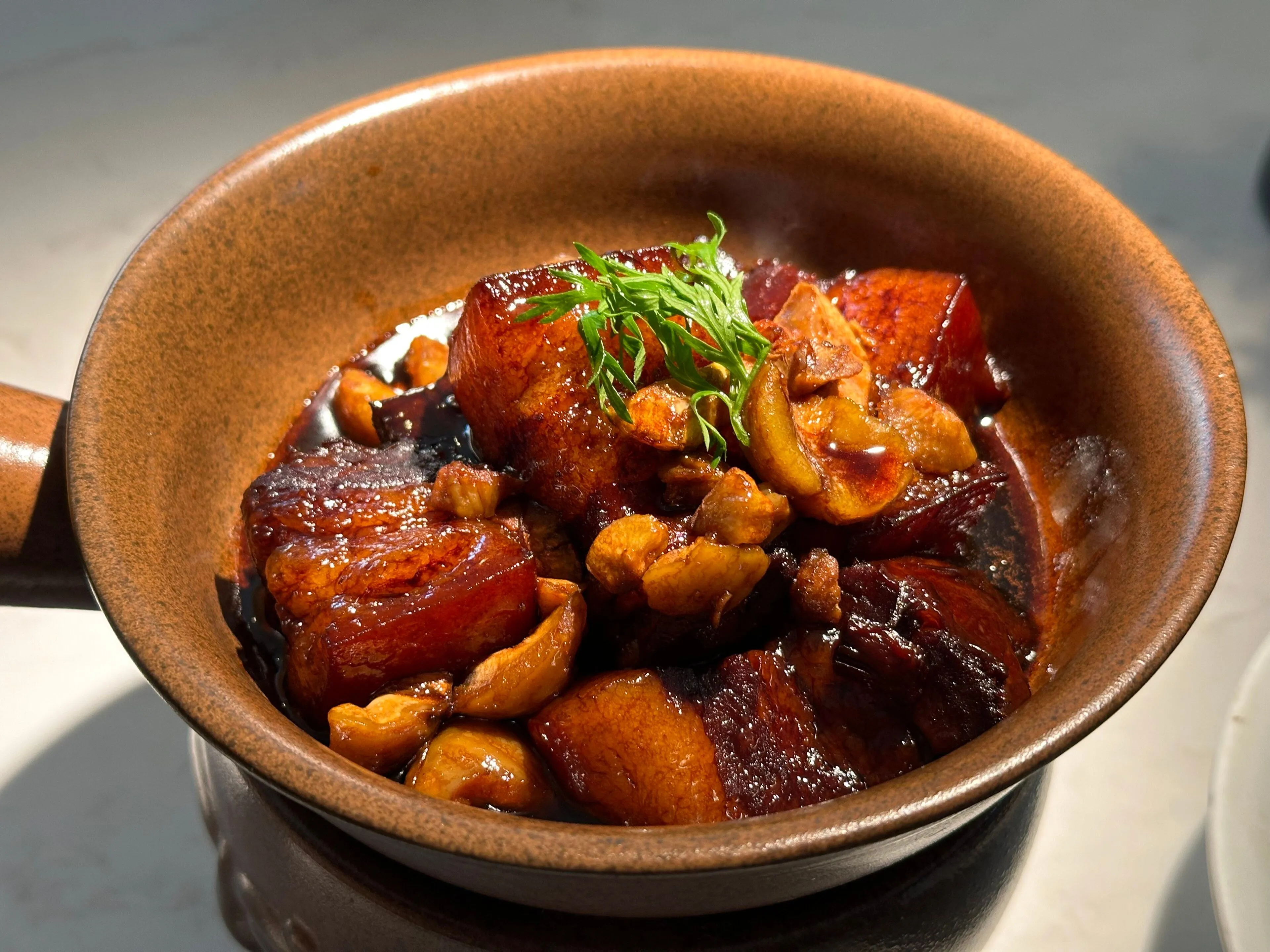 Dongpo rou in Hangzhou — a square of pork belly braised skin-up in soy, sugar and Shaoxing wine until the fat turns glassy, served in the pot it cooked in; cut it with chopsticks rather than a knife. | ||
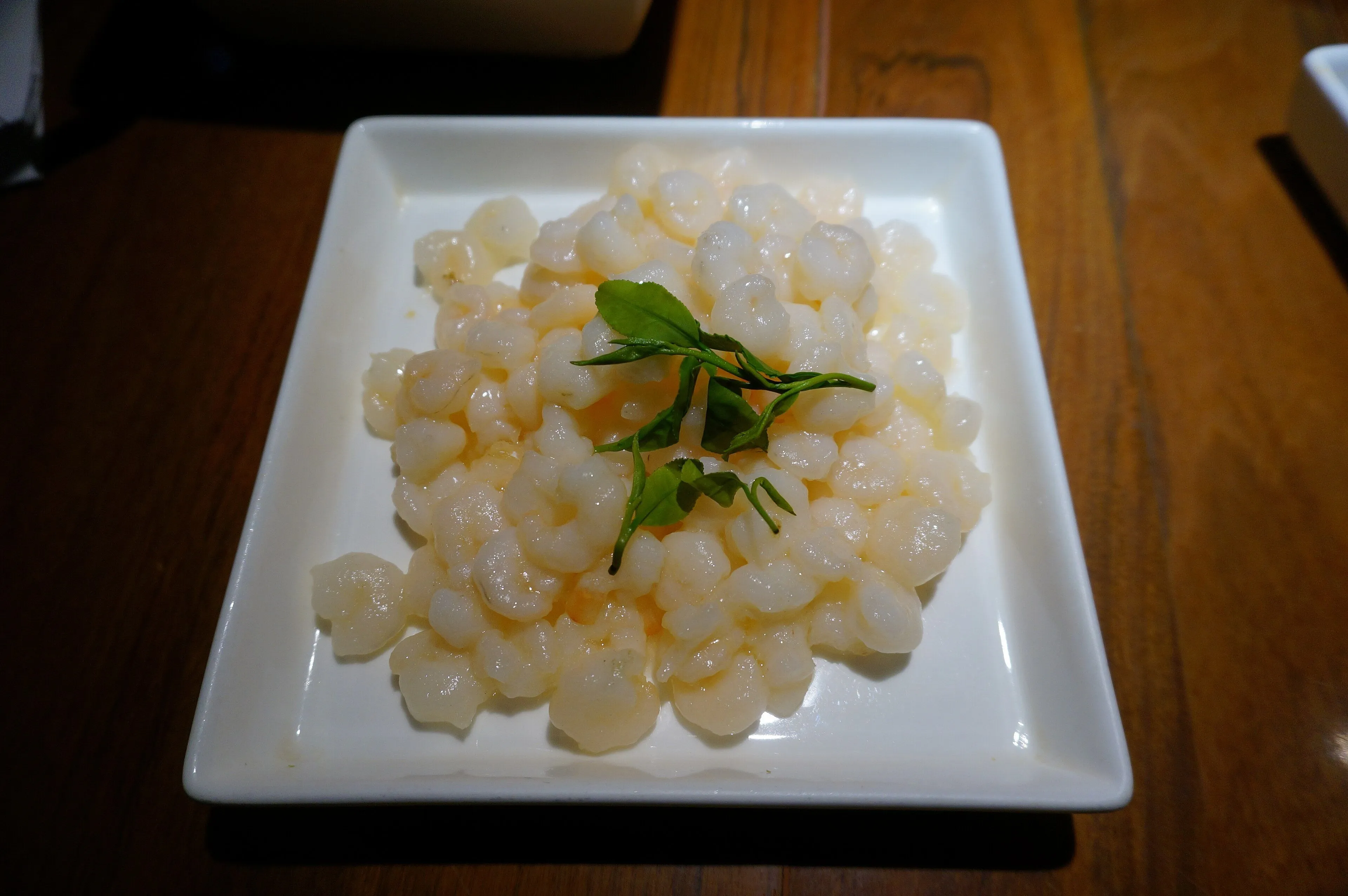 Longjing xiaren in Hangzhou — river shrimp shelled, barely stir-fried and kept almost white, with a few steeped Longjing leaves stirred through at the end; the tea is there for fragrance, and any soy in the wok would spoil the colour. |
Where to eat. Hefang Street (Qinghefang) is the main walk: a Song-dynasty axis reopened as a heritage street, reported free to enter — according to travel listings rather than a municipal page — and open all day, with shops trading into the evening and lanterns lit at dusk; a few museums and former residences along it charge their own tickets. Two names matter: Xi Le Yuan, the mutton shaomai house trading since 1788 and a recognised Zhejiang time-honoured brand, whose filling includes radish to cut gaminess and which uses yearling Hu sheep; and Dingsheng Gao, the “certain-victory” rice cake, a provincial intangible heritage food tied to a legend of cakes made for Yue Fei’s army. Gaoyin Street, just off Hefang, is the sit-down dinner end; Shenglihe is a purpose-built food street whose night market runs into the small hours. The old names still anchor the city: Lou Wai Lou, opened in the Daoguang era, and Wang Runxing, nicknamed “the emperor’s rice shop”. If you have heard West Lake Vinegar Fish is disappointing, note that Lou Wai Lou now offers a choice of fish species.
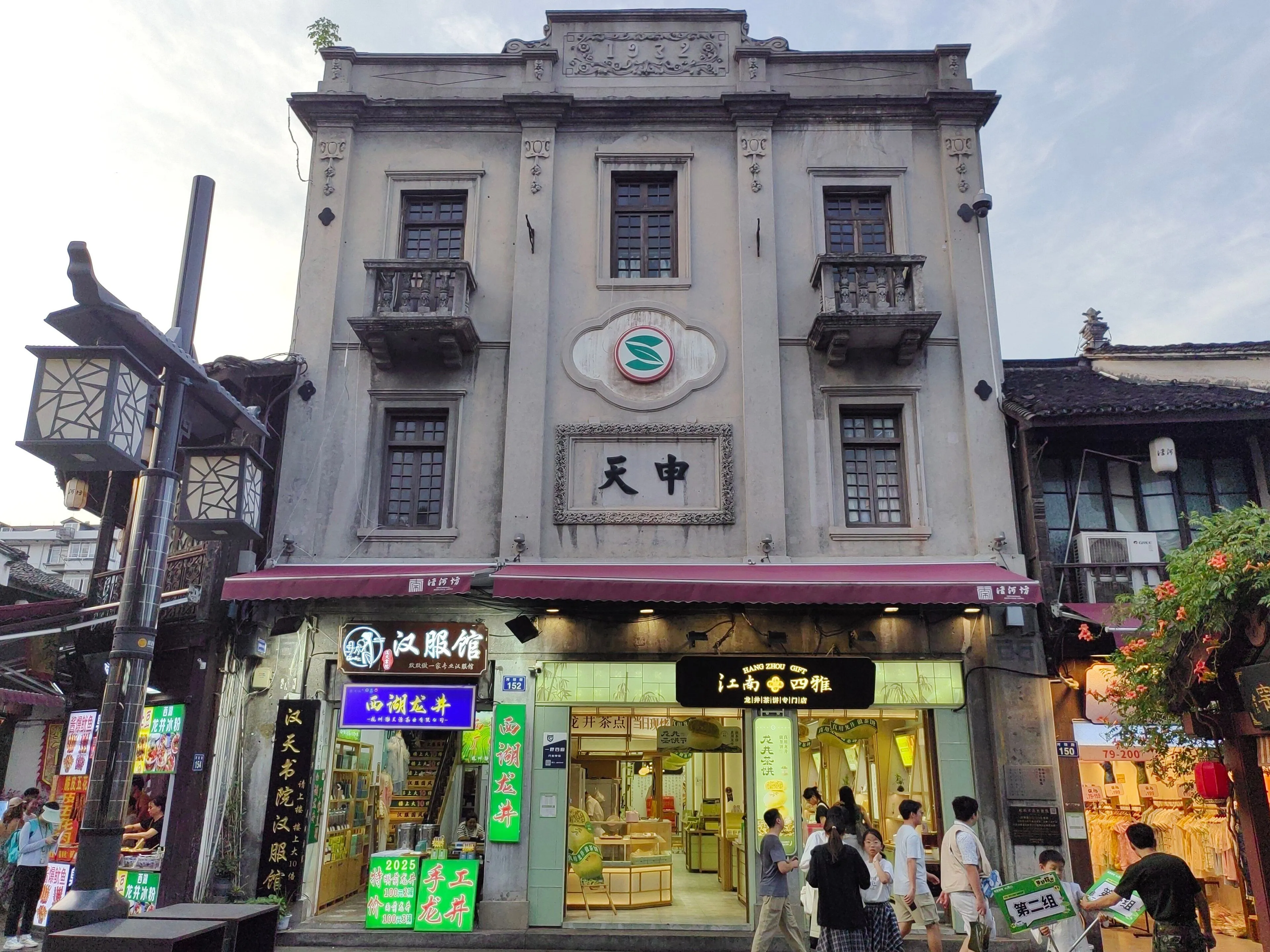 Hefang Street in Hangzhou — Longjing sold loose by weight from a grey stone shopfront and brewed to taste at the door; the street runs from the old Song axis up to Gaoyin Street, and the lanterns come on at dusk.
What it costs. West Lake vinegar fish at Louwailou is around ¥108 for a whole fish (about ¥68 for half), with a full meal there running ¥120–200 per person. Humbler local versions cost a good deal less.
Spice: very low. Vegetarian: good — water shield, bamboo, tofu and the sweet rice cakes. Halal: not verified; assume limited. See Hangzhou Travel Guide, or Hangzhou Day Trip from Shanghai.
Nanjing — Jinling Duck, and China’s Foremost Snack Tradition
Nanjing cooks Jinling cuisine, one of Jiangsu’s four branches and not Huaiyang. Ingredients lean on freshwater produce, freshness matters more than complexity, knife work is fine, and technique favours stewing, braising, roasting and simmering. The local claim: “Jinling duck dishes rank first under heaven.”
| Dish | Pinyin | What it is |
|---|---|---|
| 盐水鸭 | yánshuǐ yā | Salted duck, head of Jinling cooking; Nanjing has eaten duck for well over a millennium |
| 鸭血粉丝汤 | yāxuě fěnsī tāng | Duck blood curd and glass noodles in scalding broth with sesame oil, dried shrimp or duck intestine, coriander, and chilli oil if you want it |
| 牛肉锅贴 | niúròu guōtiē | Beef potstickers made by the “water-frying” method: crisp outside, juicy inside, salt-sweet |
| 小笼包 | xiǎolóngbāo | Soup dumplings whose broth is set as a jelly, chopped into the filling and released by steaming |
| 大煮干丝 | dà zhǔ gānsī | Tofu cut to threads, simmered in stock, dressed with sesame oil and good soy — clean on the palate, long on the finish |
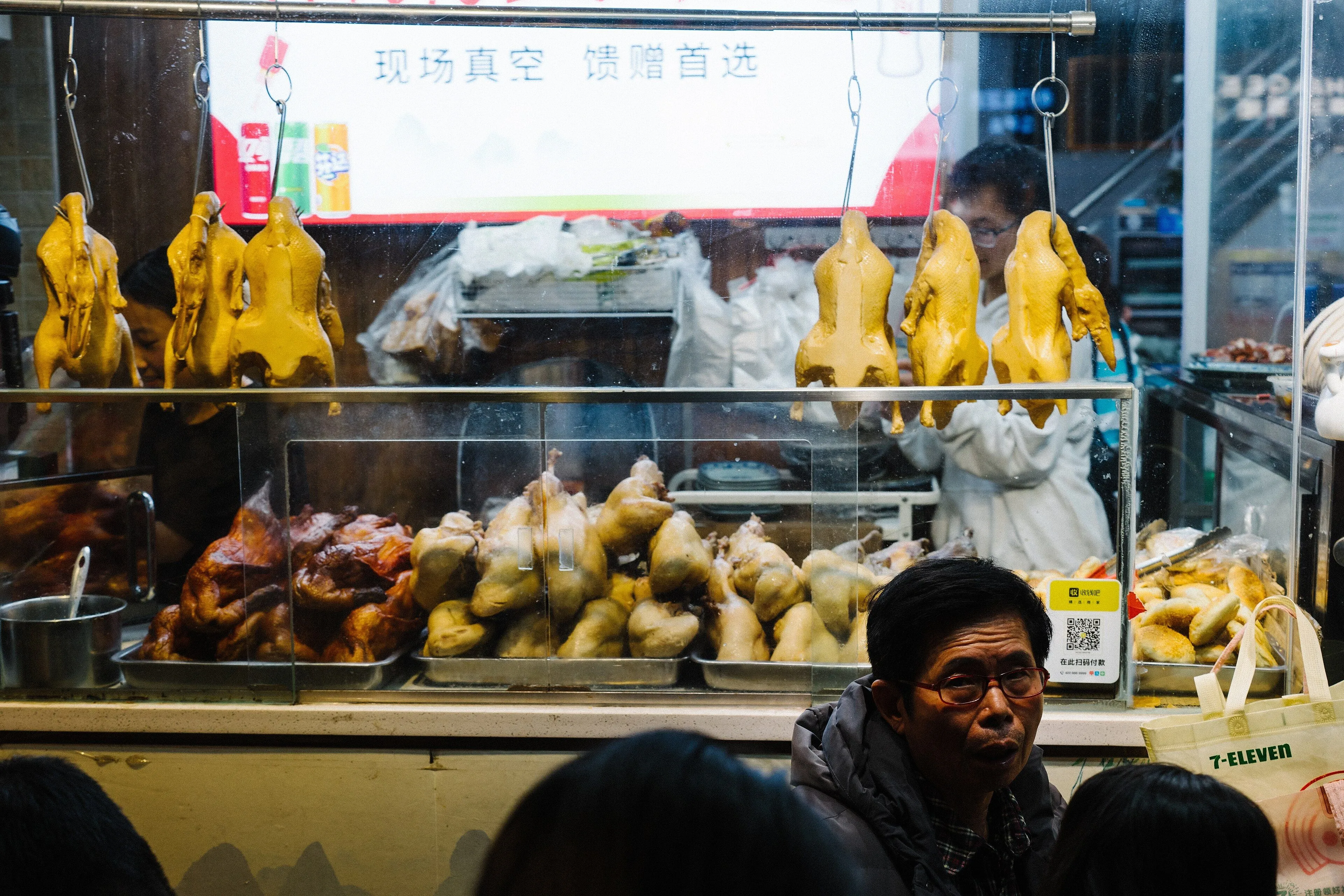 Nanjing salted duck — poached rather than roasted, which is why the birds hang pale gold instead of mahogany, sold by weight from a glass counter and chopped to order; the meat is cold, dense and gently salty, and the skin carries most of the flavour. | ||
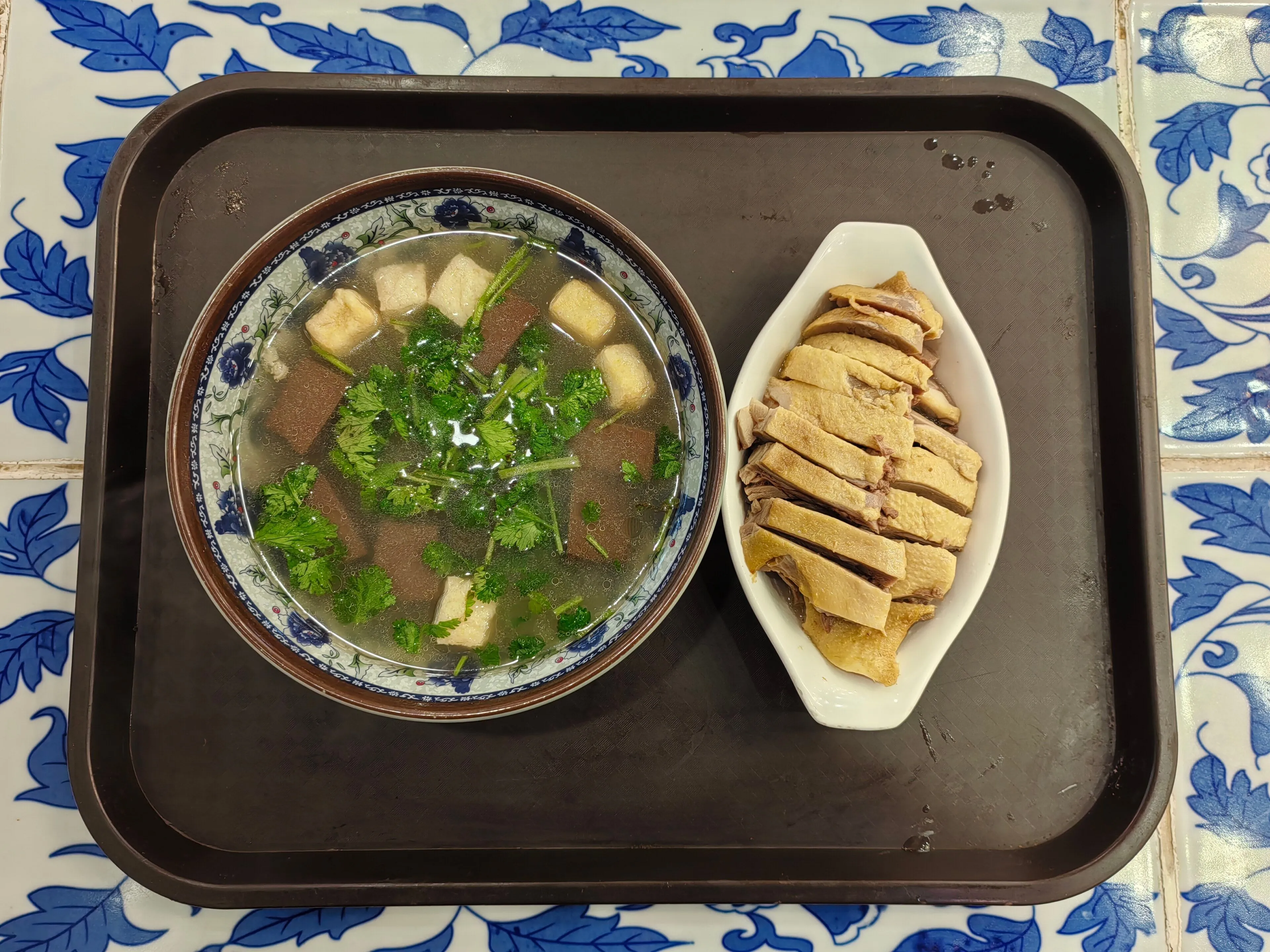 Duck blood vermicelli soup in Nanjing — duck blood cubed and glass noodles in a clear broth with tofu puffs and coriander, plus a plate of sliced duck on the side; add chilli oil and a splash of vinegar at the table and eat it scalding. | ||
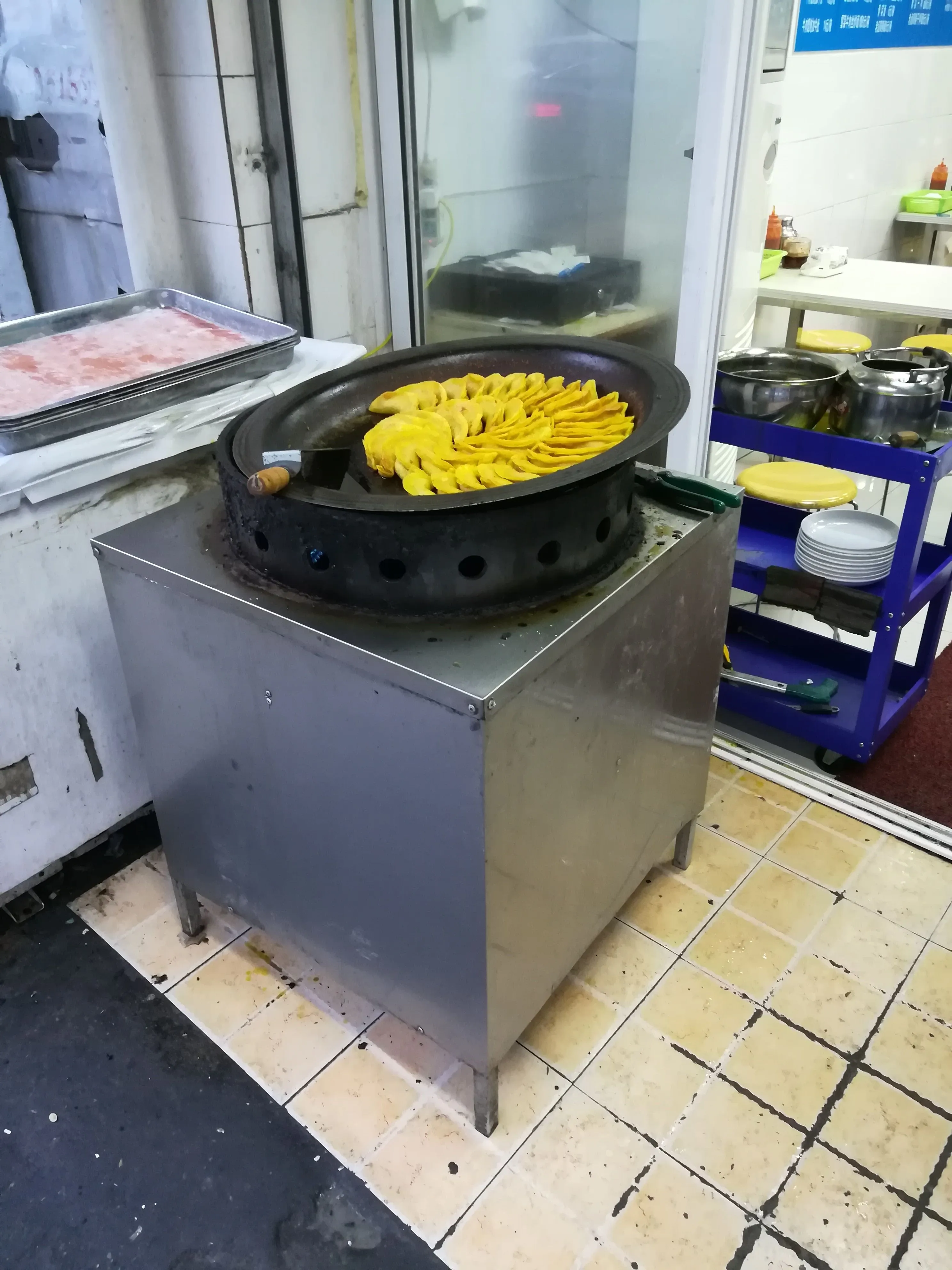 Beef potstickers in Nanjing, photographed at the pan rather than the plate — rows of them packed into a shallow iron pan, water splashed in and a lid clamped on so they steam, then the water boils off and the bases fry crisp. | ||
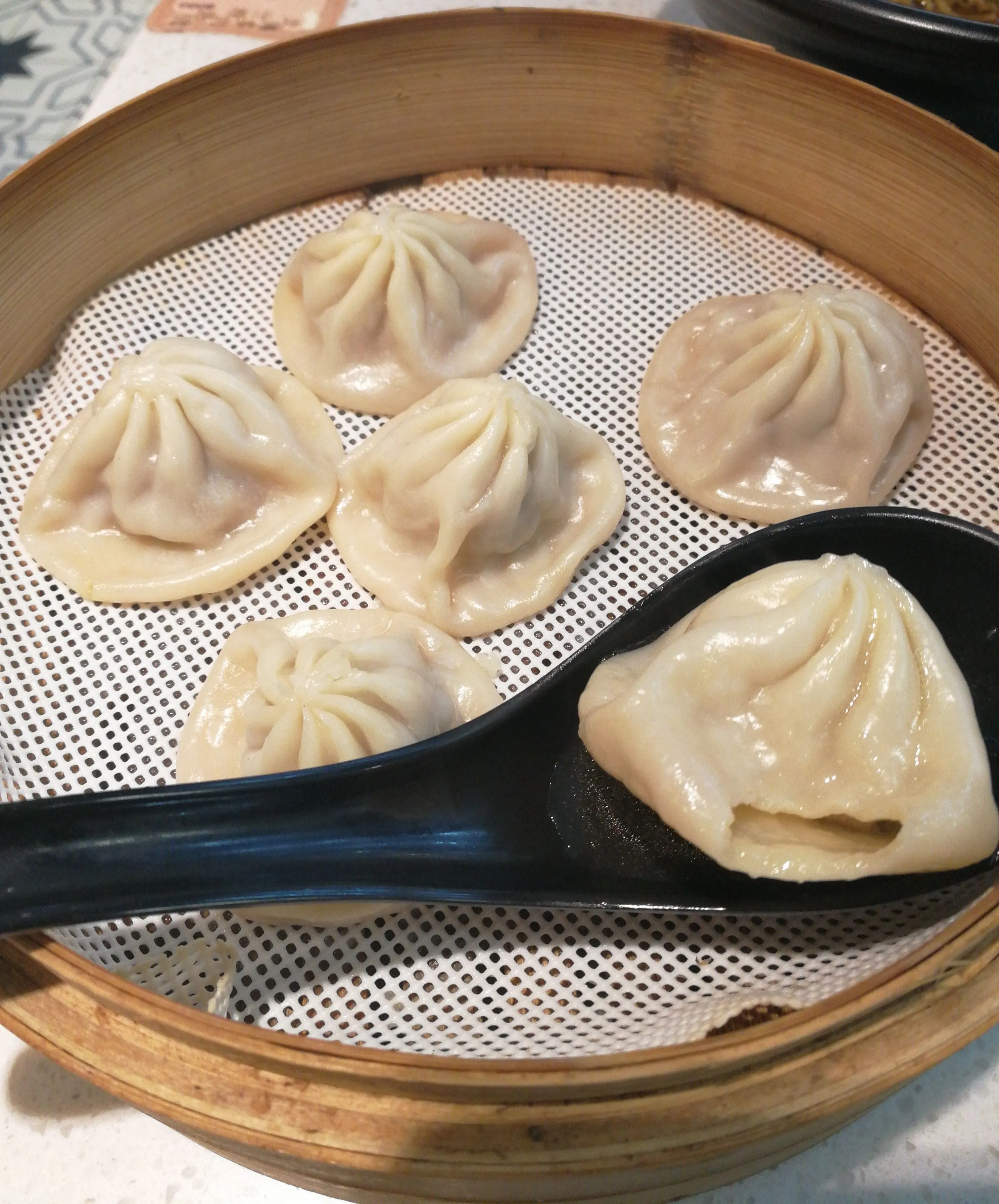 Xiaolongbao in Nanjing — five to a basket, the skins thin enough to see the soup inside, one lifted on a spoon to show how the base sags under its own weight: move it gently, lift it slowly, open a window first, then drink the soup. |
The snack tradition is the point. Jinling snacks are described as ranking first among China’s four great snack traditions, with more than a thousand years behind them and close to a hundred items across meat, vegetable, sweet and savoury. The core area is the Confucius Temple (Fuzimiao) on the Qinhuai, where local sources count the traditional foods in the hundreds and where eating is staged: dry and wet alternate, savoury and sweet interleave, and folk performance runs alongside the meal. Other clusters include Hunan Road, Xinjiekou and Chaotiangong.
The Qinhuai Eight Wonders are not eight things. They are eight sets pairing one dry item with one wet item — sixteen items in total — and there are two versions: the original list named in 1987, and a 2009 local standard that replaced it and added steamed black chicken, fried stinky dried tofu, small shaomai, duck blood soup, Yuhua-pebble dumplings and plum-blossom cakes. Check which version an English list is using. The making techniques went onto Jiangsu’s provincial intangible heritage list in 2011. And there is a rhyme for eating a Nanjing soup dumpling: “move it gently, lift it slowly, open a window first, then drink the soup.”
Where to eat. Old names include Yongheyuan, Jiang Youji, Liu Fengju, Qifangge, Lianhu, Zhanyuan and Kuiguangge, plus Liu Changxing for steamed dumplings and Wanqinglou for the assembled set. Laomendong, east of the Zhonghua Gate, is the newer favourite and reckoned better value than the main temple drag. Nanjing Da Paidang, the nostalgic dining-hall chain, is the easy one-stop introduction to the whole repertoire.
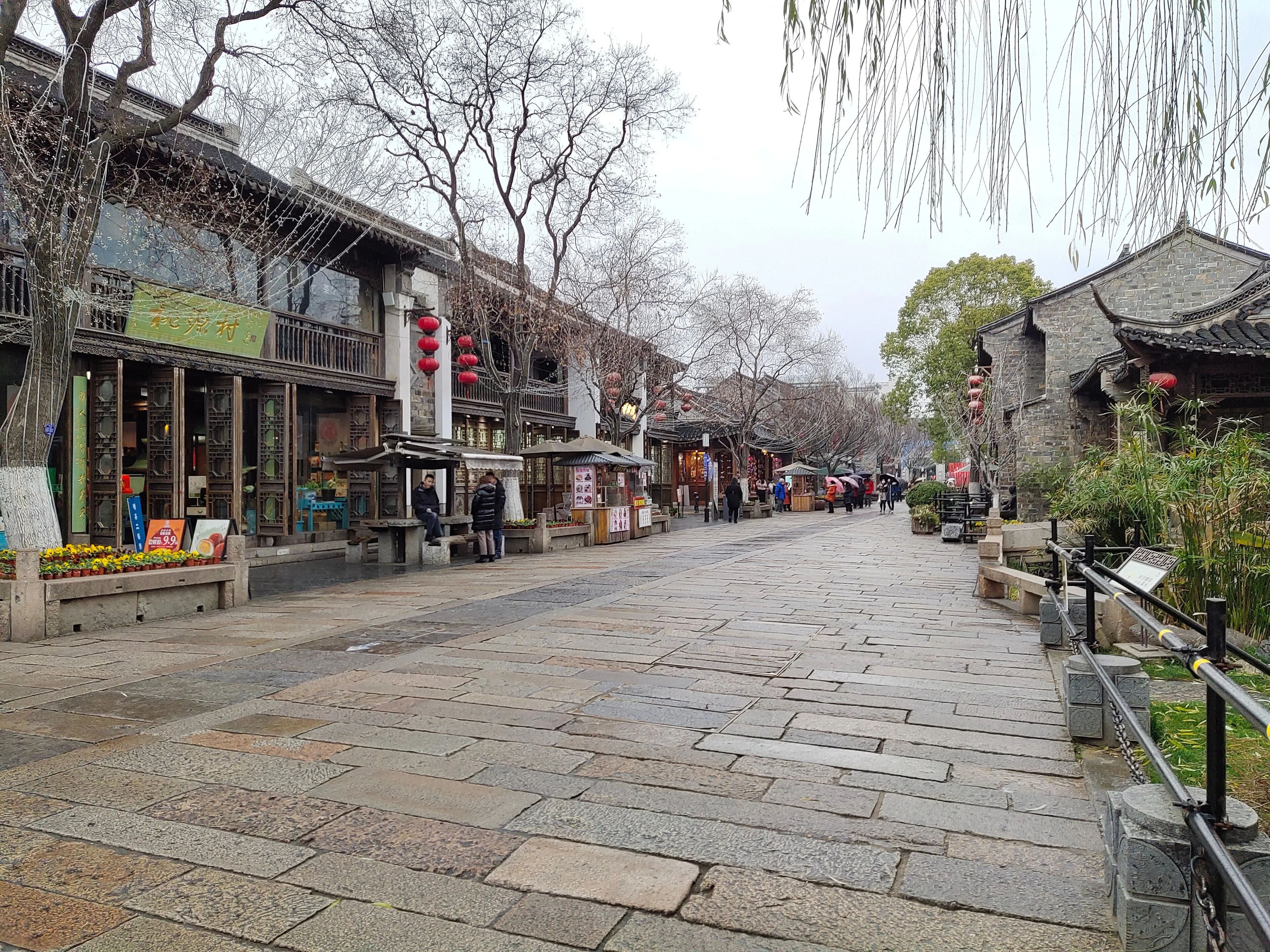 Laomendong in Nanjing — grey brick, willow and red lanterns on a stone-paved lane east of the Zhonghua Gate; the reconstruction is newer than the Confucius Temple quarter and the prices are lower than on the main temple drag.
What it costs. Nanjing runs on duck. Duck-blood vermicelli soup is ¥15–25, and salted duck sells for roughly ¥25–35 per jin (500g). A meal at Nanjing Da Paidang is around ¥60–80 per person.
Spice: low. Vegetarian: good — the snack list is explicitly mixed and includes wholly plant-based sweets. Halal: present — Nanjing has named halal snack houses, and the second of the Eight Wonders is a beef-soup-and-potsticker pairing. Planning: Nanjing Travel Guide.
Suzhou — The Sweet South, and a City Still Bidding
Suzhou cooks Subang cuisine, the Suzhou branch of the Su-Xi school within Jiangsu — again, not Huaiyang. Its character is “southern sweet”: good ingredients, fresh-sweet flavour, careful heat control, glossy dark sauces, strict selection, fine technique, and above all eating by the season. The sweetness has a history: Suzhou was once a salty kitchen, and the shift came after the Song court moved south, with dumplings, soup buns and wontons arriving via Kaifeng and Hangzhou.
| Dish | Pinyin | What it is |
|---|---|---|
| 松鼠鳜鱼 | sōngshǔ guìyú | The head of Suzhou cooking: mandarin fish scored, fried and sauced so it opens like a squirrel’s tail |
| 碧螺虾仁 | bìluó xiārén | River shrimp stir-fried with Biluochun tea from the Dongting hills |
| 响油鳝糊 | xiǎngyóu shànhú | Shredded eel with hot oil poured over at the table, so it arrives with a hiss |
| 樱桃肉 / 蜜汁火方 | yīngtáo ròu / mìzhī huǒfāng | The sweet end: “cherry” pork and honey-steamed ham |
| 枫镇大肉面 / 三虾面 | Fēngzhèn dàròu miàn / sānxiā miàn | The noodle pair — clear broth under melting pork belly, and a seasonal noodle built on shrimp meat, roe and brain |
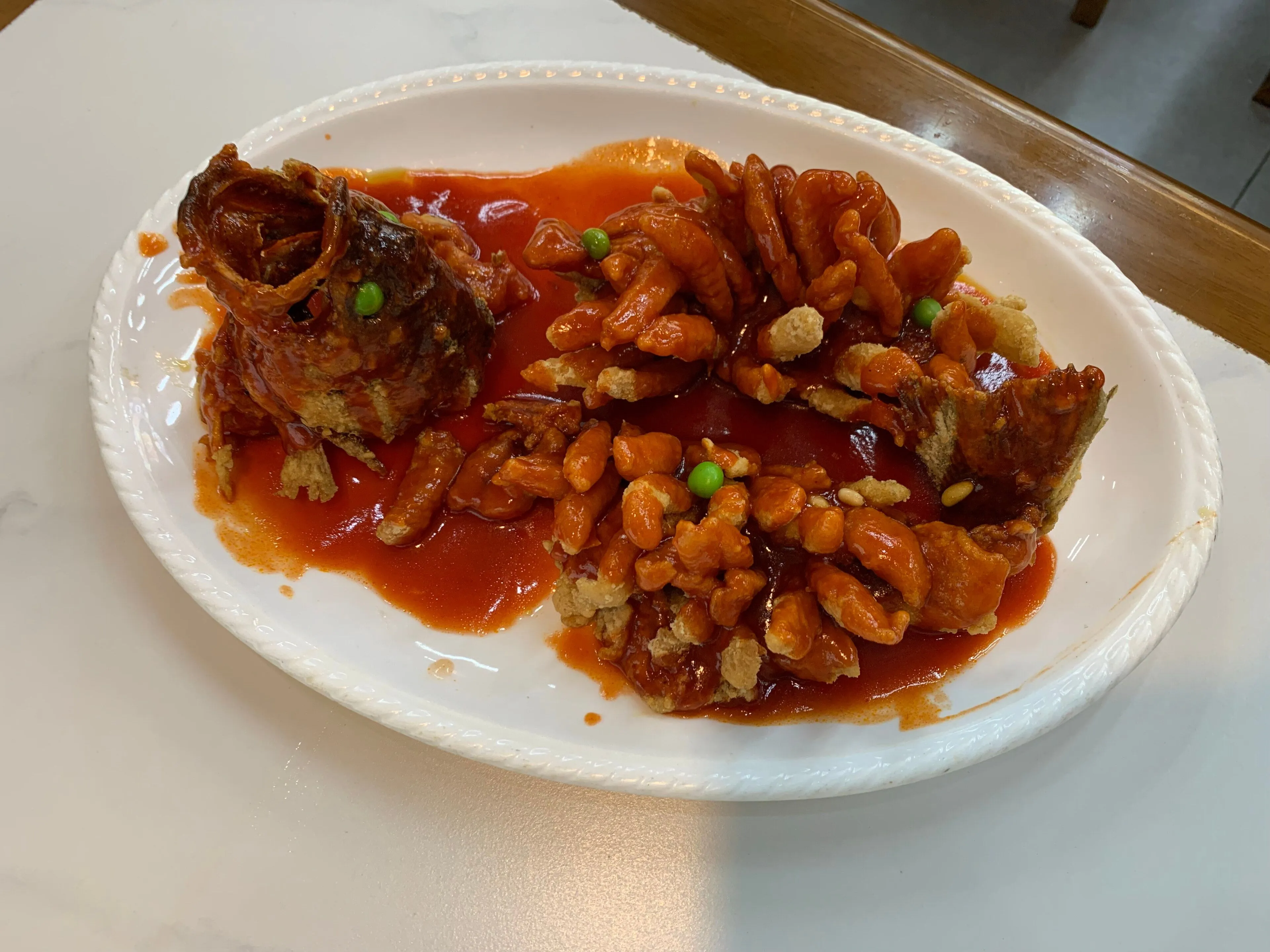 Songshu guiyu in Suzhou — mandarin fish scored in a diamond pattern, dusted and deep-fried so the flesh curls up and out like a squirrel’s tail, then flooded with sweet-sour sauce and scattered with green peas; the scoring is what makes it work, each diamond opening into its own crisp piece. | ||
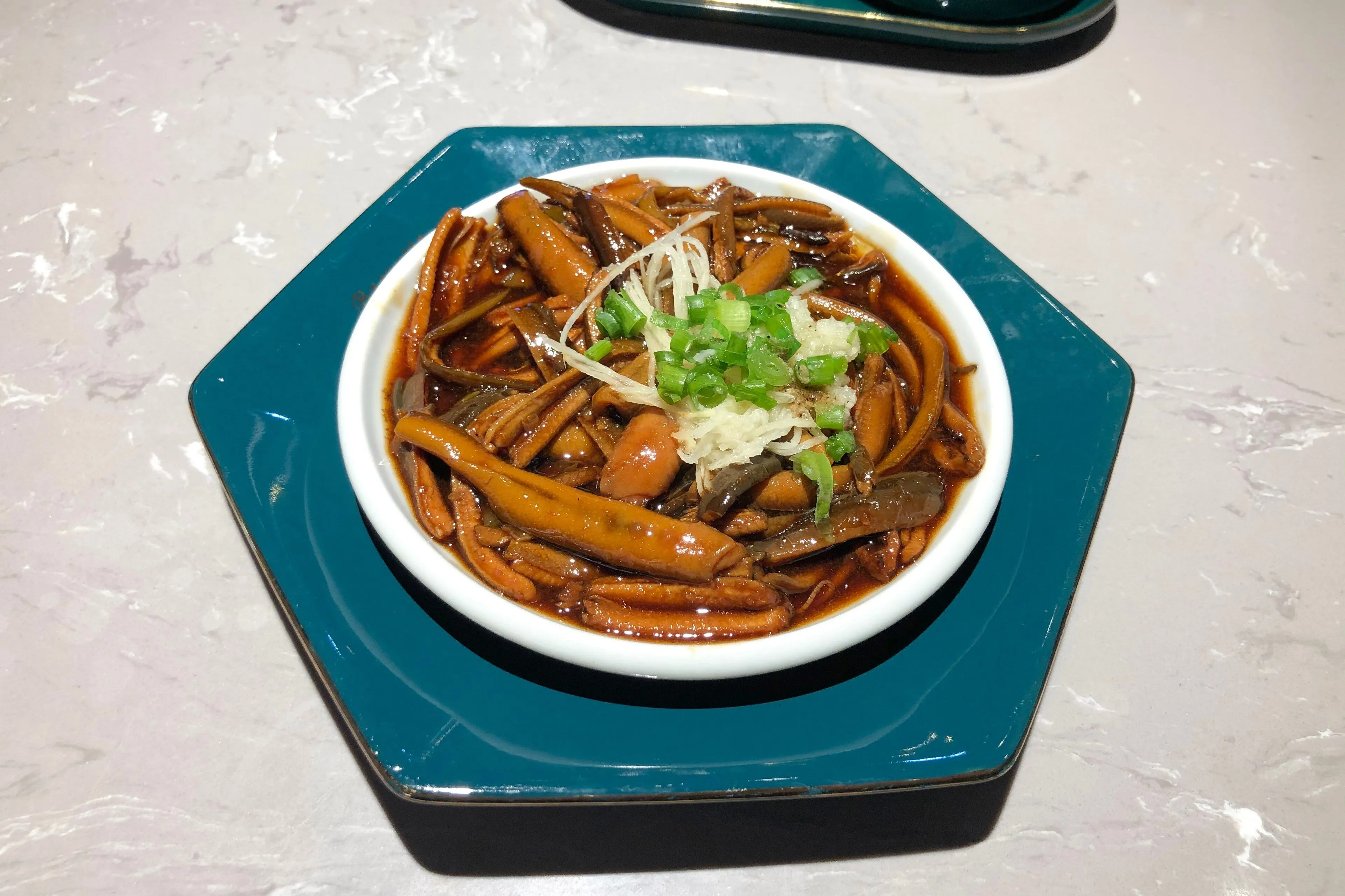 Xiangyou shanhu in Suzhou — shredded eel braised dark and sweet, topped with raw ginger and scallion, finished by pouring smoking oil over the lot at the table; order it for the hiss, and stir before the ginger cooks. | ||
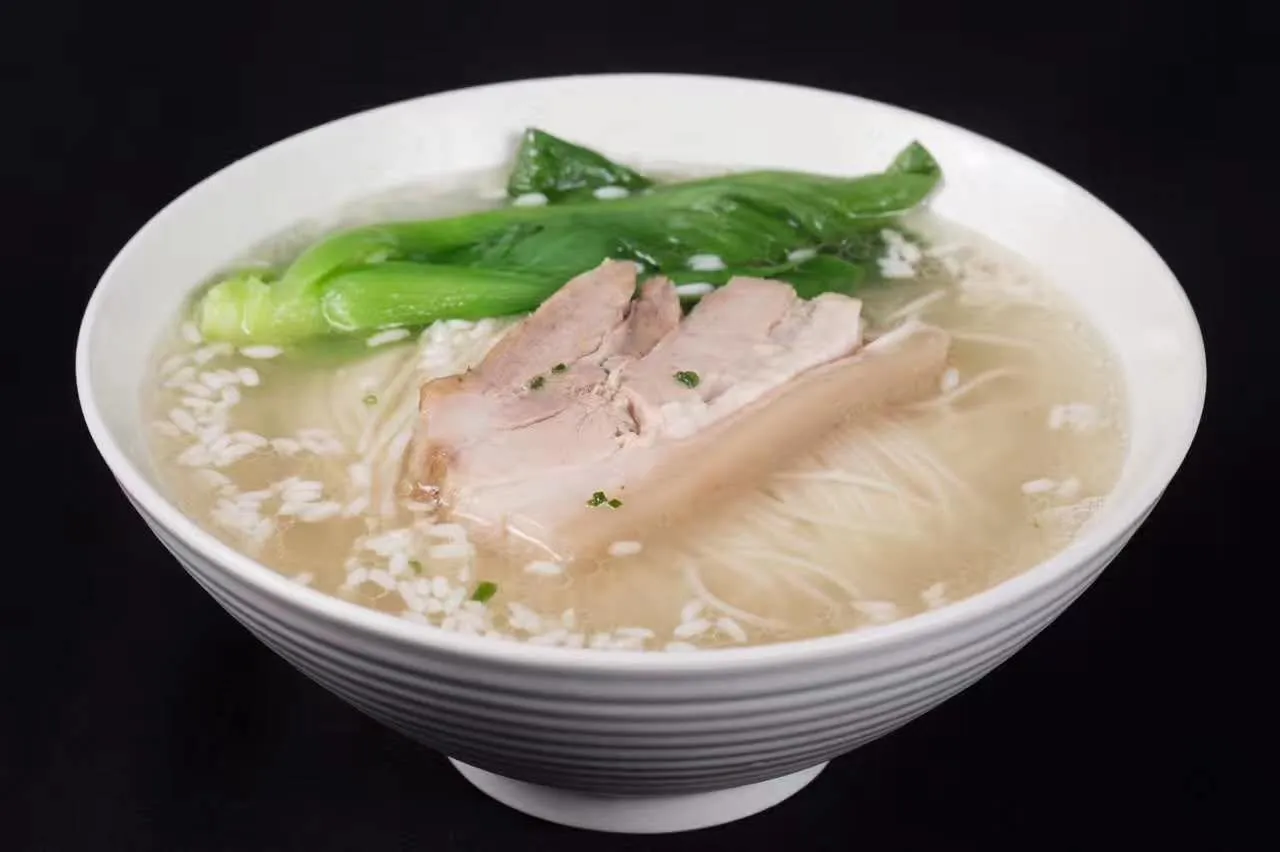 Fengzhen darou mian in Suzhou — a slab of pork belly with skin and fat intact laid over thin noodles in a pale, light broth with a few greens; the pork should fall apart at the touch of chopsticks, and the broth is drunk to the last drop. |
Where to eat. Xuanmiao Temple is one of China’s four great snack quarters. The temple dates to the Western Jin and took its present name in the Yuan; the snack cluster is dated in one account to the Ming Hongzhi era, and the Sanqing Hall became a national key protected site in 1982. Look for mint and osmanthus rice cakes, red-bean rice porridge, honeycomb-patterned cakes baked in old copper moulds, and pork-rib noodles cooked to order. Taijian Lane is the traditional food street, with Bifeng Lane historically competing across from it; the two great names are Songhelou and Deyuelou.
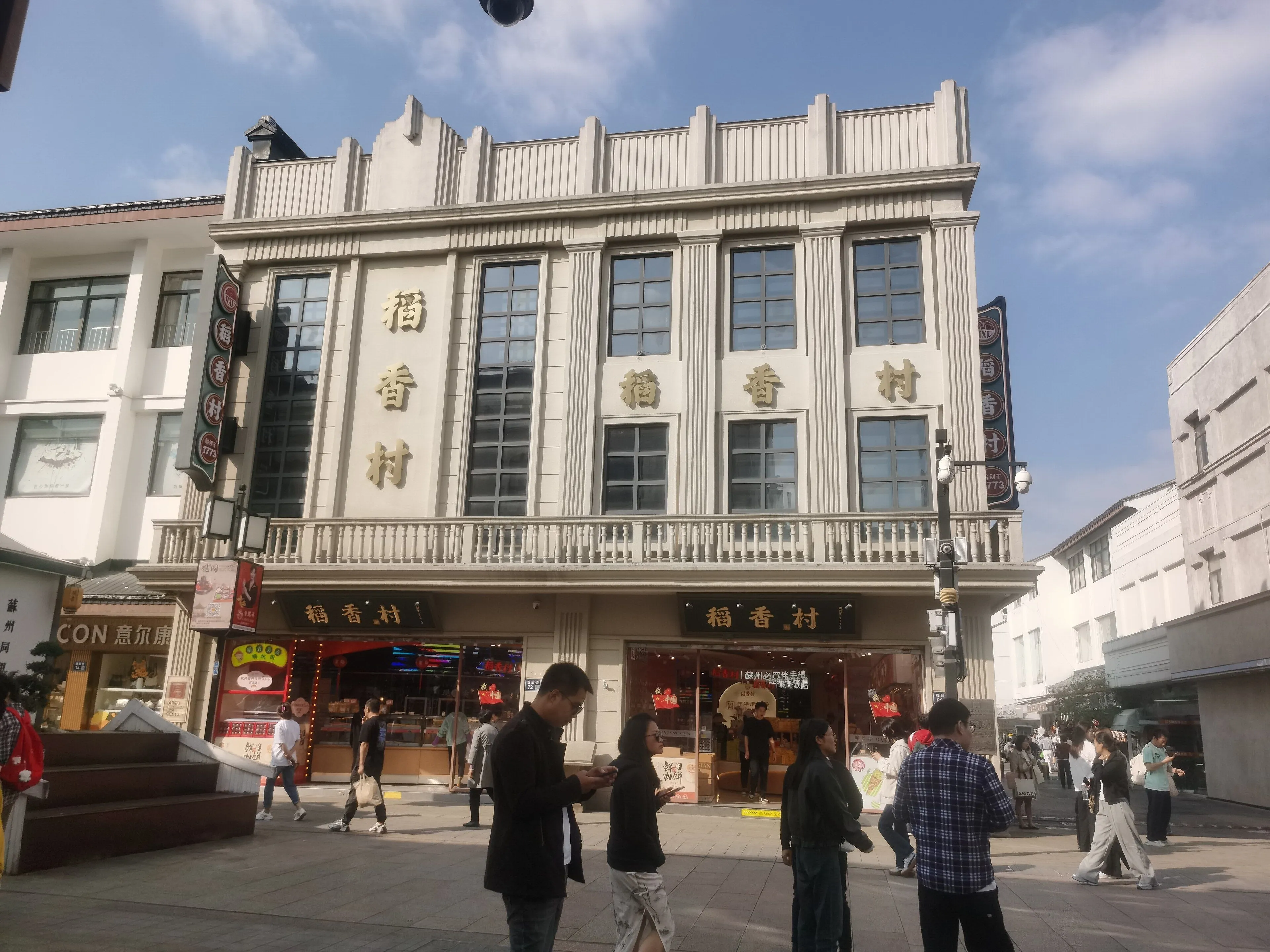 Daoxiangcun on Guanqian Street in Suzhou — a pastry shop rather than a restaurant, its windows stacked with cakes sold by weight; this is where to buy the mint-and-osmanthus rice cakes and the honeycomb cakes to eat while you walk.
Remember: Suzhou is creating a World City of Gastronomy, not holding one. Write “bidding”, never “is”.
What it costs. Suzhou is the priciest of the Jiangnan stops if you go heritage: Songhelou runs around ¥150–200 per person (its squirrel-shaped mandarin fish is about ¥258), Deyuelou ¥140–180 (fish around ¥188). Noodle shops and shengjian stalls are a fraction of that.
Spice: very low. Vegetarian: good — tofu, wheat gluten, bamboo and mushrooms are the traditional pillars here, and the sweet cakes and boat pastries are mostly plant-based. Halal: not verified; assume limited. For the gardens, canals and water towns, see Suzhou Travel Guide, or Suzhou Day Trip from Shanghai.
Changsha — Sour-Hot, Not Numbing-Hot
Changsha is the mainstream of Hunan’s Xiang River valley school, the largest of Xiang cuisine’s three strands. Get the keyword right: 酸辣 suānlà, sour-hot, not 麻辣 málà. Hunan’s provincial government settles the question in one sentence — Sichuan is numbing-hot, Hunan sour-hot, Guizhou fragrant-hot, Yunnan fresh-hot, Shaanxi salty-hot — and the provincial technical standard for Xiang cuisine describes it as sour-hot and fragrant, deep in smoked and cured flavours, tender in texture and bright in colour. In practice the heat is aromatic, oily and deeply coloured, built on chopped salted chillies and Liuyang fermented black beans and lifted by pickling and vinegar. Expect Sichuan’s numbing tingle and you will be surprised by how much of the flavour is sourness and aroma.
The depth is real: the Warring States poem “Summons of the Soul” already lists local dishes, and Mawangdui Han-tomb artefacts show a wide Han-dynasty repertoire across a full range of cooking methods.
| Dish | Pinyin | What it is |
|---|---|---|
| 长沙臭豆腐 | Chángshā chòudòufu | Stinky tofu: black and crisp outside, white and fine inside; Huogongdian’s is the famous one |
| 口味虾 | kǒuwèi xiā | Spicy crayfish, first among Changsha’s flavour snacks |
| 糖油粑粑 | tángyóu bābā | Glutinous rice cakes fried in sugar and oil — the sweet counterweight |
| 长沙汤面 | Chángshā tāngmiàn | The everyday noodle: fresh broth, tender toppings — and a whole vocabulary for ordering it |
| 姊妹团子 | zǐmèi tuánzi | ”Sister” rice dumplings, savoury and sweet paired |
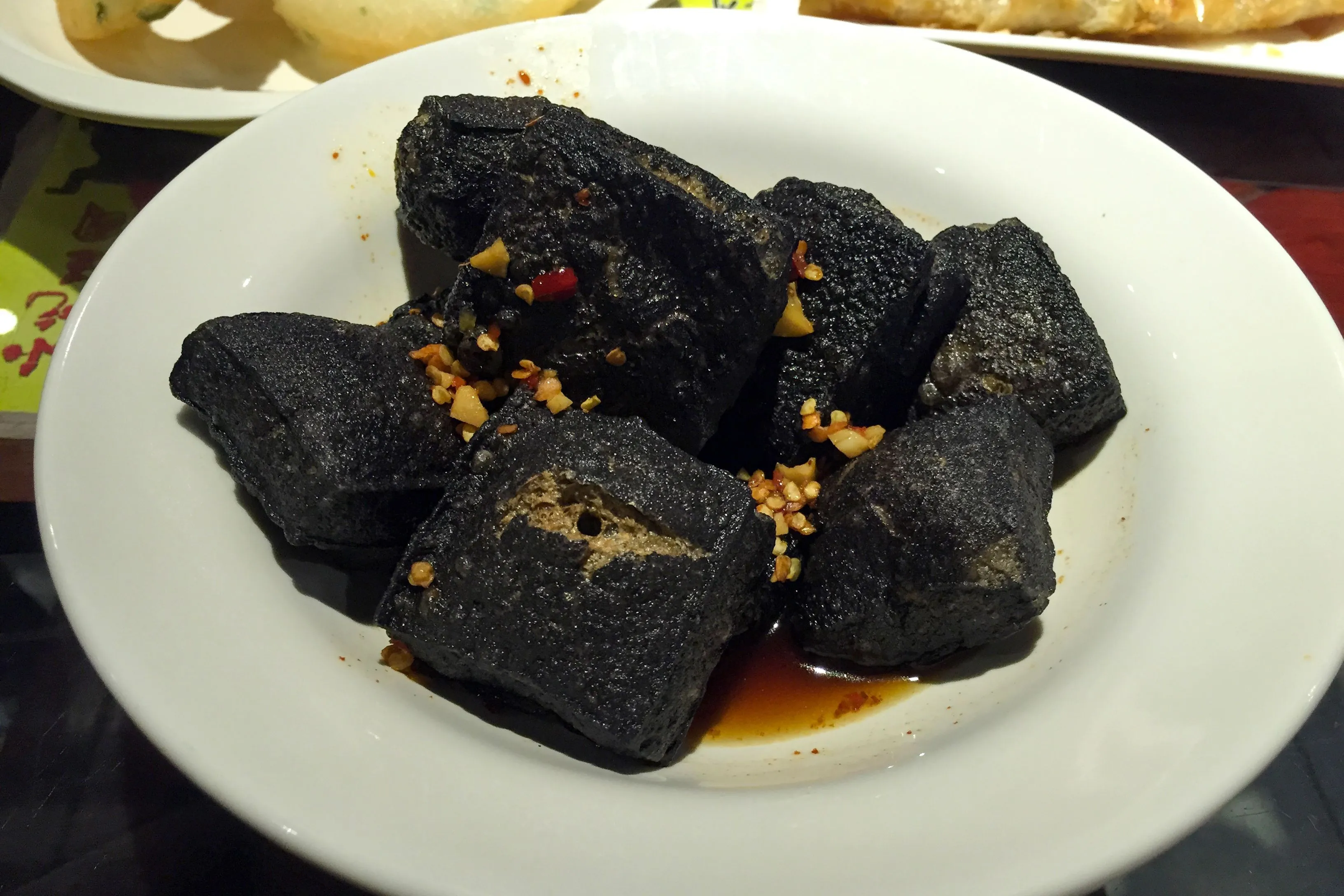 Changsha stinky tofu — fermented until the outside turns black, then deep-fried so the crust crackles while the inside stays pale and porous, split open and flooded with chilli-garlic sauce; the smell is ammonia-sharp and the taste is mild and beany. | ||
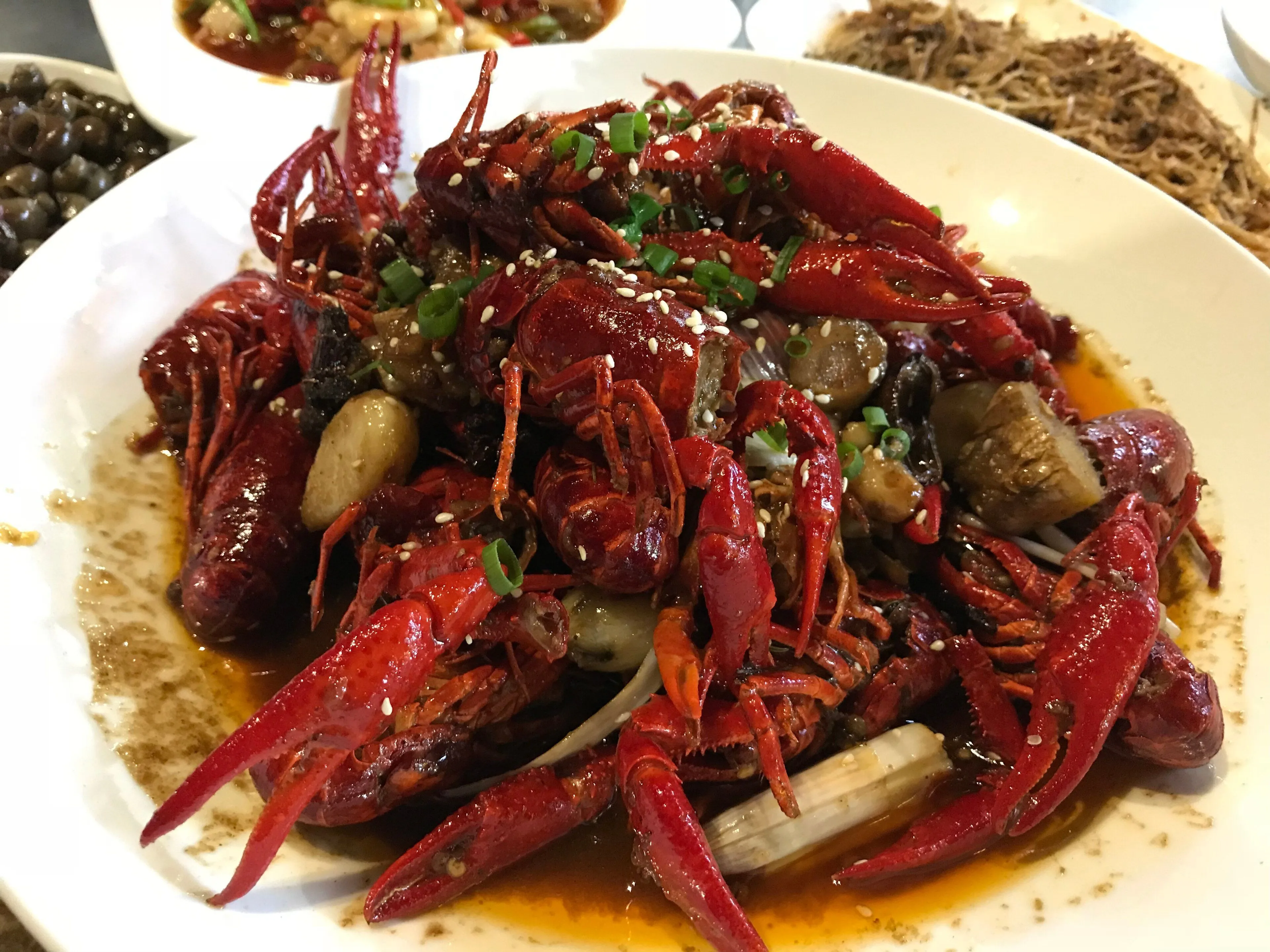 Kouwei xia in Changsha — crawfish cooked in a chilli-and-spice broth and served heaped with whole garlic cloves, sesame and chopped scallion; you eat them with your hands, and the sauce on your fingers is half the point. | ||
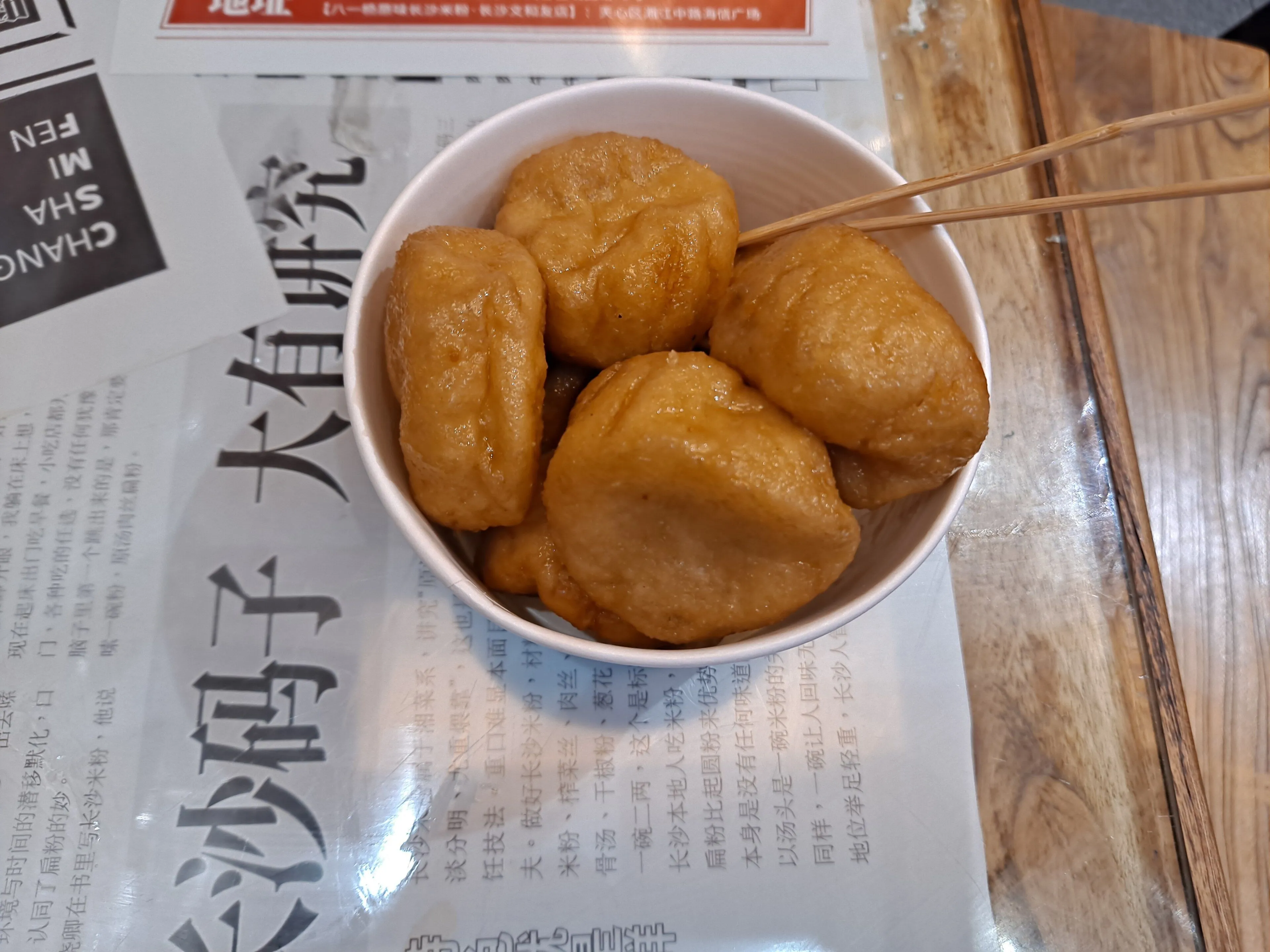 Tangyou baba in Changsha — glutinous rice cakes fried in sugar and oil until the outside caramelises and the middle stays chewy, served in a paper cup with a bamboo skewer; eat them hot, because cold they turn dense and greasy. | ||
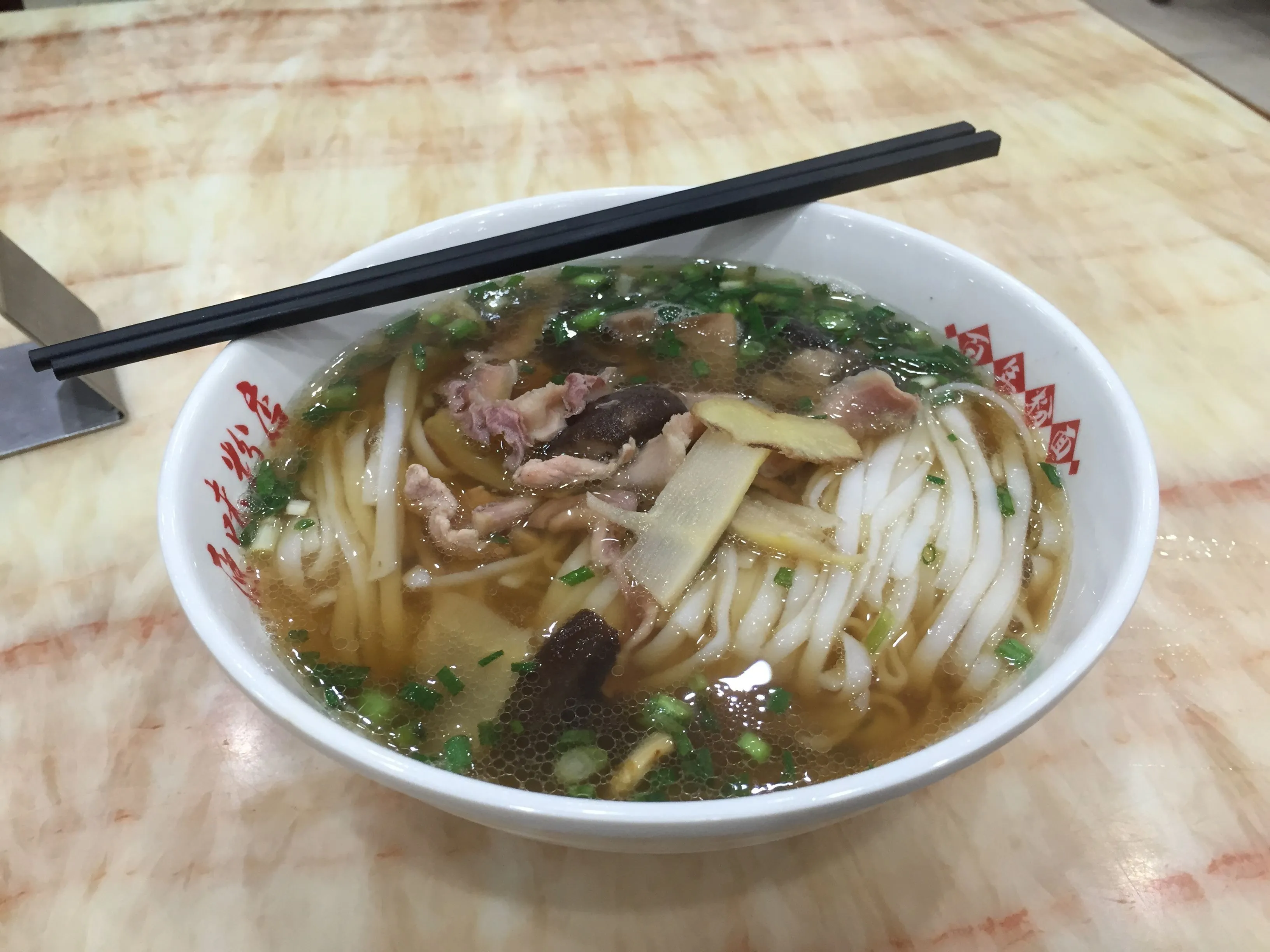 Changsha tangmian — thin noodles in a light pork broth with shredded pork, bamboo shoot and wood ear, chopped scallion over the top; the broth is the point here rather than the chilli, and locals order by noodle firmness and topping weight. |
Where to eat. Huogongdian (Fire Palace) on Pozi Street is the centre of gravity: first recorded in 1577 in the Ming Wanli reign and rebuilt in 1747 under the Qing Qianlong emperor, laid out on a “one palace, two temples, three passages, four sights” plan, with a snack repertoire grown to a very large number of items. Its stinky-tofu technique entered China’s national intangible heritage list in 2021; the temple fair was listed nationally in 2008; the eight traditional snacks’ techniques were listed at provincial level in 2009. For night eating, the markets — Yangfan, Sifangping and Dongguashan, plus Huangxing Road — are where Changsha actually eats after dark.
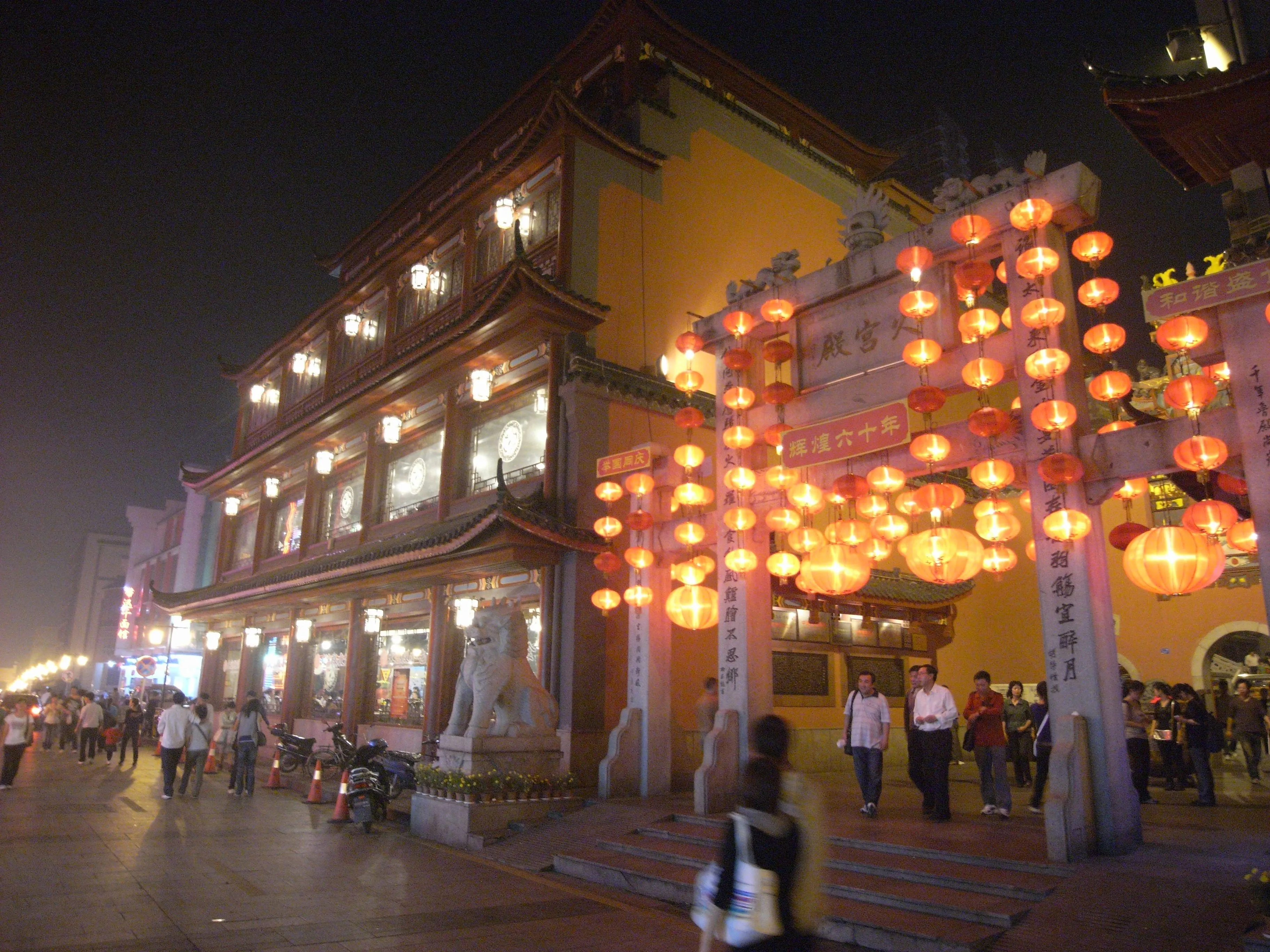 Huogongdian on Pozi Street in Changsha at night — a yellow-walled temple to eating behind a gateway hung with red lanterns, stone lions at the steps; the snack hall inside runs to dozens of small dishes, and the stinky tofu is the one with a national heritage listing.
And again: in 2017 Changsha received two honours ending in “capital” — a UNESCO City of Media Arts title, and a separate “International City of Gastronomy” awarded by the World Federation of Chinese Catering Industry on 21 December at Huogongdian itself, which is not UNESCO. Xi’an took the same non-UNESCO title from the same body eight days later. Different bodies, same year, none of them a UNESCO gastronomy listing.
What it costs. Grazing Pozi Street and the Huogongdian snack hall costs around ¥40–80 per person. Stinky tofu is roughly ¥10–20 a portion and sugar-oil baba ¥5–10. Sit-down Hunanese restaurants are mid-range.
Spice: high, second only to Chongqing. Vegetarian: moderate — cold jelly, sweet rice cakes and sweet wine with egg give room, but the cooking is oily and richly seasoned. Halal: not verified; assume limited.
How to Order: Hotpot, Pao Mo, Noodles and Dumplings
Hotpot
Choose the broth first. Chongqing’s is red — beef tallow, chilli, Sichuan pepper. Chengdu’s lean is clear oil, plus the local suobian fish hotpot. For a split table, order a yuanyang pot, divided by an S-shaped metal partition into a clear half and a red half; the divided pot is an old idea, with a Five-Flavour Vessel from the Three Kingdoms usually cited as its ancestor.
Chongqing’s nine-grid pot exists for heat management — different cells hold different temperatures for different ingredients. Local timings: tripe about fifteen seconds (“seven dips up, eight down”); duck intestine eight to ten seconds, pull it the moment it curls; throat two to three minutes; blood curd when it floats; dried mustard stems about a minute.
The dip is oil and garlic, deliberately — sesame-oil-and-garlic measurably softens the heat. Do not add vinegar or oyster sauce; local advice is that it makes the chilli bite harder. And hotpot here is not seasonal — locals eat it through the hottest weeks, outdoors, with cold beer.
Pao mo in Xi’an
Tear the bread yourself, and tear it small — about soybean size. Day-old bread tears better than fresh; machine-chopped bread exists but locals rarely accept it.
Then name your soup level, because the kitchen cooks to it: 干拔 gānbá (dry), the broth fully absorbed; 口汤 kǒutāng (one mouthful of soup); 水围城 shuǐwéichéng (“water siege”), bread in the middle and broth around it; 单走 dānzǒu (separate), bread and soup served apart. Terminology varies by shop. Say whether you want it 口重 or 口轻, heavier or lighter. Do not stir it once it arrives — eat steadily from one edge so the flavour stays consistent. Save the sweet garlic and chilli paste for the halfway point; eating them at the start dulls everything after. Winter is best.
Noodles and dumplings
Changsha noodles have their own slang. Luo guo qi lifts them straight from the pot, very firm; dai xun gan is drained and slightly firm; qing tiao a light portion, chong tiao qing gai extra noodles with a light topping; shuang you extra oil, mian qing no greens, mian hong no chilli.
Chongqing xiaomian has slang too: gan liu means almost no broth, ti huang firmer noodles; add peas and zhajiang for the full local version.
Nanjing soup dumplings come with instructions: “move it gently, lift it slowly, open a window first, then drink the soup.” Suzhou noodles are seasonal — the three-shrimp noodle is a spring-and-summer dish; the Fengzhen pork noodle is the all-year counterpart. Guangzhou dim sum has its own whole grammar, covered properly in Guangzhou Food Guide.
Ten Cities at a Glance
| City | Cuisine | Spice | Signature | Rough budget per person | Where to go |
|---|---|---|---|---|---|
| Chengdu | Sichuan, Upper River | Moderate, adjustable | Mapo tofu, twice-cooked pork, kaishui baicai, dan dan noodles | Around ¥80–150 for hotpot; ¥40–80 for chuanchuan | Jinli and Kuanzhai Alleys (free to enter); Jianshe Road, Kuixinglou, Yulin Road at night |
| Chongqing | Sichuan, Lower River (Yu) | Highest | Tallow hotpot, xiaomian, laziji, Wanzhou grilled fish | Roughly ¥50–85 at neighbourhood hotpot; ¥100–150 at famous spots | Bayi Road and the lanes off Jiefangbei; Jiaochangkou late; Hongyadong |
| Guangzhou | Cantonese (Guangfu) | Lowest | Roast meats, white-cut chicken, long-simmered soup, dim sum | Typically ¥70–120 for classic dim sum; ¥30–55 locally | See Guangzhou Food Guide |
| Xi’an | Shaanxi (Qin) — not one of the Eight | Low, aromatic | Yangrou paomo, roujiamo, hulu chicken, shuipen mutton | Around ¥40–80 grazing Yongxingfang | Muslim Quarter (#45); Yongxingfang, free to enter; Sajinqiao early |
| Beijing | Beijing (Jing) — not one of the Eight | Low | Roast duck, instant-boiled mutton, zhajiang noodles, luzhu | Around ¥150–200 for duck; around ¥100 for Niujie hotpot | Niujie for halal; Guijie for late night; Qianmen for old names |
| Shanghai | Shanghainese (benbang) | Lowest | Red-braised pork, yan du xian, crystal shrimp, shengjian | ¥80–150 at mid-range Benbang restaurants | City God Temple area; old-brand streets off Nanjing Road; Huanghe Road |
| Hangzhou | Zhejiang (Hangbang) | Very low | West Lake vinegar fish, Dongpo pork, Song Sao fish soup, pian’er chuan | Around ¥120–200 at Louwailou | Hefang Street and Gaoyin Street; Shenglihe at night |
| Nanjing | Jiangsu (Jinling) — not Huaiyang | Low | Salted duck, duck-blood vermicelli, beef potstickers, soup dumplings | Around ¥60–80 at Nanjing Da Paidang | Confucius Temple on the Qinhuai; Laomendong for value |
| Suzhou | Jiangsu (Su-Xi / Subang) — not Huaiyang | Very low | Squirrel mandarin fish, Biluochun shrimp, sizzling-oil eel, three-shrimp noodles | Around ¥150–200 at Songhelou; ¥140–180 at Deyuelou | Xuanmiao Temple snack street; Taijian Lane; Songhelou and Deyuelou |
| Changsha | Hunan (Xiang River valley) | High | Stinky tofu, spicy crayfish, tangyou baba, Changsha soup noodles | Around ¥40–80 grazing the snack streets | Huogongdian on Pozi Street; Yangfan, Sifangping, Dongguashan markets |
China’s Four Great Snack Quarters (Also Known as the Four Great Snack Streets)
Chinese sources speak of the “four great snack groups”, traced to the Qing collection Unofficial History of the Qing, and of the “four great snack streets”. These are the same four places under two names — one framed by flavour tradition, one by street. In English we call them China’s four great snack quarters, also known as the four great snack streets. Say which you mean and you will be understood; treat them as different lists and you invent a fifth.
| Snack quarter | City | Snack tradition dated to | Look for |
|---|---|---|---|
| Fuzimiao (Confucius Temple), Qinhuai | Nanjing | Ming Hongwu era | The Eight Wonders — eight dry-and-wet pairings, sixteen items |
| City God Temple | Shanghai | Ming Yongle era | Nanxiang soup dumplings (the Yu Garden shop dates to 1900), vegetarian buns, Lubolang dim sum |
| Xuanmiao Temple | Suzhou | Ming Hongzhi era (temple far older) | Mint and osmanthus rice cakes, red-bean porridge, honeycomb cakes |
| Huogongdian (Fire Palace) | Changsha | First recorded 1577; present buildings rebuilt 1747 | Stinky tofu with a national intangible heritage listing |
Three of the four are in our ten cities, and all four are a few hours apart by rail.
When to Go, and Practical Notes
Chinese cooking is seasonal in a way that matters more than weather. Guangzhou runs on an ingredient calendar: bream in spring, carp in autumn, shad in summer, sea bass in deep winter; prawns fattest around Qingming; flowering cabbage sweetest once the north wind arrives. Suzhou eats by the season, with lake ingredients and hairy crab in their own windows. Xi’an’s paomo is a winter dish. Chongqing’s hotpot ignores the calendar. For month-by-month weather and crowds see Best Time to Visit China.
- Eat where the queue is short and the menu is long — turnover at an odd hour is the most reliable signal in all ten cities.
- Go early for breakfast streets. Sajinqiao in Xi’an and the Suzhou snack lanes are genuinely morning places; some stalls sell out before mid-morning.
- Watch for the tourist-trap pattern: picture menus in six languages, no Chinese customers, a “special” set meal nobody ordered. China Travel Scams and Tourist Traps covers the wider versions.
- Menus will be in Chinese. Pointing works, and so does a screenshot of the characters; China Language Barrier Survival Guide has the phrases that help at a table.
- Prices move, so treat the figures above as orientation, not as a menu. They were rounded from Chinese-language sources checked in late 2026; service charges, scenic-area markups and festival days all shift them. China Backpacking Budget has the wider framework.
- Supermarkets and delivery are your safety net across every city here; see Food Delivery and Convenience Stores in China.
- Check a restaurant still exists before crossing town for it — Shanghai’s Xiao Nan Guo is the cautionary example, and even then the honest reading is “suspended operations at the time of writing”.
- Verify titles before repeating them. “UNESCO City of Gastronomy” is a specific designation with a specific list; “International City of Gastronomy” is an industry honour, and “food capital” in Chinese marketing copy is neither.
A food-first trip works best as a chain along the eastern corridor, where high-speed rail makes most pairs a few hours apart: Shanghai → Suzhou → Nanjing for the Jiangsu triangle, then Hangzhou, then south to Guangzhou, west to Chengdu and Chongqing, or north to Xi’an and Beijing. Because the four great snack quarters sit in Nanjing, Shanghai, Suzhou and Changsha, that theme alone gives you a route: 2 Weeks in China, 10 Days in China or 7 Days in China. To eat where tour groups do not, add Hidden Gems in China.
Related Articles
- Chinese Food Guide for Foreigners — the Eight Great Cuisines explained, plus dietary restrictions and how to order
- Iconic Chinese Dishes and Their Legends — the stories behind the dishes you will meet in every city here
- Guangzhou Food Guide — dim sum, roast meats and sweet soups in detail
- Xi’an Muslim Quarter Food — the six-street layout, the paomo houses and what to order
- Chengdu Travel Guide — China’s only UNESCO City of Gastronomy on this list
- Chinese Tea Culture and Night Markets — the evening half of Chinese food culture
- Suzhou Travel Guide — gardens, canals and a city still bidding for gastronomy status
- Food Delivery and Convenience Stores in China — eating cheaply between restaurant meals
- China High-Speed Rail Guide — how to chain these ten cities together
- Best Time to Visit China — month by month, including what is in season