Bringing a Drone to China (2026): Registration, No-Fly Zones and Camera Rules for Foreign Visitors
China is one of the most rewarding countries on earth to fly a camera over: karst peaks in Guilin, the rice terraces of Yunnan, desert highways in Xinjiang, a coastline of bays in Sanya. It is also the country where English-language drone advice is most often wrong. Guides still repeat a 250-gram registration threshold that was repealed years ago, claim Beijing only banned flying inside the Sixth Ring Road, and warn that foreigners risk deportation for an unregistered flight. None of those three statements holds up against the actual regulations.
The rules changed fundamentally twice: a national regulation took effect on January 1, 2024, and two mandatory national standards added a technical lock on May 1, 2026. Both changes matter to a foreign visitor carrying a drone, a camera, or both.
Quick answer: Yes, you can legally bring a drone to China, and yes, foreigners can register one with a passport on the CAAC platform (uom.caac.gov.cn). Every drone must be registered regardless of weight. Drones produced after May 1, 2026 cannot take off at all until registered and activated; older drones have until May 2027. Beijing is entirely off-limits without special approval, far beyond the Sixth Ring Road. Batteries go in your carry-on, never checked. A camera you take home with you is duty-free. See also our customs declaration guide and Sanya travel guide.
How we verified this: SinoWander reads the original Chinese documents that English guides cannot: the State Council regulation itself (Order No. 761), the SAMR announcement of the two 2025 national standards, Beijing municipal notice 京政发〔2025〕20号, Beijing Customs announcement 2026 No.2, and the CAAC’s own repealed-file archive. Claims were cross-checked against foreign pilots’ first-hand reports from 2025 and 2026. Each guide is date-stamped when last verified: 2026-08-18. See our methodology.
Registering a Drone with a Passport: What Actually Works
The Civil Aviation Administration of China runs a single national registry called UOM (uom.caac.gov.cn). Chinese sources openly contradict each other on whether foreigners can use it. One widely-copied answer claims overseas visitors cannot register directly and must delegate the task to a Chinese citizen who then accepts legal responsibility. That answer is wrong. The registration form’s ID-type dropdown includes passport, and multiple foreign pilots completed the process themselves in 2025 and 2026, including a detailed photo walkthrough published by a Japanese traveler in September 2025 and a thread on Reddit’s r/dji from December 2025.
So the registration itself works. The friction is in the details:
- You need a mainland Chinese phone number for the verification code. Hotel front desks, a Chinese friend, or a SIM you buy on arrival all solve this.
- You need a residential address in China. A hotel address is fine.
- You upload a photo of yourself holding your passport plus your visa or visa-free entry page. Review is manual, officially around two working days. One pilot reported a two-week wait, so budget a week and submit early.
- Name format matters. A rejected first submission was fixed by entering surname and given name in the exact comma-separated order shown on the passport page. Pilots also recommend registering after your first entry stamp exists in the passport.
Once approved, you receive an 11-character registration number (starting with UAS) and a QR code. Print it and stick it visibly on the drone body. That sticker is what turns an unregistered aircraft into a legal one.
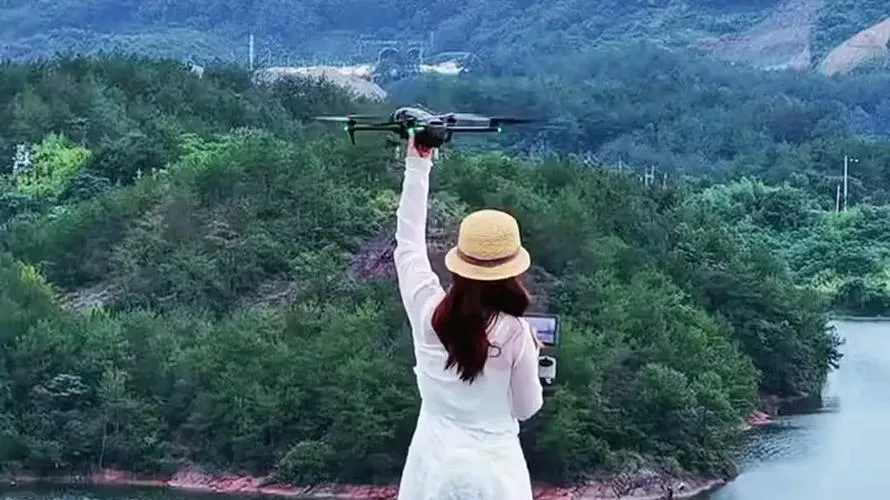 A traveler with a drone and its controller. Registration ties the aircraft to your passport, not to a Chinese ID.
The “250 Grams” Threshold Is Gone
Half the English internet, including checklist sites updated as recently as August 2026, still says only drones over 250 grams need registration. That number came from a 2017 CAAC rule (AP-45-AA-2017-03). On the CAAC’s own website, that document is stamped repealed. The 2024 regulation replaced it with a simple statement in Article 10: all owners of civil drones must complete real-name registration. No weight floor, no exception for tiny aircraft, no distinction between residents and visitors. A 129-gram DJI Mini and a 4-kilogram Mavic follow the same procedure.
This matters because the sub-250-gram drone is exactly the one travelers bring. If you bought a Mini specifically because English guides told you it flies under China’s radar, that advice is out of date.
May 2026: Drones That Refuse to Take Off
Registration used to be a paper obligation you could technically ignore. Not anymore. Two mandatory national standards, GB 46761-2025 and GB 46750-2025, published December 9, 2025 and effective May 1, 2026, require drones to be unable to fly before activation and after deactivation. The regulator’s own summary: the standards technically resolve “who can fly and who is flying.”
In practice, a drone manufactured after May 2026 will not spin its motors until you activate it through a registered account. Existing drones get a 12-month transition, so the lock becomes mandatory for them on May 1, 2027, and retrofitting older aircraft with the remote-identification hardware has a runway to 2029. If you are reading this before booking a 2026 trip, the practical takeaway is shorter: register before you fly, because the aircraft increasingly will not let you do otherwise.
A Second Registration You Have Never Heard Of
Here is something with zero coverage in English guides. Since early 2026, city-level public security bureaus have been requiring a second registration through a WeChat mini program called the Unmanned Aircraft Public Security Management Platform. A Hengqin (Zhuhai) police notice from February 27, 2026 states that drone owners must complete dual registration: the civil aviation UOM platform plus the police mini program. Dongguan issued the same requirement on February 12, and Zhuhai, Pingdingshan and several Hunan cities followed. Flying without it can draw a fine up to ¥200, or ¥2,000 to ¥20,000 in serious cases.
Two honest caveats. Whether the mini program accepts foreign passports is unconfirmed: official notices list only ID numbers and face verification, and the “passport supported” claim traces back to training-company blog posts rather than any government document. And none of the notices carve out an exemption for short-term visitors. Our advice: before your trip, check whether your destination city has issued such a notice, and treat the UOM registration as the non-negotiable baseline.
Where You Can Actually Fly: Two Gates, Not One
National airspace rules decide whether a location is legal to fly over. Then the scenic area itself decides whether drones are welcome on the ground. Both gates have to open, and the second one is closing more often: across China, parks and heritage sites have been moving from “fly freely” to “report first” to “banned entirely,” and policies shift with seasons and major events. Before every flight, check the airspace on the UOM map, then check the scenic area’s official account or call the management office.
The airspace framework under the 2024 regulation: anything above 120 meters true height, plus eight categories of zones (airports, borders, military areas, nuclear facilities, key infrastructure, radio-sensitive facilities, major heritage sites, and others), forms controlled airspace. Outside it lies the “suitable flying” zone where micro, light and small drones need no flight application at all. Inside controlled airspace, you must apply by 12:00 the day before and receive an answer by 21:00 that evening. One traveler-friendly detail: flying indoors is exempt from the entire regulation.
Beijing. The entire municipality is controlled airspace, and has been since the regulation took effect in January 2024. A municipal notice in August 2025 (京政发〔2025〕20号) formalized the publication. The “no flying inside the Sixth Ring Road” line that circulates in English comes from drone manufacturers’ pre-set geofence maps, which paint only the area inside the ring red; the restricted zone covers the entire municipality, as Beijing media themselves explained. If Beijing is your destination, plan to leave the drone in the hotel and shoot from the ground; our Beijing guide has plenty of ground-level material.
Hainan. The opposite trend. On May 14, 2026 the province activated an expanded map of suitable flying airspace, the direction most friendly to drone travelers in the country, with flight volumes doubling year over year. Check your exact spot on the UOM platform or the Hainan drone service platform (uss.ufly.com.cn) before flying, because the published boundaries are a PDF map and popular bays are not individually confirmed. Foreign pilot forums also report signal interference and firm enforcement around military zones on the island. Our Sanya and Hainan guide covers the island from the ground.
 Sanya Bay and the Coconut Dream Corridor from above. Hainan expanded its drone-friendly airspace in May 2026; confirm each spot on the official map before taking off.
Xinjiang. Do not trust any fixed list, including Chinese ones from a few months ago. Border areas (Tashkurgan, Baihaba, Khorgos) are absolutely banned. Heavenly Lake and Sayram Lake allow flying after a registration or report-in step. Kanas restricts flying to designated areas in low season and bans it outright during autumn peak. During the region’s 70th-anniversary celebrations in late 2025, the entire province temporarily banned all drone flights. The workable approach: call the scenic area’s management committee the day before, and check UOM notices.
Tibet. Strict and actively enforced, especially near borders. A 2026 police campaign targets unregistered high-altitude flights, and real fines have been issued (see below).
Penalties: What the “Deportation” Stories Get Wrong
English forums love the claim that a foreigner caught flying an unregistered drone in China faces deportation. Read the actual penalty articles and the picture is more ordinary. Flying unregistered draws a correction order and a fine under ¥200 (up to ¥20,000 in serious cases). Flying a micro or light drone into controlled airspace without approval draws under ¥500, with confiscation and ¥1,000-10,000 if consequences are serious. Tibet’s published 2026 enforcement cases fit exactly: one pilot fined ¥500 for airspace, another ¥200 for no registration.
Deportation appears in exactly one article, No. 53, and it targets a specific act: foreigners or foreign drones conducting surveying or radio-parameter testing, with fines starting at ¥500,000. Unless your itinerary involves mapping infrastructure, that clause is not about you.
Two real footnotes to that reassurance. All published fine cases we found involved domestic pilots, so treat the numbers as a floor of what enforcement looks like, not a ceiling guaranteed to foreigners. And the leniency example cuts both ways: a first-time tourist who wandered into a no-fly zone near Mount Everest base camp in May 2026 received a lecture and a signed pledge instead of a fine, but a pilot who cracked his drone’s altitude limit to reach 8,000 meters near a civil aviation route was arrested, and filming inside a military airport compound brought a three-year sentence. The line is intent. Casual mistakes meet small fines; deliberate recklessness or anything touching the military meets criminal law. If you see someone filming sensitive installations, the reporting hotline is 12339.
Do You Need a License? Almost Certainly Not
Licenses apply to small, medium and large drones flown in controlled contexts. Micro and light drones, which covers every DJI Mini, Air and Mavic series travelers carry, need no license at all in suitable flying airspace. A foreigner can technically enroll at a CAAC-filed training organization with a passport, but the theory exam exists only in Chinese, courses run 15 to 25 days, and fees hover around ¥6,800-9,800. For a tourist, the question answers itself: register, stay in suitable airspace, skip the license.
Batteries and Customs: The Part That Grounds Trips
None of the drone rules matter if the airline confiscates your batteries at the gate. China follows the standard international lithium framework with its own precise wording:
- Under 100 Wh (all DJI Mini, Air and Mavic batteries qualify): devices and spare batteries in carry-on, no approval needed.
- 100-160 Wh (Inspire-class): airline approval required, maximum two spare batteries per person.
- Over 160 Wh: prohibited.
- Spare batteries are carry-on only, never checked, with terminals protected (original packaging, tape, or individual bags).
- A drone body packed in checked luggage must have its battery removed and be fully powered off, not sleeping.
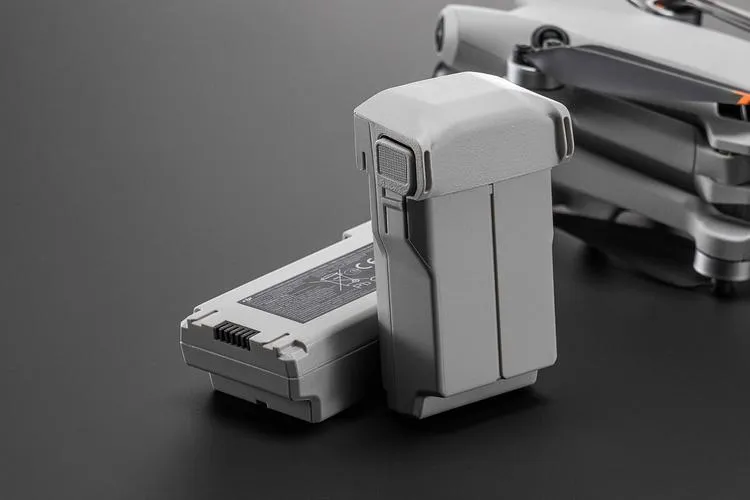 DJI flight batteries. Every Mini, Air and Mavic pack stays under 100 Wh, which means carry-on with no approval needed.
A 2025 rule banning power banks without 3C certification on domestic Chinese flights alarmed drone owners, but DJI’s official clarification confirmed it targets power banks only: drone batteries are unaffected. For travel within China, high-speed rail is the lower-friction option and our rail guide covers luggage norms.
On the customs side, one port has a drone-specific rule: Beijing. Announcement 2026 No.2, effective April 1, 2026, requires travelers entering through Beijing ports, or shipping drones to Beijing addresses, to declare them. No other port, and no national-level rule, mandates drone declaration on entry. Elsewhere the general baggage framework applies, and declaring voluntarily costs a minute; the full rules are in our customs and shipping guide.
The Camera Duty Myth
Older guides, and a customs office’s own outdated FAQ page still online as of August 2026, claim cameras are on a list of 20 goods that can never enter duty-free, so bringing a “valuable” camera means paying duty. That list dates to 1994. In August 2020, a joint Ministry of Finance and Customs announcement stopped enforcing it. Cameras now fall under the standard traveler allowance: ¥5,000 for residents, ¥2,000 for non-residents, and the non-resident limit applies only to items you plan to leave in China. A camera that flies home with you is your personal property. Bring the receipt if asked, and see our entry requirements guide for how the visa side works.
Photography Rules on the Ground
For a country with a reputation for restrictions, everyday photography in China runs on light rules. Street scenes, food, temples, people in public spaces: shoot away, as we cover in our independent travel guide. The specific rules worth knowing:
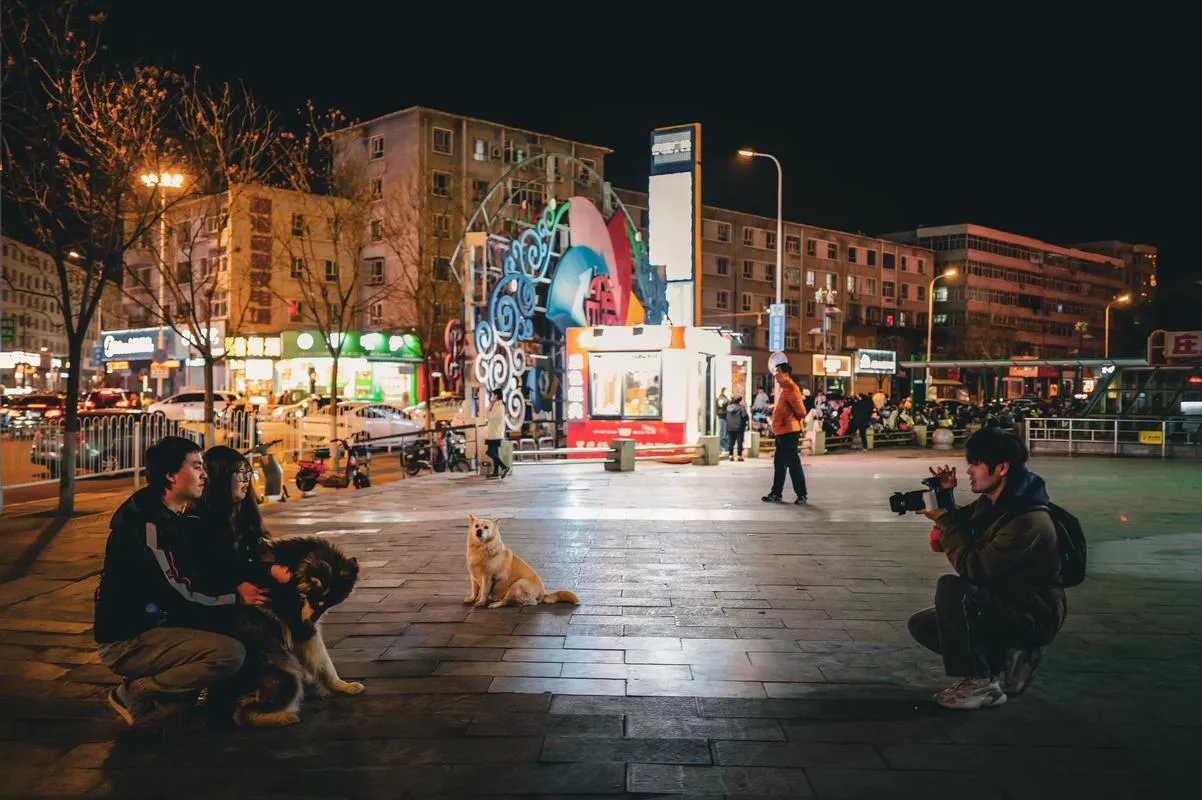 Street photography in China is everyday fare. The rules tighten only around military sites and airport runways.
The Forbidden City explicitly does not restrict normal photography; the palace’s own management said so when the current rules took effect in June 2023. What is banned: floor-standing tripods and commercial rigs, two categories of commercial shoots (product advertising and the costume-and-entourage productions), livestreaming inside exhibition halls, and, inside those halls, flash and selfie sticks. On the rules’ first morning, staff intercepted 16 photography items at the entrance, 11 of them selfie sticks, an item banned at the palace since 2015. Outside the exhibition halls, handheld shooting including phones and compact stabilizers is routine. Our Forbidden City ticketing guide covers the harder problem, which is getting in.
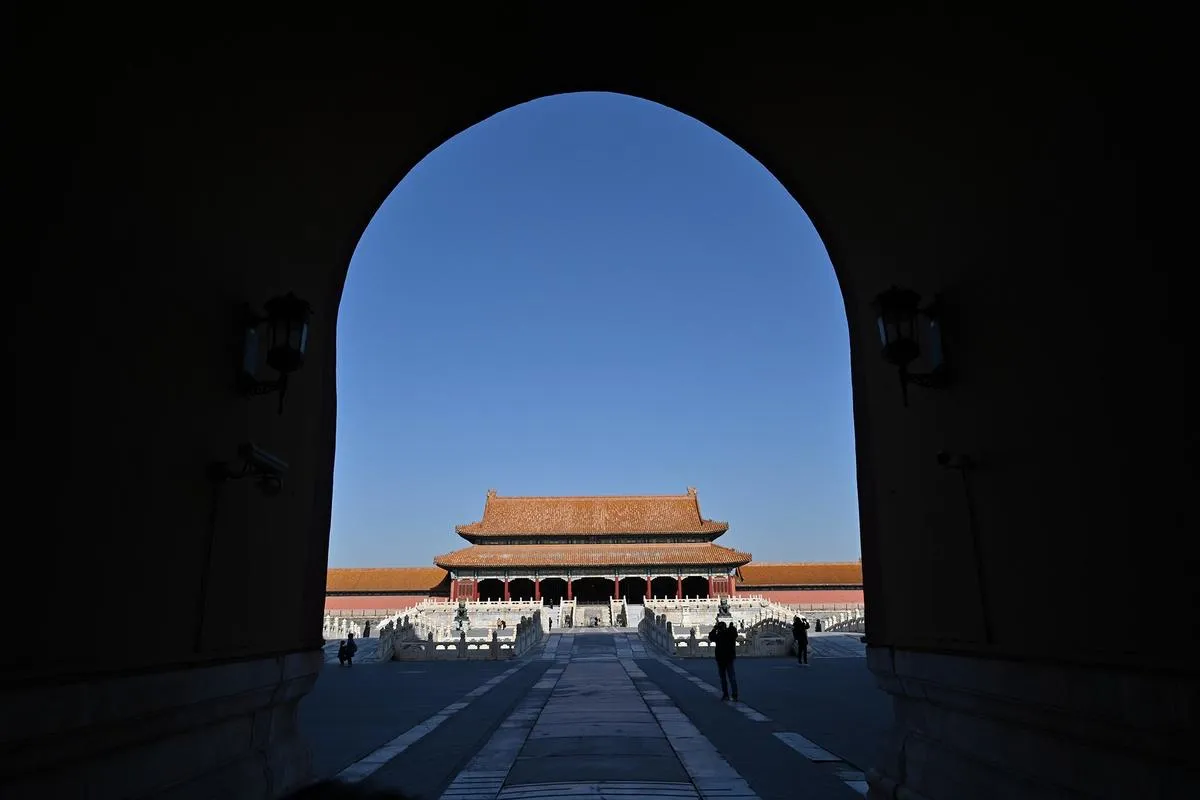 Inside the Forbidden City. Normal photography is welcome; tripods, commercial shoots and, in exhibition halls, selfie sticks are not.
Museums generally follow the same pattern: no flash and no tripods inside exhibition halls. There is no single national rule; follow the signage at each hall.
The genuine red lines are military. Runway filming during takeoff and landing at civil-military joint airports (keep the window shade down when crew ask), long-lens shots of military installations, and posting them online. One passenger who repeatedly reopened his window shade to film a military apron earned a seven-day detention and a returned flight. The framework is common sense plus obedience to signs: no photography where it is posted, nothing military, and the rest of the country is your viewfinder.
The Verdict
Bringing a drone to China in 2026 is legal, registerable with a passport, and increasingly self-enforcing through firmware. The realistic plan: register on UOM a week before departure, keep batteries in your carry-on, skip Beijing with the drone, check the UOM map plus the scenic area’s own policy before every flight, and treat the camera question as settled in your favor. The pilots who get in trouble here are the ones who either skipped registration entirely or pointed a lens at something military. Everyone else is flying. One last note: a drone crash in a remote area is exactly the kind of incident where travel insurance with medical evacuation coverage matters.
Sources & Verification
This guide was last verified on 2026-08-18. Key Chinese-language sources:
- State Council of China (国务院): the full text of the Interim Regulations on the Management of Unmanned Aircraft Flights (Order No. 761, effective January 1, 2024), including Article 10 real-name registration with no weight floor, the 120-meter controlled-airspace line, and the penalty articles (a fine under ¥200 for unregistered flight, and Article 53, the surveying clause that is the only path to deportation).
- Civil Aviation Administration of China (中国民用航空局): the UOM registration platform (uom.caac.gov.cn), whose ID-type dropdown includes passport; the 2017 rule AP-45-AA-2017-03 stamped repealed in the regulator’s own archive, which kills the 250-gram threshold; and the lithium battery carry-on framework.
- State Administration for Market Regulation (国家市场监督管理总局): the two mandatory national standards GB 46761-2025 and GB 46750-2025, published December 9, 2025 and effective May 1, 2026, requiring drones to be unable to fly before activation.
- Beijing Municipal Government (北京市人民政府): notice 京政发〔2025〕20号 confirming the entire municipality is controlled airspace, which is why the Sixth Ring Road line from manufacturer geofence maps is misleading.
- Beijing Customs (北京海关): Announcement 2026 No. 2 requiring drone declaration at Beijing ports from April 1, 2026, plus the 12360 hotline’s old and current answers on camera duty, which show the 1994 list of 20 goods stopped being enforced in August 2020.
- Hainan Provincial Government (海南省人民政府): the expanded suitable-flying airspace map activated May 14, 2026.
- Hengqin and Dongguan public security notices (横琴/东莞公安通告): the February 2026 dual-registration requirement (UOM plus the police WeChat mini-program), with passport support still unconfirmed in the official text.