Yuanyang Rice Terraces Guide (2026): Three World Heritage Titles, the 240-Hour Visa Route, and the Photography Calendar
English guides describe Yuanyang as a photographer’s dream of mirrored rice paddies and stop there. The details that decide whether your trip works stay in Chinese: that Honghe Prefecture sits inside the 240-hour transit visa’s Yunnan stay zone (so the classic Kunming-to-Jianshui-to-Yuanyang loop is legal visa-free), that the Hekou border crossing to Vietnam is NOT a 240-hour port despite every overland routing suggestion you will read, that the 70 yuan ticket covers 72 hours of re-entry, and that Yuanyang just earned its third world heritage title in September 2025, a credential the English-speaking world has not caught up with yet. This guide covers the whole chain, verified against official sources as of September 2026.
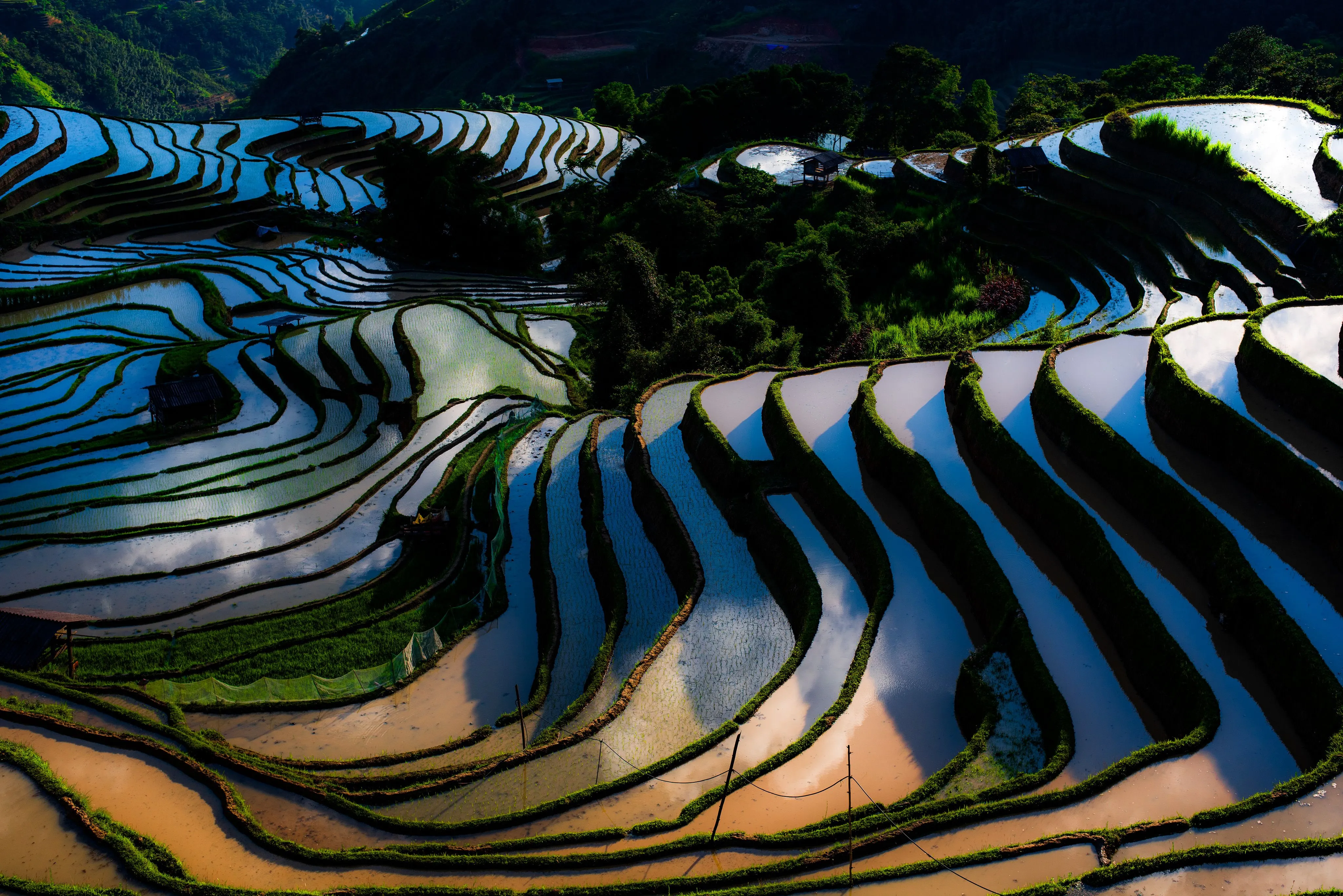 The water mirror at dawn: 3,700 stepped levels reflecting sky and cloud, December through April.
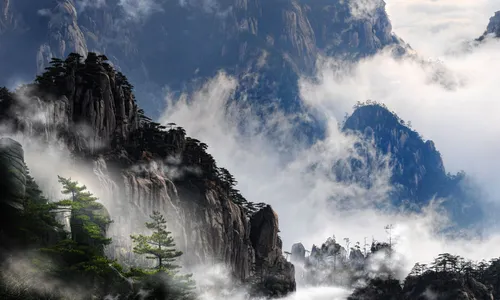
Quick answer: The Yuanyang rice terraces (元阳哈尼梯田) sit in Honghe Prefecture, southern Yunnan, about 4 to 6 hours by bus from Kunming or 1.5 hours by bullet train to Jianshui plus a 2-hour drive. Foreign visitors on the 240-hour transit visa can legally visit because Honghe is one of the nine Yunnan prefectures in the stay zone, but you must enter and exit through Kunming Changshui airport, Lijiang Sanyi airport, or the Mohan railway port (NOT Hekou). Entry costs 70 yuan for a 72-hour pass covering Duoyishu and Bada viewpoints. The water mirror season runs December through April, with the photography peak from December to February when cloud seas layer over the mirrors. Book accommodation a month ahead for that window. See our 240-hour visa-free guide, Kunming and Dali guide, and Huangshan guide for the season’s other flagship photography destination.
How we verified this: SinoWander reads the original Chinese documents that English guides cannot: the National Immigration Administration’s port and zone lists (including the December 2024 expansion and the November 2025 update that added Hekou to a Taiwan-compatriot permit list, NOT the 240-hour port table), the Honghe Prefecture government’s official overview, the Red River Development and Reform Commission’s 2018 pricing approval that cut tickets from 100 to 70 yuan, first-hand 2024 trip reports with actual minivan fares, and the September 2025 World Heritage Irrigation Structure announcement. Hani festival dates were independently calculated using the Chinese lunar calendar, not copied from secondary sources. Each guide is date-stamped when last verified: 2026-09-11. See our methodology.
Three World Heritage Titles, One Landscape
Most English guides mention Yuanyang’s 2013 UNESCO World Cultural Heritage listing and move on. The full picture is sharper. The Honghe Hani rice terraces hold three world-class heritage designations, and the Honghe Prefecture government describes them as the first place on earth to combine all three in a single landscape.
The first came in 2010, when the UN Food and Agriculture Organization named the terraces a Global Important Agricultural Heritage System (GIAHS), one of the earliest pilot sites. The second, in June 2013, was the UNESCO World Cultural Heritage listing, notable as the first world heritage site named after an ethnic group and the first centered on farming civilization. The third arrived on September 10, 2025, when the International Commission on Irrigation and Drainage added the terraces to the World Heritage Irrigation Structures list at its 76th executive council in Sydney.
That third title matters for travelers because it is new enough that almost no English-language guidebook or travel site has updated to reflect it. The “three world heritage titles, one landscape” framing is a hook that distinguishes Yuanyang from every other rice terrace destination in Asia.
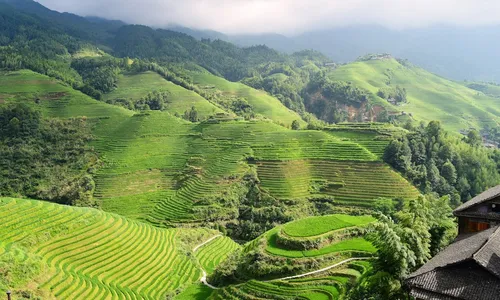
The numbers behind the view: 1,300 years of recorded cultivation, terraces climbing from 800 to over 2,000 meters in elevation, up to 3,700 stepped levels on a single slope, and a “four-element” farming system of forest, village, terrace, and water that the Hani people have maintained for over a millennium. The core scenic area spans 166 square kilometers across 82 villages.
The 240-Hour Visa Route: What Works and What Does Not
This is where Yuanyang becomes a visa story, not just a photography story. The 240-hour transit visa, open to 57 countries including the US and Canada, allows 10 days of visa-free travel through specified regions. Yunnan’s stay zone covers nine prefectures, and Honghe is on the list.
The National Immigration Administration’s published zone list for Yunnan reads, verbatim: Kunming, Yuxi, Chuxiong, Honghe, Wenshan, Pu’er, Xishuangbanna, Dali, and Lijiang. That means the classic loop, Kunming to Jianshui to Yuanyang to Mengzi, is entirely legal on the 240-hour transit visa. So is a stop in Hekou county town, which sits inside Honghe’s borders.
The Hekou trap
Here is the catch, and it is the one most English guides get wrong. Hekou is not a 240-hour entry or exit port. The only 240-hour ports in Yunnan are Kunming Changshui airport, Lijiang Sanyi airport, and the Mohan railway port on the Laos border. Hekou’s road crossing into Vietnam is a regular border port, not a transit-visa port.
The confusion comes from a November 2025 NIA announcement that added “Hekou (road)” to a list. That list was the Taiwan-compatriot travel permit issuance ports in Article 9, not the 240-hour port table in Article 6. The actual Article 6 additions were five ports in Guangdong. An AI summary or a careless guide can read “Hekou added” and assume it means 240-hour eligibility. It does not.
What this means for your routing: you can visit Hekou town on the 240-hour visa, but you cannot cross into Vietnam through Hekou on it. The “China rice terraces to Vietnam Sapa on one visa-free trip” plan that circulates in English forums is not legal. To continue to Vietnam, you need a regular visa or Vietnam’s unilateral visa-free entry (if your passport qualifies), processed at the Hekou border as a normal crossing, separate from the 240-hour transit.
For the full 240-hour policy, including the 57-country list and all 65 ports, see our complete 240-hour guide. US and Canadian passport holders should also check the visa-free country guide, since the 240-hour transit is the only visa-free route available to them.
The reverse trap: seven prefectures you cannot visit
Yunnan has 16 prefectures. The 240-hour stay zone covers nine. The seven that are NOT included: Qujing, Baoshan, Zhaotong, Lincang, Dehong (Ruili), Nujiang, and Diqing (Shangri-La). If you plan a “Yunnan grand loop” that strings Yuanyang with Shangri-La, you will exceed the stay zone. Our Kunming and Dali guide covers the Shangri-La exclusion in detail, as it is the most common trap for foreign visitors.
Getting There: No Airport, No Train (For Now)
The honest starting point: Yuanyang has no airport and no train station. Every English guide says this. What they do not say is that it is about to change, and that the change is closer than most sources admit.
The current routes
From Kunming, the direct bus runs from the South Bus Station to Yuanyang’s Nansha (new town) or Xinjie (old town, closer to the terraces). The journey takes 4 to 6 hours, with fares around 88 to 107 yuan based on 2024 first-hand reports. Xinjie is the better drop-off if you are heading straight to the viewpoints.
The smarter route, and the one most first-hand travelers recommend, is to take the bullet train from Kunming to Jianshui (about 1.5 hours), then a bus or chartered car from Jianshui to Yuanyang (another 2 to 2.5 hours). This breaks the long road stretch and adds Jianshui’s old town as a worthwhile stop. A day chartered car from Jianshui runs about 260 to 360 yuan. See our China high-speed rail guide for passport booking on 12306, which works the same on the Kunming-Jianshui line.
For the road sections, our China self-driving guide covers the mountain-road reality: the route to Xinjie is winding, steep, and fog-prone at night. New drivers should not attempt it.
The airport that is coming
Honghe Mengzi Airport, a 4C-level regional airport in Mengzi (the Honghe prefecture capital), is expected to open around the end of 2026. The timeline, verified across six official sources: the IATA assigned the code HMZ in March 2026, all flight calibration tests were completed by July 30, 2026, and the People’s Daily client reported in June 2026 that the airport is expected to open by the end of 2026 with first-season routes to Beijing, Shanghai, Guangzhou, and Chengdu.
As of September 2026, the airport is not yet operational. Do not book flights to Mengzi. But if you are planning a trip for late 2026 or 2027, check the status before you book, because the “no airport” line in every English guide may be outdated by the time you travel.
Tickets: 70 Yuan, 72 Hours, and the Laohuzui Question
The ticket system is simpler than English guides suggest, with one wrinkle.
The standard pass costs 70 yuan for adults, 35 yuan for students, children, and seniors. It covers the Duoyishu and Bada viewpoint areas and is valid for 72 hours, meaning you can enter multiple times over three days. This is not a single-entry ticket. The 100 yuan price you will see in older guides is the pre-2018 rate, cut by the Red River DRC’s pricing approval in September 2018.
The wrinkle is Laohuzui (Tiger’s Mouth), the third major viewpoint, famous for its deep-valley overlook and its status as the best midday photography spot when the light is too harsh at Duoyishu or Bada. Laohuzui closed in June 2018 after a landslide damaged 172.6 mu (about 11.5 hectares) of terraces, and it did not reopen until April 10, 2023, nearly five years later. As of 2026, it is open, but the ticketing is split: Laohuzui charges a separate 30 yuan entry, and some sources list it as included in the 70 yuan pass while others do not. There was also a report in August 2026 of a temporary closure. The practical advice: treat Laohuzui as a 30 yuan add-on, check the scenic area’s official WeChat account for the day’s status before you go, and do not assume the pass covers it.
Free viewpoints
Not every good shot requires a ticket. Aicun (also written Aichun) village has a roadside free viewpoint where the terraces appear deep blue on sunny mornings between 9 and 10 am due to light refraction. Dawazhe and Laoyingzui (Eagle’s Beak) are similar roadside stops. Farmers may charge 2 to 5 yuan to step onto their land for a better angle, but the road view itself is free.
Azheke village
Azheke, one of the five key heritage villages and the best-preserved Hani architectural cluster, charges a separate 30 yuan entry. It is worth it. In 2024, Azheke was named to the UN Tourism Best Tourism Villages list, and the “Azheke Plan,” developed with Sun Yat-sen University in 2018, lets all 65 households hold shares in the village’s tourism company through their traditional houses, terraces, residence, and household registration. Dividends are split 40 percent for traditional houses, 30 percent for terrace protection, 20 percent for residence, and 10 percent for household registration. By the tenth distribution in July 2024, cumulative dividends reached 2.33 million yuan, averaging 35,886 yuan per household. This is the anti-gentrification story: tourism revenue stays with the villagers, not outside developers.
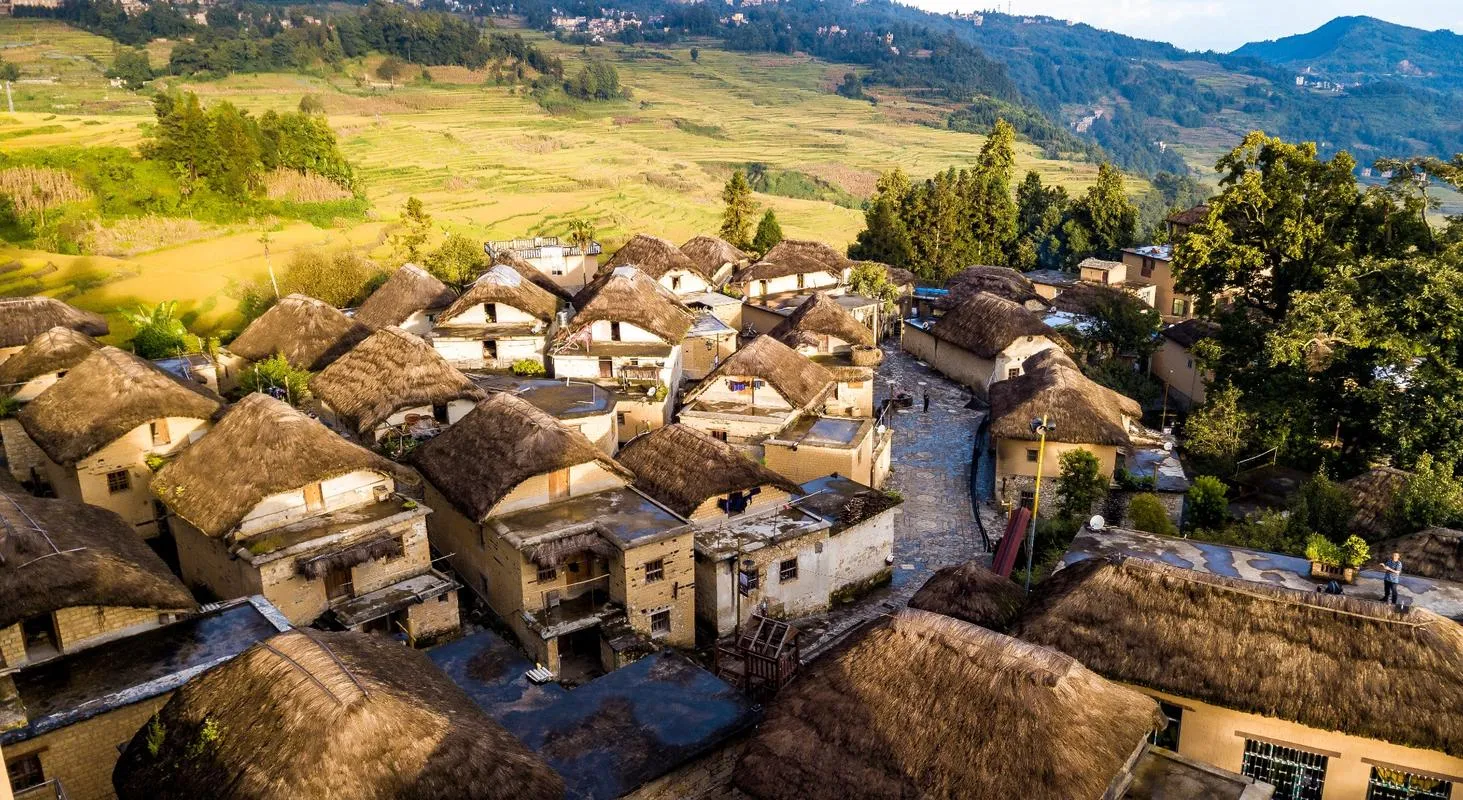 Azheke’s mushroom houses: traditional Hani architecture where all 65 households hold shares in the village’s tourism company.
The Photography Calendar: When the Mirrors Appear
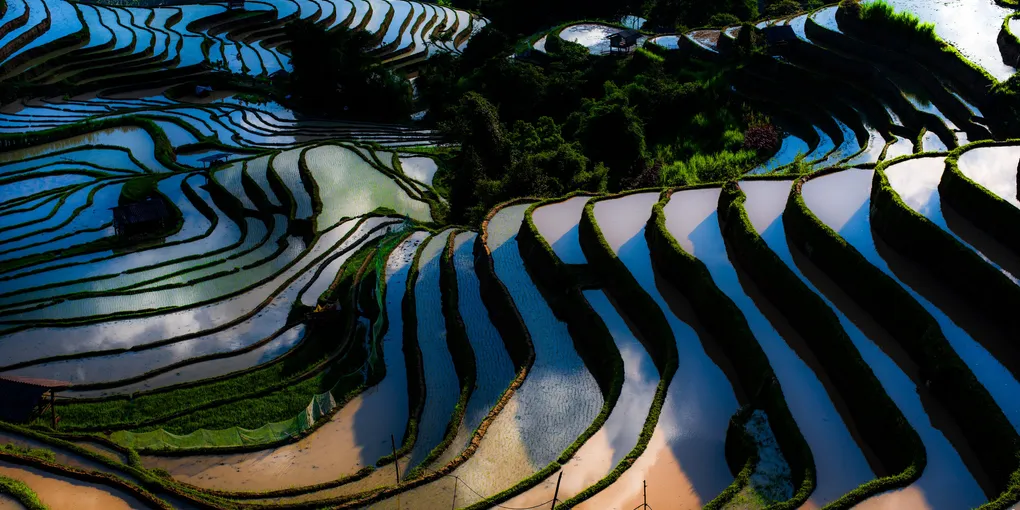
The water mirror, the image that made Yuanyang famous, exists only when the terraces are flooded but not yet planted. That window runs December through April, with the photography peak from December to February when the flooded terraces meet the winter cloud seas.
| Season | What you see | Photography value |
|---|---|---|
| December to February | Flooded mirrors plus cloud seas | Peak: the classic Yuanyang image |
| March to April | Flooded mirrors, less cloud | High: clearer skies, fewer crowds |
| April to May | Transplanting, silver mirrors turn green patches | Moderate: agricultural transition |
| June to September | Lush green waves, rain and cloud | Moderate: summer lushness, rain risk |
| October | Golden harvest, amber and gold | High: harvest color before flooding |
The honest caveat, from first-hand photographers: weather is the single variable that can ruin a day. Overcast or rainy conditions turn the mirrors into “black-and-white print tones” with little color. The advice is to stay at least two nights to give yourself three sunrise chances, and to check the forecast before you commit.
The daily shot list
The standard three-day photography rhythm, based on first-hand 2024 and 2026 reports:
- Day 1 afternoon: Arrive, settle in, shoot Bada at sunset (arrive early, the No. 3 viewing platform has the best angle, then No. 2, then No. 1).
- Day 2 dawn: Duoyishu for sunrise. The viewpoint opens at 6:00 am. Arrive at least 30 minutes before sunrise, earlier in peak season. Winter sunrise is around 7:30 am, so 6:00 to 6:30 arrival is the target.
- Day 2 midday: Laohuzui for the midday light, when Duoyishu and Bada are too bright.
- Day 2 late morning: Aicun blue terraces, best between 9 and 10 am.
- Day 2 afternoon: Azheke village, then back to a sunset spot.
- Day 3 dawn: A second sunrise attempt (weather insurance) or Laoyingzui.
Most travelers stay 2 to 3 days. The viewpoints are 15 to 30 minutes apart by car, and there is no internal shuttle system. Transport between viewpoints is by shared minivan (15 yuan from Xinjie to Duoyishu, 30 yuan from Nansha) or chartered car. See our China travel scams guide for the bargaining baseline: the prices above are the floor, and drivers will quote higher to foreigners.
 Bada at sunset: the No. 3 viewing platform has the best angle, then No. 2, then No. 1.
Where to Stay: The Sunrise Logic and the Booking Gap
The single rule: if you want to shoot Duoyishu at dawn, you must stay near Duoyishu or Shengcun village, within walking distance of the viewpoint. Driving up from Xinjie or Nansha in the dark on mountain roads is not the plan.
Three layers
- Duoyishu and Shengcun: Guesthouses and homestays along the scenic road, 150 to 900+ yuan per night in 2026 (indicative, peak season floating). Budget beds around 35 yuan exist but are not listed on major booking platforms. Some guesthouses have rooftop terraces with direct terrace views. Peak season (December to February) books out a month ahead.
- Xinjie (old town): The transport hub, with more dining options and better value. The tradeoff is a pre-dawn drive to Duoyishu.
- Nansha (new town, county seat): The most hotel options, including the Jinhui Terraced Field Grand Hotel (around 330 yuan) and the Yunti Smart Hotel (around 168 yuan). But Nansha is 50-plus kilometers from the viewpoints, making it a transit stop rather than a photography base.
A 2026 addition: the Heyuhe Manor “Terrace Lotus Hidden” boutique lodge in Niujiaozhai town, which opened in trial operation in May 2026. It renovated 53 traditional field shelters into 14 lodges with rammed-earth walls and thatched roofs, with the first batch of 7 rooms available. Listed on Ctrip at 4.9 out of 5 with 23 reviews as of September 2026, priced around 500 to 800+ yuan per night (off-peak indicative).
The foreign booking gap
Here is the problem no English guide mentions. Trip.com’s international platform returns zero properties for Yuanyang. Foreign travelers cannot book Yuanyang accommodation through the international OTA they are used to.
The workarounds:
- Ctrip (the Chinese version of Trip.com): Covers 20-plus Yuanyang properties, but requires a Chinese phone number for registration and Alipay or WeChat Pay for payment. See our Alipay setup guide and WeChat Pay guide.
- Agoda: Limited coverage, 2 to 3 properties.
- Direct contact: Call or WeChat the guesthouse directly. This is how most foreign photographers actually book.
- Book 2 to 4 weeks ahead for the December to February peak. “One room hard to find” is the verbatim phrase from 2026 Chinese sources for peak season.
For the general foreign hotel booking framework, including the registration requirement for non-hotel accommodations, see our hotel booking guide. One legal note: if you stay in a homestay that is not a registered hotel, you must register your temporary residence with the local police station within 24 hours of arrival. Your host should handle this, but confirm it.
The “3,000 Years, 400 Years” Loop: Jianshui, Bisezhai, and Mengzi
The Honghe Prefecture government promotes a cultural framework called the “3,000 Years, 400 Years” card, and it maps perfectly onto a 240-hour visa-free loop. The 3,000-year elements: the millennium-old Hani terraces (Yuanyang), the millennium-old Lin’an old town (Jianshui), and the millennium-old Jianshui purple pottery. The 400-year elements: the century-old Yunnan-Vietnam railway, the century-old tin mining, the century-old port opening, and the century-old crossing-bridge noodles.
Jianshui: the mandatory stop
Jianshui sits on the Kunming-to-Yuanyang route and deserves a full day. The old town is free to enter. Inside it:
- Jianshui Confucius Temple: 38 yuan. Built in 1285, it is the second-largest Confucius temple in China after the one in Qufu. Jianshui is called the “Zoulu of the South,” a reference to Confucius’s hometown region.
- Zhu Family Garden: 35 yuan. A late-Qing mansion built over 30 years, known as the “Grand View Garden of the South.” Open 8:00 to 18:30.
- Chaoyang Tower: 9 yuan. The surviving east gate tower from the Ming dynasty.
- Lin’an Prefecture Office: 32 yuan. A Ming dynasty government office, open 9:00 to 18:00.
- The meter-gauge small train: Runs from Lin’an station to Tuanshan, stopping at Shuanglong Bridge (30 minutes) and Xianghui Bridge (20 minutes), with a 2.5-hour stop at Tuanshan. Two departures daily at 9:00 and 14:30. Peak season: 150 yuan soft seat, 120 yuan hard seat. Off-peak: 120 yuan soft, 100 yuan hard. The line is 13 kilometers, opened in 2015, and is called “China’s most beautiful meter-gauge train.” The meter gauge is a legacy of the Yunnan-Vietnam railway, China’s earliest self-built railway.
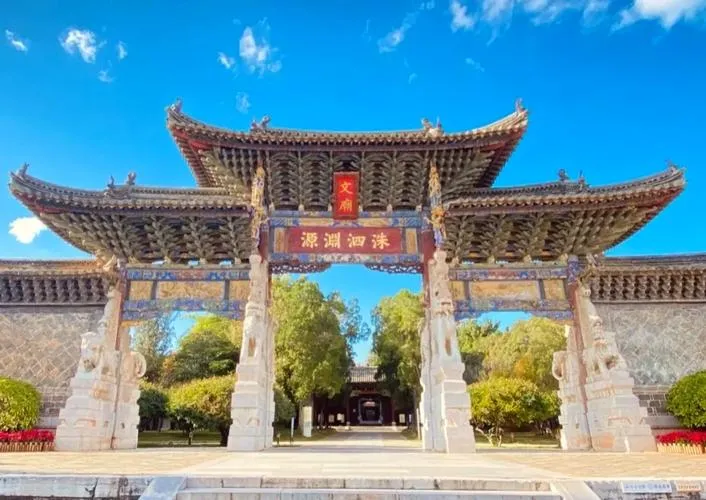 Jianshui Confucius Temple: built in 1285, the second-largest in China after Qufu. 38 yuan entry.
Bisezhai: the movie location
Bisezhai, in Mengzi’s Guanlan street, is a national-level traditional village at 1,350 meters elevation. The Yunnan-Vietnam railway reached Bisezhai in 1909, making its station one of the earliest in China’s modern history. It is also China’s first Tropic of Capricorn coordinate point. The station, with its French-style platform signs, was a filming location for the movies Fanghua (Youth) and Wuwen Xidong (Forever Young). It is now a 4A-level scenic area as the Yunnan-Vietnam Railway Historical and Cultural Park.
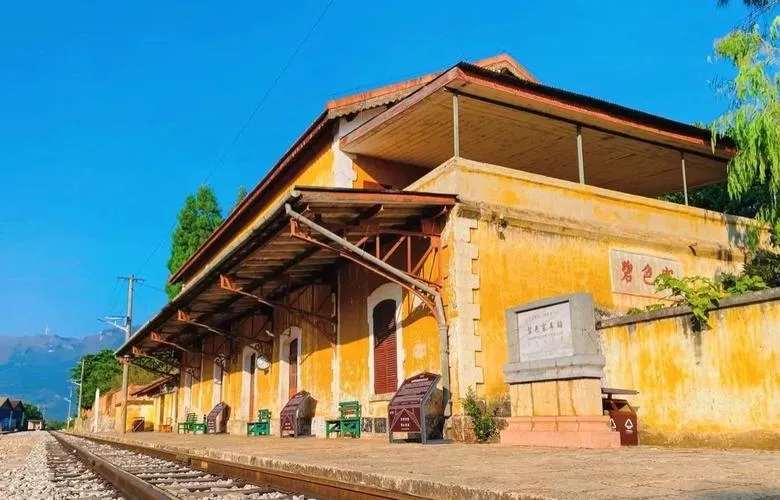 Bisezhai station: French-style platform signs on the century-old Yunnan-Vietnam railway, a filming location for Fanghua (Youth).
Mengzi and Hekou
Mengzi is the Honghe prefecture capital and the birthplace of crossing-bridge noodles, the rice noodle dish that spread across China. Hekou, on the Vietnam border, is a border town with Vietnamese-influenced cross-border tourism. You can visit Hekou town on the 240-hour visa, but remember the rule from the visa section: you cannot exit to Vietnam through Hekou on the transit visa.
The full loop, 3 to 4 days: Kunming, bullet train to Jianshui (1.5 hours), one day in Jianshui, bus or chartered car to Yuanyang (2 to 2.5 hours), two days in Yuanyang, then Mengzi for Bisezhai and crossing-bridge noodles before returning to Kunming. Every stop is inside the 240-hour stay zone.
Hani Festivals: The Dates That Are Not What You Read
Hani festival dates are a trap for lazy sources. The four major festivals, with 2026 and 2027 dates independently calculated from the Chinese lunar calendar:
| Festival | Traditional rule | 2026 (Gregorian) | 2027 (Gregorian) |
|---|---|---|---|
| Ten Month New Year (十月年) | First dragon day of the 10th lunar month, lasting 5 to 6 days | November 14 to 18 | November 9 to 13 |
| Long Street Banquet (长街宴) | Part of Ten Month New Year, not a separate festival | Same as Ten Month New Year | Same as Ten Month New Year |
| Angmatu (昂玛突) | 10th day of the 10th lunar month | November 18 | November 7 |
| Kuzhaza (矻扎扎节) | First dog day to rat day of the 6th lunar month (Yuanyang rule) | July 23 to 25 | July 7 to 8 |
Two corrections to commonly repeated errors. First, Angmatu is NOT around Spring Festival. It falls in the 10th lunar month, the same season as the Ten Month New Year, in November. Second, Kuzhaza’s start date depends on the region. The Yuanyang rule, confirmed by the Yuanyang county government portal, is the first dog day to rat day of the 6th lunar month. The “first ox day” rule you will see in some sources is the Xishuangbanna Yekuzha variant, not the Yuanyang one.
The Long Street Banquet is the signature experience. In 2025, Luchun county’s banquet set 3,265 tables along the main street, certified by Shanghai Great World Guinness as the “world’s longest banquet.” If your trip aligns with the Ten Month New Year, it is the cultural highlight of a Yuanyang visit. Exact dates vary by village, with communities taking turns across the 12-day window between the first and second dragon days. Check local announcements in September or October for the official tourism-version dates, which some counties fix around the prefecture anniversary.
Practical Notes for Foreign Visitors
Language: Yuanyang is an English-thin destination. Few people speak English outside major hotels. The NIA’s 12367 hotline runs 24 hours in English, Russian, Japanese, and Korean, in addition to Mandarin and Cantonese. Save the number. See our language barrier survival guide for the full toolkit.
Payment: Mobile payment dominates. Bring some cash for small roadside vendors and farmer-viewpoint fees. Our Alipay guide and WeChat Pay guide cover setup. Yuanyang county has a urbanization rate of only 18 percent, one of the most rural counties a foreign visitor will enter, so do not assume every vendor takes digital pay.
Altitude and weather: The viewpoints sit at 1,400 to 2,000 meters. Even in summer, mornings and evenings can drop to the low teens Celsius. Layered clothing is mandatory for sunrise shoots. The temperature swing between dawn and midday can exceed 10 degrees.
Food: Hani cuisine runs salty and spicy. The local phrase to learn: “shao yan shao la” (less salt, less spice). Signature dishes include Hani dip-water chicken (chicken with a dip of mint, wild coriander, Sichuan peppercorn, and local chili) and red rice grown in the terraces. In the broader Honghe loop, Mengzi is the birthplace of crossing-bridge noodles, and Jianshui is known for steam-pot chicken and tofu from the Daban well.
Registration: If you stay in a homestay that is not a registered hotel, your host must register your temporary residence with the local police within 24 hours. Confirm this with your host on arrival. The 240-hour transit visa requires you to carry your passport at all times.
Sources and Verification
This guide was verified against the following primary sources as of September 11, 2026:
- National Immigration Administration 2024 No. 7 announcement (144-hour era Yunnan expansion) and the December 2024 240-hour announcement (current policy basis)
- Chinese Consulate General in Montreal 240-hour FAQ (May 2025, for port and stay zone lists)
- NIA 2025 No. 4 announcement (November 2025, for the Hekou Taiwan-compatriot permit list that is NOT the 240-hour port table)
- Honghe Prefecture government official overview (July 2026, for the “three world heritage titles” and “3,000 years, 400 years” framework)
- Red River DRC pricing approval document No. 497 (September 2018, for the 100-to-70 yuan ticket cut)
- First-hand 2024 trip report with actual minivan and ticket prices
- Visit Yunnan photography guide (April 2026, for the seasonal calendar and shot locations)
- Sohu 2026 report citing CCTV coverage (August 2026, for 2026 ticket prices and viewpoint hours)
- ICID 76th executive council announcement (September 10, 2025, for the World Heritage Irrigation Structures listing)
- Yuanyang county government portal (for the Kuzhaza festival dog-day-to-rat-day rule)
- Baidu Baike entries on Honghe Hani Rice Terraces, Jianshui Old Town, Bisezhai, Honghe Mengzi Airport, and Yuanyang County
- Ctrip and Trip.com real-time checks (September 11, 2026, for hotel pricing and the Trip.com international coverage gap)
Festival dates were independently calculated using the Chinese lunar calendar, cross-checked against 2024 and 2025 actual festival announcements. The Hekou port status was verified by reading the full NIA November 2025 announcement, not just the headline. Claims that could not be verified to a primary source are marked as such in the text. See our full methodology.