Hulunbuir Travel Guide 2026: Grasslands, Russian Villages and the Border Visa Trap
Hulunbuir is a prefecture-level city in northeastern Inner Mongolia that covers 253,000 square kilometers (97,700 sq mi), slightly more than the entire United Kingdom. Inside that boundary live 2.12 million people, roughly 100,000 square kilometers of contiguous grassland, the only Russian ethnic township in China, and the land port that carries about two thirds of overland trade between China and Russia. For about two weeks each late September the whole steppe turns gold, and almost none of it is reachable by public transport. The visa rule English guides most often get wrong also applies here at full force, so this guide starts there.
Quick answer: Plan five days for the standard northern loop, and budget for a charter car with driver, because buses do not connect the sights. The 240-hour visa-free transit policy does not cover Inner Mongolia, and entering at Harbin confines you to Harbin city limits, so use the 30-day unilateral visa-free entry (50 countries, valid nationwide) or an L visa instead. Fly into Hailar (HLD) or take overnight train K7091 from Harbin (hard sleeper about 178 to 190 yuan). The golden foliage window runs roughly mid-September to early October, around two weeks; July and August are the green peak.
How we verified this: SinoWander works from Chinese-language sources that English guides cannot read, including the National Immigration Administration’s policy pages, the Heilongjiang provincial government’s transit-visa designation notice, the Erguna and Manzhouli city government websites, Baidu Baike entries cross-checked against official releases, and live Qunar and Ctrip train and ticket prices pulled on September 8, 2026. We cross-check before writing and date-stamp every guide. We have not personally visited every location. Last verified: 2026-09-08. See our methodology.
The scale of the place
The city government’s own comparison for its 253,000 square kilometers is Shandong and Jiangsu provinces combined; against countries, the UK at 244,000 is the closer match. The prefecture runs 630 km east to west and 700 km north to south, with 1,733 km of international border, 1,051 km of it facing Russia across the Argun river line and 682 km facing Mongolia. Registered residents number 2.12 million as of the end of 2025, fewer than half the population of an average London borough spread across a country-sized territory.
Chinese travel media ranks the grassland among the “four great grasslands” of the world, a canon that has no international registry behind it; treat the title as attributed praise, because the plain does not need it. The name is older than the rankings: Hulun and Buir are the two lakes at either end of the grassland, and the pairing became the region’s name. Local history also claims this stretch of steppe as mustering ground for the young Genghis Khan, a story the Jinzhanghan scenic area on the Morigele river still trades on.
For a visitor the numbers translate into one practical fact: the Hailar-to-Erguna leg alone is 120 km on the G332 national road, Erguna to Enhe adds another 94, and the full loop back to the railhead runs past 1,000 km. As a 2026 Chinese guide puts it, public transport “almost never reaches” the sights; the standard solutions are a charter car with a local driver, a self-drive trip, or a group tour.
The visa trap, stated plainly
This is the sixth article in our series on the regional fine print of the 240-hour visa-free transit policy, after Jiuzhaigou (Sichuan’s permitted zone stops short of Aba prefecture), Tibet (separate permit regime entirely), Shenzhen’s land ports, and Kanas (Xinjiang excluded outright).
The National Immigration Administration’s December 17, 2024 announcement named the 24 provinces and regions where transit travelers may stay. Inner Mongolia is not on the list. The current policy page, still updated as of August 2026, counts 65 eligible ports across those same 24 provinces; there is no Hailar, no Manzhouli and no Hohhot among them.
The double bind sits one province over. The nearest 240-hour port to Hulunbuir is Harbin Taiping International Airport, and Heilongjiang’s designated stay area under the policy is Harbin city only, in the provincial government’s own December 2024 wording. Board the overnight train toward Hailar and you have left the permitted zone on paper. Under Article 25 of the Exit and Entry Administration’s implementing regulations, staying outside your designated area counts as unlawful residence, and the immigration authority’s published guidance says such cases are penalized. English-language coverage tends to flatten “240-hour visa-free China” into a national pass; the province-by-province reality is in our 240-hour transit guide.
The routes that do work:
- The 30-day unilateral visa-free entry, open to ordinary passports from 50 countries including the UK, most of the EU, Australia, New Zealand, Japan, Korea and, since February 17, 2026 on a trial through December 31, Canada. A Foreign Ministry FAQ states it applies at every port of entry open to foreigners, not just the 65 transit ports, with no regional restrictions inside China. The full country list is in our visa-free entry guide.
- Mutual visa-exemption passports (Singapore, the UAE, Qatar, Serbia and others), also 30 days, also nationwide.
- An L tourist visa for everyone else, with the current entry paperwork in our China entry requirements guide.
One airport quirk worth knowing: Hailar is an open international port for normal visa and visa-free entry, with scheduled flights from Ulaanbaatar, Seoul and Hong Kong, but it is still not one of the 65 transit-visa-free ports. International flights and transit visa-free are two different doors, and English booking sites blur them constantly.
Getting there
By plane
The airport’s official name since 2025 is Hulunbuir Hailar International Airport (HLD), the third name for a field that started as Hailar Dongshan in 1932; older atlases and some booking sites still use the Dongshan name. Air China flies the Ulaanbaatar route in about 2 hours 15 minutes, which makes a Mongolia-plus-Hulunbuir itinerary (fly into Ulaanbaatar, overland or onward to Hailar) a realistic and rarely exploited combination. Seoul Incheon, Hong Kong and the Russian city of Chita rotate through the seasonal schedules. The field handled 3.24 million passengers in 2024, up 10.8 percent year on year, on 34 routes.
By train
No high-speed rail reaches Hulunbuir; the line here is the classic single-track Chinese Eastern Railway bed. The workhorse is overnight train K7091, leaving Harbin at 20:55, reaching Hailar at 06:15 the next morning and terminating at Manzhouli at 08:45. Live prices on September 8, 2026, identical across Qunar and Ctrip: hard sleeper 178 yuan (upper berth) to 190 (lower), hard seat 102, soft sleeper 274 to 285; the hard sleeper for the full run through to Manzhouli is 221. Foreign bookings go through the same 12306 or Trip.com passport verification covered in our China train guide. In winter, the pairing with Harbin’s Ice and Snow World is the obvious double-header.
The other train
At the opposite end of the price range, the Hulunbuir Express (Hulunbeier Hao) launched in December 2019 as what state media billed as China’s first dedicated high-end tourism train: 44 berths in total, every compartment ensuite, meals and off-train programming included, at roughly 22,000 to 30,000 yuan per person. It runs between Harbin and Hailar in both directions on five- and six-day itineraries rather than a loop. English coverage of it is close to nil, which is either a gap or a mercy depending on your budget.
The five-day northern loop
The standard circuit, consistent across the 2026 Chinese guidebooks we cross-checked:
- Day 1: arrive Hailar, the prefecture’s transport hub and only real city.
- Day 2: Morigele river grassland in the morning, Erguna wetland in the afternoon, overnight in Erguna town.
- Day 3: birch forest on the way north, then Shiwei and Linjiang, sleeping in a mukelong log guesthouse.
- Day 4: the border road south to Heishantou for horseback riding, the famous sunset, a bonfire and a night in a yurt camp.
- Day 5: west into Manzhouli for the border sights and the night skyline, then out by train or via Hailar.
Seven days adds Arxan and the hot springs in the south. A driver-guide arrangement for the basic five-day loop was quoted at “a little over 1,000 yuan per person” in a 2026 driver-affiliated guide, which we treat as an order of magnitude rather than a promise. Three warnings recur across Chinese sources: refuse low-price shopping tours, refuse unlicensed taxis at stations and airports, and ride only at licensed stables.
Foreigners can also self-drive the loop legally through the temporary Chinese license procedure explained in our self-driving guide, and the empty highways make it one of the better places in the country to do it. Travelers wondering whether somewhere this empty works without a group should read our independent China travel guide; the short version is that it does, with a driver, if you book lodging ahead.
The Morigele, a river that cannot walk straight
The Morigele runs 319 km through the grassland core and drains 4,987 square kilometers, but the statistic that matters is the folding: on a plain this flat the river loops back on itself dozens of times, a signature Chinese travel writing calls “the first winding river under heaven,” a phrase popularly attributed to the writer Lao She though the standard encyclopedia entry leaves it unsigned. See it from the bluff-top viewing decks in the hour before sunset, when the low light fills each meander; the developed Jinzhanghan stretch on the lower river adds a Mongol-tribal-camp theme on the same mustering-ground legend.
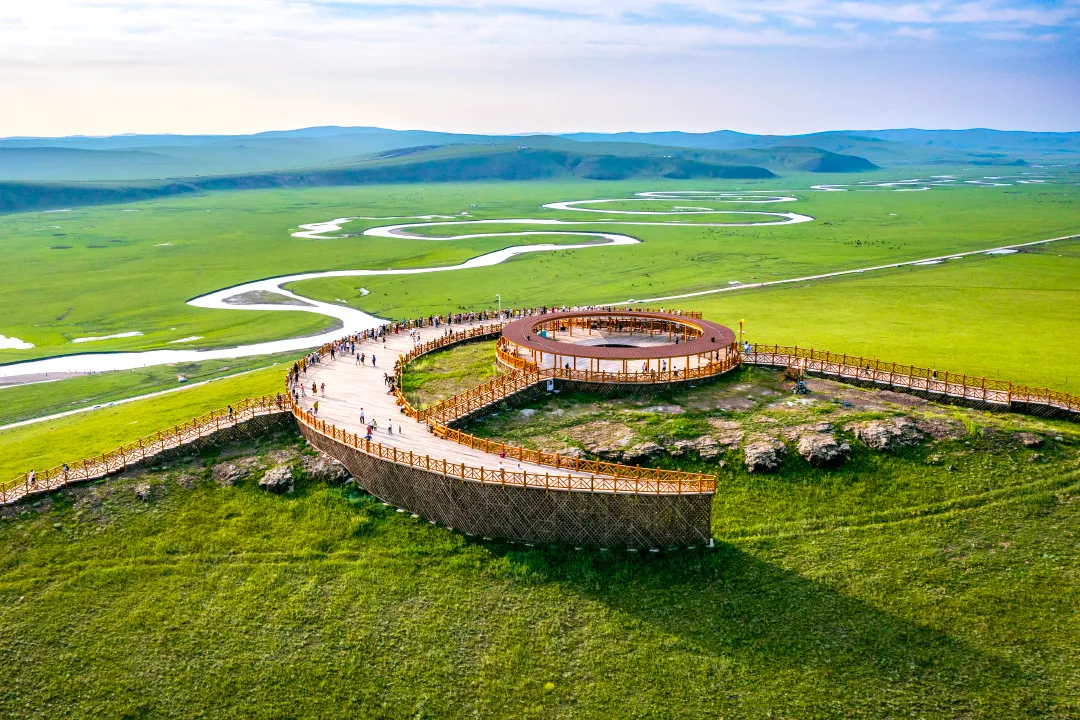 The deck above the Morigele: one river, dozens of hairpin meanders, and grassland to the horizon.
Erguna wetland
West of the Morigele, the Genhe river spreads into the wetland that sits above the town of Erguna like a moat around a green island. The developed scenic area covers about 3 square kilometers, is rated 4A, opens 08:30 to 16:30 and charges 65 yuan, with older guides quoting 60 plus 15 for the electric cart, so budget 60 to 65 depending on season. The park bills itself as the largest wetland in Asia, a title with no international referee; the hard facts behind it are the 126,000-hectare extent, an estimated 20 million birds pausing annually on the East Asian-Australasian flyway, and an October 2025 addition to the National Forestry and Grassland Administration’s list of nationally important wetlands. Locals distinguish the “old wetland” above town, also called the Genhe wetland, from the newer Erguna National Wetland Park further out; the viewing deck and boardwalk experience most photographs come from is the old one.
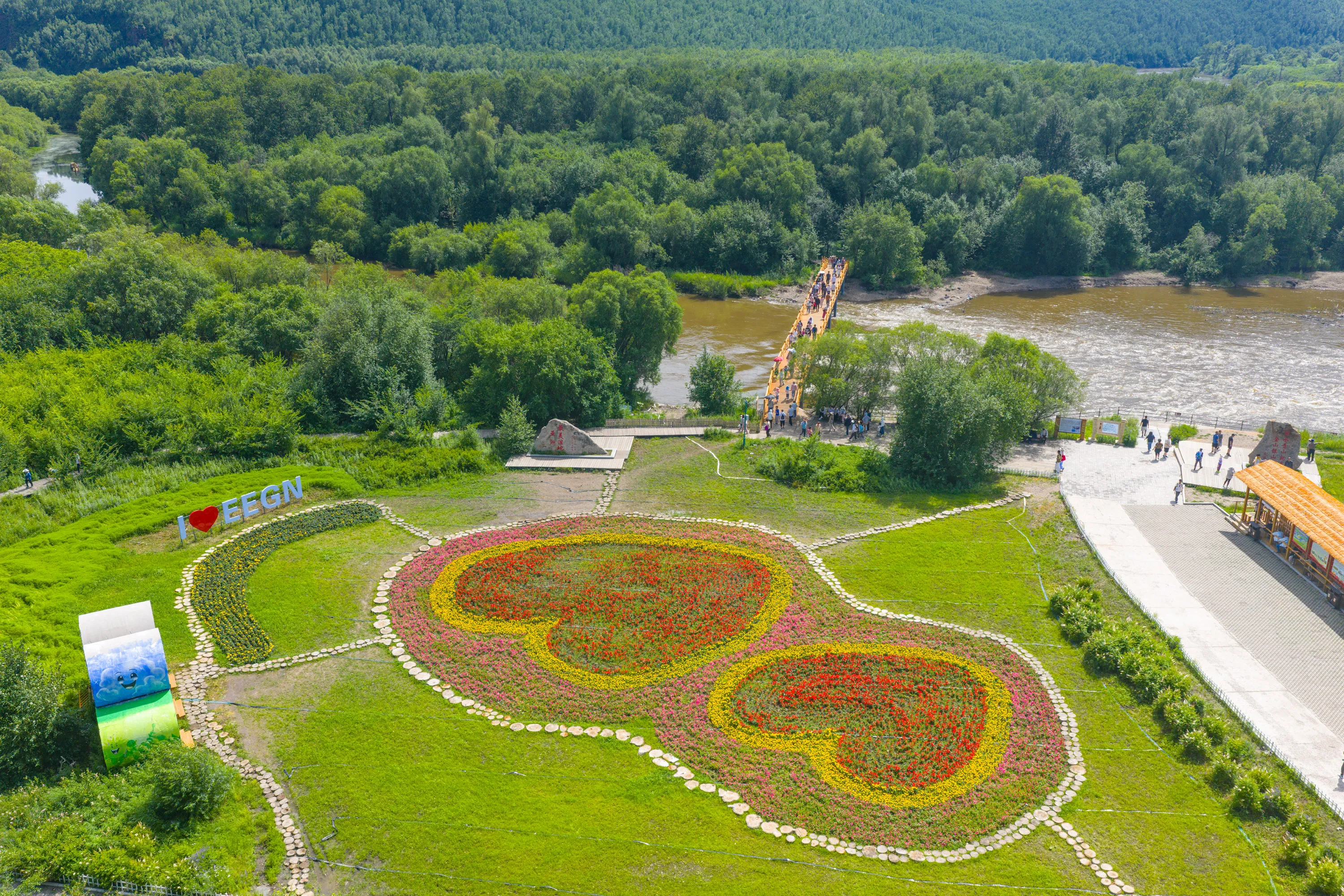 The Erguna wetland from above: the Genhe fanning into braids below the town.
Enhe and Shiwei, the Russian villages
Enhe was designated in April 1994 as the only Russian ethnic township in China, and the Erguna city government’s own introduction says about 80 percent of its residents are ethnic Russian; older self-drive accounts put the share nearer half, and either way the town is one modest cross-street of log houses and gardens. The houses are mukelong, walls of interlocked round logs sealed with moss and clay, fenced behind birch-log palisades, and half the town now runs as family guesthouses, painting retreats and bakery experiences. Eat the Russian lebba bread, drink the blueberry juice, and if the schedule allows, bake the bread and feed the reindeer yourself.
Shiwei, an hour further north on the Argun river bank, is the faster-developing twin: more hotels, more tour buses, and a direct view of Russian villages across the water. It also carries the heavier historical billing, as the Mengwu Shiwei homeland from which, on the standard account, the Mongols themselves expanded; national television named it one of China’s ten most charming towns in 2005. Between the two, Chinese guides consistently describe Enhe as the quieter, more rural stop and Shiwei as the convenience-and-sunset option. Either way, sleep one night in a mukelong, because the walls at dusk smell like resin and woodsmoke in a way concrete guesthouses never manage.
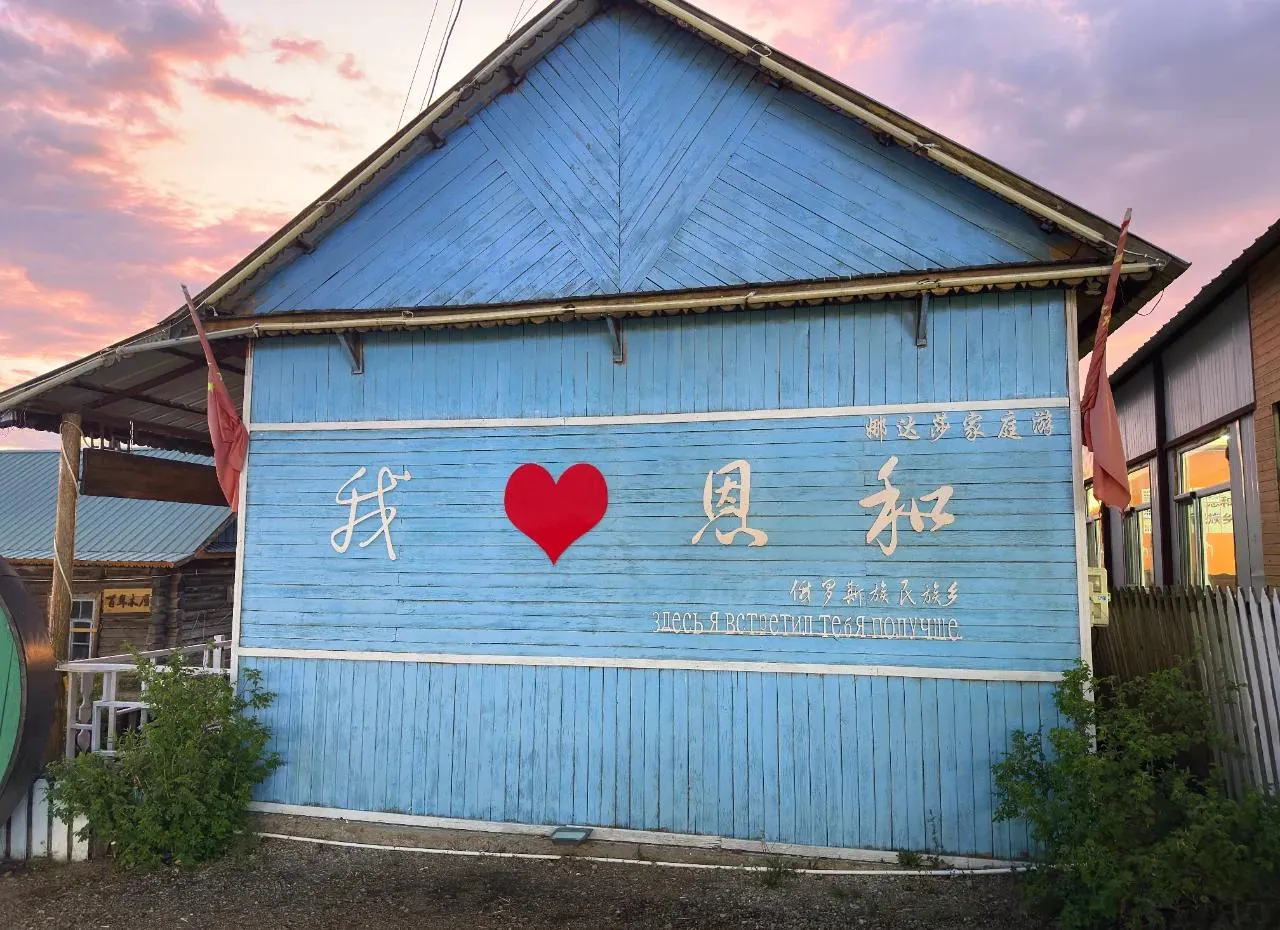 A blue-painted mukelong in Enhe, family-guesthouse signage included.
The border road, and what to carry on it
From Shiwei the paved border road strings the numbered sentry posts, from Card 9 down through Card 5, south to Heishantou, hugging the Argun the whole way. In July and August rapeseed fields flower gold on both sides of the road; in September the leaves do the same job. Chinese guides flag the same practical rules: mobile signal disappears for stretches, do not walk alone into uninhabited country, never photograph military or border installations, and keep documents on you because checkpoint stops happen without warning.
The paperwork layer deserves honesty rather than a shrug. Manzhouli, Heishantou, Shiwei and the whole border road sit inside an officially designated border management zone. Since April 2026 China has replaced the paper border-zone pass with a free electronic one, and the National Immigration Administration’s issuance guide explicitly lists foreign passport holders among those who should apply for one before traveling in such zones, in person at a county-level exit-entry office, issued the same day when materials are complete. In practice, foreign travelers on the main loop have long passed through with nothing shown at occasional checkpoints except a passport, the Manzhouli city government’s own loop write-up mentions only Chinese ID cards, and enforcement against foreign tourists on this specific route has no consistent record either way as of this writing. If you self-drive the border road, confirm current requirements ahead through the 12367 immigration hotline or a local operator. The comparable situation at Baihaba near Kanas is stricter on paper and painless in practice: foreigners get the border permit in person, free, the same day.
Manzhouli, the border city
Manzhouli was born as a railway station in 1901, when the Chinese Eastern Railway’s western line reached the border and Russian crews named the first station inside “Manchuria”; the registered population of the whole city is still only 87,582. What the place lacks in size it trades in throughput. The port handles 65 percent or more of overland China-Russia freight, ran 4,867 China-Europe freight trains in 2025 (up 11.2 percent, with return loads ranked first nationally), operates the only international road crossing on China’s border with 24-hour customs, and processed a record 920,000-plus border crossings in 2025, up 9.1 percent. A section of the new Inner Mongolia free-trade zone opened here in April 2026. None of this is decoration for travelers: it is why a city of 87,000 has a skyline of Russian-style cupolas and a pedestrian street of bilingual signage.
The National Gate: read this before you go
The China-Russia Border Tourist Area, which pairs the National Gate compound with the Matryoshka park, is Hulunbuir’s first national 5A scenic area. The fifth-generation gate looks directly across at the Russian town of Zabaykalsk, with cross-border trains sliding beneath it; entry is 60 yuan, hours 08:30 to 18:00.
The part most English guides omit: the gate compound sits in a military management zone, and its official entry notice names Chinese ID cards only. State media reported in 2012 that the standing rule barred foreigners from the gate itself and that enforcement had gone slack at the ticket desk; the most recent first-hand foreigner accounts, from 2019, describe being turned away, and we found no official notice lifting the restriction and no verified foreigner entry in the years since. Access for passport holders as of 2026 is unconfirmed by any official source, and enforcement has historically been inconsistent, so call the scenic area ahead (+86 470-6668688) and keep the honest fallback: the fifth-generation gate photographs acceptably from outside the fence, and the border-rail viewing elsewhere in the compound may or may not be part of what is refused.
The Matryoshka Scenic Area
The matryoshka park covers 870,000 square meters, its main building holds the Guinness record as the world’s largest matryoshka, and the hotel inside that building runs past a thousand rooms, with a second 93.2-meter matryoshka hotel tower begun in 2024. City buses 6 and 10 stop at the gate. Tickets run 138 to 148 yuan through the online platforms (100 to 150 off-season, around 180 at peak), and hours split by season: from July 1 to August 25 the park runs from about 9:00 or 9:30 in the morning to 22:30 at night with last ticket sales at 21:00 and a fountain-stage show at 21:00, while outside that window it typically closes around 18:00. The Russian Big Circus performs at 16:00 and 19:30 and is a summer feature, roughly late June to late August; if you come for the September foliage you will probably miss it. Circus seats run 200 to 280 yuan by zone when bought separately, with combo tickets including park entry from about 198 to 248.
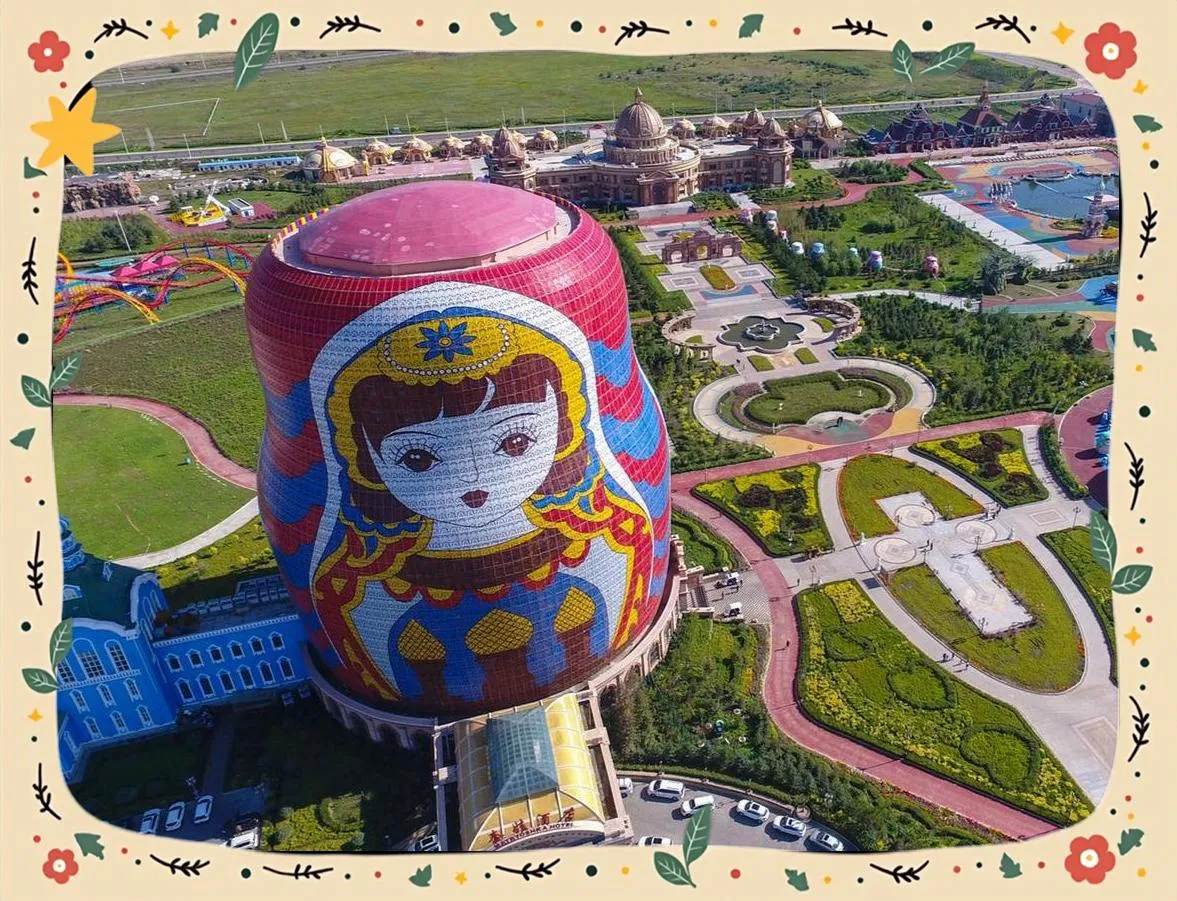 The Matryoshka Scenic Area from the air: the world’s largest matryoshka doubles as a 1,000-room hotel.
Above the town, the Gothic Wedding Palace on the hill gives the postcard view of Manzhouli’s night skyline, which Chinese guides describe as feeling like Russia without the border crossing.
On horseback
Heishantou is the region’s riding center, where the grassland meets the sunset line, and an hour at a licensed stable there upgrades any loop itinerary. Herds move at walking pace for beginners and canter for the confident; either way, the ride back toward a 19:00 sky is the image most visitors keep.
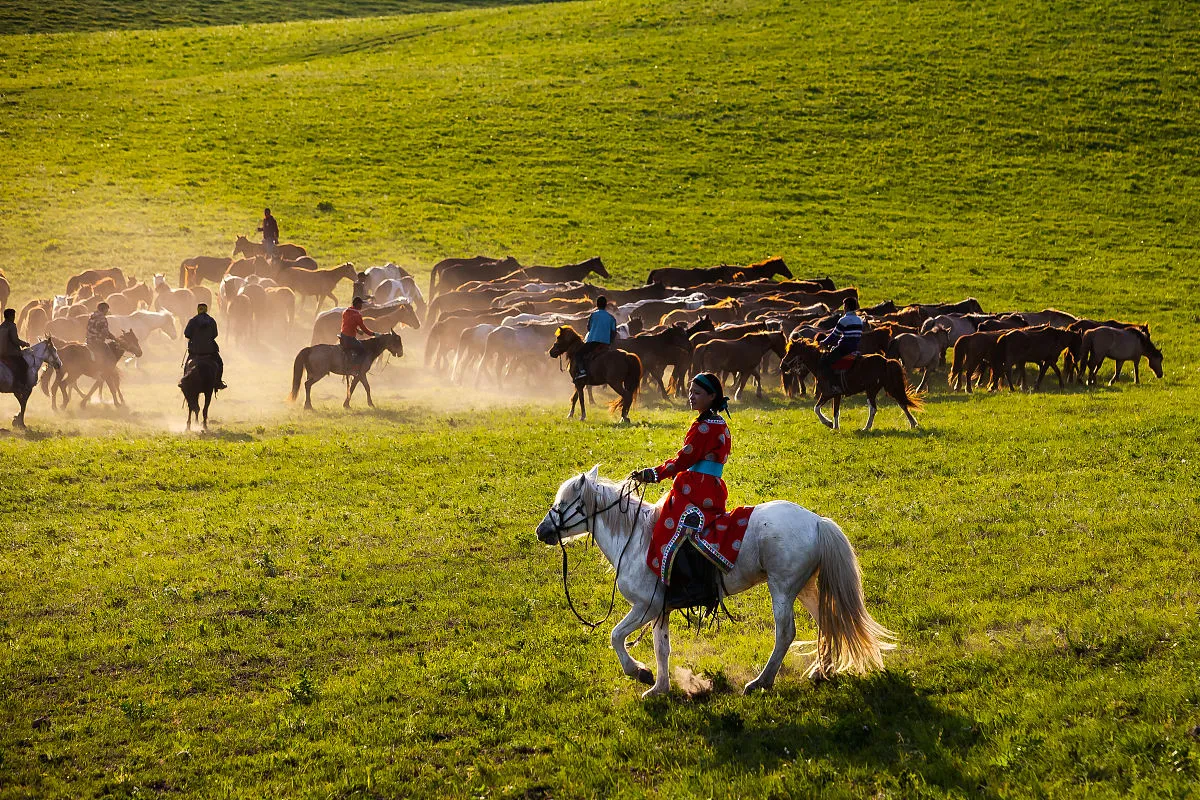 Moving horses at Heishantou, the riding heart of the loop.
When to go
The Chinese guide consensus splits the year four ways. June is the green-up: thin crowds, low hotel prices, fresh color. July and August are the green peak, 15 to 28 degrees Celsius on the typical day, with Naadam-style events and horse shows, the rapeseed bloom on the border road, and the densest domestic crowds. Mid-September to early October is the gold, birch forests included, and the window is only about two weeks long; the Chinese phrase is that if you miss it you wait a year. December through February runs minus 20 to minus 30 degrees Celsius, which is its own genre of trip and pairs naturally with Harbin’s ice festivals. Our best and worst time to visit China analysis places Inner Mongolia in the summer escape band for heat refugees from the east coast. Push the foliage trip into the first days of October and you also inherit National Day crowd and price spikes, so the smarter play is mid-September.
Sleeping: yurt or mukelong
The loop’s two signature nights are the mukelong guesthouse around Enhe, Shiwei or Linjiang and the yurt camp at Heishantou, bonfire included. Know which kind of yurt you are booking: traditional felt gers share bathrooms with the courtyard, while the commercialized resort yurts come ensuite with heated floors, the realistic choice once September nights drop toward freezing. A 2018 price anchor of around 300 yuan per room in Enhe survives in the older guides; treat it as an order of magnitude, not a quote. Wherever you stop, book properties licensed for foreign guests, the practice our hotel booking guide explains, since remote village guesthouses do not all hold the license even after the 2024 national measures encouraging acceptance.
What you eat
The regional signature is hand-grabbed mutton (shou ba rou), a dish named literally: the lamb comes in pieces so large that the polite way through it is with your hands. The ceremony above it is the roast whole lamb, the top tier of Mongol hospitality, whose ritual and pricing we cover in our guide to iconic Chinese dishes. On the Russian side of the menu, Manzhouli and Enhe serve proper Russian cuisine, lebba bread and blueberry juice among the staples, and Enhe’s bakery experiences let you bake the bread yourself. If the return luggage is heading toward Russian chocolate or tea bought at the border, the duty and mailing rules are in our customs declaration guide.
The bottom line
Five days, a driver, and a September date inside the two-week gold window is the version of Hulunbuir most worth copying. Enter on the 30-day visa-free scheme or an L visa rather than the transit policy, keep the passport on your body through the border road, expect the National Gate to say no and the matryoshka park to say yes, and book the mukelong night before the yurt night so the trip ends under a Manzhouli skyline instead of starting there. The scale does the rest: how many itineraries anywhere fit a river this crooked, a forest that changes color in a fortnight, and an international border into one week of driving.
Sources & Verification
This guide was last verified on 2026-09-08. Key Chinese-language sources:
- National Immigration Administration (国家移民管理局): the December 17, 2024 transit-visa announcement listing the 24 permitted provinces (Inner Mongolia absent), the current policy page counting 65 ports in 24 provinces (updated August 2026), and the April 14, 2026 electronic border management zone pass issuance guide, which lists foreign passport holders among applicants, in person at county-level exit-entry offices.
- Heilongjiang Provincial Government (黑龙江省政府, December 2024): the notice designating Harbin city as the province’s only 240-hour stay area, plus Article 25 of the Exit and Entry Administration’s implementing regulations on staying outside designated areas.
- Erguna City Government (额尔古纳市政府, April 2026): Enhe’s status as China’s only Russian ethnic township and its roughly 80 percent ethnic Russian residency.
- Manzhouli City Government (满洲里市政府, 2025-2026): port throughput including 65 percent of overland China-Russia freight, 4,867 China-Europe trains in 2025, the 24-hour international road crossing, the 920,000-plus 2025 crossings, the 5A scenic area’s theaters, and the border-loop itinerary recommendation.
- Baidu Baike cross-checked against official releases: city and grassland areas and populations, Morigele river data, the Erguna wetland’s 4A rating and October 2025 national wetlands listing, the Matryoshka park’s Guinness record and dimensions, K7091 timings, and Hulunbuir Express configuration.
- Live OTA prices (September 8, 2026): Qunar and Ctrip real-time listings for K7091 (hard sleeper 178-190 yuan Harbin to Hailar) and Matryoshka Scenic Area tickets (138-148 yuan), plus a Xinxing agency itinerary for circus combos (198-248 yuan).
- First-hand and historical reporting on the National Gate: Guangming Daily’s 2012 investigation of the foreigners-barred rule and lax enforcement, and Tripadvisor reviews from 2019 describing foreigner refusals; no official source confirming a policy change by 2026 was found.
See our full verification methodology.
Related Articles
- Kanas Travel Guide 2026 - The other great golden-autumn border destination, and the parallel case where the border permit is painless for foreigners
- China Visa-Free Countries 2026 - The 50-country list that is the correct entry route for Hulunbuir
- Harbin Ice and Snow World Guide - The winter twin-stop at the other end of the K7091 sleeper line