Chinese Culture Etiquette Guide: Greetings, Dining, Red Envelopes, Face, Gift-Giving & Lucky Numbers
 A figure in a blue robe and a black cap held with a hairpin, hands folded at chest height against a background of ink-wash mountains — the gongshou (拱手) greeting described below. The height matters as much as the hand position: the clasped hands stay at the chest and never drop to the waist.
Most English advice about Chinese etiquette starts with a list of taboos: never stick chopsticks upright in your rice, never hand someone a clock, never write someone’s name in red. The lists are real, but they are memorized without context, and that is where foreigners get lost. You can follow every rule mechanically and still offend someone, because Chinese manners reward respect, humility, and reading the room more than any single gesture.
This guide is the practical version. It walks through how to greet and address people, how to behave at a shared meal, how red envelopes and mobile red envelopes work, what people mean when they talk about “face,” what to give and never give as a gift, and which numbers to use and avoid. It is written for a traveler, not a sociologist, so every section ends in something you can actually do.
Quick answer: Shake hands, or return a small bow, and say “nǐ hǎo” (hello). At a meal, wait to be invited, never point your chopsticks, and don’t empty every dish. Hand or accept a red envelope with both hands and don’t open it in front of the giver. Treat people with “face” — never embarrass anyone in public, and never refuse an invitation harshly. If you bring a gift, avoid clocks, umbrellas, pears, and shoes, and pick an amount or a number with an 8 in it. Numbers ending in 4 are unlucky; 8, 6, and 9 are lucky.
How we verified this: SinoWander reads the original Chinese-language sources that English guides cannot reach: the Baidu Baike entries on etiquette, red envelopes, lucky money, “face,” gift-giving, and number homophones. Each fact was cross-checked against at least two independent sources (including English and Chinese Wikipedia) and date-stamped. Last verified: 22 October 2026. See our methodology.
Why This Matters More Than a List of Taboos
Chinese etiquette runs on a shared code of respect more than on a fixed list of rules. Two ideas support almost everything in this guide.
The first is respect for hierarchy and age. You defer to hosts, elders, and superiors — let them eat first, toast first, sit first, and walk first. Doing so is more important than any specific gesture.
The second is not losing face, either your own or someone else’s. This idea is so central that it gets its own section below. For now, take the working definition: never humiliate someone in public, and always give people a graceful way out of an awkward situation. If you hold those two ideas in mind, the individual rules make sense instead of feeling random.
Greetings and Addressing People
The Handshake Is Now the Standard
The modern default in China is a handshake, and it has been for about a century. During the Republican era (1912–1949), shaking hands and a small bow gradually replaced the older rituals of bowing and kneeling, and the handshake became the everyday greeting in both official and social settings. So you do not need to learn any exotic greeting just to say hello.
The Traditional Gesture: Gongshou (拱手) / Bowing
You will still see the traditional greeting, especially with older people, during festivals, and when someone wants to show particular respect. It is the gongshou (拱手) or “hands-folded” bow: stand straight, bring your hands together in front of your chest, and give a small nod. It is used for greetings, farewells, good wishes, thanks, congratulations, apologies, and when asking someone for a favor.
The important detail is the hand position:
- A man’s respectful version (jibai, 吉拜): make a loose fist with the right hand and cover it with the left hand, palm over the fist. This is the courteous gesture for greetings and farewells.
- The reverse (xiongbai, 凶拜): fist with the left hand and cover with the right. This is reserved for funerals and mourning.
- A woman’s version is the opposite: she makes the fist with the left hand and covers it with the right for the respectful gesture.
The reasoning is simple: most people are right-handed, so keeping the left hand outside is a way of showing you are not a threat and are meeting the other person sincerely.
Keep your hands roughly at chest height. The polite rule is raise them high rather than low, and never lower them below your chest. For very senior or respected people, a slightly deeper bow while holding the gesture is appropriate.
If a handshake and a gongshou both feel awkward, a simple nod with a slight bow (about 15 degrees) is a universally safe greeting.
What about Hugs and Cheek Kisses?
Not the norm. In formal and business settings, hugging or kissing on the cheek is uncommon and can make people uncomfortable. Greet with a handshake or a nod. As a general rule, don’t initiate a hug unless the other person reaches out first.
How to Address People
Chinese names put the family name first, then the given name. The writer Ba Jin is a pen name, but the pattern holds for most real names: for someone named Wang Xiaoming, Wang is the family name and Xiaoming is the given name. Use the family name with a title.
The easiest and most respectful approach for a traveler:
- Mr. and Mrs./Ms. work as a fallback: “Mr. Wang” (Wáng xiānsheng) or “Ms. Li” (Lǐ nǚshì). If you are not sure of someone’s title, this is the safe choice.
- Title + family name is the Chinese norm and shows you noticed their position: Teacher (Lǎoshī), Doctor (Yīshēng), Manager (Jīnglǐ), Professor (Jiàoshòu).
- “Teacher” (Lǎoshī) has expanded far beyond schools. In modern China it is a general term of respect for people whose job involves knowledge or skill, and it is widely used even outside education.
- “Master” (Shīfu) is a respectful way to address skilled workers — drivers, mechanics, technicians, and craftspeople. You can safely call your taxi driver “shīfu.”
- Avoid using someone’s given name unless they invite you to, and avoid the overly casual “Lǎo” + surname (used for older colleagues) unless you are very familiar.
If you are unsure, “Mr./Ms. + family name,” or a polite smile and a nod, will never embarrass you.
Dining Etiquette
Shared meals are the heart of Chinese social life, and most business and friendship is built at the table. The rules fall into three groups.
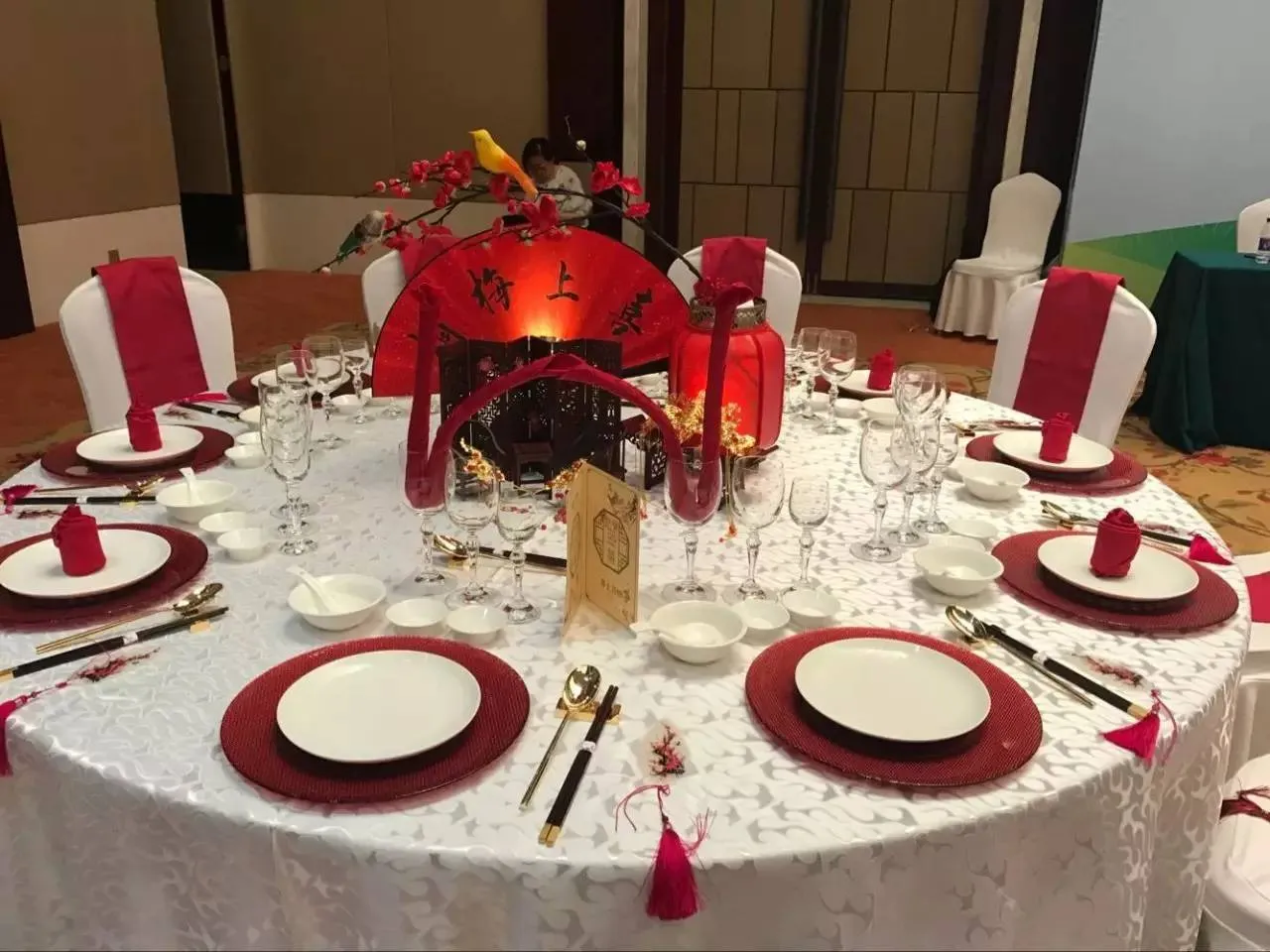 A banquet table laid for a formal dinner: red charger plates, stemmed glasses, chopsticks tied with red tassels, and a lit fan-shaped centrepiece at the middle of the table. The round shape is the point — with no head of table, the seat facing the door becomes the seat of honour, and every guest can reach every dish.
Seating
At a round banquet table, the seat of honor faces the door — that is where the host seats the most important guest. The seat to the host’s right is the next most important guest, and the seat to the host’s left the next after that.
The guest of honor, or the most senior person, sits first, and everyone waits for the host to begin. Do not sit until the host invites you, and do not start eating before the host does. Tradition and modern custom actually coexist here: older “honor the left / face east” (shàngzuǒ zūn dōng) rules survive, while modern formal banquets follow the Western-style “honor the right” seating with the top guest at the host’s right. In practice, follow the host’s lead — they will show you where to sit.
Chopstick and Table Manners (the Eight You Actually Need)
Chopsticks are where foreigners most often slip up. The rules:
- Never stick chopsticks upright in your rice bowl. It resembles the incense sticks burned at ancestor shrines and is a bad omen.
- Never point at someone with your chopsticks. Treat them as not pointing at people.
- Never bang chopsticks against the bowl or table. That is how beggars attract attention.
- Don’t dig through a dish. Look at what you want and pick it up cleanly; don’t rummage.
- Don’t eat directly from a shared dish. Use the serving chopsticks or the serving spoon, and put food into your own bowl first.
- Don’t put food back once you have touched it with your chopsticks.
- Rest chopsticks on the chopstick rest, not on the rim of your bowl or plate.
- Don’t cross your chopsticks with someone else’s at the table.
As a guest, don’t pick up your chopsticks before the host. A small note if you drop a chopstick: it is fine to simply ask the server for a clean one.
Toasting, Serving, and the Bill
- Toast to guests first. The host opens the meal by raising a glass and toasting the table.
- Serve drinks from the oldest/most senior first, women before men, and pour your own last. When pouring, fill to near-full as a sign of respect.
- Stand when someone toasts you. If someone at another part of the table toasts your table, everyone at your table stands.
- If you don’t drink alcohol, say so at the start of the meal, before the toasting begins. It is completely acceptable.
- Use a spoon for soup, in small sips, without slurping or blowing on it, and don’t raise the bowl to your mouth.
- Don’t rush to pay the bill. In a restaurant, guests should not grab the bill or get into a tug-of-war over it — that tug-of-war is actually considered bad manners. In China, the host who invites usually pays. Splitting the bill (“AA”) is an imported idea that is gradually catching on among young friends, but “I’ll treat” remains the norm. Accept the host’s treat graciously and say thank you.
Two traditional points with caveats. Older etiquette said a guest should not finish every dish, so the host would not feel the food was insufficient. In modern, everyday meals that has largely faded under the “clean-your-plate” (guāngpán) habit. And a very old custom had the senior person pour a little of their wine into the other’s cup when toasting — treat that as history, not something you need to do. When the meal ends, wait for the host or the senior guest to leave before you get up.
A Few Extra Traditions
- Knocking on the table — if someone pours you tea, a light tap of two or three fingers on the table is a traditional silent “thank you.”
- Don’t flip the fish. Turning a whole fish over mid-meal is avoided in some coastal regions (it suggests a boat capsizing).
- Don’t say “I’m done eating” in a literal way. Say “I’ve had enough” (wǒ chībǎo le). The literal “I’ve finished eating” carries an uncomfortable double meaning.
- Avoid a table of seven dishes in some traditions (seven is associated with funeral banquets), though this is rarely enforced today.
Red Envelopes (Hóngbāo)
The red envelope — a red paper packet holding money — is one of the most visible Chinese customs. In Cantonese it is called lìshì (“lucky packet”). It appears at Chinese New Year, weddings, birthdays, housewarmings, new babies, and store openings.
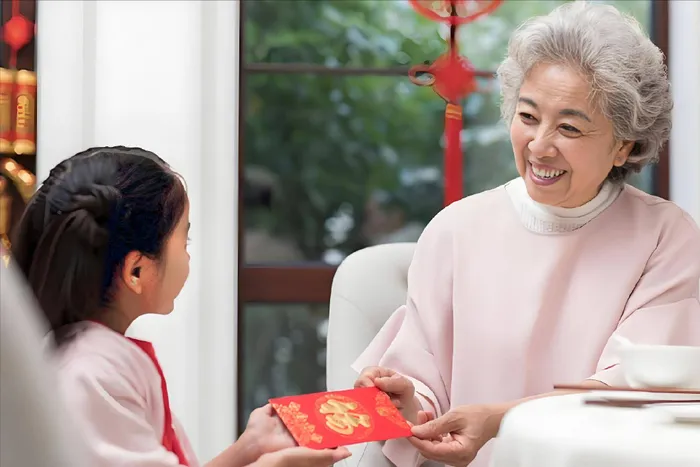 A grandmother hands a red envelope to her granddaughter across a restaurant table, a red Chinese knot hanging in the window behind. Both hands on the packet, a gold-stamped design, and no opening at the table — the whole etiquette in one frame.
Where It Comes From
The custom traces back to the Han dynasty (206 BC–220 AD), when people used yànshèng qián, coin-shaped charms meant to ward off evil rather than spendable currency. A popular legend explains the red color: a creature or evil spirit called suì (祟) would sneak in on New Year’s Eve and touch a sleeping child’s head. Parents placed eight coins wrapped in red paper under the pillow, and the red packet warded the spirit off. (The word for “lucky money,” yāsuì qián, literally means “money that presses down suì.”)
The practice of giving yāsuì qián was established and spread during the Ming and Qing dynasties (1368–1912). In the Republican era people switched to red packets of copper or, once paper money arrived, crisp new banknotes.
Mobile Red Envelopes
You will meet the digital version far more than the paper one. In January 2014, WeChat launched its red-envelope feature, and it became a national habit almost immediately. Two kinds exist:
- A regular red envelope — a fixed amount you send to one person.
- A “lucky” (pǐng shǒuqì) red envelope — a random-split envelope sent into a group chat, where each tapper gets a random share.
Alipay has a similar feature. If you have a foreign card linked to WeChat Pay or Alipay, you can send and receive digital red envelopes too. For setup details, see our WeChat Pay guide and Alipay guide.
The Money: Amounts and Lucky Numbers
The number on the red envelope matters more than the amount:
- Lucky numbers: 8 sounds like “prosper/fā,” 6 like “smooth/liù,” and 9 like “long-lasting/jiǔ.” So 8, 18, 88, 168 (yīlù fā, “fortune all the way”), 520 (“I love you”), and 1314 (“one life, one lifetime”) are all well received.
- Avoid 4. It sounds like “death” (sǐ) and is avoided wherever possible.
- Use even numbers and fresh, crisp notes. People generally prefer new bills for the “new year, new start” feel.
- Double amounts with 8 — 88, 168, 888 (fā fā fā) — are popular for weddings.
There is no universal “correct” amount, and it varies with the city, how close you are to the person, and your budget. A practical rule for a traveler: pick an auspicious, even number you’re comfortable with and don’t overthink it. The meaning is in the red packet and the goodwill, not the total.
Red Envelope Manners
- Use both hands to give and to receive a red envelope.
- Don’t open it in front of the giver. Opening it immediately is considered rude; open it later, in private.
- Give to younger people. Traditionally, married people give red envelopes to unmarried children and young relatives. Married guests give at weddings; the receiving couple does not.
- Who gets lucky money: adults give it to children and unmarried young people (in practical terms, until they are adults or married). It is handed out from New Year’s Eve through the Spring Festival visiting period, not just on one day.
Face (Miànzi) and Social Grace
Face (miànzi, 面子) is the single most useful concept for understanding Chinese social behavior, and there is no clean English translation. Roughly, it is a person’s public dignity and social standing: the respect others show them and the image they project. Because face is fragile and social, losing it in public is painful.
You will hear two classic quotes. The writer Lin Yutang called face one of the “three goddesses” that rule the Chinese. Lu Xun called it the “spiritual program” of the Chinese people. The folk saying “sǐ yào miànzi huó shòuzuì” (“would rather die for face than live in discomfort”) captures how far people go to protect it.
For a visitor, face mainly means never embarrass anyone, and give people an easy way out. Concretely:
- Avoid loud arguments or public criticism. If you disagree, soften it, or raise it privately later.
- Don’t correct someone in front of others. If a misunderstanding matters, handle it one-on-one.
- Give people a graceful out. The polite phrase “gǎitiān ba” (“let’s do it another day”) is often a gentle way of declining without a blunt “no.”
- Don’t force someone to answer “yes” in public if the answer is awkward. Chinese speakers often use “let me think about it” or “let me check” to save face for both sides.
- Treat people with small honors: let the host serve first, toast first, and take the senior seat. These small gestures are what “giving face” looks like in practice.
Related to face is rénqíng (人情), the web of mutual favors and obligations. Lǐshàng wǎnglái — “courtesy demands reciprocity,” from the Book of Rites — means gifts and favors are returned over time. People treat relationships as long-term investments, not one-off transactions. If someone does you a kindness, a later reciprocal gesture keeps the relationship healthy.
Gift-Giving Etiquette
Gifts are expected at Chinese social visits, and the rules are straightforward once you know the taboos.
What to Give (Safe Choices)
For a visit to a Chinese home, safe, well-received gifts are fruit, flowers, wine or baijiu, tea, and quality food. Tea and local specialties from your own country are popular with hosts. If you are invited to a meal, bringing something small is appreciated; showing up empty-handed is seen as a miss.
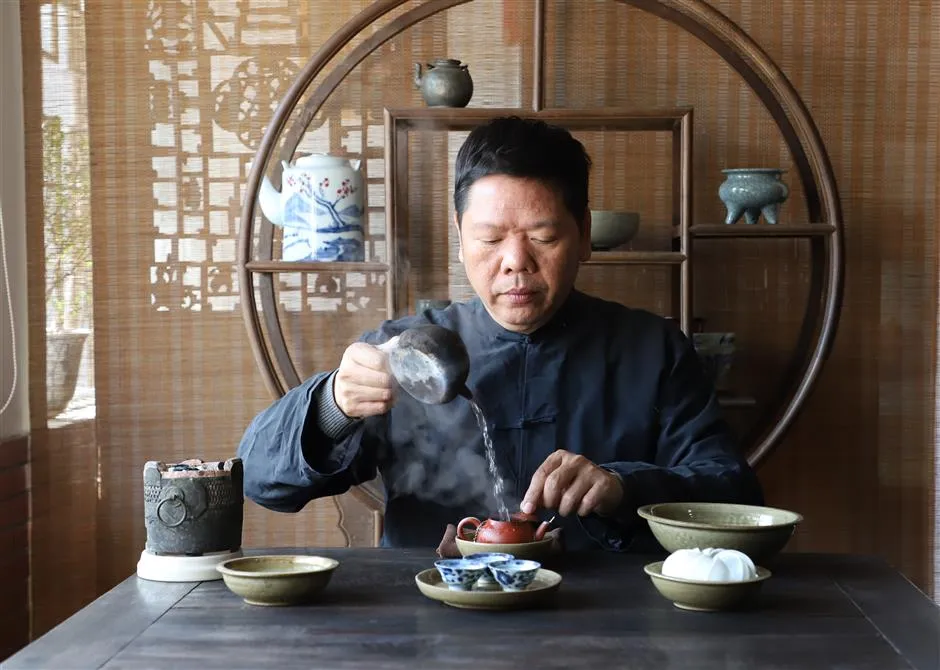 Water poured from a silver kettle into a small clay pot, steam rising, with cup-sized bowls lined up on the tea table. This small-pot, small-cup service is the host’s opening gesture in a Chinese home, and the reason tea makes a safer gift than almost anything else.
The Taboos: What Never to Give
These are based on homophones and cultural symbols, and they are the things foreigners most often get wrong. Give them as a table rather than a rule list:
| Gift | Chinese sound | Why it’s avoided |
|---|---|---|
| A clock | zhōng (终) | “zhōng” sounds like “end/death” — giving a clock implies “seeing someone off.” A classic taboo. |
| An umbrella | sǎn (散) | Sounds like “to scatter/separate.” |
| A pear | lí (梨) | Sounds like “to separate” (lí). |
| A pair of shoes | xié (鞋) | Sounds like “evil” (xié) in some regions; in others, “walking away.” |
| Apples when visiting the sick | — | In Shanghai, “apple” (píngguǒ) sounds close to “passed away” (bìnggù), so avoid them at hospital visits. |
| A green hat | — | In Chinese, “wearing a green hat” (dài lǜmào) means your spouse is unfaithful. |
| A mirror | — | A broken mirror suggests a broken relationship; the symbol has negative overtones. |
Never give a clock, no matter how nice — it is the strongest gift taboo in China. Also avoid giving ties or belts to men (the sense of being “tied down”), and avoid necklaces or rings to women unless you are very close.
How to Give and Receive
- Don’t expect the gift to be opened immediately. The Chinese custom is to not open the gift in front of the giver — the opposite of the Western habit of ripping it open. If you receive a gift, thank the giver warmly and set it aside.
- Expect polite refusal. Chinese recipients often decline a gift a few times before accepting, out of modesty (“I couldn’t possibly”). Accept the refusal lightly; they will usually take it in the end.
- A gift is returned. Because of lǐshàng wǎnglái, receiving a gift creates an expectation to reciprocate eventually. Very expensive gifts can burden the recipient with obligation, so moderate is better.
Lucky and Unlucky Numbers
Numbers carry strong meanings in Chinese because of homophones. This matters for phone numbers, room numbers, prices, and red envelopes.
 Red lanterns with yellow tassels hung beneath a temple eave, with painted bracket sets and blue-green beams above them and lattice windows below. The lanterns are the festival layer; the painted wood behind them is the building’s rank — in Chinese architecture the two are always read together.
The Single-Digit Homophones
| Number | Sounds like | Meaning |
|---|---|---|
| 0 | líng | you, or completion |
| 1 | yī | one, or “want” (yào) |
| 2 | èr | love (ài) |
| 3 | sān | life/birth (shēng), or “think” (xiǎng) |
| 4 | sì | death (sǐ) — avoid |
| 5 | wǔ | me (wǒ) |
| 6 | liù | smooth (liù) — lucky |
| 7 | qī | intimate, invite, or “up” |
| 8 | bā | prosper, get rich (fā) — most lucky |
| 9 | jiǔ | long-lasting (jiǔ) — lucky |
Lucky Combinations
- 520 = “I love you” (so 5.20 has become an unofficial online Valentine’s Day)
- 1314 = “one life, one lifetime”
- 888 = “fā fā fā” (prosperity three times)
- 168 = “yīlù fā,” fortune all the way
- 3399 = “long and long” (cháng cháng jiǔ jiǔ)
- 5201314 = “I love you for life”
- 666 = “smooth” (liù) — though in modern internet slang it is also used to mean “awesome/impressive,” so context matters.
Numbers to Avoid
- 4 is the big one. It sounds like “death,” so buildings often skip the 4th floor, phone numbers avoid it, and you should never put a 4 in a red envelope. In internet slang, some 4-containing numbers carry dark meanings (such as 748, “go die”).
- 250 = “èr bǎi wǔ,” a slang insult meaning “fool/blockhead.”
- 14 = sounds close to “yào sǐ,” “want to die.”
The “prosper” meaning of 8 became widespread during the Ming and Qing dynasties, when 8 was adopted as a symbol of wealth. Today people pay premium prices for phone numbers and license plates full of 8s, and avoid 4s.
For the Traveler, in One Line
A phone number, room number, or price full of 8s and 9s is good news; anything with a 4 in a prominent place is best avoided.
Quick Tips for Travelers
- Greet with a handshake or a small bow. Return a gongshou bow with the left hand covering your right fist, held at chest height. Don’t initiate hugs.
- Address people as Mr./Ms. + family name (or use the title: “Teacher,” “Doctor,” “shīfu” for drivers and workers). Family name comes first.
- At a meal: wait to be invited, don’t start before the host, don’t point your chopsticks, don’t stick them upright in rice, use the serving spoon, and don’t rush to pay.
- Red envelopes: give and receive with both hands, don’t open them in front of the giver, use even lucky numbers, avoid 4, and don’t write a number with 4.
- Treat people with face: never embarrass anyone publicly, give people a graceful way out, and let the host go first.
- Gifts: fruit, flowers, wine, and tea are safe. Never give a clock, umbrella, pear, pair of shoes, or green hat. Don’t open a gift in front of the giver, and expect a polite “I couldn’t possibly” before they accept.
- Numbers: 8, 6, and 9 are lucky; 4 is unlucky. “888,” “168,” “520,” and “1314” are all good wishes in number form.
For the wider cultural picture before you go, our guide to Chinese festivals and Chinese New Year guide cover the calendar of events where all of this etiquette plays out. For the art that sits alongside all of it — calligraphy, ink painting and Peking opera — see our guide to Chinese art. To handle the daily logistics of language and payment, start with our language survival guide and how to pay in China.