Chinese Art for Travellers: Calligraphy, Ink Painting and Peking Opera Explained
Most visitors leave China having seen a great deal of art without ever feeling they understood any of it. A scroll in a museum case looks like grey washes on paper. A Peking opera performance sounds like cymbals and shouting. A temple inscription is beautiful in a way that is hard to explain, even to yourself.
That gap is not a failure of taste. It is a failure of scaffolding. Chinese art is built on a small number of conventions that are almost never stated in English — and once you know them, the work opens up quickly. This guide gives you those conventions for the three art forms a visitor actually encounters: calligraphy, ink painting, and opera. Then it tells you where to see each one, what it costs, and how to check that the gallery you are travelling to is actually open.
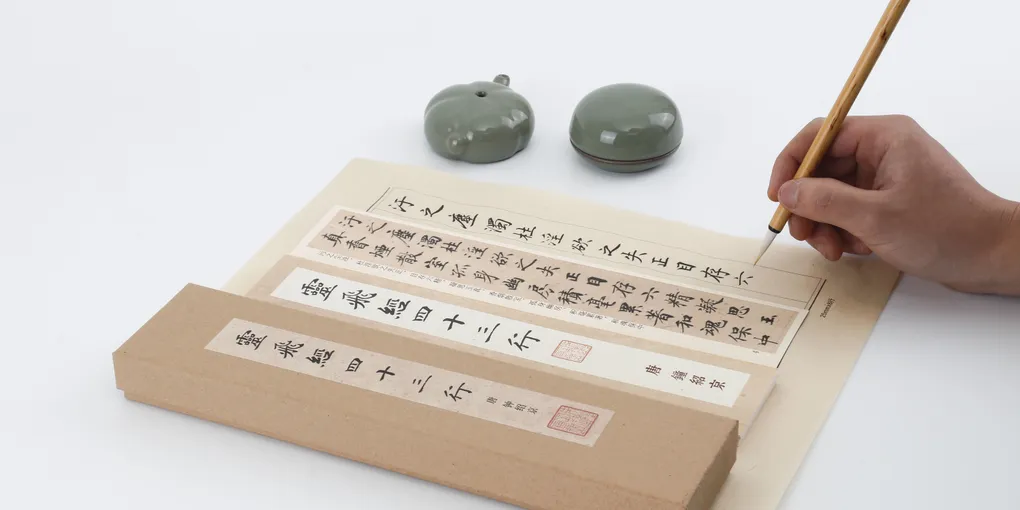
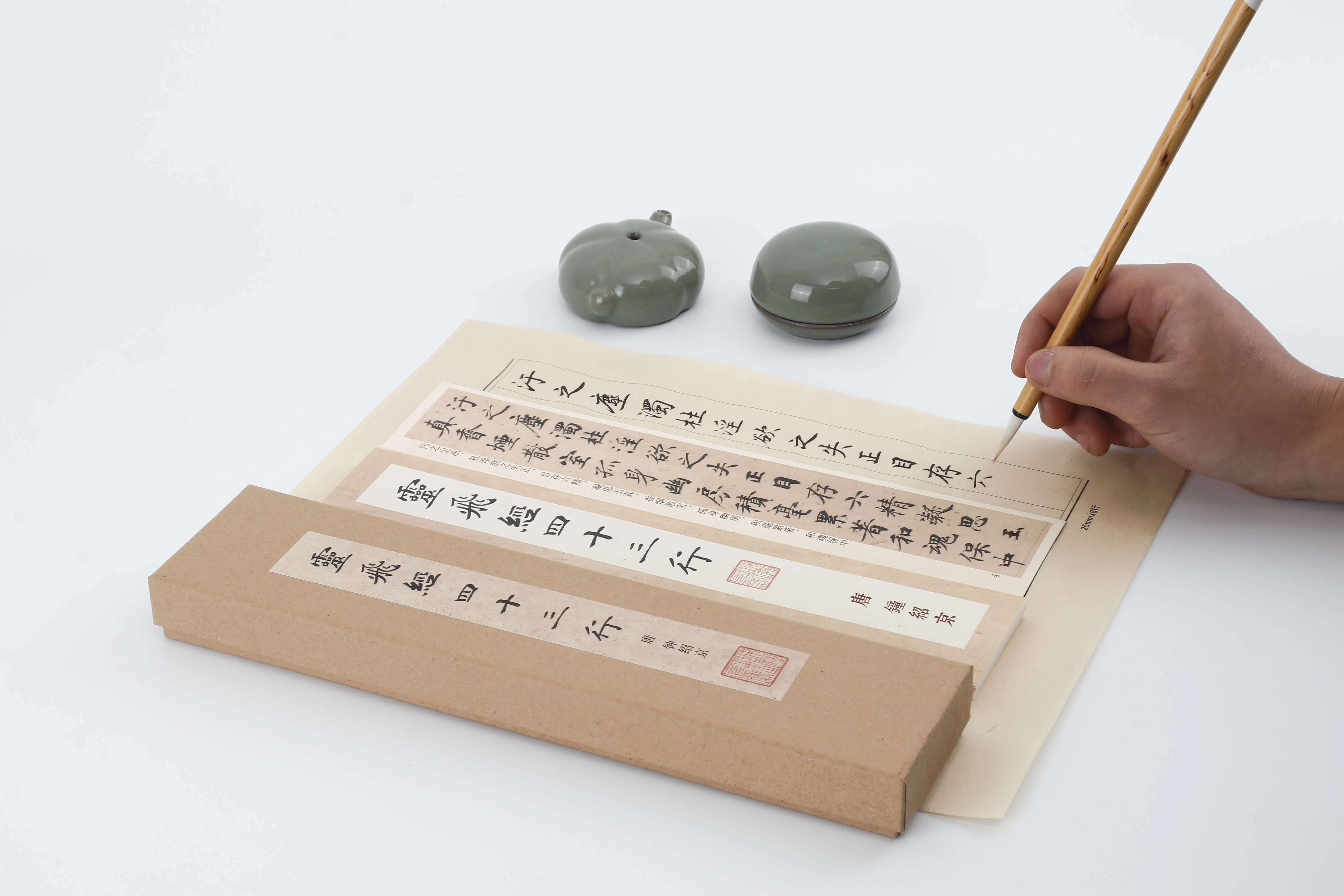 A brush held upright over a page of small regular script, two celadon water vessels on the desk and a copybook case printed with the title Lingfei Jing, 43 lines (靈飛經四十三行, Tang, Zhong Shaojing). Copying a Tang model stroke by stroke is still how calligraphy is taught — brush, ink, paper and inkstone are the Four Treasures.
Why Chinese Art Looks Different
Three ideas do most of the work.
First, the brush is the same brush. In the West, writing and drawing were historically separate crafts with separate tools. In China the same brush, the same ink and the same paper served both. A person who wrote well was assumed to be capable of painting well, and vice versa. That is why calligraphy sits at the top of the hierarchy rather than at the bottom — it is not “handwriting,” it is the foundational discipline from which painting grows.
Second, resemblance was never the primary goal. Western art spent centuries on perspective and anatomy — the project of making a flat surface look like a window. Chinese painting took a different route: it treats the surface as a place to register the painter’s understanding of a subject rather than its appearance. The classical formula is xieyi (写意, “writing the idea”), as opposed to gongbi (工笔, “meticulous brush”). A Song dynasty landscape is not a bad photograph of a mountain. It is a considered statement about what mountains do to a person.
Third, empty space is content. Where a European oil painting fills the canvas, a Chinese scroll often leaves most of the paper blank. That blankness is not unfinished. It is mist, water, distance, or simply room for the viewer to enter. Painters were judged on how well they used what they left out.
If you want the physical counterpart to this — why Chinese buildings are timber frames rather than stone vaults, and what a garden is trying to do — that is covered separately in our guide to Chinese architecture and gardens. Art and building here come out of the same set of assumptions.
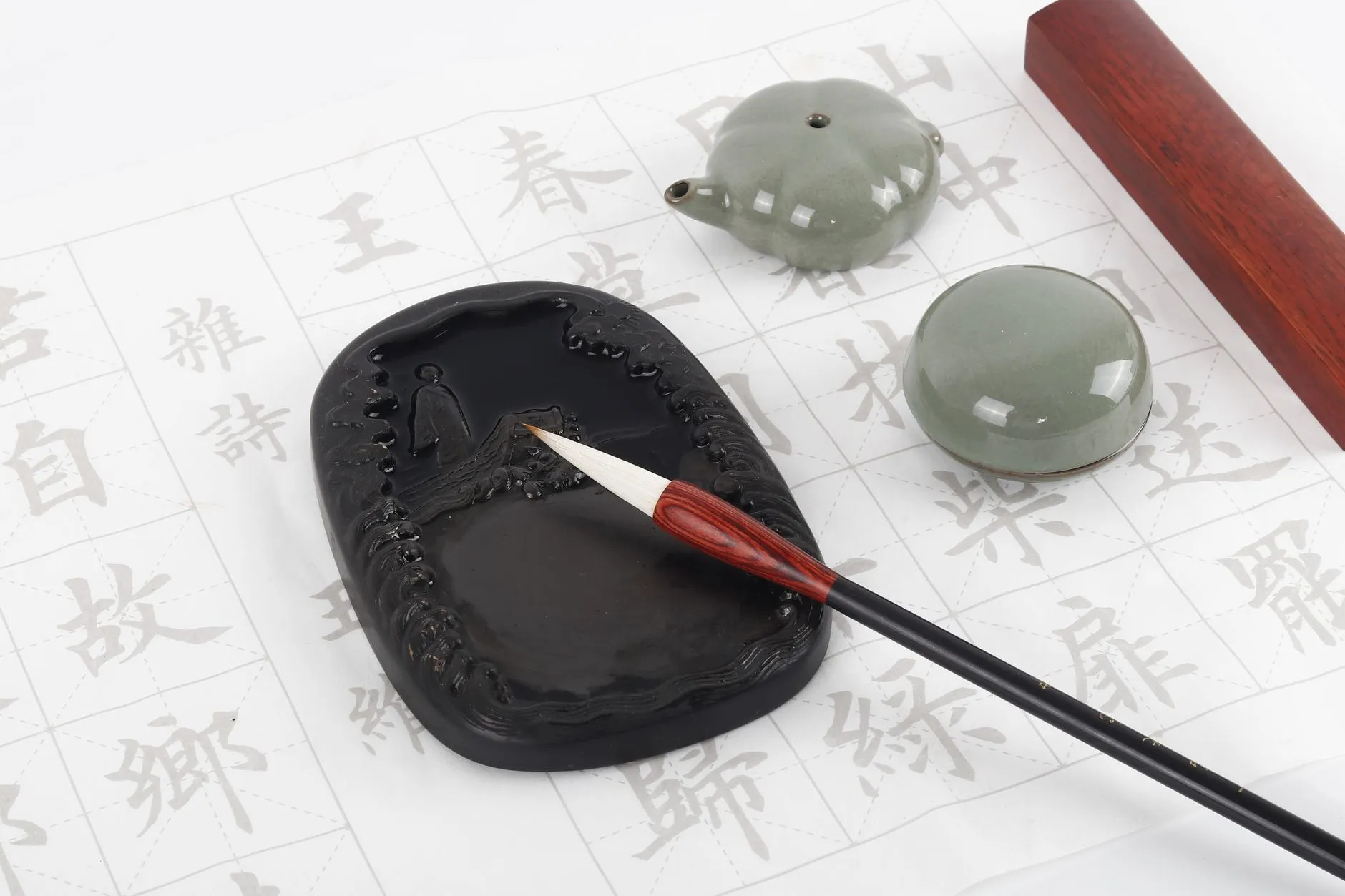 A carved black inkstone with a brush laid across it, a celadon water pot and a rosewood paperweight on a sheet of gridded practice paper. The pale characters are models to be traced — 米字格 paper, the same training aid Chinese schoolchildren use.
Calligraphy: One Stroke, Fifteen Centuries
Chinese calligraphy was inscribed on UNESCO’s Representative List of the Intangible Cultural Heritage of Humanity in 2009 (nomination file No. 00216). Note the category: it is intangible heritage, not a World Heritage site — the recognition is for a living practice, not a monument.
What it actually is
Calligraphy is the art of writing Chinese characters with a brush, in a way that is judged on far more than legibility. The classical description is unusually poetic for an art form: “wordless poetry, soundless music, a painting without pictures, a dance without a body.”
Practitioners are assessed on stroke order and pressure, the structure of each character, the spacing between characters, and the rhythm of the whole column. A single character may contain a dozen decisions about where the brush lands, how long it pauses, and how fast it lifts.
The five scripts
Chinese writing evolved through five major scripts, and a visitor who can name them can date almost any inscription at a glance.
| Script | Chinese | Character | Where you’ll see it |
|---|---|---|---|
| Seal | 篆书 | Thin, even strokes; the script of Qin unification (3rd century BC) | Stone seals, monument titles |
| Clerical | 隶书 | Wide, flat characters with flared terminals (“silkworm head, swallow tail”) | Han dynasty steles, temple plaques |
| Regular | 楷书 | Square and upright, the “model” script | Inscriptions, signboards, printed books |
| Running | 行书 | Between regular and cursive — characters connected but readable | Letters, prefaces, the most common artistic script |
| Cursive | 草书 | Abbreviated and continuous; can be unreadable even to native readers | Album leaves, expressive works |
A useful Western parallel: this is roughly the trajectory from carved Roman capitals to medieval Gothic to copperplate cursive to modern handwriting — except that in China all five remain in active artistic use, and a calligrapher is expected to command several.
The four treasures
Calligraphy needs four things, collectively called the Four Treasures of the Study (文房四宝): brush, ink, paper, and inkstone. The concept of the “studio” (文房) dates to the Southern and Northern Dynasties; the phrase itself first appears in a Northern Song poem.
- Brush — hair, usually goat, wolf or a blend, judged on four qualities: pointed, even, round, and resilient (尖齐圆健). Legend credits its invention to the Qin general Meng Tian. The most famous brushes come from Shanlian in Huzhou, Zhejiang; the craft was added to China’s national intangible heritage list in 2006.
- Ink — artificial ink from pine soot appeared in the Han dynasty. Hui ink from the old Huizhou prefecture is the prestige product: a geographical indication product since 2015, and national intangible heritage since 2006.
- Paper — Xuan paper from Jingxian, Anhui, is the benchmark, prized for absorbing ink without bleeding. It has been a geographical indication product since 2002, and Xuan paper-making was inscribed by UNESCO in 2009.
- Inkstone — the “first of the four treasures.” Four stones are traditionally ranked: Tao in Gansu, Duan in Guangdong, She in Anhui, and Chengni in Shanxi. Duan stone from Zhaoqing has been worked for over 1,300 years and has held origin protection since 2004.
One caution if you are shopping: not every famous studio craft holds the same kind of protection. Huzhou brushes, for example, have no geographical indication product status — their 2006 listing is intangible heritage, and their geographical mark is a 2010 certification trademark, which is a different system from the GI status held by Xuan paper, Hui ink and Duan stone.
Two names you will keep hearing
Wang Xizhi (c. 303–361; an alternative dating gives 321–379) is the “Sage of Calligraphy.” He worked in the Eastern Jin, and is credited with shifting the art from the blocky, archaic manner of the Han and Wei toward a fluent, elegant line. He and his son Wang Xianzhi are known together as the “Two Wangs.”
His Preface to the Orchid Pavilion Collection (兰亭集序) is the most famous piece of calligraphy in Chinese history. It was written in 353 at a spring gathering of poets at the Orchid Pavilion near Shaoxing, where guests floated wine cups down a winding stream and composed poems as the cups passed. The preface runs to 28 lines and 324 characters — the figure given by the Palace Museum’s own catalogue.
Two things about it are worth knowing. The number of guests is disputed: 41 is the figure used by the Palace Museum, derived from an early commentary, while some Song dynasty sources give 42; the preface itself names no one. And the original does not exist. Tradition holds that the Tang emperor Taizong admired it so much that it was buried with him at Zhaoling — but Zhaoling has never been excavated, and the story rests on Tang and Song texts that disagree with each other. What you see today are copies. Write “tradition holds,” not “was buried.”
Yan Zhenqing (709–785; some sources give 784) is the counterweight: a Tang official and general whose “Yan style” is broad, upright and heavy, in deliberate contrast to Wang’s elegance. The pairing of Yan’s bone and Liu Gongquan’s sinew became the standard formula for judging regular script. His Draft of a Requiem for My Nephew (祭侄文稿), written in 758 in grief after his nephew’s death in the An Lushan rebellion, is called the second greatest running-script work in history and is held by the National Palace Museum in Taipei. For an accessible entry point, his Duobao Pagoda Stele of 752 stands in the Beilin (Forest of Steles) in Xi’an — a standard model for beginners.
Ink Painting: Why Likeness Was Never the Point
What you are looking at
Chinese painting (国画) uses brush and ink on silk or paper, and is organised into three genres: figures, landscape, and bird-and-flower. Two techniques cut across all three: gongbi, the meticulous outlined manner, and xieyi, the abbreviated “writing the idea” manner. Formats are scrolls (hanging or hand), albums, and screens.
The governing ideas are worth memorising, because they explain almost every choice a painter makes:
- Spirit over likeness. The canon asks for “form expressing spirit, with both present” and qiyun shengdong — “spirited resonance, alive and moving.”
- Moving perspective. Instead of a single vanishing point, the viewer’s eye is allowed to travel. A handscroll is unrolled arm’s length at a time, so the composition is experienced as sequence, not as a frozen view.
- Ink has colour. “Ink is colour” and “ink divides into five tones” — from scorched black through to pale grey. A monochrome painting is not a drawing; it is a full tonal system.
A workable Western analogy is abstract expressionism: the point is the trace of a decision, not a record of an object. The difference is that the Chinese version is 900 years older and considerably more disciplined about it.
The earliest surviving works
The earliest surviving Chinese figure painting on silk is a pair of Warring States banners from a Chu tomb — the Dragon and Phoenix and Lady with a Dragon and Phoenix pieces. Note “earliest surviving,” not “earliest.”
The Admonitions Scroll attributed to Gu Kaizhi is the work most often described as China’s first great figure painting, and it is also the most frequently misdescribed. The version in the British Museum is dated by the museum to the 5th–7th century and catalogued as “After Gu Kaizhi” — a copy, not the original. It preserves nine of the original twelve sections; the three missing sections open the scroll. The Palace Museum in Beijing holds a Song dynasty copy with all twelve sections intact. So: not the original, and not the most complete. What it is, is the earliest substantial painting on silk that survives anywhere in the world.
Landscape, and the trouble with “the first”
Landscape (山水) became an independent genre in the Sui and Tang and reached maturity in the Five Dynasties and Northern Song. The tradition’s three distances — high, deep, and level — let a painter stack a mountain range into a single sheet of paper without pretending to be a camera.
The Spring Excursion scroll attributed to Zhan Ziqian is usually called the earliest surviving Chinese landscape painting. The Palace Museum, which owns it, is more careful: its own exhibition text describes it as “one of the earliest surviving scroll landscape paintings,” and says only that it has “traditionally been attributed” to Zhan. Its dating is genuinely contested — Sui original, Tang copy, and Song copy have all been argued by serious scholars. Do not repeat a museum’s caution as your own certainty. (The museum’s own pages also give three slightly different dimensions for the work, which is why this guide gives none.)
Bird-and-flower painting gave Chinese art its most portable symbol system. The Four Gentlemen — plum, orchid, bamboo and chrysanthemum — stand for resilience, integrity, humility and autumn fortitude respectively. But the grouping is later than most English guides imply: the four plants appear as motifs from the Song, yet the set crystallised in the late Ming, when Huang Fengchi published the Four Manuals of Plum, Bamboo, Orchid and Chrysanthemum and Chen Jiru glossed them as the “four gentlemen.” The Yuan painter Wu Zhen is often credited with the grouping, incorrectly — what he painted was Pine, Plum, Bamboo and Orchid, a set with no chrysanthemum.
Two modern masters
Qi Baishi (1864–1957) is the popular favourite, named a “People’s Artist” by the Ministry of Culture in 1953 and a “World Cultural Figure” by the World Peace Council in 1963. He is famous for shrimp, and the fame is technical: from his late sixties he progressively reduced the number of legs he painted, and in old age worked with diluted ink that let the bodies appear translucent. His formula for the whole enterprise was “the wonder lies between likeness and unlikeness.”
Xu BiHong (1895–1953; usually transliterated Xu Beihong) went the other way. He studied in Paris from 1919 to 1927, came back arguing that drawing from life was the foundation of all representational art, and built a career on fusing Western anatomical realism with Chinese brushwork — most visibly in his galloping horses. He was tasked with founding the National Academy of Fine Arts in November 1949; it was renamed the Central Academy of Fine Arts in January 1950, and he became its first president under that name. (Sources that say “president in 1949” compress the two steps.)
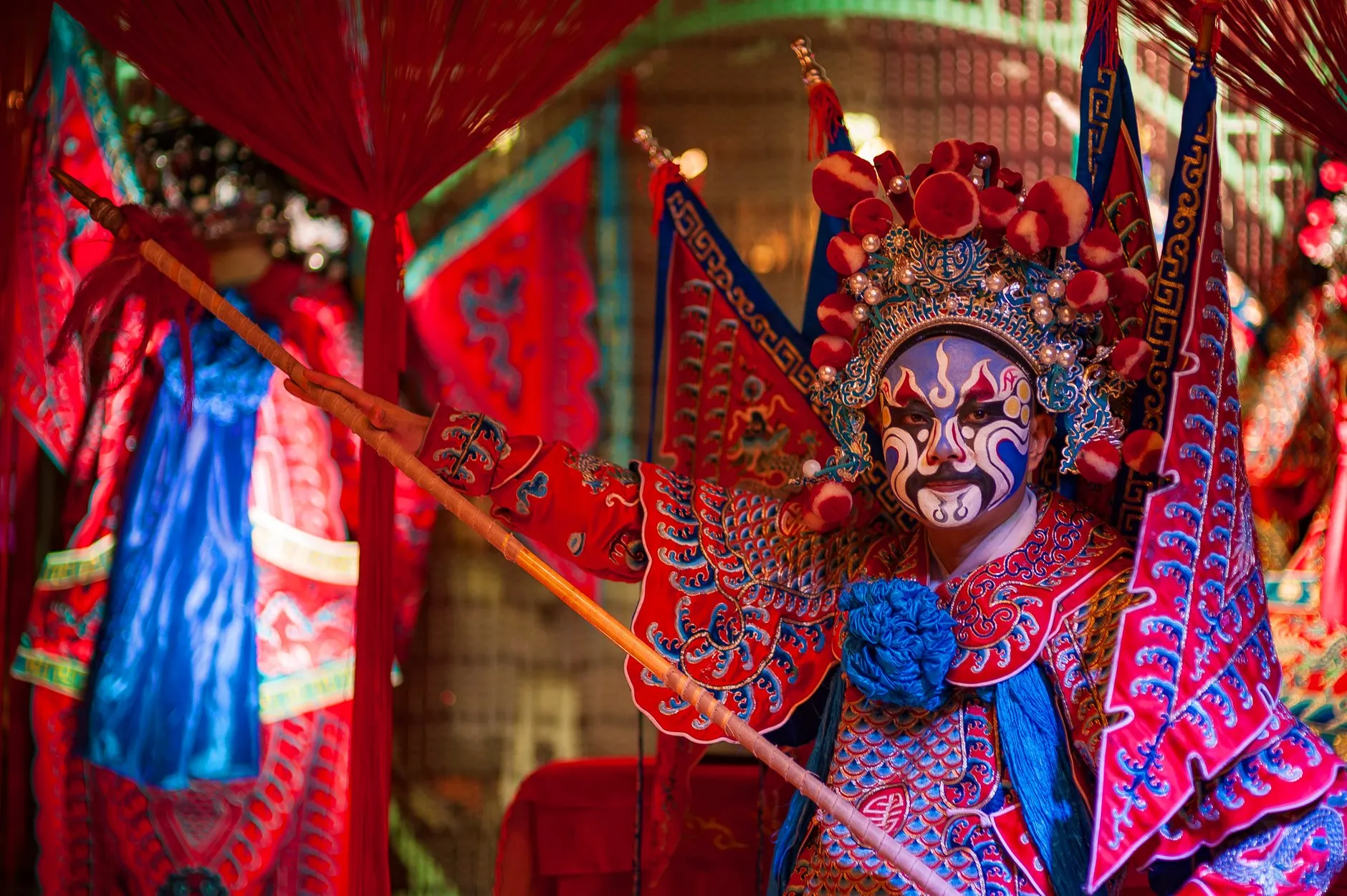 A jing (painted-face) general: a white ground with blue and black linework, an embroidered red robe, and four back-banners (靠旗) fanning up behind the shoulders. The banners are the fastest read in the theatre — they mark a warrior before he sings a note — while the face colours are the folk code the article warns you not to over-read.
Peking Opera: Reading the Face Before the Story
What it is, and what it is not
Peking opera (京剧) is not Chinese opera in general — it is one regional form among hundreds, and the youngest of the major ones, which is why it is sometimes called the “national opera” only by courtesy. Its nearest Western analogy is not opera but a hybrid of opera, ballet and mime: the singing carries the emotion, the movement carries the action, and a great deal is conveyed with almost no scenery.
It is built on four skills — song, speech, movement, and combat (唱念做打) — accompanied by a string-and-wind ensemble (wenchang) and a percussion section (wuchang). The percussionist is effectively the conductor: cymbals and clappers cue entrances, exits, and the internal rhythm of a scene.
The 1790 date, correctly
The standard English line is “the four great Anhui troupes arrived in Beijing in 1790 and Peking opera was born.” Both halves are wrong in detail.
What is documented is that in 1790 the Sanqing company travelled from Yangzhou to Beijing to perform for the Qianlong Emperor’s 80th birthday. The other leading Anhui companies followed over the following decade, and the four-troupe configuration was only complete around 1803. Peking opera itself did not exist yet: it took shape in roughly 1840–1860, when Hubei troupes brought the xipi melodies that fused with Anhui’s erhuang. The 1790 date marks the beginning of a process, not its conclusion.
Two official recognitions followed much later: China’s first national intangible cultural heritage list in 2006 (item No. IV-28), and UNESCO’s Representative List in 2010. Note that IV-28 is the Chinese national list number, not a UNESCO identifier.
The four role types
Every character belongs to one of four role categories, and knowing them is the single most useful thing you can learn before a performance.
| Role | Chinese | What it covers | How to spot it |
|---|---|---|---|
| Sheng | 生 | Male roles: scholar-officials, young scholars, warriors | No heavy face paint; beards denote age and rank |
| Dan | 旦 | Female roles, traditionally played by men | Elaborate headdress, high falsetto singing |
| Jing | 净 | Painted-face roles: generals, officials, bandits, deities | Full-face colour design |
| Chou | 丑 | Comic roles, civilian and martial | Small white patch across the bridge of the nose |
A fifth category, mo, existed in the earliest period and was later absorbed into sheng, which is why you will sometimes read about “five role types” in older sources.
Reading a painted face
Face painting (脸谱) is applied mainly to jing and chou roles, and it is a legible code: the audience knows who is trustworthy and who is not before a word is sung.
The three colours you will definitely see carry stable meanings. Red is loyalty and rectitude — Guan Yu, the deified general, is red. Black is blunt integrity, often with a choleric edge — Bao Zheng the incorruptible judge, and Zhang Fei, both black. White is treachery — Cao Cao is the standard example.
Beyond those three, be careful. Blue, green and purple are variously glossed as fierce resolve, rashness, and steadfastness, but the sources genuinely disagree (one common popular reading gives blue as “sinister”), and there is no national standard. The honest framing, and the one this guide uses, is that these are folk conventions, not a codified system. Stick to red, black and white and you will be right.
Mei Lanfang, and one number to stop repeating
Mei Lanfang (1894–1961) is the reason Peking opera became internationally known. He specialised in dan roles, toured the United States in 1930 with a 72-day run and the Soviet Union in 1935, and invented the practice of adding a second stringed instrument and a follow spot to the traditional staging. He is one of the Four Great Dan of Peking opera — Mei Lanfang, Cheng Yanqiu, Shang Xiaoyun and Xun Huisheng.
He is often described in English as “the 1927 top-ranked of the Four Great Dan.” That is a mistake, and it is widespread enough to be worth correcting. What happened in 1927 was a newspaper poll run by Shuntian Shibao on new plays by five famous performers, one play per performer. Mei’s Tai Zhen Wai Zhuan finished third with 1,774 votes, behind Shang Xiaoyun (6,628) and Cheng Yanqiu (4,785). The “ranked first” claim traces to a different exercise: a 1931 essay competition in the Shanghai journal Xiju Yuekan, where Mei did come top with 565 points. Say “one of the Four Great Dan, generally regarded as the foremost” — that is defensible. Do not attach a 1927 ranking to it.
Kunqu, the ancestor
Kunqu is the oldest of the surviving Chinese operatic forms and the one that taught the others their grammar — hence “the ancestor of a hundred operas.” It developed around Kunshan near Suzhou from the 14th century, was refined by Wei Liangfu into the “water-polished” melodic style, and dominated Chinese theatre for nearly three centuries from the mid-Ming. Its language is literary and its pace is slow; The Peony Pavilion and The Palace of Eternal Life are the canonical works.
Its heritage dates are the most commonly mangled in English. Kunqu was proclaimed a Masterpiece of the Oral and Intangible Heritage of Humanity in 2001 — one of the first 19 proclamations, and the first Chinese element ever to receive UNESCO recognition of this kind. It heads China’s first national list of 2006 (No. IV-1). But it was only incorporated into the Representative List in 2008, when the earlier “Masterpieces” proclamations were folded into the new mechanism. Writing “listed on the Representative List in 2001” collapses two different programmes.
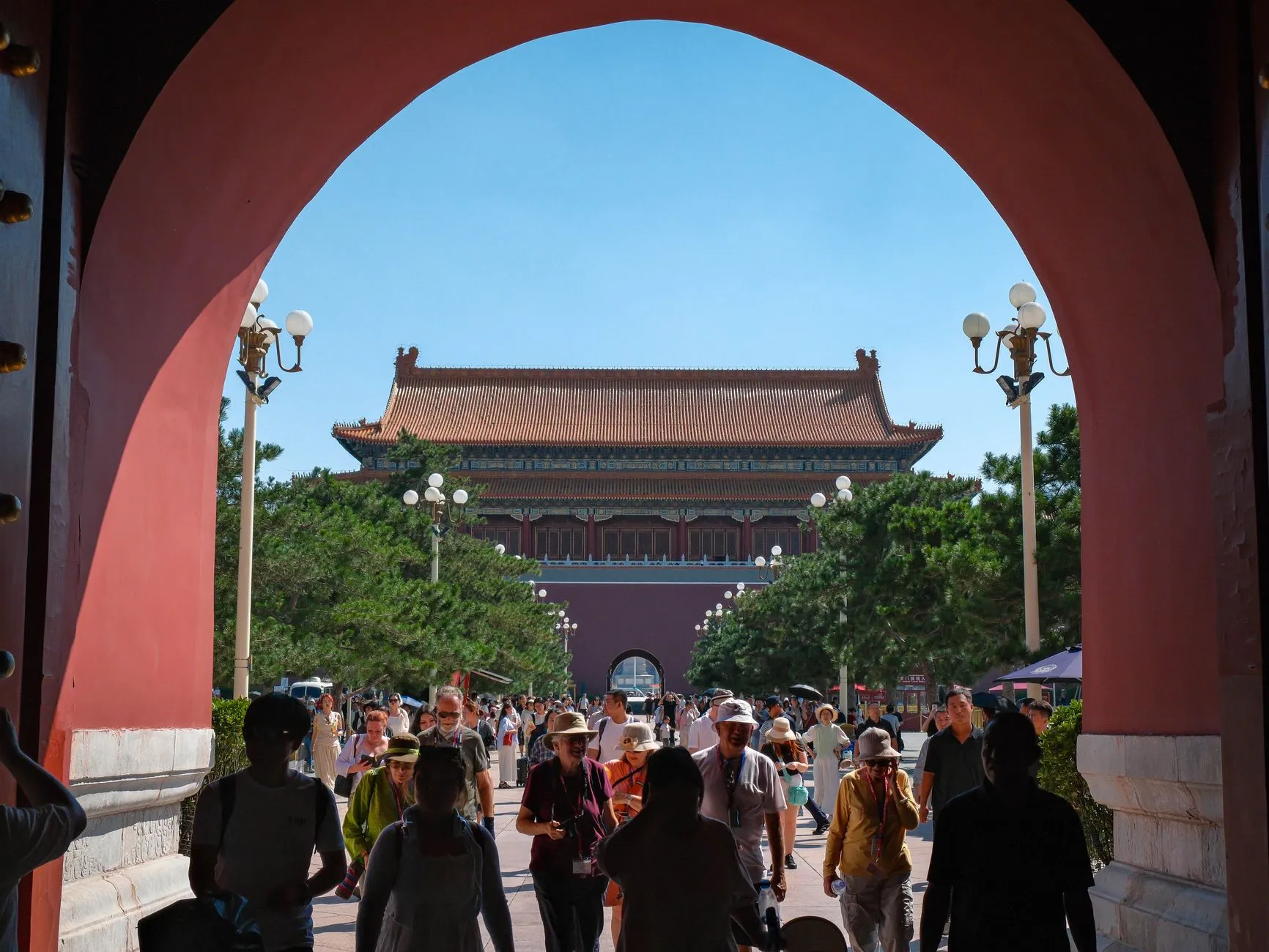 Looking out through one of the Forbidden City’s vaulted red gate passages toward the next gate tower on the central axis. The passage is half the experience: the axis was staged so that each gate and courtyard built anticipation on the way to the throne hall.
Where to See the Real Thing
This is the section most English guides get wrong, usually by describing permanent displays that no longer exist. Chinese museums rotate their painting and calligraphy holdings aggressively, and closures are announced with little notice. Everything below was verified on 26 October 2026.
Peking opera in Beijing
Chang’an Grand Theatre (长安大戏院) is the workhorse. Opened in 1937, relocated to its current site at 7 Jianguomennei Dajie in 1996, roughly 800 seats, about 450 performances a year, with a monthly gathering for amateur singers on the first Sunday. Programming is mostly Peking opera with some Kunqu, pingju and Huangmei opera; four to seven performances a week, doubling up on holidays.
Tickets are dynamically priced — in practice roughly ¥50 to ¥800 depending on the production, with subsidised seats held at ¥50 and ¥100. Buy through Damai, the main Chinese ticketing platform: its real-name booking explicitly accepts passport as an ID type, and the QR code at the door is enough to collect your ticket — you do not need a Chinese ID card. Whether the theatre’s own website accepts a passport for registration is not stated anywhere official, so treat the box office or Damai as your route.
Mei Lanfang Grand Theatre (梅兰芳大剧院) is the National Peking Opera Company’s own house, completed in 2007 at 32 Ping’anli Xidajie — 995 seats in the main hall, 154 in the studio, with a bronze of Mei in the lobby and a small opera museum on the upper floors. It runs a genuinely seasonal programme: “Voice of Spring” around May Day, “Rhyme of Autumn” around National Day, a year-round studio series, and an annual revival season. Tickets run roughly ¥100–¥680 in the main hall and ¥100–¥280 in the studio, again priced by production.
For both: check the schedule the same week you plan to go, not a month ahead.
Calligraphy and painting
The Palace Museum, Beijing. The painting and calligraphy galleries are in the Hall of Literary Glory (Wenhua Dian), and they host rotating exhibitions, not a permanent display. As of late October 2026 the hall was showing the second instalment of a Tang-and-Song calligraphy and painting exhibition, closing 1 November 2026; the next rotation had not been announced. Entry is included in the main ticket — ¥60 high season, ¥40 low season — but you must still reserve through the museum’s mini-program. Passports are explicitly accepted; tickets are released at 20:00 seven days ahead and same-day tickets are not sold.
Shanghai Museum, East Bund branch. This one matters: the Chinese Calligraphy Gallery and Chinese Painting Gallery on the second floor have been closed for re-display since 28 September 2026, with no reopening date announced. The closure is to prepare for a major Bada Shanren exhibition running roughly December 2026 to March 2027, which will occupy both halls. On the same floor, the Hai Shang painting and calligraphy gallery remains open (fourth rotation from 1 October 2026, around 70 works). The East Bund branch is free and needs no reservation — you tap in at B1 with your passport. The People’s Square branch is running a single ticketed exhibition from 9 July 2026 to 14 November 2027 (¥148 / ¥135 / ¥74), and its official notice explicitly says overseas visitors can buy through Trip.com.
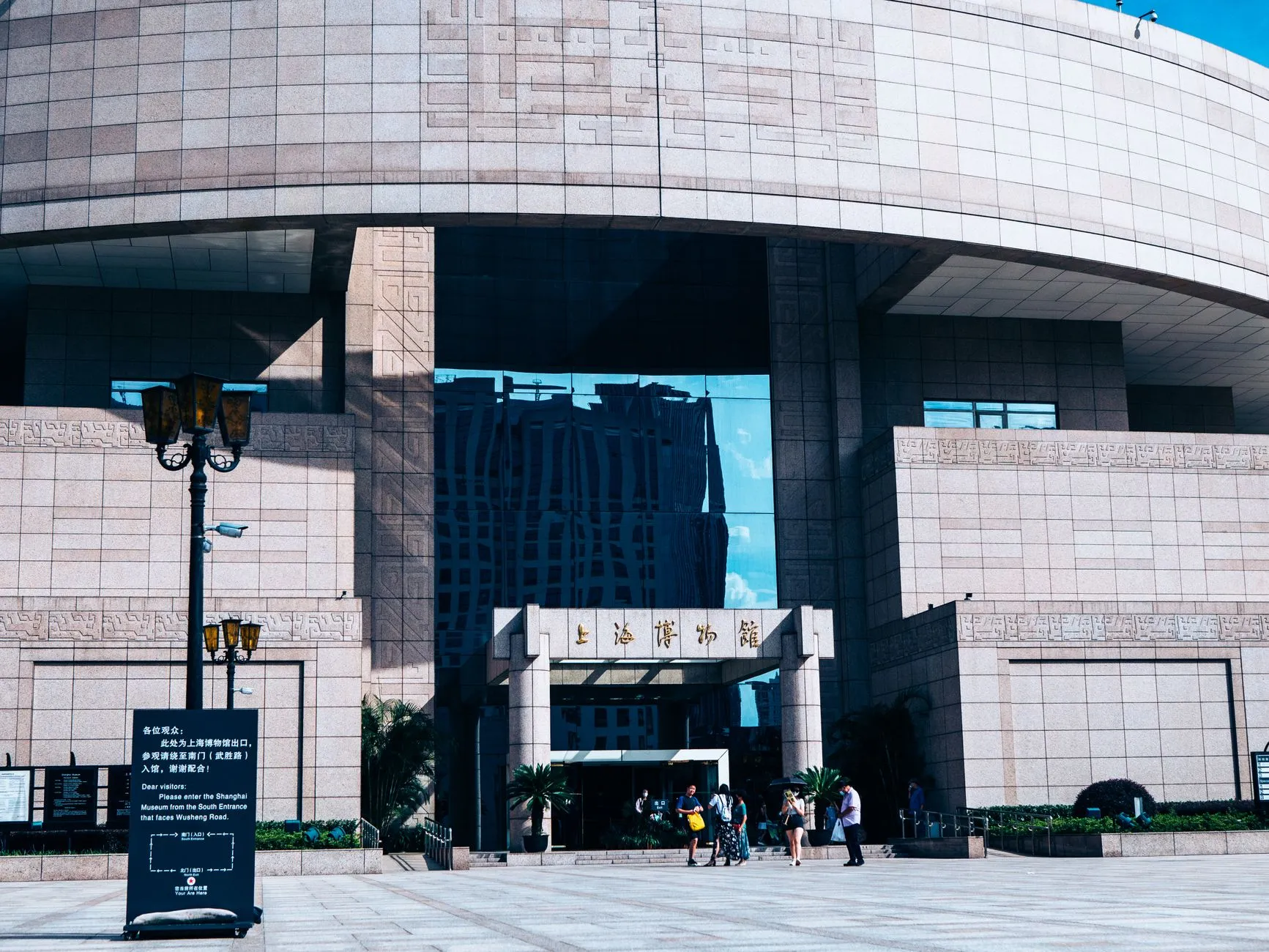 The Shanghai Museum’s People’s Square building, its curved granite facade banded with bronze-motif reliefs and the name set in gold over the door. The black sign at the left is the practical detail — this door is the exit, and visitors enter by the North Gate on Wusheng Road.
The one habit that saves a wasted trip
Chinese museums and theatres publish closures, exhibition changes and booking-rule updates on their official WeChat accounts first. Official websites lag, and often respond to a closure with nothing more useful than “reopening to be announced.”
So before you travel to a venue, check its official WeChat account (公众号). Search the venue’s name inside WeChat to find and follow it. If you do not use WeChat, ask your hotel front desk or your guide to check for you — this is a completely normal request in China, and it takes them two minutes.
One warning: do not trust third-party “exhibition calendar” sites. While verifying this article we found a site publishing a fabricated Palace Museum exhibition with a plausible-sounding title, wrong dates, misrendered names, and no counterpart on the museum’s own site — apparently machine-generated. If a listing is not on the museum’s site or its official account, assume it is wrong.
If you are building a museum-heavy itinerary, the best time to visit China covers crowd patterns by month, and worst time to visit explains which weeks to avoid entirely.
Practical Tips
Book the big museums before you fly. The Palace Museum releases tickets seven days ahead at 20:00 and does not sell on the day. This is not a soft recommendation — in peak season it sells out.
Bring your passport, physically. It is your ticket at most state museums and the accepted ID for theatre bookings. A photograph on your phone will not always work.
Sit close, and to the side, at opera. Subtitles are rare. The percussion is loud. A seat in the first ten rows, slightly off-centre, lets you watch the hands and the footwork, which is where most of the information is.
Go to a highlights programme first. Full-length Peking opera runs two to three hours with a slow middle. The theatres above regularly stage excerpt evenings — four or five famous scenes with the plot explained — which is the right entry point for a first-timer.
Dress for a cold hall. Museum galleries in winter are kept at conservation temperatures, which means cold. The Forbidden City in January is an outdoor walk of several hours.
Learn five characters. 书 (calligraphy), 画 (painting), 戏 (opera), 墨 (ink), 笔 (brush). They appear on every label and ticket machine, and recognising them turns a wall of text into a navigable space. More survival vocabulary is in our language barrier guide.
Pay the way locals do. Museum shops, theatre box offices and tea houses increasingly prefer mobile payment. Setup is covered in how to pay in China and WeChat Pay for foreigners.
Getting around. Both theatres are on the metro — Jianguomen (lines 1 and 2) for Chang’an, Chegongzhuang (line 2) for Mei Lanfang. The metro guide covers ticketing, and Didi is the reliable late-night option after a performance.
Frequently Asked Questions
Can I appreciate calligraphy if I can’t read Chinese? Yes, and more than you would expect. You are reading pressure, speed, spacing and rhythm rather than meaning — the same way you can hear a recital in a language you do not speak. Start with cursive, which is the most expressive and the least legible, then work backwards.
Do I need Chinese to enjoy Peking opera? No, but you need a plot summary. Read the synopsis before the lights go down; the staging is designed to be followed by an audience that already knows the story. Highlights programmes usually print one.
Where can I see genuine ancient Chinese painting? Two reliable answers: the Palace Museum in Beijing, which rotates its holdings through the Hall of Literary Glory, and the Shanghai Museum, whose painting and calligraphy galleries are currently closed for re-display but whose Hai Shang gallery is open. Both are free or cheap, and both require checking the current rotation before you go.
How much does Peking opera cost? Roughly ¥50–¥800 at Chang’an Grand Theatre and ¥100–¥680 at Mei Lanfang Grand Theatre, depending on the production and seat. Both hold cheap seats; both price by show rather than by fixed tariff.
Is Kunqu different from Peking opera? Substantially. Kunqu is older, slower, more literary, and sung to a different melodic system; Peking opera is faster, more acrobatic, and was shaped for a popular Beijing audience. If you have one evening, Peking opera is the easier introduction.
What is the single biggest mistake visitors make with Chinese art? Treating a museum visit as a checklist. A single Song landscape, looked at properly for twenty minutes, teaches you more than forty scrolls walked past. Pick two or three objects per gallery and stay with them.
Keep Exploring
Chinese art does not sit in a separate box from the rest of the culture — it is woven into the calendar, the buildings and the table.
- The frame around the art: Chinese architecture and gardens explains the timber frame, the roof tiers and the garden as a miniature world. To place any of it in time, see the Chinese dynasties timeline. Religions and festivals covers the Buddhist and Daoist imagery you will be looking at.
- The manners that go with it: Chinese culture and etiquette covers the small behaviours that make museum and theatre visits go smoothly — queueing, pointing, photography rules, and the etiquette of religious sites.
- The places: the Forbidden City for the palace the painting galleries sit inside, Suzhou for the gardens that shaped landscape painting, the Terracotta Warriors for Qin material culture, and Mount Emei and Leshan for Buddhist art at scale.
- The seasons: spring, summer, autumn and winter — museum-heavy trips work best in the shoulder months.
- Before you go: China’s entry requirements and the visa-free country list for the paperwork; what to pack and travel safety for everything else.
- Getting there: high-speed rail, buying train tickets, and airport-to-city transfers.
If you only do one thing: book a highlights evening at one of the two Beijing theatres, read the synopsis on the way, and sit close enough to see the hands. Everything else in this guide will make sense afterwards.