China's Religions & Festivals Guide: Confucianism, Buddhism, Taoism & the Calendar Explained for Visitors
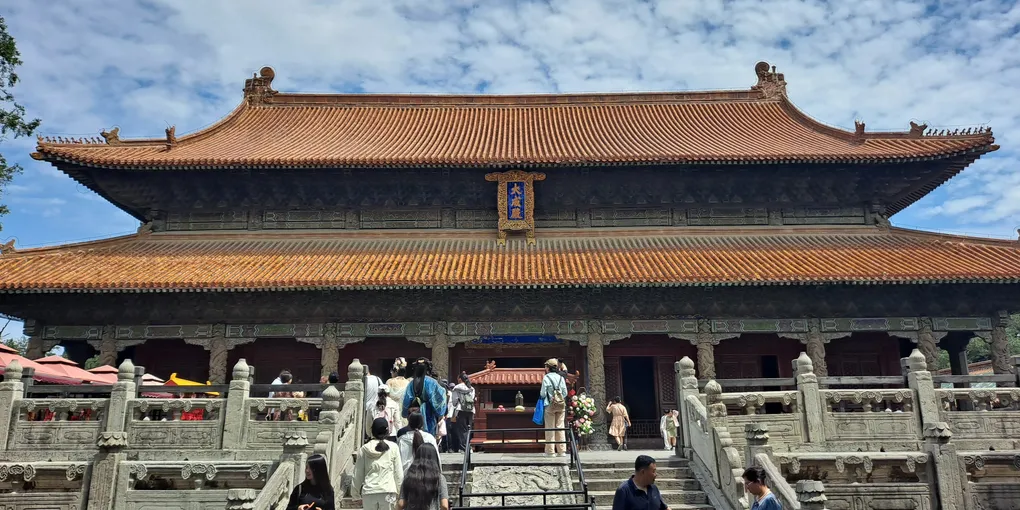
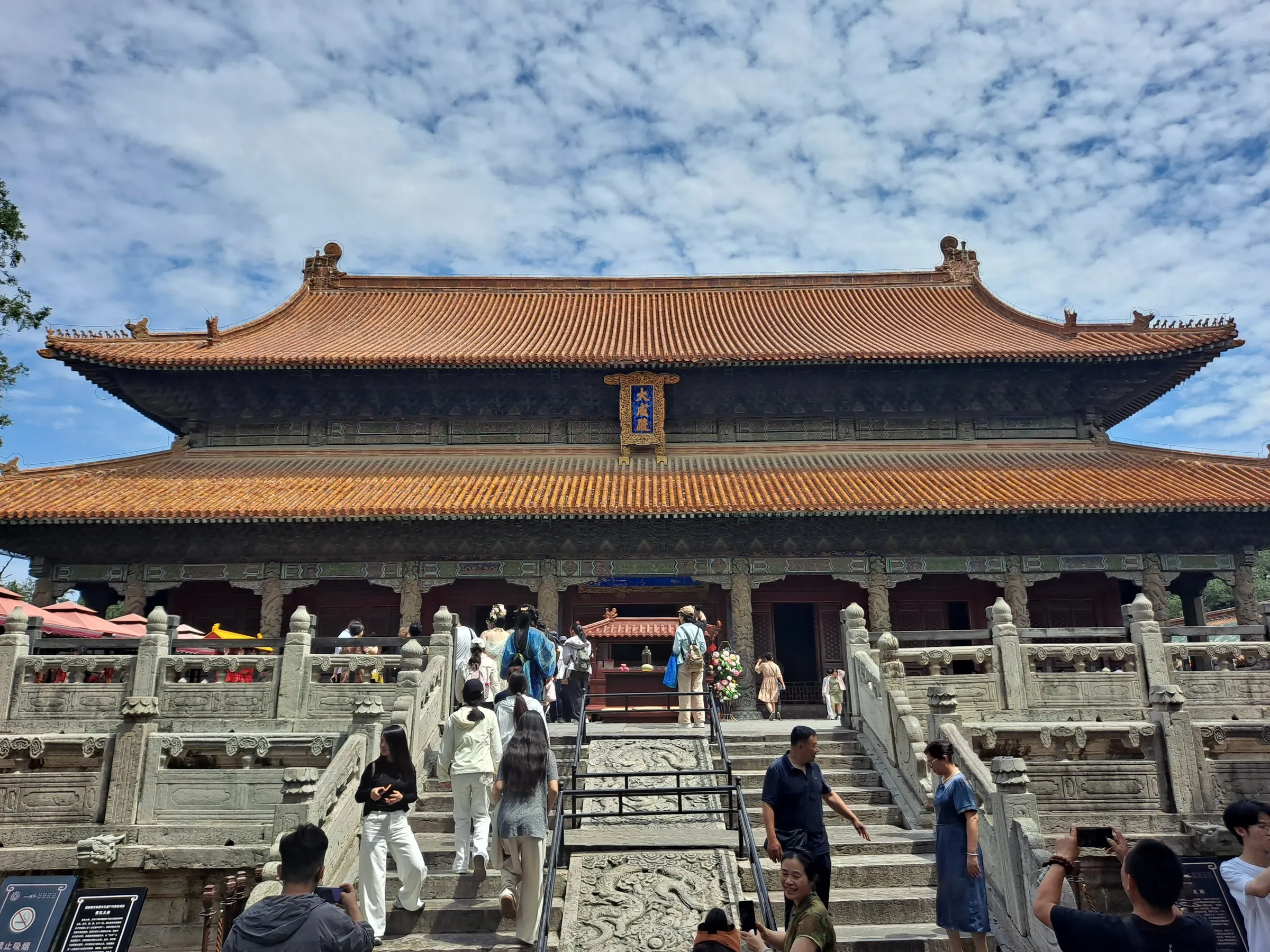 The Dacheng Hall in the Temple of Confucius at Qufu, Shandong: double eaves under yellow glazed tiles, a blue-and-gold plaque, and a white marble terrace with a dragon carved down the central ramp. Yellow tile and a double roof are rank signals — this is the most important of the hundreds of Confucian temples, and it is built to say so.
Chinese religion and Chinese festivals can be hard to read from the outside. You have heard of Confucius, of Chinese New Year and the Temple of Heaven, but how they fit together, and what they mean on the ground, is rarely obvious.
Confucianism, Buddhism, and Taoism overlap far more than Western religion does and sit alongside a deep folk tradition. The festival calendar, from Spring Festival to the Double Ninth, dictates when the whole country moves, works, and travels.
Quick answer: Most Chinese people do not belong to a single religion. Confucianism, Buddhism, and Taoism have coexisted and blended for centuries, alongside a deep folk tradition of ancestor worship and local gods. Confucius (551–479 BC) shaped the ideas about family, education, and “face” that still guide everyday Chinese life. For festivals, the two big ones are Spring Festival (Chinese New Year, on 17 Feb 2026 / 6 Feb 2027) and National Day (1 Oct) — both trigger the country’s busiest travel season, so book far ahead. When visiting a temple: dress modestly, be quiet, and walk clockwise around pagodas and stupas.
How we verified this: SinoWander works from original Chinese-language sources that English guides cannot reach — the Baidu Baike entries on Confucianism, Buddhism, Taoism, and every major festival — plus Chinese Wikipedia and the official Palace Museum website. Key facts were cross-checked against at least two independent sources, and festival dates were computed independently from the lunar calendar (anchored to the known 2026 and 2027 Chinese New Year dates). Last verified: 22 October 2026. See our methodology.
Why Start with Confucianism?
China’s most important “religion” is not really a religion. Confucianism is better described as a system of ethics, family values, and social rules. It has no god, no church, and no holy book the way Buddhism or Christianity do, yet it shaped Chinese life more than any belief system.
If you understand three Confucian ideas, half of China’s “unwritten rules” start to make sense:
- Family and elders come first. Respect for parents (filial piety), for age, and for hierarchy sits at the heart of Chinese society. This is why you defer to elders and hosts, and why “face” matters so much.
- Education and self-improvement are sacred. Confucius prized learning. The famous Chinese focus on exams and schooling flows directly from him.
- Harmony over conflict. Keeping the peace, saving face, and avoiding public embarrassment are valued above “winning” an argument.
Hold those three and China’s “unwritten rules” start to read as a system. The host who insists you eat first is deferring to hierarchy and filial order; the colleague who never gives a straight “no” is saving face for both of you. The same logic runs through the temple etiquette and the festival customs.
Confucianism, Explained for a Foreigner
Who Was Confucius?
Confucius (known in Chinese as Kǒngzǐ, 孔子) was a teacher and philosopher who lived from 551 to 479 BC, roughly the same era as the Buddha and the Greek philosophers. He was born into a poor but noble family in what is now Shandong province. After an unsuccessful career as an official, he spent his later years teaching and collected the thoughts that became the Analects (Lúnyǔ, 论语), a book of his sayings.
He was not trying to start a religion. He wanted to fix a chaotic society by restoring good order, good government, and good personal conduct. His core idea was that if each person behaves well in their role (ruler, parent, child, friend), society works. That idea became the foundation of Chinese civilization for over two thousand years.
The Core Ideas: Ren, Li, and the Five Virtues
Two Chinese words anchor everything Confucius taught:
- Rén (仁) — often translated “benevolence” or “humaneness.” It is the quality of treating other people with real care and kindness. Confucius described it as “loving people.”
- Lǐ (礼) — “ritual,” “propriety,” or simply “good manners.” This is not just ceremony; it is the set of social rules that let people interact smoothly and respectfully.
Confucius also taught the Five Constant Virtues (wǔcháng, 五常), which he saw as the five root qualities of a good person:
- Rén (仁) — benevolence, caring for others
- Yì (义) — righteousness, doing what is right
- Lǐ (礼) — ritual, good manners
- Zhì (智) — wisdom, sound judgment
- Xìn (信) — trustworthiness, keeping your word
There is also the ideal of the jūnzǐ (君子), the “gentleman” or “person of virtue,” roughly a person who is morally upright, well-educated, and considerate. If you want a one-word Western analogy, think of the ideal of the “gentleman-scholar” or “person of good character” that every society respects.
Filial Piety: Why Family Comes First
Filial piety (xiào, 孝), respect for and care of one’s parents and elders, is perhaps the single most important Confucian value. Confucius taught that honoring your parents is the root of all good character. The classic text on this, the Classic of Filial Piety (Xiàojīng, 孝经), is the shortest of the Confucian classics and was promoted by emperors for centuries.
Filial piety is why, even today:
- Older people are treated with visible respect in China.
- Young adults commonly help support and care for their aging parents.
- Family gatherings, especially at festivals, are central to life.
You do not need the full philosophy to practice the visible part: be polite and deferential to older people, let them go first, and don’t argue with them in public. It will make Chinese hosts warm to you faster than any memorized rule.
The Imperial Exam: How Confucius Built China’s Education Culture
One of Confucianism’s biggest and most surprising legacies is the imperial examination (kējǔ, 科举), a system, begun around the Sui dynasty (roughly the 7th century), that chose government officials by written exam rather than by birth. For about 1,200 years, any man, regardless of family background, could rise to high office by studying the Confucian classics and passing the tests.
This was revolutionary for its time, and it is the deep reason why Chinese culture so prizes education and test scores to this day. The phrase “study hard and you will become an official” captures it: in China, academic success has always been seen as the path to success in life.
Ancestral Halls: Where You’ll Actually See It
If you travel in southern China (Guangdong, Fujian, Anhui, Zhejiang, and Jiangxi provinces), you will spot ancestral halls (cítáng, 祠堂): traditional buildings where families honor their ancestors and hold ceremonies. These are especially common in the south, where lineage tradition is strongest. Many were destroyed during the 20th century’s political upheavals, but since the 1980s they have been rebuilt and revived. They are a living, visible piece of the Confucian idea that family and ancestors matter.
Confucianism Beyond China: East Asia’s Shared Foundation
Confucianism did not stay in China. It spread across East Asia and shaped the whole region. Scholars speak of the Sinosphere or “East Asian cultural sphere,” countries including China, Japan, Korea, and Vietnam that were historically shaped by Chinese writing, Buddhism, and Confucian values.
Three concrete examples you can use to picture it:
- The exam system spread. Japan, Korea, and Vietnam all adapted China’s civil-service exam. Korea ran its version for about 900 years; Vietnam kept one until 1919, the last imperial exam system in the world to be abolished.
- Confucian family ethics spread. Ideas about respect for elders, filial piety, and family harmony still shape family values in Japan, Korea, and Vietnam today, even though those countries no longer use Chinese characters in daily life.
- So did ancestor respect. The emphasis on honoring family and ancestors is common across East Asia.
If you have visited Japan or Korea, much of the “respect for elders, politeness, and group harmony” you noticed there has Confucian roots. China is where that tradition began.
Confucianism Today: Still Everywhere, Quietly
Nobody in China announces “I follow Confucianism” the way someone might say “I am Christian.” But Confucian values are baked into daily life:
- Family ties remain extremely strong.
- Education is treated as the top priority for children.
- Social harmony and “saving face” (see our etiquette guide) still govern how people interact.
Confucius is also still honored in physical form: the Confucius Temple (Kǒngmiào, 孔庙) in his hometown of Qufu, Shandong, known as the Temple of Confucius and a UNESCO World Heritage site, is the most important of hundreds of Confucian temples across China. For one place that captures Confucianism in stone, start there.
The Religious Landscape: Three Traditions, No Clear Lines
China’s religion is not neatly organized the way Western religion is.
For centuries, Confucianism, Buddhism, and Taoism have coexisted in China, blending and borrowing from one another with no strict boundary between them. On top of all three sits a vast layer of folk religion: ancestor worship, local gods and goddesses, and practices like consulting fortune or honoring a village deity. A single Chinese family might have an altar to ancestors (folk tradition), visit a Buddhist temple to pray, and consult Taoist ideas about balance, all without feeling any contradiction.
Three quick facts:
- China has no state religion. The constitution protects freedom of religious belief.
- Five religions are officially recognized: Buddhism, Taoism, Islam, Protestant Christianity, and Catholicism.
- Statistics are fuzzy. China’s government does not publish exact counts of believers, and surveys vary widely, partly because many Chinese blend several traditions and do not see themselves as “members” of one religion. The rough picture is that folk religious practice is widespread (most Chinese honor ancestors or local gods in some way), Buddhism and Taoism have the largest recognized followings, and Muslims and Christians are smaller but significant minorities.
So when you see someone lighting incense at a temple, you do not need to label them Buddhist or Taoist. They are simply taking part in China’s broad, flexible religious culture, and you are welcome to do the same.
Buddhism in China
A Religion That Traveled to China
Buddhism began in India and reached China along the Silk Road during the Han dynasty (roughly the 1st century AD), with the earliest written records dating to about 65 AD. A famous but legendary story credits the Han emperor with bringing Buddhism to the capital around 68 AD and building the White Horse Temple, often called China’s first Buddhist temple. Historians treat that founding tale as legend, but the temple itself is real and still stands in Luoyang.
Over the centuries, Buddhism blended deeply with Chinese culture to form Chinese Buddhism (hànchuán fójiào, 汉传佛教). Today China has one of the world’s largest Buddhist communities, with countless temples and monasteries.
Key ideas you may encounter at any temple:
- Karma and rebirth — the idea that your actions shape your future, including future lives.
- Bodhisattvas — enlightened beings who delay their own final escape to help others. The most famous is Guanyin (观音), the goddess of compassion, whom you will see in nearly every Chinese Buddhist temple.
Tibetan Buddhism: A Distinct Tradition
In the far west and on the Tibetan Plateau, you will meet Tibetan Buddhism (zàngchuán fójiào, 藏传佛教), the form of Buddhism practiced in Tibet, Qinghai, Sichuan, Yunnan, and Gansu, and in some areas of Inner Mongolia. It grew out of the same roots as Chinese Buddhism but developed its own rituals, texts, and institutions, including the famous tradition of recognized spiritual leaders (lamas) and the turning of prayer wheels.
Landmarks to know: the Potala Palace and Jokhang Temple in Lhasa, Tibet; the Kumbum Monastery in Qinghai; and the Labrang Monastery in Gansu. These are among Tibet’s most important religious and pilgrimage sites.
The Four Sacred Buddhist Mountains
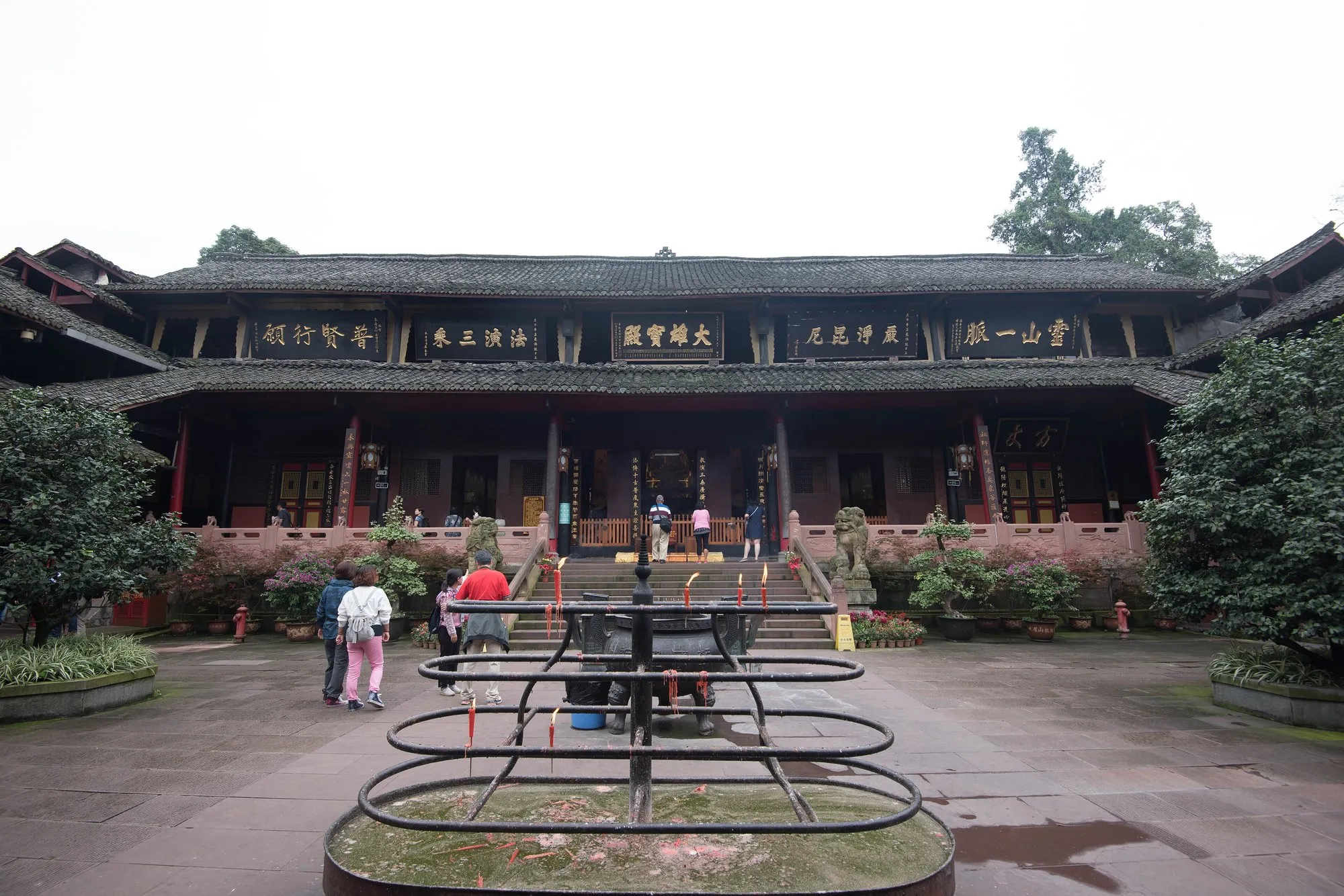 The courtyard of Baoguo Temple on Mount Emei, with a censer standing on the axis before the main hall and a row of plaques under its eave. The hall behind is plain timberwork — grey tiles, dark columns, deep eaves — the grammar you will see repeated all the way up the mountain.
If you want to experience Chinese Buddhism properly, the classic destinations are the Four Sacred Mountains of Buddhism, each linked to a bodhisattva:
- Wutai (山西 Shanxi) — sacred to the bodhisattva of wisdom (Manjushri)
- Emei (四川 Sichuan) — sacred to the bodhisattva of great practice (Samantabhadra), and the one with a genuine multi-day ascent; our Emeishan and Leshan guide covers tickets, the summit cable car and the climb
- Jiuhua (安徽 Anhui) — sacred to the bodhisattva of great vows (Kshitigarbha)
- Putuo (浙江 Zhejiang) — an island sacred to Guanyin, the goddess of compassion
The temple halls you will see on these mountains follow the same grammar as China’s palaces: courtyard on courtyard on a central axis, sweeping tiered roofs and carved wooden brackets under the eaves. If you want to learn to read those buildings, our guide to Chinese architecture and gardens walks you through the dougong brackets, roof tiers and timber frames that make a temple (and every Chinese building) work.
These are both holy sites and beautiful mountain scenery, excellent places to combine pilgrimage, hiking, and history.
How to Behave in a Buddhist Temple
Temple etiquette is simpler than most people fear. The basics:
- Dress modestly — cover your shoulders and knees.
- Be quiet. Temples are working places of worship, not just museums.
- Walk clockwise around pagodas, stupas, and Buddhist halls. Clockwise symbolizes harmony with the cosmic order. (In Tibetan temples, prayer wheels and walking circuits also turn clockwise.)
- Photography: rules vary from temple to temple. Many temples ask you not to photograph Buddha statues; look for signs or ask before you shoot.
- As a courtesy, ask before photographing monks, and avoid touching them.
A common “rule” you may hear, that you should never step on the door threshold, is a piece of folk custom rather than a firm rule, so don’t worry about it too much; simply don’t block doorways.
Taoism (Daoism): China’s Homegrown Religion
If Buddhism came to China from outside, Taoism (dàojiào, 道教) is the religion born in China. And it has two sides that people often confuse:
- Taoism as philosophy grows from the Tao Te Ching (Dàodéjīng, 道德经), traditionally attributed to the sage Laozi (老子). Its famous ideas are the Tao (“the Way”), Yin and Yang (the balance of opposites), and wu wei (无为), acting without force, going with the flow.
- Taoism as a religion (with temples, priests, and gods) was formally founded in the 2nd century AD by Zhang Daoling (张道陵, 34–156 AD), who established the “Celestial Masters” movement. Taoists honor a deified Laozi as a god and seek longevity and harmony with nature.
For a traveler, the visible face of Taoism is:
- Yin-yang symbols (the familiar black-and-white circle) on many buildings and objects, a symbol of balance that originated in Taoist thought.
- Taoist temples (dàoguàn, 道观), which differ from Buddhist temples in their gods and their often more nature-focused atmosphere.
- Tai Chi and qigong practitioners moving slowly in parks at dawn, Taoist-influenced health practices you will see every morning across China.
The Four Sacred Taoist Mountains
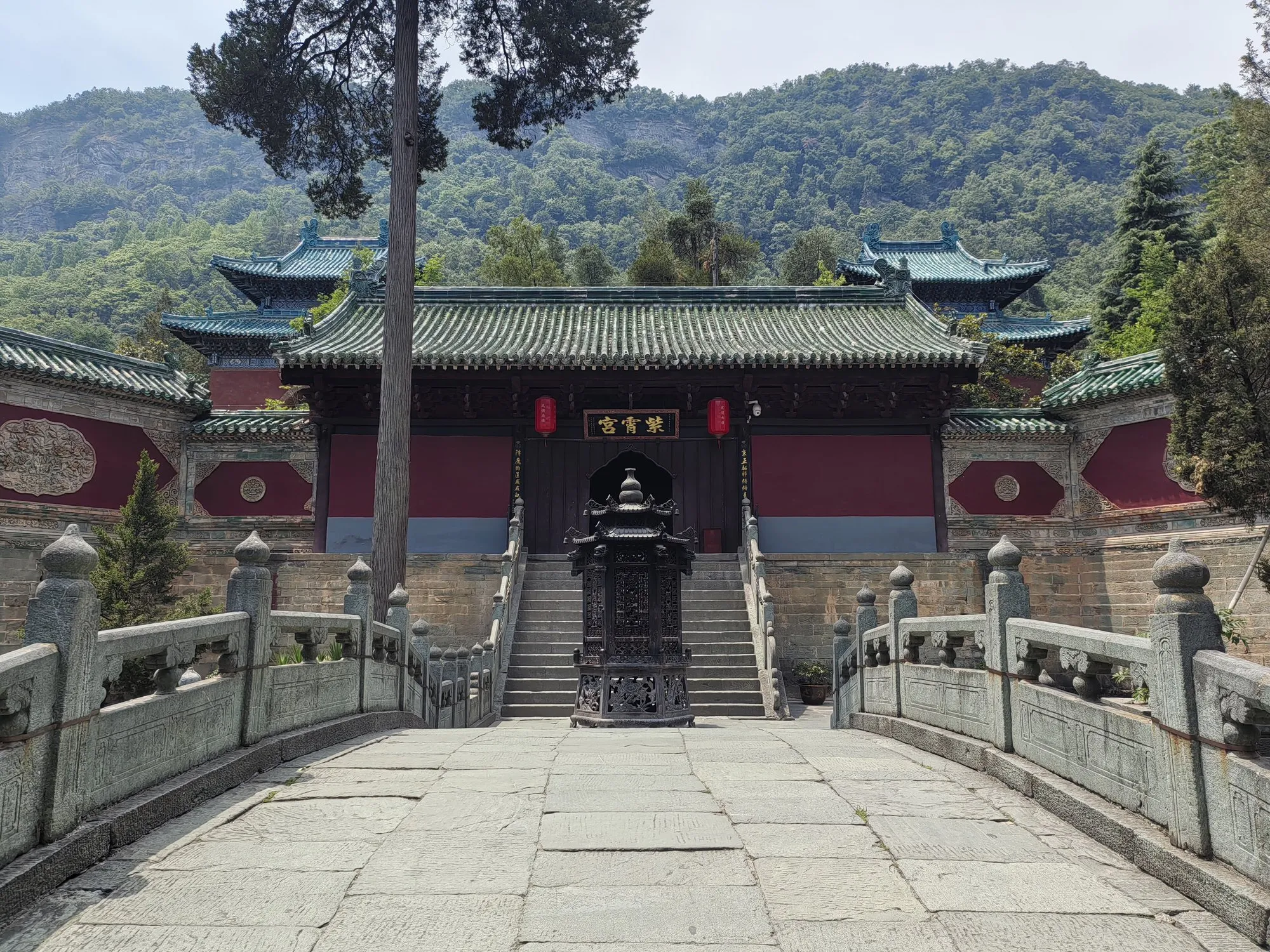 The gate of Zixiao (Purple Cloud) Palace on Wudang Mountain, under green glazed tiles and a blue-and-gold plaque, with a bronze censer on the paved terrace in front. Green tile rather than imperial yellow marks a religious foundation rather than a palace — one of the quickest reads on any Chinese roofline.
The Four Sacred Mountains of Taoism are:
- Wudang (湖北 Hubei) — the most famous, closely tied to martial arts (the “Wudang school” of kung fu)
- Qingcheng (四川 Sichuan)
- Longhu (“Dragon Tiger,” 江西 Jiangxi)
- Qiyun (安徽 Anhui)
Other Taoist sites, such as Laoshan in Shandong and Maoshan in Jiangsu, are also revered, but these four are the classic “Big Four.” Wudang is the standout for most travelers, offering ancient architecture, mountain scenery, and a connection to Chinese martial-arts culture.
Islam and Christianity in China
China has been more religiously diverse than many outsiders realize, and two more traditions complete the picture.
Islam
Islam arrived in China by the 7th century along the Silk Road. Today, China’s 2020 census counted roughly 25 million Muslims, under 2 percent of the population. Ten officially recognized ethnic groups are predominantly Muslim, most notably the Hui (Chinese-speaking Muslims scattered across China) and the Uyghur (mostly in the far-western Xinjiang region). Most Muslims live in the northwest (Xinjiang, Ningxia, Gansu, and Qinghai) as well as Yunnan.
Two mosques worth seeking out as a traveler:
- Xi’an’s Great Mosque — one of China’s oldest mosques, founded in the Tang dynasty (7th century) and rebuilt in the Ming dynasty. It is famous for blending Islamic design with traditional Chinese courtyard architecture, a peaceful, photogenic spot open to visitors. (Note: the exact rebuilding date is disputed, so don’t quote one.)
- Qingjing Mosque in Quanzhou — dating to around the 11th century, one of China’s oldest Arabic-style mosques, and part of the city’s UNESCO World Heritage site.
Christianity
Christianity has been present in China for centuries and has a visible community today. China’s official 2018 figures put Protestant Christians at roughly 38 million and Catholics at about 6 million, around 3 percent of the population. Independent estimates vary, and some are higher.
You will see church buildings in many cities, such as the historic cathedrals in Shanghai and Beijing. Christianity exists alongside Buddhism, Taoism, Islam, and folk tradition in China’s broad religious mix.
The Festival Calendar: The Best Year to Visit
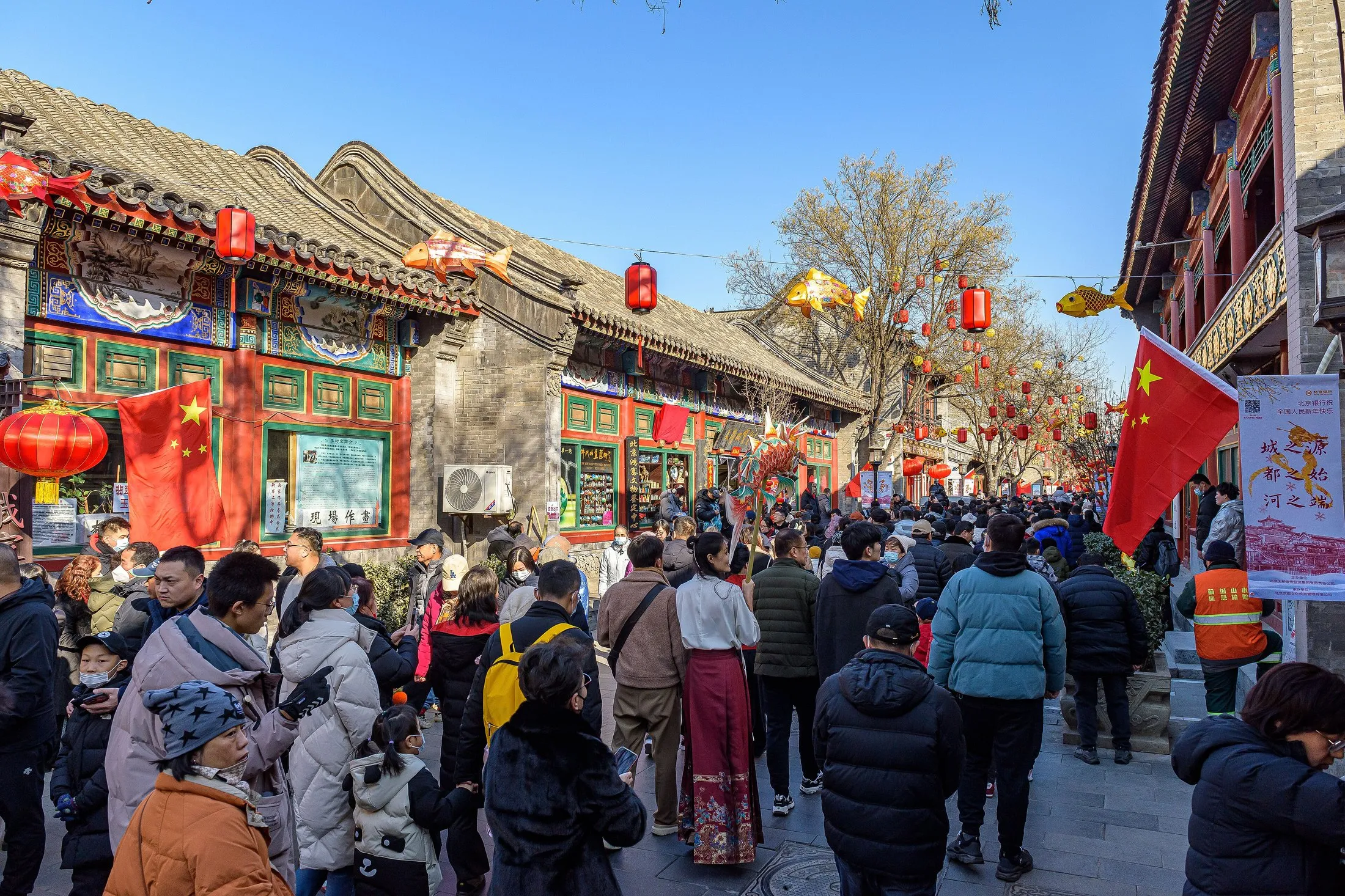 Liulichang East Street during the Changdian temple fair: strings of red lanterns overhead, shopfronts in old-style paintwork, and crowds in padded winter coats. The fair fills the streets of the old antiques quarter through the first half of the first lunar month.
China’s traditional festivals follow the lunar calendar, so their dates change every year on the Western (solar) calendar. The ones worth knowing are below, with what each means and the exact 2026 and 2027 dates, computed independently from the lunar calendar.
The Big Ones
Spring Festival / Chinese New Year (chūnjié, 春节) — the biggest holiday of the year, roughly the equivalent of Christmas, New Year, and a family reunion rolled into one. Families travel home, eat a huge reunion dinner, give red envelopes (hóngbāo, 红包) of money (often digitally via WeChat), set off fireworks, and visit relatives. In 2024 it was added to UNESCO’s list of the world’s intangible cultural heritage.
National Day (guóqìngjié, 国庆节) — 1 October, marking the founding of the People’s Republic in 1949. Together with Spring Festival, it creates one of China’s two “golden week” long holidays.
The Traditional Festivals
Lantern Festival (yuánxiāojié, 元宵节) — the last day of the New Year celebrations and the first full moon of the year. People light lanterns, solve lantern riddles, and eat sweet rice dumplings (tāngyuán, 汤圆) symbolizing family unity. Not a public holiday.
Qingming / Tomb-Sweeping Festival (qīngmíngjié, 清明节) — around 4–5 April. Families visit and clean the graves of their ancestors, and the weather makes it a popular time for a spring outing. A 3-day public holiday.
Dragon Boat Festival (duānwǔjié, 端午节) — the 5th day of the 5th lunar month. People race dragon boats and eat sticky-rice dumplings wrapped in bamboo leaves (zòngzi, 粽子). It was the first Chinese festival recognized by UNESCO. A 3-day public holiday.
Mid-Autumn / Moon Festival (zhōngqiūjié, 中秋节) — the 15th day of the 8th lunar month, on the full moon. Families gather, admire the full moon, and eat mooncakes (yuèbǐng, 月饼). It is linked to the legend of the moon goddess Chang’e. A 3-day public holiday.
Chongyang / Double Ninth Festival (chóngyángjié, 重阳节) — the 9th day of the 9th lunar month. Traditionally a day to climb high and view chrysanthemums, it is now also celebrated as a seniors’ day honoring the elderly. Not a public holiday.
Festival Dates and Public Holidays: 2026 and 2027
The exact Western-calendar dates for the main festivals, computed from the lunar calendar and anchored to the known Chinese New Year dates, are below.
| Festival | 2026 | 2027 | Public holiday? |
|---|---|---|---|
| Spring Festival (Chinese New Year) | 17 Feb | 6 Feb | ✅ Yes — the longest holiday of the year |
| Lantern Festival | 3 Mar | 20 Feb | ❌ No |
| Qingming | ~5 Apr | ~5 Apr | ✅ Yes (3 days) |
| Dragon Boat Festival | 19 Jun | 9 Jun | ✅ Yes (3 days) |
| Mid-Autumn Festival | 25 Sep | 15 Sep | ✅ Yes (3 days) |
| Chongyang | 18 Oct | 8 Oct | ❌ No |
A few practical notes:
- Spring Festival 2026 falls on 17 February (Chinese New Year’s Day), with the official holiday running 15–23 February, a nine-day break (one of the longest on record), as authorities extended it by arranging a couple of weekend workdays. In 2027 it falls on 6 February.
- Qingming 2026 is about 5 April (a Sunday holiday weekend). The festival always falls in early April.
- The exact number of days off for each “3-day” holiday is confirmed by China’s official holiday schedule each year; the dates above tell you when the festival itself falls.
How Festivals Change Your Trip (The Practical Part)
Festivals are wonderful to experience, and they change how you travel. The key fact:
Spring Festival and the National Day golden week are China’s busiest travel periods. Around Chinese New Year, the country runs Chunyun (春运), the world’s largest annual human migration, with hundreds of millions of trips in just a few weeks (the 2026 season was predicted to see over 500 million passenger trips in 40 days). Trains, flights, and top attractions are packed, and prices surge.
The practical rules:
- Book everything far in advance if you travel during Spring Festival or the October golden week. This includes trains, flights, hotels, and popular attraction tickets.
- Or travel off-peak. The days around these two holidays are crowded; the rest of the year is calmer.
- Spring Festival is family time. Many small businesses and some restaurants close for the holiday, so expect a quieter service scene in the days around it. At the same time, it is the best time to see real Chinese New Year customs, lantern displays, and family atmosphere.
- The short 3-day holidays (Qingming, Dragon Boat, Mid-Autumn) draw big regional crowds but are not as overwhelming as the golden weeks.
Take the Forbidden City. The Palace Museum in Beijing is open Tuesday to Sunday and closed on Mondays (except on national holidays, and it closes on New Year’s Eve). In peak season it runs 8:30–17:00. Crucially, it does not sell tickets on the day; you must book online in advance, with a daily visitor cap of 40,000. The same principle applies to China’s most famous sights around festival periods: check the official website and book ahead.
A Quick Traveler’s Cheat Sheet
Before you go
- Check the official holiday schedule for the year you travel. If you want quieter crowds, avoid the Spring Festival and early-October golden weeks.
- For top sights like the Forbidden City, book tickets online in advance (many do not sell on the day).
At a temple or shrine
- Dress modestly, be quiet, and be respectful of people praying.
- Walk clockwise around pagodas, stupas, and Buddhist halls.
- Ask before photographing Buddha statues or monks.
- Removing your shoes is sometimes expected at inner shrines; watch what others do.
With people
- Be polite and deferential to elders; let them go first.
- If you’re invited to a family meal during a festival, that is a high honor; accept it.
- A red envelope or small gift is a warm gesture during New Year; see our etiquette guide for the full rules.
To truly see it
- Confucianism: the Temple of Confucius in Qufu, and the ancestral halls of southern China.
- Buddhism: the Four Sacred Mountains, or any city temple; try the White Horse Temple in Luoyang.
- Taoism: Wudang Mountain, or watch tai chi in a park at dawn.
- Islam & Christianity: Xi’an’s Great Mosque, and the historic cathedrals of Shanghai and Beijing.
You will meet these religions in daily life rather than in any single checklist. The three big ideas (Confucian family values, Buddhist temples, Taoist balance) will cover most of what you see; knowing when the big festivals fall helps you book the trip around crowds. The visual side of these traditions — temple statuary, scroll painting, and the opera stages where festival stories are still performed — is covered in our guide to Chinese art. If you want to know when each of those traditions was built, the Chinese dynasties timeline dates every temple, pagoda and grotto you’ll visit. Before you buy anything, check the holiday schedule for your travel year: if Spring Festival or early October sits in your window, move the dates or book now. Plan your trip.
Image credits: all four photographs are from Wikimedia Commons. The Dacheng Hall photograph is released under CC0 (no attribution required). Baoguo Temple by Siyuwj (CC BY-SA 4.0); the gate of Zixiao Palace by Yumeto (CC BY-SA 4.0); Liulichang during the Changdian fair by N509FZ (CC BY-SA 4.0). All images resized for this page.