Chinese Dynasties: A Traveller's Timeline — How to Date What You're Looking At
You are standing in front of a temple hall. The sign says it was built in 857. Three streets away is another hall that looks much the same, built in 1749. A third building, a pagoda, has a sign claiming the Tang dynasty — but the tower you see was rebuilt four hundred years later.
Chinese architecture is unusually hard to date by eye, because the tradition is remarkably conservative: the same post-and-beam frame, the same tiled roof, the same bracket sets have been in continuous use for well over a thousand years. A Song hall and a Qing hall are not different in kind. They are different in proportion.
This guide gives you the timeline, then teaches you the four things you can actually see — roof, bracket, pagoda, statue — and finally tells you where to go to see each dynasty at its best. It also corrects ten things that English-language guides repeat and that are simply wrong.
If you want the broader cultural frame first, our guides to Chinese architecture and gardens, Chinese art, religions and festivals and culture and etiquette cover the horizontal categories. This article is the vertical axis those four sit on.
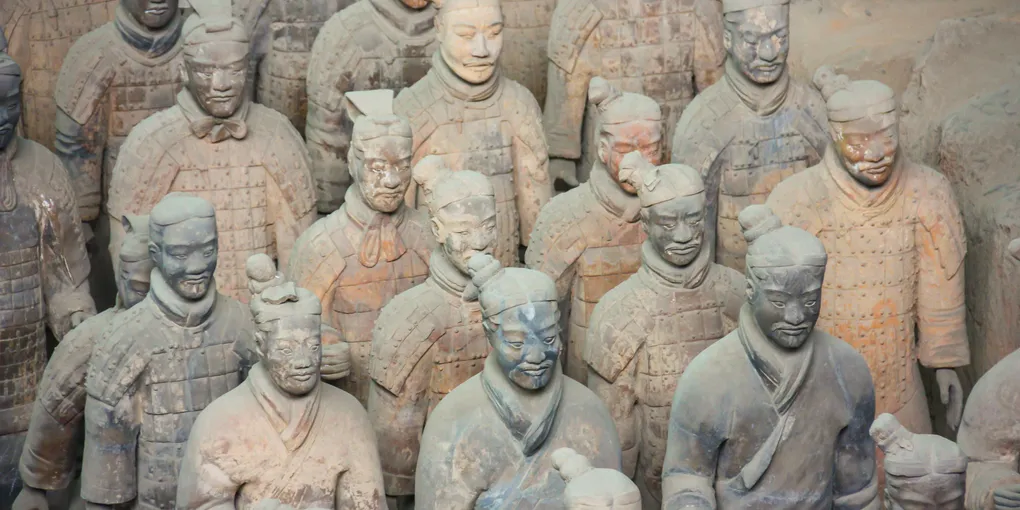
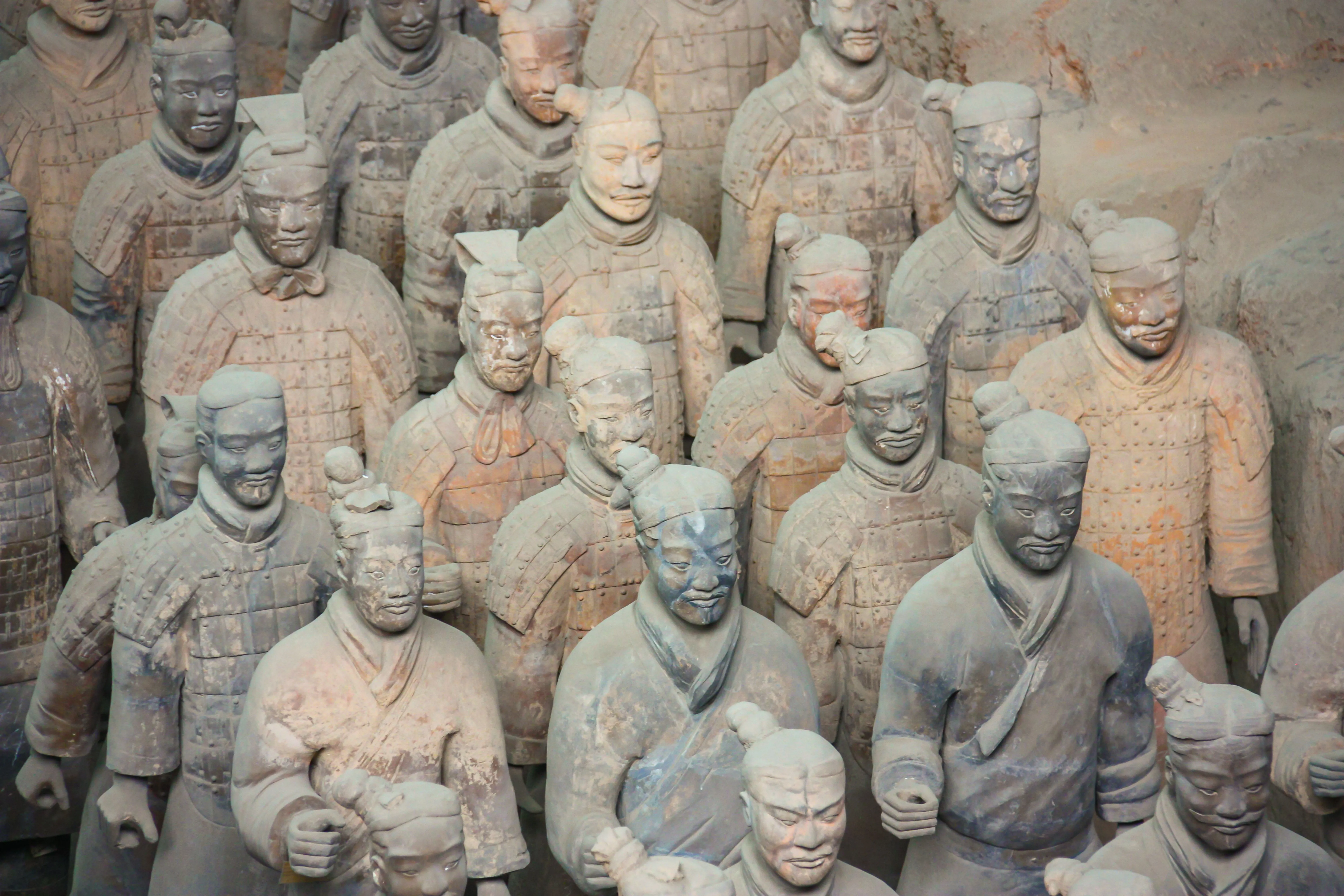 Terracotta Army figures in the excavation pit at Xi’an. Every face was modelled individually, and traces of the original pigment survive in the sheltered corners of the figures.
Why Chinese History Is Hard to Read at a Glance
Three structural reasons.
The tradition is continuous, not sequential. European architecture visibly breaks: Romanesque, Gothic, Renaissance and Modern are separated by collapses and rediscoveries. China’s building tradition did not collapse. The same structural system crossed dynastic boundaries intact, so style changes are gradual refinements rather than replacements. What changes is proportion — the depth of the eaves, the size of the bracket, the pitch of the roof.
Most of what survives is either very old or relatively recent. Wood burns, rots and is replaced. China’s surviving timber buildings cluster at two ends: a tiny handful from the Tang (9th century), and a vast quantity from the Ming and Qing (14th–20th centuries). The middle — Song, Yuan — survives mainly in paintings, in stone pagodas, and in a few isolated halls. So a traveller who sees “old buildings” in China is usually seeing either a national treasure or something 300 years old, with little in between.
Buildings get rebuilt, and the sign often describes the original. This is the single most common trap. The Big Wild Goose Pagoda in Xi’an carries a Tang date, but the tower standing today was largely rebuilt in 1604. The Summer Palace in Beijing is a Qing imperial garden, but what you walk through is the Guangxu-era reconstruction after 1860. Neither is a lie; both require you to read the sign more carefully than you expect.
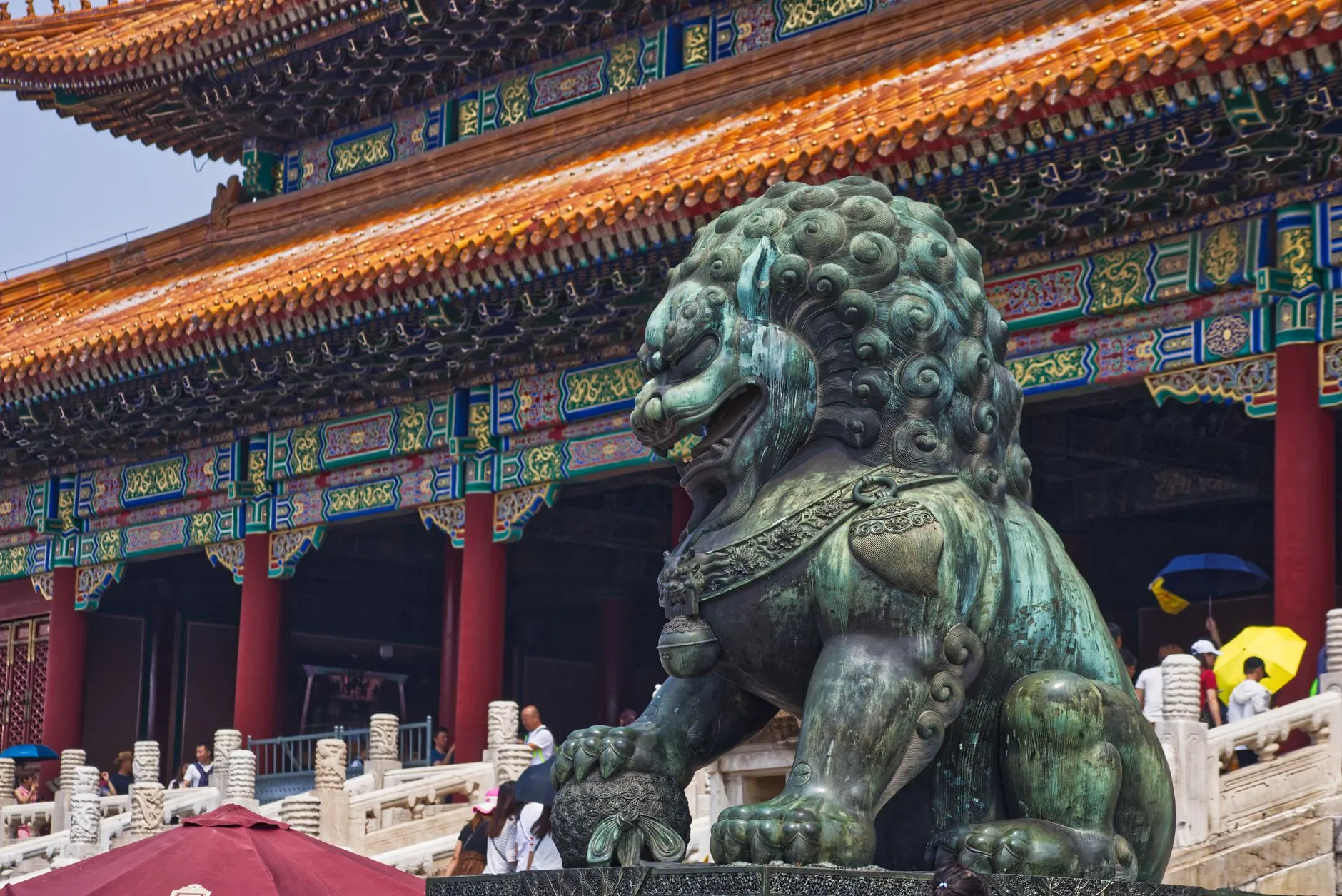 A bronze guardian lion before a palace gate in the Forbidden City. The painted bracket sets behind it are the late-Qing form of the same component described above — numerous, small, and largely decorative.
The Timeline on One Screen
A working timeline for travellers. Dates are conventional, not exact — where scholars disagree by a year or two, this table gives the figure that most often appears on site signage.
| Period | Dates | What a traveller actually sees |
|---|---|---|
| Neolithic (Liangzhu, Longshan) | c. 3300–2300 BC | Jade, rammed-earth walls, waterworks. The “5,000 years” debate starts here |
| Xia | c. 2070–1600 BC | Erlitou. Whether this was a dynasty at all is still argued |
| Shang | c. 1600–1046 BC | Oracle bones, bronze ritual vessels — Yinxu, Anyang |
| Western Zhou | 1046–771 BC | Ritual bronzes, the codification of ceremony |
| Eastern Zhou (Spring & Autumn, Warring States) | 771–256 BC | Iron, chariots, the Hundred Schools of Thought |
| Qin | 221–206 BC | The first unification. Terracotta Army, standardised script and weights |
| Han | 202 BC – 220 AD | Silk Road, tomb figurines, jade burial suits |
| Three Kingdoms to Northern & Southern | 220–589 | Buddhism arrives and becomes Chinese; the first great cave temples |
| Sui | 581–618 | The Grand Canal, the examination system |
| Tang | 618–907 | Cosmopolitan trade, poetry, Buddhism at its height. Three timber halls survive |
| Five Dynasties | 907–979 | Fragmentation. The hall long called China’s fourth Tang building belongs here |
| Song (Northern & Southern) | 960–1279 | Literati aesthetics, ceramic peak, gardens mature |
| Liao / Jin | 916–1125 / 1115–1234 | Northern dynasties. Most surviving multi-eaved pagodas are theirs |
| Yuan | 1271–1368 | Dadu (Beijing’s grid), Yongle Palace murals, mature blue-and-white porcelain |
| Ming | 1368–1644 | The Forbidden City, the Great Wall you climb, the Nanjing city wall |
| Qing | 1644–1912 | The Summer Palace, Chengde, most surviving garden fabric |
Two notes on reading this table.
The “5,000 years” claim needs precision. Chinese civilisation is conventionally dated back some 5,000 years, measured from the emergence of early states such as Liangzhu (c. 3300–2300 BC) rather than from written records, which begin around 1200 BC with the oracle bones. That is the honest framing: the 5,000-year figure measures the appearance of organised states, not of writing. Count from writing and you get about 3,300 years. UNESCO’s own listing for Liangzhu describes it as “an early regional state” — it does not adjudicate the total length of Chinese civilisation, and this guide does not either.
The Xia dynasty is a live question, not a settled fact. The site of Erlitou in Henan is generally identified as the capital of the late Xia dynasty, though the identification is not settled. What is rarely mentioned: when the archaeologist Xu Xusheng found Erlitou in 1959, his own preliminary judgement was that it was “quite possibly the capital of Tang, founder of the Shang” — the site was first proposed as a Shang capital, and only later attached to the Xia.
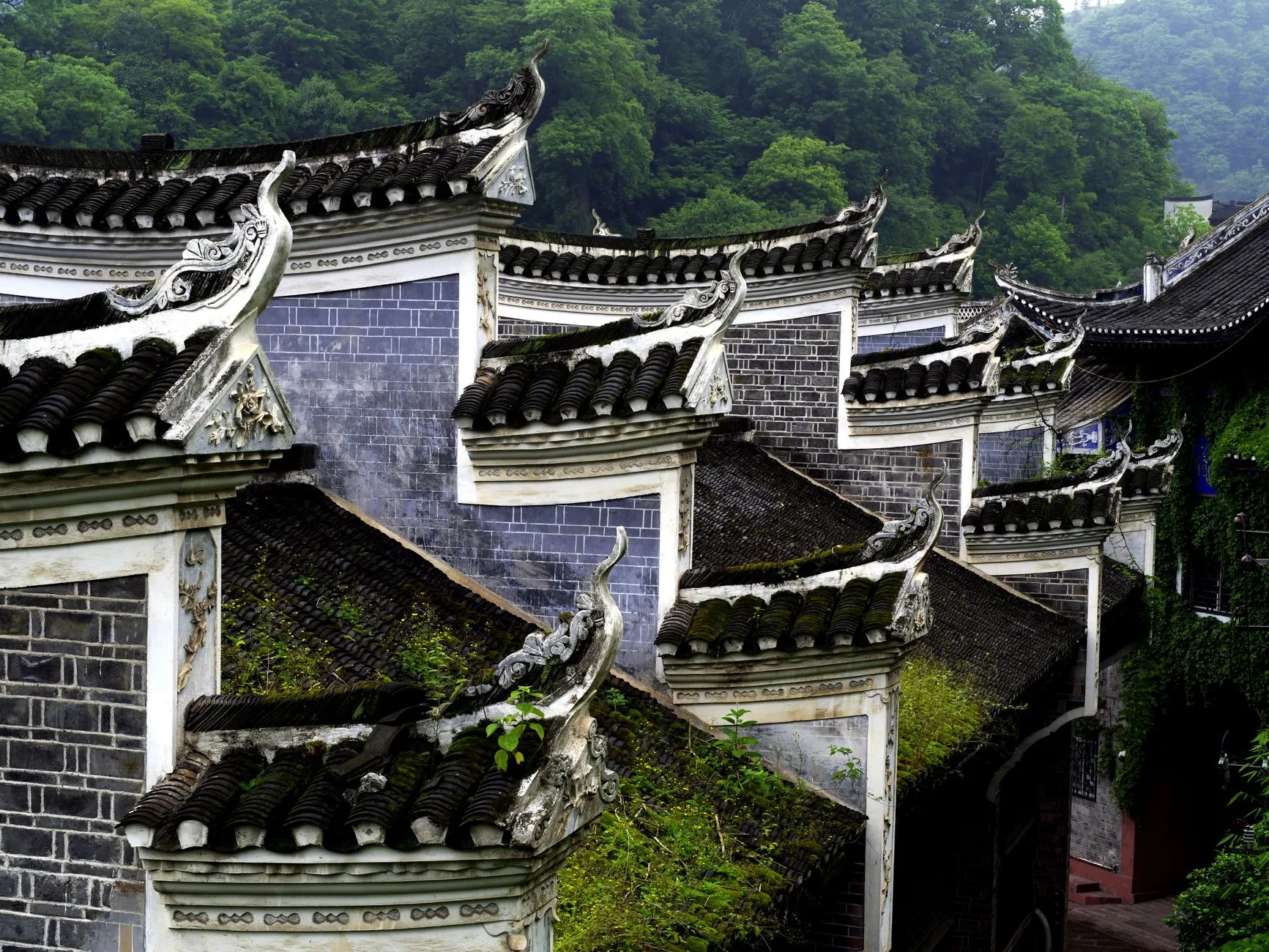 Stepped gable walls at Fenghuang in Hunan. This is vernacular building rather than imperial architecture, which is why it follows different rules from the halls that rank roofs by type.
How to Date a Building Just by Looking
Four things you can see from the ground. None of them requires a guidebook.
1. The roof, and what the roofline tells you
Chinese roofs are ranked, and the ranking is visible. From highest to lowest:
| Type | What it looks like | Where you see it |
|---|---|---|
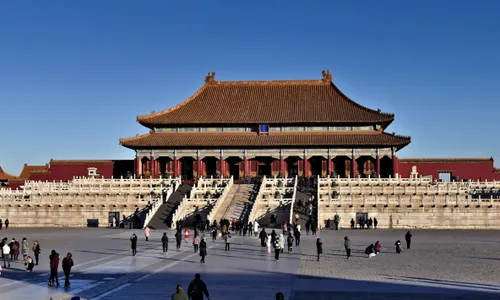
| Wudian (hip roof) | Four sloping sides meeting at a single ridge; no vertical gable ends | Imperial halls of the highest rank — the Hall of Supreme Harmony, the Hall of Great Harmony in the Temple of Heaven complex |
| Xieshan (hip-and-gable) | A hip roof with a gable triangle inserted at each end | Very common on major temple and palace halls |
| Xuanshan (overhanging gable) | A simple gable roof whose edges overhang the walls | Ordinary temple halls, residential buildings |
| Yingshan (flush gable) | A gable roof flush with the wall plane | Vernacular buildings, shopfronts, courtyard houses |
One correction worth carrying: the pyramidal roof (zanjian) does not belong in this ranking at all. It has no ridge — the four slopes converge on a point — and Chinese architectural convention classifies it as a “miscellaneous” form rather than placing it fifth. You will see it on the Temple of Heaven’s Hall of Prayer for Good Harvests, which outranks almost everything around it; anyone telling you pyramidal roofs rank lowest has copied a bad table.
Then look at the eaves. Tang roofs are broad, low-pitched and fly far beyond the wall — the eaves of Foguang Temple’s main hall project roughly four metres. Ming and Qing roofs are steeper and pull the eaves back. This is usually explained as a change in taste. It is more usefully explained as a change in walls: deep eaves existed to throw rain clear of rammed-earth walls, and once brick became standard in the Yuan and Ming, the deep overhang lost its job.
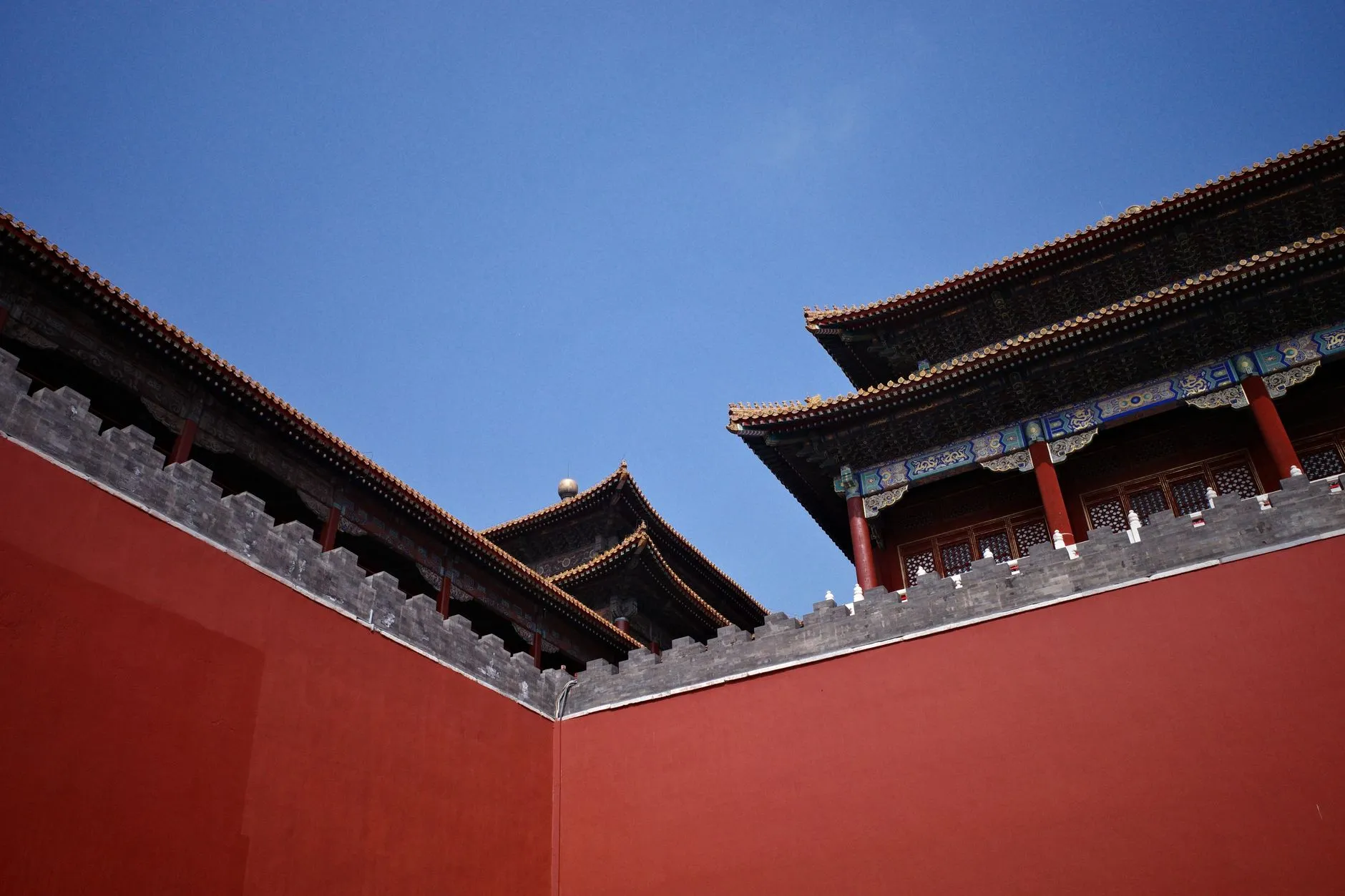 The Forbidden City’s red wall and layered roofline. The walling is brick with a rendered face — the material change that made deep eaves unnecessary, and pulled Ming roofs inward.
2. The bracket set (dougong), and why “ten times bigger” is wrong
The bracket set — the cluster of interlocking blocks and arms where column meets roof — is the most diagnostic element in Chinese timber building, and the most badly described online.
You will find English guides saying Tang brackets are “ten times the size” of Qing ones. That figure comes from a Chinese popular-science page which gives the Foguang Temple bracket as “210 cm × 300 cm” — a unit error, since the measurement is in millimetres, i.e. 21 × 30 cm. Measured properly on the cross-section of the bracket timber, the Tang example is roughly 5.4 times the late-Qing one, not ten. To reach ten you would have to compare the main structural timber of a Tang hall against the smallest decorative bracket inside a Qing interior — which is not a comparison at all.
Use countable facts instead. They are checkable on site and they are more striking:
| Tang (Foguang Temple, 857) | Qing (Hall of Supreme Harmony, 1695–1697) | |
|---|---|---|
| Bracket height vs column height | roughly half the column height | roughly one eighth |
| Bracket sets between two columns | one | eight or more |
Stand at the front of a Tang hall and the brackets are architecture — they visibly carry the roof. Stand in front of a Qing hall and the brackets are pattern: many, small, and no longer doing much structural work. That shift, from structure to ornament, is the single clearest visual marker of “early” versus “late” in Chinese architecture.
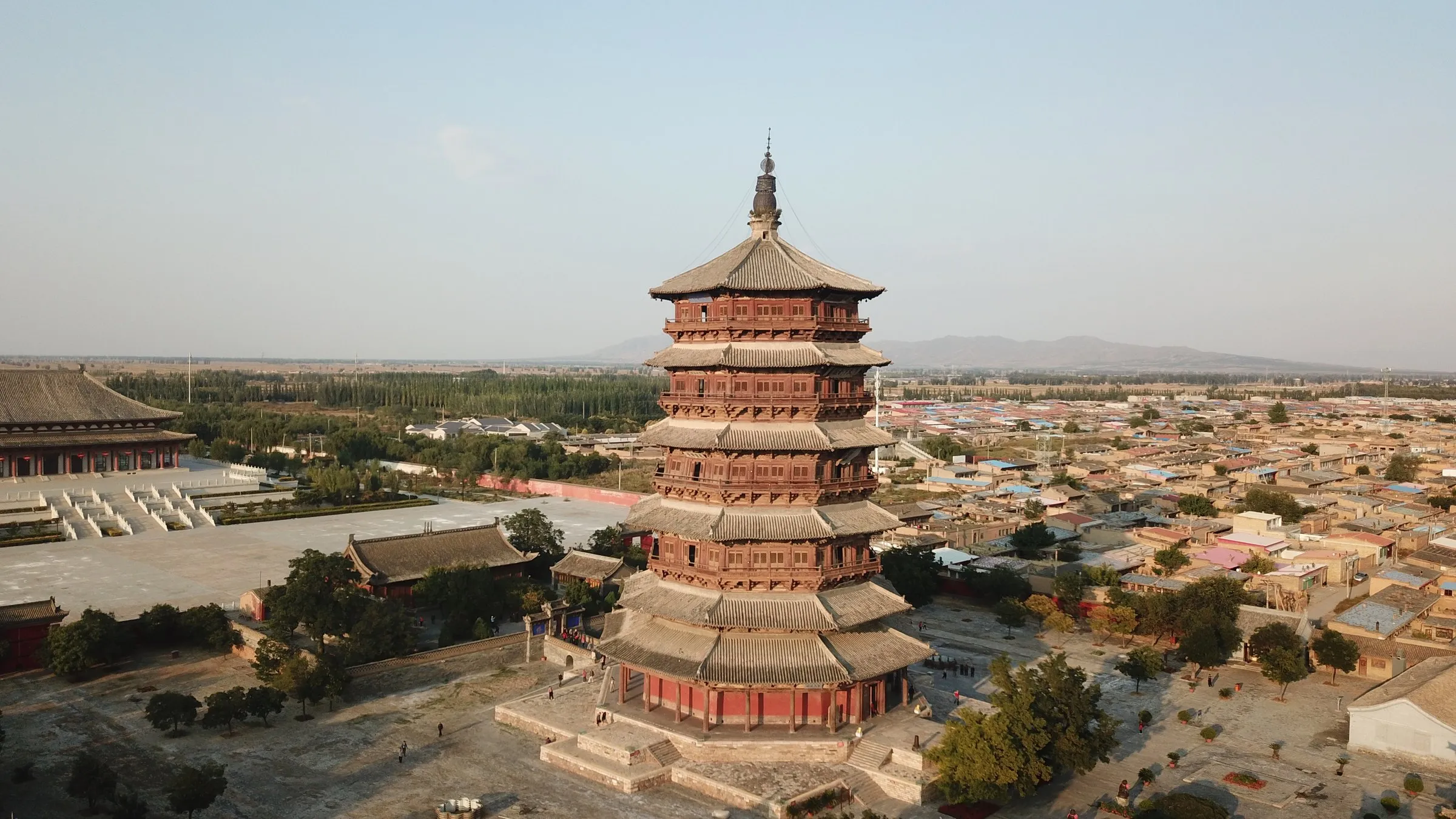 The Yingxian Wooden Pagoda in Shanxi, built in 1056 and still the oldest and tallest timber pagoda in China. Nothing here is masonry: every bracket, beam and eave is wood, which is why so few buildings from this period survive anywhere else.
3. The pagoda’s shape
Pagodas are the easiest buildings to date from a distance, because the form changed decisively.
- Tower-style (louge shi) — a multi-storey tower with balconies and doors on each level. Flourishes from the Tang onward. The Big Wild Goose Pagoda in Xi’an is the canonical example, though the tower you see was substantially rebuilt in 1604.
- Multi-eaved (miyan shi) — a solid core wrapped in closely stacked eaves, no balconies, often with a dramatic taper. Associated with the Northern dynasties through Liao and Jin. The Songyue Temple Pagoda (Northern Wei) is the oldest surviving example in China.
- Dome-topped (fubo shi / “lamasery” stupa) — a bulbous white body on a square base, with a tall slender spire. Arrives with Tibetan Buddhism under the Yuan. Beijing’s Miaoying Temple White Dagoba (1279) is the type site.
- Diamond-throne (jingang baozuo) — a square base surmounted by five small pagodas. A Ming form. The Five Pagoda Temple in Beijing is the example.
One detail worth knowing when you look at the Songyue Temple Pagoda: it was originally white. The brick body today is grey-green because the lime wash has weathered off. What you are seeing is the building’s skeleton, not its original finish.
4. The Buddha’s face
Statuary is the fastest stylistic clock in China, because the changes are readable at a glance and the sequence is clear.
| Period | Face and body | Where to see it |
|---|---|---|
| Northern Wei, Pingcheng phase (5th c.) | Square, full-faced; broad shoulders; heavy, thick drapery | Yungang Grottoes, cave 20 — the great seated Buddha |
| Northern Wei, Luoyang phase (late 5th–6th c.) | Slender, elongated: gaunt cheeks, long neck, dense rhythmic drapery lines — the “xieshou qingxiang” (slender-boned, pure-image) style | Longmen Grottoes, Binyang Middle Cave |
| Tang (7th–8th c.) | Full, rounded, flesh modelled; drapery clings to the body | Longmen, Fengxian Temple |
| Song (10th–13th c.) | Worldly, individualised, sometimes almost portrait-like | Dazu Rock Carvings, Chongqing |
The placement matters, because it is commonly got wrong. The gaunt, aristocratic “slender-boned” style is not a Yungang style. Yungang’s cave 20 Buddha is described by the site’s own research institute as having a “square and rounded face, broad shoulders, and heavy drapery” — thick and powerful. The slender style arrived later, after Emperor Xiaowen moved the capital south to Luoyang and southern Chinese aesthetic ideals travelled north with the court. Its mature examples are at Longmen, not Yungang.
Ten Things Everyone Gets Wrong
These are not obscure points. All ten appear repeatedly in English-language travel writing, and all ten are checkable.
1. “Only four Tang wooden buildings survive”
Three. The undisputed Tang timber halls are all in Shanxi:
| Building | Date | Location |
|---|---|---|
| Nanchan Temple main hall | 782 | Wutai, Shanxi |
| Guangrenwang Temple main hall | 831 | Ruicheng, Shanxi |
| Foguang Temple East Hall | 857 | Wutai, Shanxi |
The fourth building in the old list, the Maitreya Hall of Tiantai’an, was reclassified after a 2014 restoration found an ink inscription reading “built in the fourth year of Tiancheng of the Great Tang” — that is 929, the Later Tang of the Five Dynasties period, not the Tang. Every “four” you read in English is pre-2014.
Chinese architectural historians have since coined a phrase, “three and a half”, counting the three Tang halls plus the bell tower of Kaiyuan Temple in Zhengding — half a Tang building, since its upper storey is a Qing rebuild. For a visitor, “three” is the number that matters. (Note on Guangrenwang Temple: some provincial pages have listed it as not currently open to visitors while local tourism material promotes it as a destination. Check before you go.)
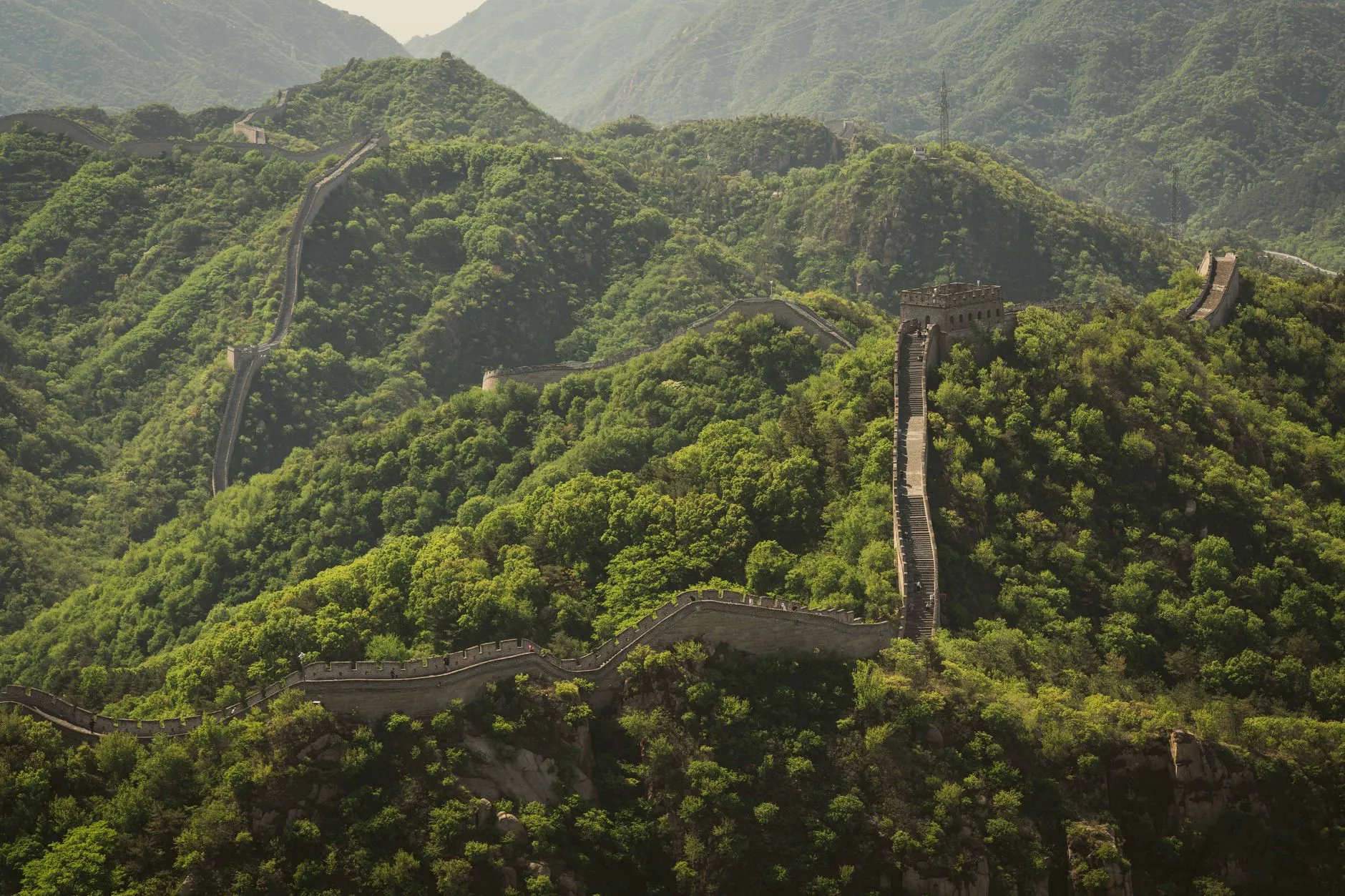 The Ming Great Wall north of Beijing. Brick facing, a crenellated parapet and regularly spaced watch towers are all Ming features — none of them appear on the Qin wall further north, which is now little more than a grass-covered ridge.
2. “The Great Wall was built by the Qin dynasty”
The wall you climb is Ming. Badaling’s gatehouse dates to 1504; Mutianyu was begun under Xu Da in 1368 and refurbished by Qi Jiguang in 1569. The Badaling administration’s own description calls it “the most essential section of the Ming Great Wall”.
The numbers: the Ming wall runs 8,851.8 km. All dynasties combined, 21,196.18 km. The Qin wall is a different line, running further north along the Yin and Yan mountains. In Hebei its remains stand 0.3–1.5 m high and 2–3 m wide — a grassy ridge, not a monument. Most visitors walk past it without realising it is there.
And no, you cannot see it from space. The wall averages about 6 m wide. Yang Liwei, China’s first astronaut, put it plainly: he looked as hard as he could and still could not see it.
3. “Chinese civilisation is 5,000 years old, universally accepted”
See the note above. The 5,000-year figure measures the emergence of states, not of writing; it is a convention, widely used in China, and it is not a UNESCO ruling. Written Chinese begins with the oracle bones around 1200 BC — roughly 3,300 years ago.
4. “Erlitou is the Xia capital, and that settles it”
Erlitou is generally identified as the capital of the late Xia dynasty, though the identification is not settled. Official phrasing has actually become more cautious: a 2022 Chinese Academy of Social Sciences page described a “broad consensus” that Erlitou was a Xia capital, while a December 2023 State Administration of Cultural Heritage briefing said it “very probably” was. The site was also first proposed as a Shang capital, not a Xia one.
5. “Tang bracket sets are ten times the size of Qing ones”
Covered above: the ten-times figure rests on a unit error. The measured ratio is about 5.4. Use the column-height ratio and the bracket count instead — both are correct and both are more impressive.
6. “The slender Buddha style is from Yungang”
It is from Longmen. Yungang’s cave 20 is square-faced and heavy; the gaunt, elongated style arrived with the court’s move south.
7. “Pyramidal roofs rank lowest”
The pyramidal (zanjian) roof has no ridge and sits outside the four-type ranking entirely. It crowns the Hall of Prayer for Good Harvests at the Temple of Heaven, which is about as high-status as Chinese architecture gets.
8. “The Big Wild Goose Pagoda is a Tang building”
It is a Tang foundation with a substantially Ming reconstruction — the present tower dates to 1604. Worth climbing anyway; just do not tell yourself you are touching 7th-century brick.
9. “The Summer Palace is the Qing imperial garden”
The garden is Qing. The buildings you walk through are the Guangxu-era reconstruction, rebuilt after the 1860 destruction. This is normal in China and not a disappointment — but it does mean “original” is the wrong word.
10. “You can visit the Song-dynasty capital at Kaifeng”
You can visit the site. You cannot see the city. The Northern Song capital lies 8 to 12 metres below the modern street level, buried under centuries of Yellow River flooding and rebuild. What is on the surface is a reconstruction and a museum.
Three smaller corrections worth knowing: Tang sancai glazed figures are tomb goods, not household ware, which is why they look so unlike anything anyone actually used. The “Five Great Kilns” of the Song is a Ming-era literary grouping, not a contemporary category, and the Ge kiln’s site has never been identified. And a carved stone stele or a rebuilt hall can carry the original date on its sign without being the original object — always read whether the sign says “built” or “rebuilt”.
Where to See Each Dynasty
Beijing and the north
The Palace Museum (Forbidden City). The definitive Ming and Qing ensemble, built 1406–1420. Note that the ceramics gallery in the Wuying Hall has been closed since 19 October 2026, along with the bronze, architecture and arms galleries — check the museum’s site or its official WeChat account before you plan a visit around them. Tickets are timed, released seven days ahead at 20:00, and same-day tickets are not sold. Passports are accepted for booking.
The National Museum of China. The closest thing to a single-dynasty-spanning survey, on the east side of Tiananmen Square. Passport booking accepted.
Yungang Grottoes, Datong. Northern Wei Buddhist sculpture at its most monumental — and the correct place to see the early, square-faced style rather than the slender one.
Xi’an and the centre
Terracotta Army / Emperor Qin Shi Huang’s Mausoleum Site Museum. The Qin in one hangar. See our Terracotta Warriors guide for the practical detail.
Shaanxi History Museum. The best single collection for Zhou, Qin, Han and Tang, and the natural companion to any Xi’an itinerary. See the Xi’an travel guide.
Han Yangling. A Western Han imperial tomb with the excavation hall built over the pits. Note: passport holders generally need the staffed counter here rather than online booking.
Luoyang, Anyang and the early dynasties
Longmen Grottoes, Luoyang. Where you see the Northern Wei slender style and the Tang full-bodied style in the same cliff, a few hundred metres apart. This is the single best place to learn the difference.
Yinxu, Anyang. The Shang capital, oracle bones, and the tomb of Fu Hao. Passport holders: staffed counter.
Erlitou Site Museum, Yanshi. The Xia question, presented with appropriate caution. Official pages list ID-card booking; passport holders may need the counter.
Henan Museum, Zhengzhou. The strongest regional collection for the Xia–Shang–Zhou sequence.
The south and west
Shanghai Museum. Two buildings, and the distinction matters: the East Bund branch holds the Chinese collections and is free and unreserved — tap in at B1 with your passport. The People’s Square branch currently shows only a ticketed touring exhibition (through 14 November 2027, ¥148 / ¥135 / ¥74). Note also that the East Bund branch’s calligraphy and painting galleries have been closed since 28 September 2026 for re-display, with no reopening date announced. Closing day is Tuesday, not Monday.
Sanxingdui Museum, Guanghan. The Shu culture bronzes — a civilisation parallel to, and unlike, the Shang.
Liangzhu Museum, Hangzhou. Neolithic jade and the earliest state in the region. Be aware that the celebrated jade cong known as the “King of Cong” belongs to the Zhejiang Provincial Museum, not Liangzhu, and appears at Liangzhu only as a loan.
Nanjing Museum. The strongest holdings for the Six Dynasties and the Ming.
Dazu Rock Carvings, Chongqing. Song Buddhist sculpture at its most human — the clearest demonstration that Chinese religious art became worldly over time.
Three routes
Bronze and early statehood: Anyang (Shang) → Zhengzhou (Xia–Shang–Zhou) → Yanshi (Erlitou) → Guanghan (Sanxingdui). Five to seven days.
Imperial tombs: Xi’an (Qin) → Xianyang (Western Han) → Qianling (Tang) → Beijing (Ming). Seven to ten days.
Buddhist art: Datong (Northern Wei) → Luoyang (Northern Wei to Tang) → Tianshui (Maijishan) → Chongqing (Song). Ten days, and the most coherent single thread in Chinese art.
For city-level planning, see our Beijing and Shanghai guides, and the best time to visit China for when to schedule a museum-heavy trip.
Practical Tips
Check closing days per museum, not per country. This is the mistake that wastes most days. Shanghai Museum’s East Bund branch closes Tuesday. The Forbidden City and the National Museum close Monday. Sanxingdui, Yinxu, the Terracotta Army museum and Han Yangling are open on Mondays. There is no national rule.
Bring your passport, and expect to use a counter. Booking rules vary more than you would think. The National Museum, the Palace Museum, Shaanxi History Museum, Henan Museum, Nanjing Museum, Sanxingdui and the Terracotta Army museum all accept passport booking online. Yinxu and Han Yangling generally require the staffed counter. Erlitou and Liangzhu list ID-card booking only, which in practice means asking staff.
Expect closures with no notice. Chinese museums rotate galleries aggressively and announce changes on WeChat first. As of late October 2026 the Palace Museum’s ceramics, bronze, architecture and arms galleries are all shut; Shanghai Museum’s calligraphy and painting galleries are shut. Before you travel to a museum specifically for one collection, check its official WeChat account — search the museum’s name inside WeChat to follow it. If you do not use WeChat, your hotel front desk can check in two minutes.
Prices and booking rules change often. Confirm on the museum’s official site or WeChat account before you go. The figures in this article were verified on 26 October 2026.
Read “rebuilt” on every sign. Chinese heritage signage is usually honest about reconstruction, but the English translations often are not. If the original date and the visible fabric disagree, the fabric is later.
Learn four characters. 唐 (Tang), 宋 (Song), 明 (Ming), 清 (Qing). Dynasty labels on museum cases and site signs are almost always these, and recognising them turns a wall of Chinese into a date. More survival vocabulary is in our language barrier guide.
Getting between sites. The high-speed network links most of these cities in under four hours; see high-speed rail, buying train tickets and refunds and changes. Domestic flights help for the far west — domestic flights guide — and airport transfers covers the last mile. Within cities, the metro guide and Didi are all you need.
Frequently Asked Questions
Which dynasty should I care about as a tourist? Three do most of the work: Qin (the Terracotta Army, the idea of a unified China), Tang (the cosmopolitan golden age, and the three surviving timber halls), and Ming–Qing (the palaces, walls and gardens you will actually walk through). If you have a fourth slot, add Northern Wei for the cave temples.
Why are there so few old buildings in China? Timber. Chinese architecture is a post-and-beam system, and wood decays, burns, and gets replaced. Add deliberate destruction — the 1860 burning of the Summer Palace, the Taiping wars — and the survival rate for anything older than 700 years is vanishingly small. Stone pagodas and cave temples survive because they are stone.
Is the Great Wall one wall? No. It is a series of walls built across roughly 2,000 years, mostly along the same strategic latitudes. What you climb near Beijing is Ming. The Qin wall is further north and largely a grass-covered ridge. Combined length of all periods is over 21,000 km.
Can I tell the dynasty of a building without a guide? Yes, up to a point. Roof pitch and eave depth get you a rough century. Bracket proportions get you closer. Pagoda form is close to decisive. Statue style is decisive. It will not replace a sign, but it will tell you when a sign is lying.
How long does the “5,000 years” claim actually cover? About 5,000 years from the emergence of regional states around 3300 BC — or about 3,300 years if you count from the first writing. Both figures are used; they measure different things.
Do I need to book Chinese museums far ahead? For the Palace Museum and the National Museum, yes — the Palace Museum releases tickets seven days ahead at 20:00 and sells no same-day tickets. Most provincial museums need a reservation but have same-week availability. Smaller site museums often need nothing but a passport.
Keep Exploring
This is the fifth and last piece in our series on understanding Chinese culture before you travel. The other four cover the horizontal categories this timeline sits underneath:
- Chinese architecture and gardens — roof types, bracket sets and garden design in full
- Chinese art — calligraphy, ink painting and Peking opera
- Religions and festivals — the belief systems that built the temples
- Culture and etiquette — how to behave inside them
Places that carry the timeline visibly: the Terracotta Warriors, the Forbidden City, Mount Emei and Leshan for Buddhist sculpture at scale, Suzhou for gardens, Huangshan for the villages behind the ink paintings.
Before you go: China’s entry requirements, the visa-free country list, what to pack, travel safety, how to pay, WeChat Pay setup, the apps you need and shopping and tax refund.
Image credits: the Terracotta Army, bronze lion, Fenghuang, Forbidden City and Great Wall photographs are from Pexels and free to use. The Yingxian Wooden Pagoda photograph is by Charlie fong, via Wikimedia Commons, licensed under CC BY-SA 4.0 — cropped and resized for this page.