Harbin Ice and Snow World (27th Edition, 2025-2026) — A Complete Guide
Harbin Ice and Snow World (27th Edition, 2025-2026) — A Complete Guide
Every December, workers cut blocks of ice from the frozen Songhua River and stack them into a temporary city of slides, towers, and full-scale buildings in Harbin’s Songbei district. This is Harbin Ice and Snow World (哈尔滨冰雪大世界) — the largest ice-and-snow theme park in the world, first built in 1999 for the millennium and now in its 27th edition for the 2025–2026 winter. It is the main reason foreign travelers brave −20 °C to reach northeast China in January.
If you are planning a trip, three things matter most, and most English guides get them wrong: (1) the “Ice and Snow World” park and the “Ice and Snow Festival” are not the same thing; (2) foreign visitors can now enter Harbin visa-free for up to 240 hours; and (3) the headline ticket price already covers the famous ice slide and the Snowflake Ferris wheel. This guide covers all three, plus tickets, timing, transport, and how to stay warm.
Ice and Snow World vs. the Ice and Snow Festival — know the difference
These two names are used interchangeably in English, and it causes real confusion.
- Harbin Ice and Snow World is a park — the actual ice-built amusement site out in Songbei. It launched in 1999. The 2025–2026 season is its 27th edition, opening on December 17, 2025.
- The China·Harbin International Ice and Snow Festival (中国·哈尔滨国际冰雪节) is a citywide festival that began in 1985 — China’s first international festival themed on ice and snow. The 2026 edition is the 42nd, and it officially opens every year on January 5 and runs for about a month.
The relationship: the Ice and Snow World park is the festival’s centerpiece and the site of its opening ceremony (the 42nd festival opened on January 5, 2026, inside the 27th-edition park). But they count their “editions” separately. For a traveler, the park is the must-see; the festival is the reason the whole city is buzzing when you go.
Harbin’s festival is one of the world’s four great ice and snow festivals, alongside the Sapporo Snow Festival (Japan), the Quebec Winter Carnival (Canada), and the Holmenkollen Ski Festival (Norway).
Good news for foreign visitors: 240-hour visa-free entry
Since December 17, 2024, Harbin Taiping International Airport has been the only port in Heilongjiang province authorized for China’s 240-hour (10-day) transit visa exemption. Citizens of 54 countries — including the U.S., U.K., Canada, Australia, most of the EU, Russia, Brazil, and others — transiting to a third country can enter Harbin and stay up to 10 days without a visa.
This is a recent and major change. In the first year after launch, visa-free foreign arrivals at Harbin topped 60,000 passengers (up 20.6% year-on-year), with visa-exempt foreign visitors rising 285%. If your itinerary routes through Harbin on the way to, say, South Korea or Japan, you can spend up to 10 days in northern China visa-free — plenty of time for the ice park plus side trips. (For the full country list and rules, see our China visa-free transit guide.)
The 27th edition: theme, scale, and opening
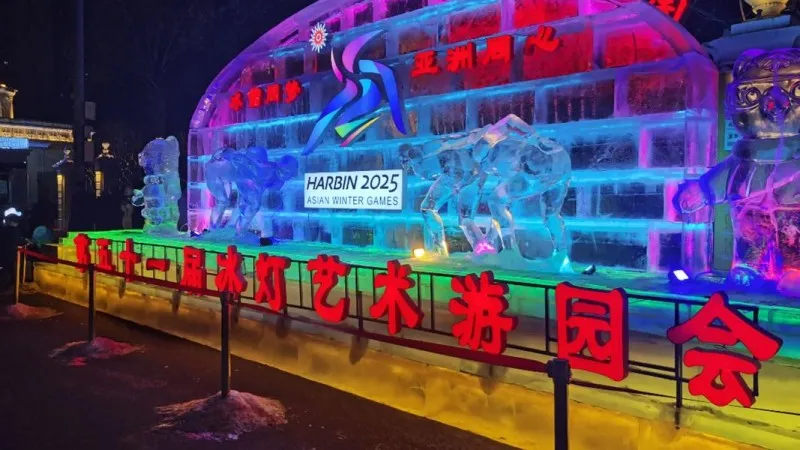
The 27th Harbin Ice and Snow World opened at 10:00 a.m. on December 17, 2025, under the theme “Ice and Snow, Fairytale World” (冰天雪地 童话世界). The operator — Harbin Ice and Snow World Co., Ltd., founded in 2013 — has stated this is the largest edition in the park’s history. Highlights among the ice-built landmarks include replicas of the Old Harbin Railway Station, the Yellow Crane Tower, and a Belgian “Fairytale Kingdom” complex of ice buildings.
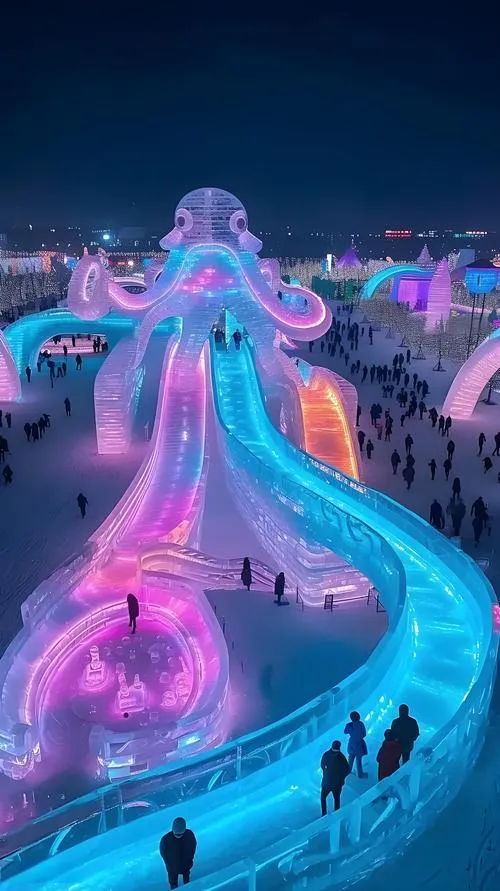 Ice-built landmarks carved from Songhua River ice — the 27th edition is the largest in the park’s history.
For reference, the previous (26th) edition ran for 68 days (December 21, 2024 – February 26, 2025) and drew 3.56 million visitors. Expect the 27th to operate on a similar winter schedule — roughly mid-December through late February.
Tickets (27th edition)
Prices for the 27th edition, confirmed across the Heilongjiang culture authority, Harbin Local Treasure (本地宝), and ticket platforms:
| Ticket | Price |
|---|---|
| Standard adult | ¥328 (~$48) |
| Concession (students / children / seniors) | ¥240 (~$35) |
| Opening-week special (Dec 17–23) | ¥298 (~$44) |
From December 24 onward, the adult price returns to ¥328. Buy through the park’s official WeChat mini-program for real-time navigation, queue lengths, and restroom availability.
Foreign visitors: the mini-program generally requires a Chinese WeChat account. The smoother route is Trip.com (the international version of Ctrip) or buying on arrival at the gate with your passport. For payment inside China, bind a foreign card to Alipay or WeChat Pay before you fly — see our Alipay setup guide.
What’s included — the ice slide and Ferris wheel are in the ticket
The ¥328 ticket is not just for entry — it is a sightseeing-and-rides pass. According to the official 26th-edition policy (carried forward), the ticket includes:
- The Super Ice Slide (超级冰滑梯) — the viral long ice chute, now with more lanes each year; free with admission, but reservation required as it is the most popular ride.
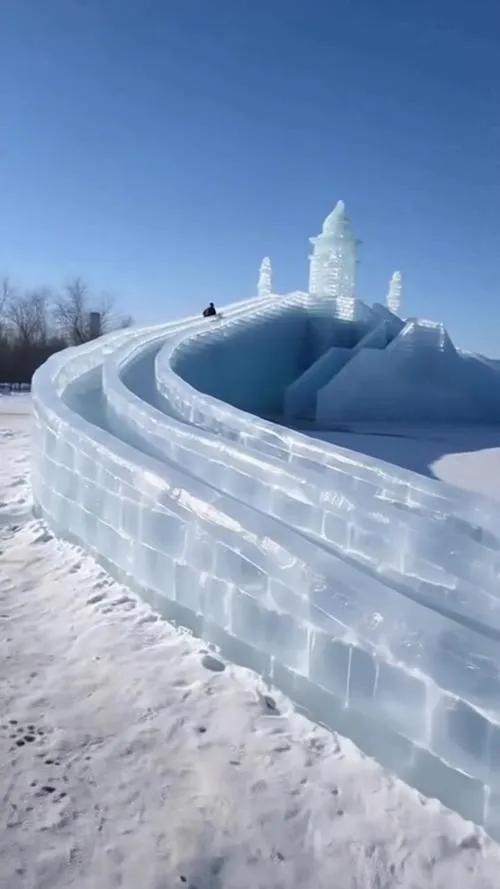 The Super Ice Slide — included in the ticket, but reserve a slot on entry; queues fill fast.
- The Snowflake Ferris Wheel (雪花摩天轮) — the park’s signature ride; free for ticket holders, but reservation required (real-name QR sign-up after opening each day). Only visitors who enter the park for free (e.g. certain children) pay a separate ¥168 for the wheel.
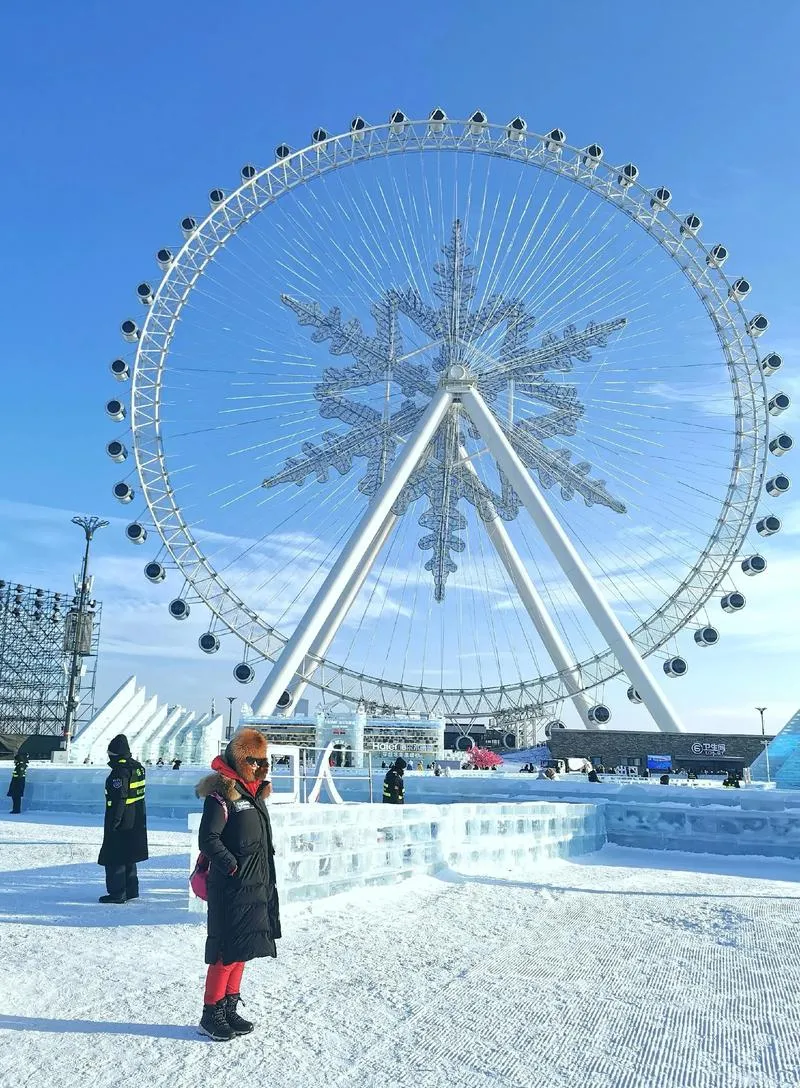 The Snowflake Ferris Wheel — the park’s signature ride, free with admission via real-name reservation.
- Car ballet show, snow-tube slides, spinning snow rides, ice bicycles, and ice tops — all included.
In short: budget the ¥328 and you are not paying extra for the headline rides — you are reserving time slots for them. Book the slide and wheel reservations as soon as you enter; queues fill fast.
Planning your visit: the 14:00 rule
The single best piece of advice from the park itself: arrive before 14:00. Ice sculptures look impressive in daylight (you can see the carving detail and scale), but they are spectacular after dark when lit — so arriving in early afternoon lets you see both versions in one visit. Most first-timers come only for the evening light show and miss the daytime craft.
Other planning tips:
- Use the official mini-program in-park for the shortest walking routes, live restroom availability, and which food stalls have the shortest lines.
- Opening day ceremony (Dec 17) features drum and welcome-dance performances, with “first-day ice can” souvenirs given away — fun if you happen to be there, crowded if you are not.
- Photography: the park publishes its own shooting guide; daytime for detail, blue-hour and night for the glowing-tower shots.
How to get there
The park is at the west side of Sun Island (太阳岛), Songbei District, Harbin, on Songbei Avenue.
- Metro Line 2 to “Ice and Snow World” station (冰雪大世界站) — the entrance is right at the exit. This is the easiest option and avoids winter traffic.
- Bus routes 29, 42, and 47 run directly to the park.
- Driving: the on-site parking lot is free; arrive before 9:00 in peak season to find a spot.
- From Harbin Taiping International Airport: about 40 km; taxi or ride-hail (avoid unlicensed drivers who refuse the meter — insist on DiDi or a metered cab, see our DiDi guide).
Staying warm — Harbin in January is serious cold
January in Harbin runs roughly −20 °C to −30 °C, and you will be outside on ice for hours. Layer up seriously: a thermal base layer, a mid-layer, a long insulated parka, windproof trousers, insulated boots with good grip (ice is everywhere), gloves, a warm hat, and a face mask or scarf. Hand and foot warmers (暖宝宝) are worth packing. Phone batteries drain fast in the cold — keep your phone in an inner pocket and carry a power bank.
Beyond the ice park
Harbin earned its nickname the “Ice City” (冰城), and its other face is “Eastern Moscow” — a legacy of the Chinese Eastern Railway (built 1898) and the Russian immigrants who followed. Pair the ice park with:
- Sun Island (太阳岛) — right next to the park, connected by a free shuttle; its snow-sculpture expo is the daytime counterpart to the ice park.
- Central Street (中央大街) — a cobblestoned avenue of Russian-style buildings, ideal for food and photos.
- Saint Sophia Cathedral (圣索菲亚教堂) — the landmark Russian Orthodox church at the city’s heart.
The bottom line
For foreign travelers, the 27th Harbin Ice and Snow World is more accessible than ever: the 240-hour visa-free rule removes the biggest barrier, Metro Line 2 drops you at the gate, and the ¥328 ticket already bundles the ice slide and Snowflake Ferris wheel. Go in late December through February, arrive before 14:00 to catch both daylight and the lit-up night show, reserve the headline rides on entry, and dress for serious cold. Then walk it off with hotpot and a walk down Central Street — the Ice City is best experienced as a full winter day, not just a night at the lights.
Sources: Harbin Ice and Snow World Co., Ltd. official sites (hrbicesnow.com / ice.hrbicesnow.com); Heilongjiang Provincial Department of Culture and Tourism; Harbin Local Treasure (本地宝); National Immigration Administration 240-hour transit visa-exemption announcement (Dec 17, 2024); Ctrip; Baidu Baike.